
Fruits of spoil: Laos’ forests disappearing as fruit farms flourish
Mekong eyes – 16 December 2024 at 9:27 (Updated on 16 December 2024 at 15:40)
The country’s improved railway connectivity facilitates fruit exports to China but has also sparked a boom in foreign-owned banana and durian farms, leading to forest clearance

The report was produced with support from the Pulitzer Center’s Rainforest Investigations Network (RIN) and Internews’ Earth Journalism Network as part of the “Ground Truths” collaborative reporting project on soils.
ATTAPEU, LAOS — The new high-speed railway has enabled faster fruit exports from Laos to China, attracting more investment in large-scale plantations. However, this growth has come at the cost of deforestation.
Bananas and the “king of tropical fruit” – durians – are very popular in China, but they typically ripen within a few days of harvesting.
However, that problem was resolved with the launch of the Laos-China Railway in 2021, which has enabled landlocked Laos to deliver its fruit quickly to China’s 1.4 billion consumers.

Operating at speeds of up to 120 kilometers per hour, the high-speed train allows fast-ripening fruit like bananas to travel from Laos’ capital, Vientiane, to China’s southern Yunnan province in just about one day, retaining their “bright appearance and excellent taste.”
Road transportation required at least four to five days to get goods to the border.
However, this progress has come at a cost – deforestation and soil contamination driven by the rush to expand fruit plantations, much of it led by Chinese entrepreneurs.
In Sanamxay district in Laos’ southern Attapeu province, a 14-hour drive from Vientiane, heavy trucks bearing Chinese and Lao license plates lumber along muddy, pothole-ridden roads toward a sprawling banana plantation.
The air is thick with the smell of pesticides and fertilizers. Row upon row of banana trees stretch endlessly, nourished by the fertile soil enriched by sediment deposits from the Xekong River floodplain.
At the plantation office, where Lao and Chinese national flags are visible from afar, a sign identifies the farm as being operated by Chinese company Jin Yao (金耀) – one of many reaping the benefits of Laos’ improved connectivity and access to China’s large consumer market.
“Here used to be a forest,” recalled Chai*, a man in his 40s, gesturing to the rows of banana trees weighed down by heavy fruit. “Here it was too. And there.”


Attapeu province has emerged as one of the country’s deforestation hotspots, with forest loss steadily increasing between 2021 and 2023.

Satellite images from Planet Labs revealed that the land now occupied by the Jin Yao plantation was a dense forest until mid-2019. Over time, the green patches thinned and the forest cover gradually disappeared.
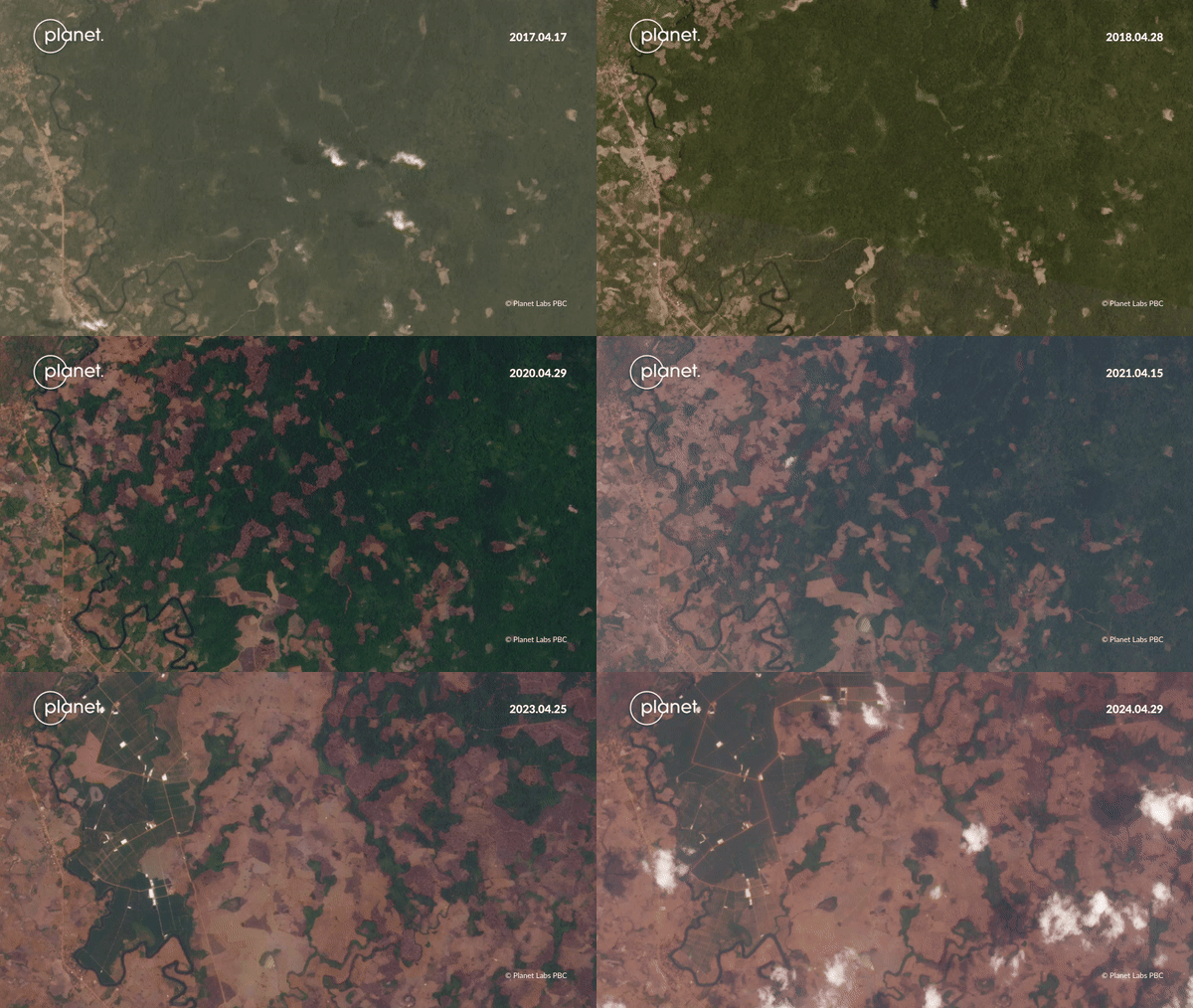
Satellite maps from Planet Labs reveal significant changes in Sanamxay district, located in Laos’ southern Attapeu province, between 2017 and 2024. GRAPHIC: Rainforest Investigations Network
This transformation started with the construction of access roads, followed by newly cleared land in late 2021.
Soon after came an office building, a warehouse and rows of banana trees. By 2024, the Jin Yao plantation had grown to 1,000 hectares, making it one of the largest banana plantations in Attapeu.
On Douyin, a popular social media platform in China, an account purportedly linked to Jin Yao shared plans in 2022 to expand the farm to 5,000 mu (about 340 hectares) the following year.
A promotional video showed workers harvesting long bunches of green bananas amid traditional Chinese celebratory firecrackers, marking the first fruit of the plantation’s harvest.
Our reporter contacted Jin Yao via email obtained from Tianyancha, a data technology company providing information about Chinese enterprises,, but the message failed to deliver.
Land-to-capital strategy
For Chinese consumers, bananas are seen as a healthy fruit offering beneficial nutrients, while the sweet taste and pungent aroma of the thorny durian make it a high-class gift, often presented during special occasions such as weddings.
The popularity of both fruit has long encouraged Chinese farmers and agricultural corporations to cultivate them domestically. However, large-scale production has faced challenges due to the limited span of the tropics in China.
As a result, imports have become the primary option for consumers eager to try these exotic fruits.
China ranked as the world’s third-largest importer of bananas last year, following the United States and the European Union, according to the Food and Agriculture Organization.
Despite a sluggish economy, China imported 95% of global durian exports in the same period, totaling nearly US$7 billion – a 66% increase from the previous year – making durian the country’s leading imported fruit.
Thailand and Viet Nam are the main suppliers of durian, while Laos is shaping up as a vast orchard catering to the growing demand from Chinese consumers.

Land is one of Laos’ most valuable assets, and the government has leveraged this by offering investors long-term leases and concessions, some lasting up to 50 years, under the so-called “land-to-capital” strategy.
A report published in 2020, based on land transaction data from 2014 to 2017, revealed that deforestation occurred in nearly a quarter of the land deals between Laos and foreign investors.
In addition, the government has authorized investors to use more than 110,000 hectares of land within national conservation and protected forest areas, converting them into “production forests” – meaning areas where trees are planted for the purposes of agriculture and logging.
While agriculture accounts for only 10% of this land, experts believe this figure has significantly increased due to the surge in Chinese investment in Lao agriculture in recent years.

In 2018, in response to local communities’ complaints of land grabbing and alarming deforestation rates, the government issued a moratorium on land deals to suspend new concessions for mining, rubber and eucalyptus plantations.
However, new land deals have continued to be approved since then, particularly after Laos faced an economic crisis after the Covid-19 pandemic, which led to high inflation.
In a bid to generate quick revenue to repay its debts, with China being the primary creditor, the government has increasingly sought investment in land.
“The government once tried to regulate and control projects, but facing the pressure of an economic crisis, they had to quickly attract investment and overlooked environmental standards,” said a Lao expert, who requested anonymity for safety reasons.
Agro-development under China’s BRI
Located 30 kilometers from Jin Yao’s banana plantation, the once-verdant expanse of forest has been replaced by endless rows of banana plants and durian saplings. Since 2020, at least three plantations, covering a total of 650 hectares, have been established in this area.
Residents reported that part of the old-growth forest was cleared for roads and plantations by private companies.
During a site visit, our reporter found remnants of ancient trees scattered near the farms.

One of these farms belongs to the owner of Guangxi Jianda Jinniu Agricultural Technology Co, Ltd (建大), based in China’s Sichuan province, known for its award-winning banana brand called “Jianda Golden Cow.”
Residents stated that parts of the land were once cassava fields operated by locals, who are now accused of encroaching on the forest.
“The authorities and the [Chinese] companies use the fact that cassava fields were once forested to seize land from the locals. If you disagree, they will still take it, uproot your cassava, and bring in bananas and durian,” said Jay*, a member of the Indigenous Laven community in Attapeu.
She claimed that 12 hectares of land her family cleared four years ago were recently reclaimed by the government and handed over to a newly arrived foreign fruit company.
Our reporter was unable to reach Jianda as there is limited public information about the company’s contacts.
“There’s a significant lack of law enforcement in this country. Environmental protection regulations exist only on paper,” said Denis Smirnov, an independent environmental investigator who monitors infrastructure projects in Laos.
After reviewing satellite images of forests based on coordinates provided by our reporter, he could not help but remark: “All this is sad news.” Forests in areas he visited years ago for his research are now being destroyed at a breakneck pace.

The Laos-China Railway plays a significant role in the supply chain, as our reporter observed cardboard boxes full of bananas bearing the Jianda logo being loaded onto trucks and transported to Vientiane, the railway’s starting point.
The railway is a key component of China’s Belt and Road Initiative, known as BRI, which aims to promote a “community with a shared future for mankind” in Southeast Asia.
The initiative highlights agro-industry as one of its key areas and includes a project titled “Forest Restoration and Full-Scale Eco-Agricultural Development,” with durian identified as the principal crop along with the emphasis on forest restoration and green agriculture.
Driven by this project, the Sichuan-based agricultural technology company Jiarun (嘉润) arrived in Laos after the Covid-19 pandemic with a $152 million investment and has quickly become one of the largest agricultural investors in the country.

The company’s bright yellow headquarters, located in Sanamxay district, stands out with a large signboard at the front, surrounded by forest and cassava fields. Nearby, durian trees planted nearly two years ago have now spread rapidly, thriving like weeds.
Here Laos has leased 5,000 hectares of land to Jiarun for 50 years, with the hope of boosting the district’s economy. The company plans to dedicate 3,000 hectares to creating the world’s largest durian plantation, with 200 varieties of the fruit.
Jiarun will cooperate with the Chinese Academy of Tropical Agricultural Sciences, under the administration of China’s Ministry of Agriculture, to develop the farm and advance forest restoration efforts.
Additionally, the company has pledged to share agricultural technology, create more than 5,000 local jobs and fund 20 schools and 20 clinics or health centers for local communities over the next five years.
Jiarun’s verified account on Douyin shared a video clip of a backhoe falling a large tree in the middle of cleared land, likely for planting durian.
Though the post’s caption does not mention the location, the account’s bio says the company was granted a land lease in southern Laos. Our reporter contacted Jiarun via its website and received no response at the time of publication.


According to an environmental impact assessment for Attapeu province, the farm is within the Xe Khampho-Bang Wilai national production forest area, which remains rich in natural resources and wildlife.
Viet Nam’s wealthiest cash in on fruit harvest
Before Chinese companies entered southern Laos in large numbers, Vietnamese banana plantations had already been established in the country for more than a decade.
Viet Nam has leveraged land capital in Laos to produce bananas for export to China, with Vietnamese-exported bananas accounting for nearly half of China’s banana imports.
Expanding durian cultivation in Laos is part of Vietnamese agro-companies’ strategy to compete with Thailand and Malaysia, the region’s major durian exporters.
With its closer proximity to China, Viet Nam can lower fruit prices by shortening transportation distances, helping make China’s vision of “durian freedom” – enjoying the fruit without concerns about high prices – a reality.
Hoang Anh Gia Lai Joint Stock Company (HAGL) is one of the leading players in Laos’ durian industry, and has obtained 1,500-hectare plantation in southern Champasak province, according to a local report.
In 2007, the company secured a 35-year lease on 10,000 hectares of land in the Phouvong and Saysettha districts of Attapeu province for timber harvesting and rubber cultivation.
Later, HAGL’s chairman, Doan Nguyen Duc – formerly one of Viet Nam’s top 50 wealthiest men – announced a shift toward banana and durian cultivation to capitalize on changing market opportunities.
He revealed during the company’s shareholder meeting last year that the Chinese market accounted for between 60% and 65% of the company’s production in both Laos and Viet Nam.
Satellite imagery from late 2020 to early 2021 shows that banana trees have replaced cleared forest areas adjacent to the company’s plantation in Saysettha district.

A study by Miles Kenney-Lazar, a scholar at the University of Melbourne who studies plantations in Southeast Asia, revealed that the Lao government had bypassed land surveys, as well as environmental and social impact assessments, in the concession areas, increasing the risk of further deforestation.
“When I saw the forests of my homeland being cut down, my heart ached,” said Vong*, a member of the Laos Communist Party in Attapeu, referring to HAGL’s arrival in his hometown.
“But I don’t blame the company because they built roads and hospitals for our province. I just blame the government for giving them so much forest.”
The NGO Global Witness published a report in 2013 that accused HAGL of evicting communities in Laos’ and Cambodia’s forested land to make way for rubber plantations. Duc denied this in a Reuters’ report, saying the accusations were “fabrication and vilification.”
Our reporter contacted the company via email, but did not receive a response by the time this report went to press.
In 2021, HAGL’s banana farm in Phouvong district was transferred to Tran Ba Duong, the chairman of Thaco Group and one of Viet Nam’s five wealthiest businessmen listed by Forbes this year.
From the satellite image, the rim of the farm is less than 50 to 100 meters from the Nam Kong River, which provides water to local farmers. Such a narrow strip of buffer may result in contaminated water if agrochemicals are applied without protection measures.
This was followed by the Lao government recently permitting Thaco to establish a 27,000-hectare agricultural complex, which will plant bananas and durians across Attapeu and its neighboring Sekong province.
Bananas from HAGL and Thaco are first exported to Viet Nam before being shipped to major Chinese ports such as Dalian and Shanghai.

Forest loss accelerated by corruption
Siri*, an expert on Laos’ development who prefers a pseudonym for fear of state percussions, said land leases for banana and durian plantations have brought better economic value when compared to casinos – most of which are in the country’s north.
According to a report by the Vientiane Times, Laos earned $1.4 billion from agricultural exports to China in 2023, a 20% increase from the previous year, with bananas among the top export commodities.
Durian was also expected to generate more revenue soon, as China and Laos agree on the fruit exports quota.
Stuart Ling, an expert working in Laos for more than two decades, raised concerns about the government’s ability to monitor the projects in concession areas.
While land concessions are often granted near natural forest areas, he said there is no guarantee that investors won’t encroach on them. Some locals also take advantage of new roads, built by foreign companies, to claim forest areas for cash crop plantations.
Plantations have been launched without the requirement for Environmental and Social Impact Assessments or resettlement plans, he said, reflecting the close ties between the Lao government and investors.

A leaked 2015 report revealed that large-scale illegal logging commonly occurred outside designated concession areas and was often facilitated by corruption.
In August, Attapeu authorities uncovered eight companies and two individuals who had illegally seized more than 5,800 hectares of protected forest in Sanamxay, though their names have not been disclosed.
The root of the problem may lie in investors not receiving clear boundary data from the government, according to some experts, as forest zones are often poorly defined and inadequately monitored.
In many cases, encroachment is deliberate – driven by investors’ desire for land or extra profits from illegal logging in forest areas.
“They often don’t care about the boundaries between natural forests and production forests. And because there are no consequences for violating land use maps, they have even less respect for them,” said Siri.
“The laws in Laos are applied irregularly and subject to political interference so that companies who are willing to pay have normal approval processes overlooked.”
The US International Trade Administration has highlighted corruption as a major obstacle in the Lao market, where bribery and payments are ingrained in the business culture.
Companies from countries lacking legal or ethical frameworks to combat corruption have exploited the situation, obtaining approvals and concessions from the Lao government.
Our reporter sent an email to the address provided on the website of Laos’ Ministry of Natural Resources and Environment, but it failed to deliver. A message was also sent via a contact channel on the National Assembly Office’s website, without any response.

Ian Baird, a political ecologist at the Department of Geography, University of Wisconsin–Madison, said inflation and economic pressure have deepened corruption in Laos.
Local officials, earning meager salaries, are often compelled to take on side jobs with investors to make ends meet.
“They can arrange for investors to acquire the land, and the investors pay them. This is very common in Laos,” he said.
Political ties drive farm expansion
The partnership between the Lao government and Vietnamese and Chinese investors signifies more than just a market-driven collaboration.
Beneath the surface lies the influence of geopolitical dynamics, with major investors receiving support from their home governments, as well as Laos, to consolidate influence.
For Beijing, Laos is a crucial link in its bid to extend its sway across Southeast Asia. Investments in the country are seen as integral to President Xi Jinping’s Belt and Road Initiative.
For Hanoi, Laos remains the top destination for its outbound investments. According to Nguyen Khac Giang, a visiting fellow at the ISEAS-Yusof Ishak Institute, Viet Nam’s vigorous investment in Laos serves multiple strategic objectives.
“While officially framed as strengthening traditional friendship and mutual prosperity, it’s also clearly about securing Viet Nam’s strategic interests. Hanoi wants to maintain its strategic influence in Laos at a time when China’s economic and political presence in the region continues to grow,” said Giang.
In addition to investment flows, Vientiane has received a steady stream of aid packages and concessional loans from both governments.
With close ties to businessmen, Laos’ high-ranking officials have occasionally shown gratitude to investors from neighboring countries.
Somsavat Lengsavad, Laos’ former Standing Deputy Prime Minister, once stated: “The government and people of Attapeu will always remember the generous, unconditional assistance of the Hoang Anh Gia Lai Group,” acknowledging the company’s significant investment in local infrastructure, job creation and revenue generation.
Lao central government officials have also visited the plantations of HAGL and Thaco in Laos and their headquarters in Viet Nam.
Similarly, the Vice-President of the Lao National Assembly has praised Chinese company Jiarun as an exemplary model of agricultural collaboration between the two nations.
The company’s chairman has personally visited top Lao officials, openly expressing his gratitude to the Deputy Prime Minister for his “trust and support.”

Such strong support leads experts to argue that it is unlikely penalties will be imposed on those violating environmental regulations.
“They [local authorities] simply can’t act beyond their power,” said Ling. “The companies undertaking deforestation have usually been approved by the higher levels of government, which makes it difficult for them [local authorities] to act.”
Back in Attapeu, Chai has watched helplessly as trees were felled after the arrival of a Chinese large-scale fruit farm.
“The authorities said they would build roads, but I haven’t seen anything since they arrived,” he said.
*Pseudonyms are used for the safety of interviewees.
**The scrolling map used in this story was created by the Rainforest Investigations Network using satellite imagery provided by Planet Labs.
This story is the first of two investigative reports exploring the impact of large-scale agriculture on deforestation and soil quality in Laos, using satellite imagery from Planet Labs to identify deforested areas.
The report was produced with support from the Pulitzer Center’s Rainforest Investigations Network (RIN) and Internews’ Earth Journalism Network as part of the “Ground Truths” collaborative reporting project on soils.
***

Mekong eyes – OUDOMXAY & BOKEO, LAOS – Northern Laos is experiencing soil degradation after years of monocropping and widespread chemical use on banana farms operated by Chinese entrepreneurs.
Thiep doesn’t remember the name of the Chinese fruit company that leased his family’s land, only that it was one of the first to arrive in his northern Lao village in 2007.
After a decade of monocropping bananas, the company left and then returned the land to his family. But in the interim, the earth had changed in ways Thiep and his household couldn’t have anticipated.
“The soil is unusually hard and dry, not like it used to be. We had to replace the plow with a stronger one just to break the ground,” Thiep recalled.
His family members invested extra effort into its first rice crop after reclaiming the plotland. That year, they enjoyed a bumper harvest that was more than they had before the arrival of the Chinese company. But it was the last time they saw such abundance.
“The yield kept decreasing after that,” Thiep said, planting seedlings in the flooded paddy. “Before we leased it out, this plot produced 60 bags of rice. Now it’s down to 30, not enough for the family to eat.”
Nearly two decades ago, Chinese entrepreneurs, attracted by geographic proximity, blanketed northern Laos with banana plantations.
Exporting bananas to China quickly became an economic mainstay, replacing the long reliance on subsistence rice farming. The plantations not only created local jobs but also increased income for households leasing their land to companies.
But investment capital is bittersweet: it may have provided the region with a ladder out of the depths of poverty, but it has ushered in new perils.
Some local workers have reportedly fallen ill or died after pesticide spraying on farms.

A 2017 study, conducted with the Lao government’s involvement, found that agricultural chemicals – used intensively and without consistent management on banana plantations – had poisoned rivers and soil, and harmed the health of residents and plantation workers.
Among the chemicals identified were paraquat – a highly toxic herbicide banned in several countries, including Laos and China – and chlorothalonil, a hazardous substance banned in the EU in 2020 due to its potential to pollute groundwater and cause cancer.
Facing the issue, an official from the Ministry of Industry and Commerce verbally stated in early 2017 that the Prime Minister’s Office had ordered a ban on all commercial banana cultivation, according to the Laos News Agency. However, our reporter was unable to find any official orders on public platforms dating back to 2016.
The banana boom in northern Laos cooled off after the ban, but it quickly rebounded due to strong demand from China, driven by the outbreak of Panama disease caused by Fusarium oxysporum. This fungal disease leads to the death of banana plants and severely impacts banana supplies.
Bananas remained a top earner among agricultural products, making up the largest share of Laos’s agricultural exports. Most were sent to the Chinese market, valued at around US$ 225 million in 2021.
Despite the halt in trade during the COVID-19 pandemic, large-scale banana plantations resumed production after the crisis. The continued use of chemicals despite the ban has left farmers struggling with the lasting impact of soil erosion.
The use of heavy chemical depletes land
Banana investors in northern Laos have leased existing agricultural land directly from residents, often with little to no initial involvement from government officials.
This method is unlike in southern Laos, where the vast majority of agro companies — mostly from China and Viet Nam — obtain land concessions from the government before beginning the cultivation.
In northern Bokeo and Oudomxay bordering China, once the epicenters of the banana boom, many locals say that Chinese companies bypassed them, and negotiated and signed contracts directly with village authorities of questionable legitimacy.
Thon, an ethnic Khmu farmer from a village in Oudomxay, was shocked when the village leader informed him in 2018 that a Chinese company would lease nearly all of the village’s cornfields for 8 million kips (US$364) per hectare per year.
“I agreed right away because it was much more than what we earned from rice or corn,” recalled the father of three children.
Three years later, the unknown company pulled out of the area earlier than expected due to the Covid-19 pandemic that shut down the borders between China and Laos.
Corn quickly returned to village fields. Thon, like other villagers, had a bountiful harvest in the first year after reclaiming their land. It would, however, be their last full harvest.
“When it rains, the soil surface gets wet, but when I dig deeper, it’s still dry underneath. The water doesn’t seep through,” Thon explained.
After failure with corn cultivation, Thon recently switched to cassava which remained stunted despite six months of planting. Some plants barely rise above the ground.

More than 30 farmers in Oudomxay and Bokeo were interviewed and shared similar experiences despite having varying lease periods and deadlines when the land was finally reverted.
They reported that the companies used fertilizers, herbicides, and pesticides extensively during banana cultivation, although the exact frequency is unclear. “They used drones to spray pesticides,” Thon recalled.
“They sprayed chemicals year round. There wasn’t a day I didn’t smell the stench,” said a woman whose home is near a Chinese-owned banana plantation in Bokeo. While the plantation hasn’t been around for five years, her family still avoids using water from the nearby well, fearing it may be contaminated.
To assess these claims, Mekong Eye and RIN collected soil samples in the summer of 2024 from Thon’s cassava field. The samples were analyzed at a commercial laboratory in Laos.
Based on the results and interviews with local farmers, soil scientists, and ecologists from three U.S. universities and a Singapore-based organization Living Soil Asia, it is very likely that the soil in Thon’s farm has become compacted.
Compaction may seem like a benign process, but the risks for agriculture and the environment are far from insignificant.
It is a widespread issue affecting a large portion of the world’s arable land, plant growth, and crop yields by reducing water infiltration, limiting root development, decreasing soil aeration, and even leading to the spread of vector-borne diseases.
Dr Franta Majs, director of the Analytical Services Laboratories at the University of Florida, explains that the soil at this site may be heavily weathered, naturally deficient in nutrients, and depleted by monocropping with corn which may have arrived before bananas.
After the shift to banana cultivation, the soil received regular applications of an unspecified amount of industrial fertilizer to promote banana growth.
The initial spike in crop yield during the first growing season after the lease was likely due to residual fertility from the fertilizers used on the banana plants. Once the corn’s fibrous roots absorbed any remaining nutrients, there was probably little left for subsequent growing seasons.

There is not enough information to definitively conclude the cause of soil compaction. However, based on the soil test results, the scientists interviewed theorized that prolonged monocropping combined with the intensive chemical application by the fruit companies could have played a significant role.
Majs also noted that deep mechanical tilling can disrupt soil’s porous structure, reducing water infiltration.
The use of heavy machinery in banana plantations may also cause compaction beneath the surface. This compacted layer in combination with disrupted porosity can block water from penetrating the soil structure beneath, leading to dryness.
Bananas thrive amid corruption
There has been no public announcement to date confirming a rescission of the ban on further banana cultivation. Yet, since 2016, numerous banana projects have been approved by both national and local authorities, with some described by the government as organic plantations.
Orlathay Santikhongkha, a member of the Vientiane Capital People’s Council suggested in his research that as of 2018, the government has upheld the ban while encouraging clean agricultural practices for alternative crops – but not for bananas.
All the residents in Oudomxay and Bokeo interviewed by Mekong Eye and RIN said they were unaware of such a ban. Land lease agreements for banana plantations, facilitated by local authorities, have persisted in their villages, along with the unregulated use of agricultural chemicals.
Vong’s rice field was once far from a plantation whose Chinese name she cannot remember. But the plantation steadily expanded, creeping closer to her land, and by last year, it bordered her property.
The rumors she had heard about other districts regarding the dangers of banana plantation chemicals became a reality on her own land.
“Pesticides drifted onto my field and killed the rice. Two of my buffalo dropped dead after drinking water from a pond near the plantation. They dumped the chemicals used to wash bananas after harvest into it,” Vong said. “I spoke to the managers of the plantation, but they told me to take it up with the village leader.”

Among the remaining plantations in Oudomxay is Jinsui (金穗), a subsidiary of Guangxi JinSui Ecological Technology Co., Ltd., a key national enterprise in agricultural industrialization based in Nanning, Guangxi Zhuang Autonomous Region.
Ranked among China’s top ten banana brands, Jinsui’s “Kinana” bananas are exported to Central Asia and Russia and were once chosen to be served at the Beijing Summit of the Forum on China-Africa Cooperation.
The company’s billboards, along with its Kinana trademark, are prominently displayed along the main roads in Oudomxay, becoming a familiar sight to locals.
In a recruitment post, the company announced that by 2018, it had planted over 1,000 hectares of bananas and planned to expand by another 1,000 hectares in the province in 2019.
“Corn and rice fields keep shrinking, replaced by Jinsui’s bananas,” said Nhu, a farmer in Beng district of Oudomxay. Since Jinsui established itself in the district a decade ago, its sprawling Cavendish banana plantation has shown no signs of slowing its expansion.
According to the company’s website, the president of Laos visited Jinsui’s office in 2022 and affirmed the company’s contributions to society.
The pungent odor of chemicals lingered over Jinsui’s plantation in Beng when reporters visited last summer. Chinese workers wearing face masks sprayed the chemicals on the farm. Seasonal workers from the indigenous Hmong and Khmu, including children, worked without protective gear.
Agricultural chemical packaging – labeled in Chinese but not translated into Lao as required by the country’s Chemical Law – was stacked in piles across the plantation and disposed of by burning. Like other plantations in Beng, the land at Jinsui was barren of weeds.
Nhu’s rice fields lie adjacent to the company’s plantation. In recent years, her rice crop has failed repeatedly, which she believes is due to chemicals from Jinsui drifting over onto her land. She has never reported the issue to local authorities, convinced they will always side with such a big company.
Our reporter attempted to contact Jinsui via an inquiry request on its official website, but the submit button did not work, preventing the message from going through. A phone call was also made, but the line was unavailable.

Professor Ian Baird, a political ecologist in the Department of Geography at the University of Wisconsin–Madison, with extensive research experience in Laos, pointed to a conflict of interest when companies hire local officials to facilitate farmland concessions.
These officials often overlook violations – not only to protect their interests but also to avoid conflicts with the central government, which may also benefit from other foreign investments.
“But corruption isn’t the only factor,” he added. “There are central and local officials who genuinely want to address the issue. But they lack the budget to visit the sites and conduct proper inspections.”
The true cost of banana plantations
In August 2024, Jinsui’s parent company was recognized as a leading national enterprise in agricultural industrialization by the General Conference on Agricultural Industrialization held in Guangxi Zhuang Autonomous Region.
Meanwhile, May, a corn farmer in Beng, faces a difficult decision: how to retain her land as Jinsui’s presence continues to expand across her ancestral soil. The company’s 10-year land lease agreements with multiple households expired last year.
She is unwilling to renew her contract, citing the stagnant rental rate of 8-10 million kip (US$364-455) per hectare per year. This rate has remained unchanged for a decade.
“At that price, I used to be able to save enough to buy a motorbike in two years, but now the currency is losing value, and everything is getting more expensive,” said the mother of two.
However, May also worries that reclaiming the land could bring her challenges. She has seen neighboring villagers struggle with land returned by investors that were left desiccated, compacted, and stripped of nutrients.
“Or, if they agree to return the land to me, it [her cornfield] will be surrounded by their banana plantation, and the pesticides will drift over and kill everything,” she said. “Either way, it’s bad.”
Her dilemma is echoed by numerous farmers in Oudomxay whom our reporter met. A decade ago, the arrival of plantations brought a glimmer of hope for escaping poverty. That hope has faded today and has been replaced by the growing threat of livelihoods lost.
Research by a member of the Vientiane Capital People’s Council indicates that the Lao government has largely neglected the long-term negative impacts of chemical-intensive monocropping on people’s lives.
Land concession and lease agreements with Chinese investors are deeply flawed as drafted, often failing to require investors to clear and restore land to its prior condition after the agreements have expired.
Experts say restoring soil compacted and polluted by agrochemicals is not a simple process, requiring significant effort and years to fully achieve. In some cases, it can take up to forty years to restore soil health.
According to Professor Alice Catherine Hughes, a conservation biologist at the School of Biological Sciences, University of Hong Kong, the use of pesticides not only contaminates the soil but also poses a severe threat to bats.
The bats, found to harbor the SARS-CoV-2 virus in a study of cave-dwelling species in the karst landscapes of northern Laos, are already displaced by habitat loss due to deforestation.
Exposed to high pesticide levels, the bats are forced to forage over wider areas in search of food, Hughes noted. This expanded range increases their interactions with other animal species, heightening the risk of zoonotic disease transmission and posing a significant threat to future spillover events of new diseases.
Not only must the ecosystem bear the cost, but so too must the people as the working conditions for local laborers on banana plantations remain persistently poor.
Workers in Oudomxay told our reporter they often suffer from itchy rashes, dizziness, and headaches – symptoms they believe may be linked to exposure to pesticides.

“Jinsui and other companies here pay me 150,000 kip ($6.80) per day. It’s decent, as long as we don’t get sick,” said a seasonal worker with nine years on the plantations.
The Jinsui workers added the company provided only meager compensation – far from enough to cover medical treatment for child laborers who broke their legs or arms while climbing ladders to tend to banana flowers.
Fertilizers harm soil health
Northern Laos’ experience with the expansion of heavy-chemical fruit farms mirrors that of the south, where forests have already been cleared to accommodate a surge in investments in banana and durian plantations.
The Cavendish banana, now extensively cultivated across southern provinces, delivers high yields but relies heavily on chemical fertilizers, pesticides, and fungicides. The same is true for durian, which is booming in the region.
Interactive content by Flourish
During our reporter’s visit to farms in both the north and south, discarded China-made fertilizer bags and plastic containers of fungicides and pesticides were scattered along the rows of banana plants.
Experts who reviewed photos of the chemical packaging concluded that the label listed synthetic fertilizer compounds used in conventional agriculture.
“The label on a fertilizer package states that the product is suitable for soil disinfection, meaning a fungicide or pesticide is mixed in,” said Huiying Ng, a social science researcher specializing in agroecology and a member of Living Soil Asia.
“Beneath the surface lies a vibrant ecosystem of organisms like earthworms, nematodes, and beneficial bacteria, all crucial for healthy soil. Fungicides can kill supportive organisms in this ecosystem, leading to the soil’s degradation.”
Fertilizer bags containing organic fertilizers with heavy metals listed on their labels were also found at the Jinyao (金耀) plantation in Attapue Province of southern Laos. Jinyao produces banana brands such as Jinyao, Emma and Yue Xing.
This raises concerns about the potential for heavy metal contamination in soil, a problem that has plagued many banana plantations in India and China where excessive use of such fertilizers has led to higher yields, but likely at a cost to both human and environmental health.
Nitrates were found in the fertilizer bags within the acceptable ratio at the Jinyao plantation.
However, according to Huying Ng, if the company were to apply too much nitrate fertilizer over an extended period, the air pockets in the soil would disappear.
Normally, soils contain pores, which routinely aerate or hydrate roots and soil organisms. However, an excess of nitrates can interfere with this natural structure. Over time, the impact of nitrates can impair soil restoration efforts, which requires significant time to correct.
“The nitrates can eventually leach into the groundwater, leading to further environmental issues,” she said.
<

On other plantations run by Thaco and Hoang Anh Gia Lai, owned by Vietnam’s top wealthy businessmen, workers confirmed the use of agricultural chemicals by both companies.
Residents near Thaco’s plantation expressed concerns that pesticide runoff could contaminate the Namkong River and smaller streams, which they rely on for fishery and their livelihoods.
Bananas from both companies are primarily exported to China. According to the supply chain intelligence platform Sayari, HAWEI Supply Chain Group (哈威) — mainly owned by a Singapore-registered company with Chinese state-owned companies as shareholders—is among their partners in China.
Our reporter attempted to contact Jin Yao, Thaco, and Hoang Anh Gia Lai via email addresses available on public platforms, but the messages either failed to deliver or remained unanswered by the time this report went to press.
Insufficient benefits and returns
The majority of agricultural projects across the country follow the so-called “2+3” model as outlined by the government: Laos provides land and labor, while foreign investors supply capital, technology, and markets.
Yet, nearly two decades into these investments, the country—becoming a banana republic—still struggles to establish itself as a key producer in the fruit’s supply chain, despite promises from Chinese companies to share technical expertise with Laos.

According to the World Bank, the tax revenue generated from investors remains modest, owing to Laos’ generous tax incentives. This resembles a colonial or mercantilist model where the raw producers receive less in return than what they provide.
On banana plantations, Lao workers are primarily assigned seasonal, low-skilled tasks such as planting and harvesting. This means the jobs offered at the plantations are neither stable nor sustainable, contrary to the company’s initial promises.
As a result, Laos contributes so little to the banana value chain. The country receives only a small share of the annual export revenue, despite the significant environmental resources sacrificed.
According to experts, the land and forest degradation the country is experiencing is also eroding the livelihoods of more than two-thirds of the population, who rely on forest and land resources for income and nutrition.
“When people no longer have arable land, they may be forced to turn to the forests to clear land for farming,” warned Siri*, an expert on Laos’ agriculture who prefers a pseudonym for fear of state repercussions.
Across the country, an unequal power dynamic persists between investors and local communities — forcing the latter to surrender to unfair land deals.
Numerous studies suggest that investors have used their influence and close ties with the authorities to acquire land from local people, turning plantation investments into land grabbing and often stripping communities of their livelihoods.

In Attapeu, a conflict erupted between a newly arrived Chinese agro company and the village of B., a member of the Indigenous Laven community. Once more, no one in the community was able to identify the name of the firm. Eventually, B. was forced to hand her 12-hectare cassava field to the company.
“Many don’t want to do so because the compensation is too low, and the company has threatened them. The local authorities aren’t protecting the villagers,” B. said. Others claimed that the company used guns to intimidate local farmers.
Meanwhile, in Oudomxay, most interviewees reported that companies often fail to pay their land rent on time.
When the rental price becomes unattractive, they repeatedly complain to the village leader – the intermediary between the company and the community members – to renegotiate timely payments. Little progress has been made.
For Thiep, the rice farmer who has faced years of poor harvests, his hope that investors will return to lease his land, even at a lower price, has faded.
“They know how poor my field is now, so no one wants it,” he lamented.
The launch of the China-Laos high-speed railway in 2021 has attracted more investors from China to Laos, as fruits can now be exported to China within a day.
This logistical improvement has spurred interest in the remaining fertile land in Thiep’s homeland, with many investors seeking to cultivate watermelons and mangoes. Many are heading further south, where the land remains vast, untapped, and rich in potential.
“If I had two plots of land, I’d lease them one and keep the other for rice,” the farmer tells of his dream. “Later, if they returned the land to me in poor condition, I’d still have the good land left to farm.”
He pauses. “But in reality, I just have only one plot.”
*All interviewees requested anonymity due to concerns about retaliation from local authorities and companies.
This story is the second of two investigative reports exploring the impact of large-scale agriculture on deforestation and soil quality in Laos, using satellite imagery from Planet Labs to identify deforested areas. Find the first part here.
The report was produced with support from the Pulitzer Center’s Rainforest Investigations Network (RIN) and Internews’ Earth Journalism Network as part of the “Ground Truths” collaborative reporting project on soils.


