Lý Quang Diệu viết về Đông Nam Á và Việt Nam

Posted on by NCQT

lkybookcovere

Nguồn: Lee Kuan Yew (2013). “Southeast Asia”, in L.K Yew, One Man’s View of the World (Singapore: Straits Times Press), pp. 159-203.

Biên dịch và Hiệu đính: Trương Thị Thanh Hiền & Vũ Thị Hương Giang[1]

Bài liên quan: Các chương khác của cuốn One Man’s View of the World

INDONESIA: Dịch chuyển khỏi trung ương

Sự phát triển quan trọng nhất trong nền chính trị Indonesia kể từ cuối thời kỳ cầm quyền của Tổng thống Suharto là một sự phát triển không ấn tượng một cách đáng ngạc nhiên. Nó không liên quan đến các cuộc biểu tình đường phố ồn ào kêu gọi những thay đổi sâu rộng hay các kế hoạch táo bạo của chính phủ để thay đổi nền kinh tế đất nước. Bạn không thể tạo ra một bom tấn Hollywood từ điều đó. Tuy nhiên, tôi tin rằng các sử gia, những người nhìn lại nhiều năm trước, sẽ nhận ra bản chất rất quan trọng của nó. Sự phát triển mà tôi đang đề cập đến chính là sự khu vực hóa, còn được gọi là sự phân quyền (hay phi tập trung hóa – NHĐ). Tiếp tục đọc “Lý Quang Diệu viết về Đông Nam Á và Việt Nam”

Tìm hiểu về xã hội công dân

02:35-19/12/2011
Nguyễn Hải Hoành

TS – Xã hội công dân (Civil society, XHCD) là một khái niệm khá mới mẻ, hiện chưa có một nhận thức tương đối thống nhất. Nhân dịp nước ta đang chuẩn bị sửa Hiến pháp, chúng tôi xin trình bày một vài tìm hiểu còn rất sơ sài về đề tài này, mong bạn đọc cùng bàn thảo để làm sáng tỏ.

Xã hội và xã hội công dân

Có thể hiểu XHCD là một hình thức xã hội tự quản, khi toàn dân đều tham gia quản lý xã hội một cách có tổ chức, có trật tự; sự tự quản ấy vận hành song song với sự quản trị xã hội của bộ máy nhà nước.

Các triết gia từ cổ đại đến hiện đại đều quan tâm vấn đề xã hội tự quản, muốn dùng nó để thay thế cho hình thức xã hội được quản lý bằng bộ máy quyền lực nhà nước, bởi lẽ họ đã thấy rõ những mặt tiêu cực vốn có của quyền lực. Sử gia Lord Acton có một danh ngôn: Quyền lực dẫn tới tha hóa và quyền lực tuyệt đối thì tha hóa tuyệt đối [1]. Tiếp tục đọc “Tìm hiểu về xã hội công dân”

Setting the Post-Paris Climate Agenda

Photo courtesy of Kim Seng from https://www.flickr.com/photos/captainkimo/6702244011/
Dec 1, 2015

CSIS – UN climate negotiations are sort of like the holiday season. In the lead up there is always huge amounts of anticipation, lots of planning and logistics, and the promise of something new, merry, and important. The event itself is chaotic with lots of complicated family dynamics and the ever-present threat of someone storming off in a huff. The day after often brings plenty of leftovers to be dealt with, presents to be stored, regifted, or returned, and a sense that it is time to move on to all the things that had been put off while dealing with the big preparations.

There is no denying that for the climate community the last twelve months have been one big crescendo to Paris, a carefully orchestrated set of activities and announcements designed to drive momentum and activity toward the big moment. By any stretch this has been a tremendously successful crescendo. The country pledges that have been rolling in since this past spring total over 180 in number and cover approximately 95 percent of global emissions. By the UN’s own estimates, these pledges, if pursued in earnest, could keep the world in the ballpark of limiting temperature rise to 2.7 degrees Celsius above pre-industrial levels. Over 400 cities, 1,000 plus companies, and countless members of civil society pledged separate and additional actions. The Pope and several other groups of religious leaders weighed in on the moral imperative to tackle climate change and the United States denied the Keystone XL pipeline project – a major North American symbol of the environmentalist struggle to catalyze action on climate change. Unlike five years ago in Copenhagen , there is a lot on the table this time even before the talks get underway. Tiếp tục đọc “Setting the Post-Paris Climate Agenda”

Germany Could Make $2 Billion By Exporting Electricity

November 10th, 2015 by

cleantecnica – The Fraunhofer Institute has found that Germany made about €1.7 billion, or $1.93 billion, in 2014 by selling surplus electricity. In 2015, that amount could reach €2 billion or $2.2 billion. Germany may also achieve a record export surplus of 40 TWh of electricity in 2015. “Over the past years, Germany was able to secure higher prices for its electricity exports than it paid for electricity imports,” explained Fraunhofer professor, Bruno Burger.

germancliffsRenewables added 118 TWh of energy production capacity in Germany from the period beginning in 2010 through 2014. What are some of Germany’s other exports? According to one source, Germany exported about $2.6 billion in pharmaceuticals to Japan in 2014. In 2007, cheese exports were about €2.7 billion. Tiếp tục đọc “Germany Could Make $2 Billion By Exporting Electricity”

Powering the Internet with renewable energy

December 3, 2015

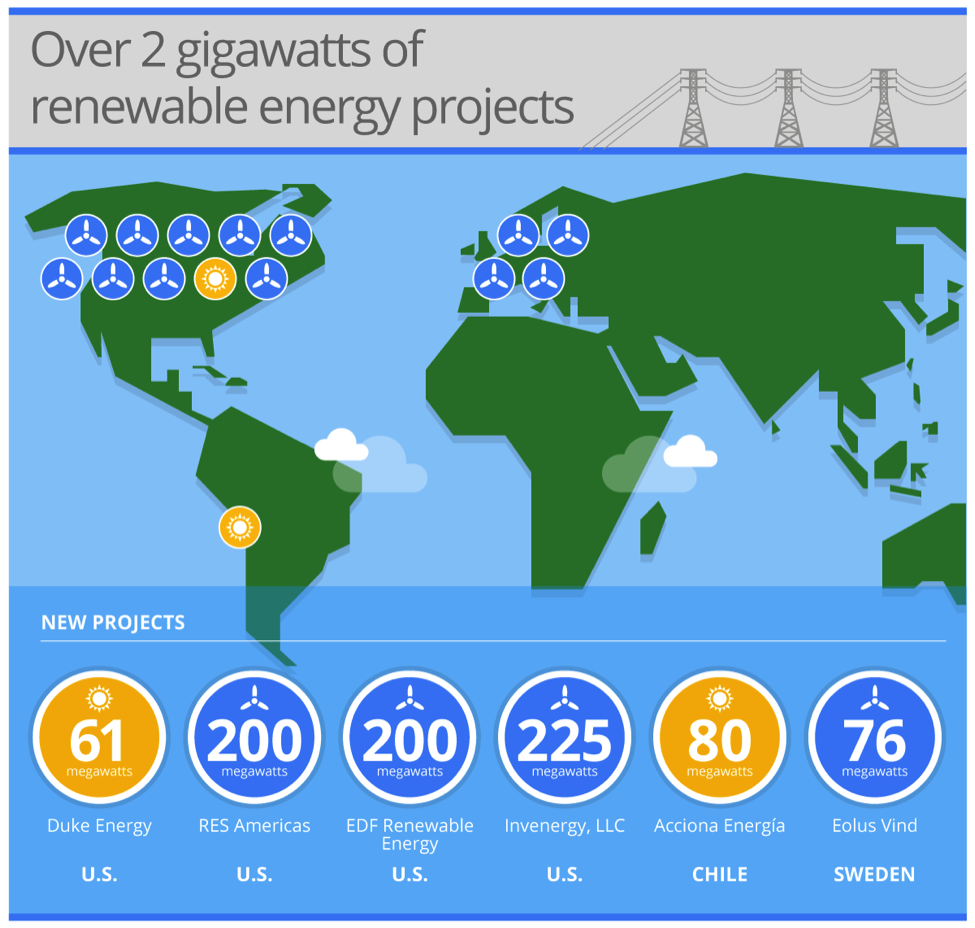
Googleblog – Today we’re announcing the largest, and most diverse, purchase of renewable energy ever made by a non-utility company. Google has already committed to purchase more renewable energy than any other company. Now, through a series of new wind and solar projects around the world, we’re one step closer to our commitment to triple our purchases of renewable energy by 2025 and our goal of powering 100% of our operations with clean energy. 842 MW of renewable energy around the world Today’s agreements will add an additional 842 megawatts of renewable energy capacity to power our data centers. Across three countries, we’re nearly doubling the amount of renewable energy we’ve purchased to date. We’re now up to 2 gigawatts—the equivalent to taking nearly 1 million cars off the road. These additional 842 megawatts represent a range of locations and technologies, from a wind farm in Sweden to a solar plant in Chile.

These long-term contracts range from 10-20 years and provide projects with the financial certainty and scale necessary to build these wind and solar facilities—thus bringing new renewable energy onto the grid in these regions. For our part, these contracts not only help minimize the environmental impact of our services—they also make good business sense by ensuring good prices. Our commitment to a sustainable energy future Since we opened our very first owned data center in 2006, we’ve been working to promote renewable and sustainable energy use in several ways:

  • First, we’re building the world’s most efficient computer infrastructure by designing our data centers to use as little energy as possible.

Tiếp tục đọc “Powering the Internet with renewable energy”

Why do we know so little about corporate human rights abuses?

Posted: 12/02/2015 12:53 pm EST

huffingtonpost – They called it “the plane that became a convertible.” In 1988, on a routine flight from Hilo to Honolulu, Aloha Airlines flight 243 depressurized mid-flight, ripping the top off the plane. A flight attendant, the only one who wasn’t strapped in, was sucked out of the plane with it.

The accident was a wake-up call for the aviation industry. For years, deregulation had attracted more companies to the sector, increasing pressure on airlines to extend the lifespan of their fleets and skip maintenance to keep them in the air.

After the accident, airlines and regulators decided to solve the safety problem head-on. The U.S. Federal Aviation Authority required every airline to report its maintenance, testing and accident data, and set statutory limits for how many times each piece of equipment could be used before it had to be retired. Tiếp tục đọc “Why do we know so little about corporate human rights abuses?”

ASEAN and Global Change

John Pang

Synopsis

As we set our eyes on the long horizon of economic integration we should not neglect the important role ASEAN can play in the wider region today.

Commentary

RSIS – THIS HAS been a year of high expectations and of disappointment in Southeast Asia. Rarely has the economic and strategic importance of the region been as apparent. As China’s economy transitions towards “a new normal” marked by lower growth, structural and financial reform, and as the other BRICS markets have also slowed, investors have looked to ASEAN, with its favourable demographics and market-oriented economies, as both an alternative and a complementary market to China.

ASEAN’s prospects have often been approached through the criteria of economic integration. Hopes have centred on the ASEAN Economic Community (AEC), which is being inaugurated as we speak. The bold language of “a single market and production base” and of the launch of an economic community implies a change in the way business will be done in Southeast Asia. The reality is slow and incremental progress. Tiếp tục đọc “ASEAN and Global Change”

Thúc đẩy khoa học, công nghệ và đổi mới sáng tạo trở thành động lực cho tăng trưởng bền vững tại Việt Nam

24 Tháng 11 Năm 2014

Image

Bấm vào đây để xem đồ họa thông tin về đánh giá của WB và OECD về khoa học, công nghệ và đổi mới sáng tạo tại Việt Nam.

 WB – Hà Nội, ngày 24/11/2014 – Việt Nam cần lựa chọn con đường nâng cao năng suất lao động dựa trên sáng tạo nhằm thúc đẩy phát triển kinh tế, một báo cáo nghiên cứu chung giữa Ngân hàng Thế giới và Tổ chức Hợp tác và Phát triển Kinh tế (OECD) được công bố hôm nay nhấn mạnh.

Báo cáo Đánh giá Khoa học, Công nghệ và Đổi mới sáng tạo tại Việt Nam nghiên cứu các yếu tố, mối quan hệ và động lực chính thúc đẩy hệ thống đổi mới sáng tạo tại Việt Nam cũng như các cơ hội để Chính phủ có thể hỗ trợ thêm thông qua chính sách. Tiếp tục đọc “Thúc đẩy khoa học, công nghệ và đổi mới sáng tạo trở thành động lực cho tăng trưởng bền vững tại Việt Nam”

Cải thiện vệ sinh môi trường tại các thành phố ven biển ở Việt Nam

27 Tháng 7 Năm 2015
  Image

Sông Cầu Rào ở thành phố Đồng Hới trước và sau khi được cải tạo trong dự án.

 Ngân hàng Thế giới

Tóm tắt

WB – Dự án Vệ sinh môi trường các thành phố ven biển thực hiện thoát nước, xây dựng các công trình thu gom và xử lý nước thải và chất thải rắn, và thực hiện một chương trình nâng cao năng lực toàn diện. Trên 800.000 dân sẽ được hưởng lợi, trong đó 250.000 sẽ được hưởng lợi từ việc giảm nhẹ úng lụt. Trên 800.000 dân được hưởng lợi từ dịch vụ xử lý chất thải rắn, 65.000 học sinh được sử dụng công trình vệ sinh sạch đẹp hơn, và 8.452 hộ gia đình được vay vốn từ quỹ quay vòng phục vụ cải tạo công trình vệ sinh trong gia đình. Tiếp tục đọc “Cải thiện vệ sinh môi trường tại các thành phố ven biển ở Việt Nam”

Ancient tombs reflect cultural exchange


Cross-cultural gravesite: A local resident takes care of tomb of Banjiro, in 1665, in her garden in Hoi An.

VNN – The tombs of families of Japanese traders who died in Hoi An in the 17th century have been cared for by generations of local people. They have become a cross-cultural project for researchers from the two countries. Hoai Nam reports.

Vietnamese and Japanese cultural researchers from Hoi An’s Centre for Cultural Heritage Management Preservation and Japanese universities have been seeking the families of three Japanese traders who died and were buried in Hoi An in the 17th century.

Their tombs, which have been preserved by local people in Cam Chau Commune, attracts Japanese residents and tourists. Tiếp tục đọc “Ancient tombs reflect cultural exchange”

Chùa Hà Trung và sư Tạ Nguyên Thiều

Nguyễn Hữu Vinh

Huế không thiếu những ngôi chùa nổi tiếng, không phải vì chùa tọa lạc ở nơi  phong cảnh nên thơ, mà vì các chùa đã đóng vai trò quan trọng trong công việc hoằng pháp giáo lý Phật giáo trong suốt thời gian dài trong quá khứ. Quần thể chùa chiền ở Huế đa số đều tập trung vào các vùng lân cận thành phố, phân bố rãi rác về phía Tây Nam của kinh thành. Ðây là dải đất ven bờ sông Hương,  phong cảnh thiên nhiên hữu tình, sông núi hiền hòa nên sự có mặt của các ngôi chùa này là điều dễ hiểu. Nhưng có một ngôi chùa rất xưa, không nằm trong dải đất ven bờ sông Hương, núi Ngự hữu tình này và đã bị lãng quên trong suốt thời gian dài. Ðó là chùa Hà Trung.

Chùa Hà Trung

Từ chùa Thiên Mụ ven theo tả ngạn sông Hương lần đi về thành phố, tạt ngang chùa Báo Quốc, xong hướng về hướng Nam dọc theo quốc lộ 1,  đi khoảng 30 km, dần dần sẽ đến vùng gió cát vi vu thơm mùi nước mặn biển cả. Ðó là vùng kề cận đầm Hà Trung phá Tam Giang. Tiếp tục đọc “Chùa Hà Trung và sư Tạ Nguyên Thiều”

Bắc di cư: Dân Công giáo tị nạn từ miền Bắc và vai trò của họ tại Việt Nam CH, 1954-1959

Posted on by The Observer – NCQT

Nguồn: Peter Hansen (2009). “Bac Di Cu: Catholic Refugees from the North of Vietnam, and Their Role in the Southern Republic, 1954–1959”, Journal of Vietnamese Studies, Vol. 4, No. 3, pp. 173 -211.

Biên dịch và Hiệu đính: Đỗ Hải Yến

Gia Kiệm, một thị trấn khoảng tám mươi ngàn dân, nằm cách thành phố Hồ Chí Minh chừng năm mươi kilômét về phía Bắc, trên đường đến Đà Lạt. Thị trấn nổi bật bởi sự phồn thịnh và quy củ, nhưng điểm đặc biệt nhất là sự phong phú của các nhà thờ Công giáo vốn nằm rải rác trên trục đường chính, chỉ cách nhau vài trăm mét. Gia Kiệm không phải là một cộng đồng lâu đời. Trên thực tế, trước năm 1954, đó còn chưa phải là một ngôi làng. Nhưng vào năm đó, Giám mục Thaddeus Lê Hữu Từ đã chọn Gia Kiệm làm nơi tái định cư cho hàng ngàn dân Công giáo bỏ chạy vào Nam từ Giáo khu Phát Diệm của ông ở miền Bắc. Dân Công giáo từ các giáo khu khác ở miền Bắc như Bùi Chu và Thanh Hóa nhanh chóng gia nhập đoàn giáo dân của Lê Hữu Từ tại Gia Kiệm. Tên của các giáo xứ mới thành lập tại Gia Kiệm gợi nhắc gốc gác miền Bắc của họ: Phát Hải, Thanh Sơn, Phúc Nhạc, Ninh Phát, Kim Thượng, v.v…[1] Tiếp tục đọc “Bắc di cư: Dân Công giáo tị nạn từ miền Bắc và vai trò của họ tại Việt Nam CH, 1954-1959”

CSIS: Southeast Asia from Scott Circle – Dec 3, 2015

Southeast Asian Nations Watch Paris for Deal to Cut Greenhouse Gases

By Murray Hiebert (@MurrayHiebert1), Senior Fellow and Deputy Director, Chair for Southeast Asia Studies (@SoutheastAsiaDC), CSIS

December 3, 2015

Much of the focus at the Paris climate summit that began on November 30 will be on the delegations from the United States, China, and India, and the pledges of the world’s largest greenhouse gas emitters to limit emissions, protect forests, and launch rigorous renewable energy projects. Countries in Southeast Asia, several of which are among the most vulnerable to the impact of climate change, are watching closely to see if the nearly 200 participating countries put forward action plans robust enough to pull the world away from its trajectory toward perilous levels of global warming. Tiếp tục đọc “CSIS: Southeast Asia from Scott Circle – Dec 3, 2015”

CSIS: Southeast Asia SIT-REP – Dec 10, 2015

CSIS Southeast Asia SIT-REP

The SIT-REP gives you links to all of CSIS Southeast Asia’s (@SoutheastAsiaDC) best updates and programs in a five minute read. This issue includes a congressional testimony on democratic transitions in Southeast Asia, analysis of the prospect of joint Sino-Vietnamese development in the South China Sea, the threats posed by the Islamic State to Indonesia and Malaysia, and much more. Links will take you to the full publications, multimedia, or to registration for upcoming programs when available. To jump to a section, select one of the following:

Tiếp tục đọc “CSIS: Southeast Asia SIT-REP – Dec 10, 2015”