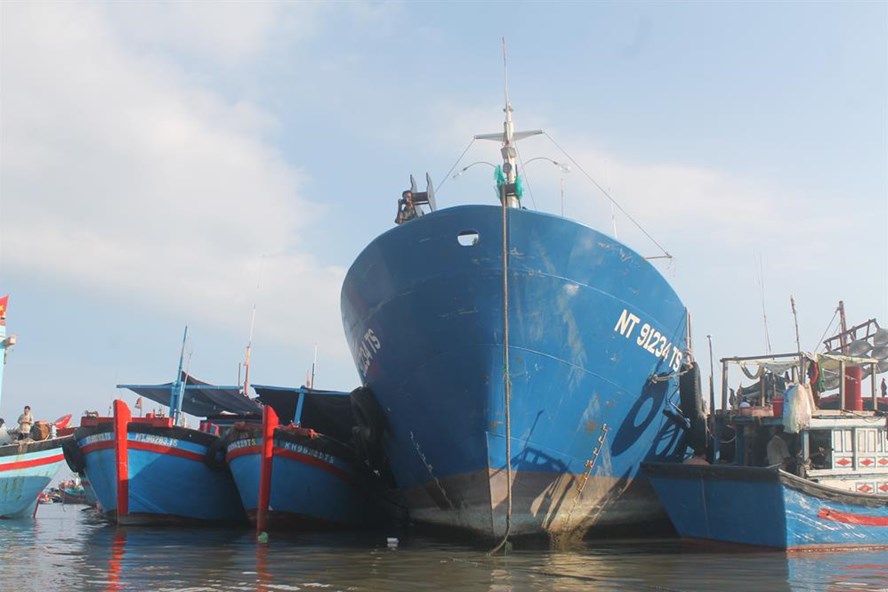
“Đáy tàu nhọn hoắt, không lắc mới lạ” – ông Dương Văn Thắng nói. Ảnh: P.V
“Tôi sợ tàu lật tôi không đi. Ai dám đi con tàu này không? Tôi sẵn sàng chuyển giao, để xem họ có đi biển được không? Cơ quan chức năng nói tàu không lắc, hãy tự tay điều khiển con tàu ra biển thử 2 ngày” – ông Dương Văn Thắng (phường Mỹ Đông, TP.Phan Rang – Tháp Chàm) nói về con tàu vỏ thép dịch vụ hậu cần (số hiệu NT-91234) duy nhất đóng theo NĐ 67 do ông làm chủ ở Ninh Thuận nằm bờ đã 2 năm qua.
White Paper on the Hoang Sa (Paracel) and Truong Sa (Spratly) Islands
Republic of Vietnam
Ministry of Foreign Affairs
Saigon, 1975
CHAPTER I
Foreword
The Vietnamese archipelagoes of Hoang Sa (Paracel) and Truong Sa (Spratly) are both situated in the South China Sea off the Republic of Vietnam’s shore. Their very modest size by no means lesser the importance given them by the Vietnamese: to Vietnamese hearts, these remote insular territories are as dear as could be any other part of the fatherland. The Hoang Sa Islands to the North were occupied by force of arms by the People’s Republic of China on January 20, 1974, following a brazen act of invasion which left the world extremely indignant. As for the Truong Sa Islands 500 km to the South, two other foreign powers are illegally stationing troops on four of the main islands in the archipelago. Tiếp tục đọc “White Pape of the Republic of Vietnam on the Hoang sa (Paracel) and Truong Sa (Spratly) Islands – (1975)”→
Vietnamnet_Residents in two communes of the southern province of Binh Dinh have raised a heated protest against titanium mining activities, citing pollution concerns.
Residents in My An and My Tho communes of Phu My District took to the streets to protest the polluting titanium mining company in Binh Dinh Province. — Photo tuoitre.vn
For many days now, people living in My An and My Tho communes of Phu My District have been preventing Hoang Dat Co from exploiting the titanium in the region fearing water pollution.
Dang Ngoc Thai, head of Xuan Phuong village of My An Commune, said previously, a vast casuarina forest covered the region.
“However, since 2006, when the company was allowed to exploit titanium in the region, they have chopped down hectares of the forest. The trucks carrying titanium ores are a constant source of pollution,” he said.
Thai also added that the wells in the village had run dry, forcing residents to spend a hefty sum of money to dig new wells.
In the neighbouring village of Xuan Binh (My An Communme), the foul smell and muddy water are also suspected to be caused by the company’s mining activities.
“Now, if the authorities once again let them resume their mining, then we will suffer further; the environment is heavily polluted already. We demanded a halt on all the titanium mining activities here,” a resident said, expressing his anger. Tiếp tục đọc “Locals protest against titanium mining in Binh Dinh”→
On July 28, 2013, a few hours after his customary religious obligations, Pope Francis prepared to go to the Apostolic Palace. As always, he checked his datebook first. “This is what I’ve always done. I carry it in a black briefcase. Inside is a razor, a breviary, an appointment book, and a book to read.” The Pope carefully reviewed his notes. That morning he had a meeting with Archbishop Jean Louis Bruguès, the librarian and archivist of the Holy See. But his most important appointment of the day was a noon meeting scheduled to take place in one of the most inaccessible and mysterious spaces in the Palace: the Sala Bologna, on the third floor, between the papal apartment recently vacated by Benedict XVI and the quarters of the Secretariat of State. Tiếp tục đọc “Merchants in the Temple”→
Vietnam Business Forum said actual development and investment in solar power projects may be limited under current PPA model. Credit: Intel Free Press
pv-tech.org_A consortium of international chambers of commerce has advised the Vietnamese government that its draft solar PPA template is “non-bankable” and cannot attract financing for PV in Vietnam, particularly for medium and utility-scale projects, according to documents seen by PV Tech. Tiếp tục đọc “Vietnam solar Power Purchase Agreement is ‘non-bankable’”→
HO CHI MINH CITY — Vietnam’s TTC Group is planning to sink about $1 billion into solar energy projects in a country still dependent on coal-fired thermal and hydro power for its power needs, with national electricity demand growing faster than 10% annually.
TTC Group, a sugar, energy and real estate conglomerate, said it plans to build as many as 20 solar parks with a total capacity of 1,000 megawatts by next year. The group executed a number of clean energy projects using sugarcane waste before moving into the solar sector Tiếp tục đọc “Vietnam’s solar energy push draws investors”→
The history of witchcraft in Europe begins with both folk beliefs and with religious and classical texts. The texts have roots in Hebrew, Greek and Roman history. The development of beliefs about what witchcraft meant — and especially the history of its gradual identification as a kind of heresy — takes effect over hundreds of years. I have also included a few American and global events for perspective on the history of witchcraft trials and executions. Tiếp tục đọc “Witch Hunts in Europe: Timeline”→
Chính phủ Việt Nam chưa đạt đầy đủ các tiêu chuẩn tối thiểu về xóa bỏ nạn buôn người; tuy nhiên, đã có những nỗ lực đáng kể. So sánh với kỳ báo cáo trước, chính phủ VN đã thể hiện nỗ lực ngày càng tăng; vì vậy, Việt Nam vẫn được duy trì ở nhóm 2.
Chính phủ thể hiện sự tăng thêm nỗ lực thông qua việc xác định các nạn nhân; mở rộng các chương trình đào tạo về chống buôn người và chiến dịch nhận thức cho các cán bộ thực thi pháp luật, cán bộ địa phương, thành viên của các nhóm có nguy cơ bị buôn bán; và ban hành hướng dẫn tới các bộ liên quan, lãnh đạo các tỉnh về kế hoạch hành động quốc gia chống nạn buôn người. Tuy nhiên, chính phủ đã không đạt được những tiêu chuẩn tối thiểu ở một số lĩnh vực chính. Nỗ lực chống nạn buôn người bị cản trở do thiếu sự hợp tác giữa các ngành, các cán bộ tỉnh chưa nắm rõ luật chống buôn bán người, thủ tục xác định nạn nhân, và thu thập dữ liệu chưa đầy đủ. Tiếp tục đọc “Nạn buôn bán người ở Việt Nam – Báo cáo của Bộ Ngoại Giao Hoa Kỳ 2017”→
Vox_Since 2014, China has been building islands in the middle of the South China Sea. What were once underwater reefs are now sandy islands complete with airfields, roads, buildings, and missile systems. In less than two years, China has turned seven reefs into seven military bases in the South China Sea, one of the most contentious bodies of water in the world.
href=””>United Nations Law of the Seas, which says a country’s territory extends 200 miles off its shores, an area called the exclusive economic zone, or EEZ. Any trade or resources that fall in a country’s EEZ belong to that country; they’re its sovereign territory. Any area that is not in an EEZ is considered international waters and subject to UN maritime law, meaning it’s shared by everyone. Every country in the region, which includes Malaysia, the Philippines, Brunei, and Vietnam, bases its claim to the South China Sea on the UN’s EEZ laws — except China.
China argues it has a historical claim to the South China Sea, dating back to naval expeditions in the 15th century. After World War II, the Japanese Empire lost control of the South China Sea, and China took advantage of the moment to reclaim it. On maps, it started drawing a dashed line that encompassed most of the South China Sea. This line became its official claim and is known today as the Nine-Dash Line, because it always has nine dashes. In 1973, when the UN law established EEZs, China reaffirmed its Nine-Dash Line, refusing to clarify the line’s boundaries and rejecting other countries’ claims.
Since then, tensions have built around who rightfully owns the South China Sea. The dispute has centered on the Spratly Islands, an archipelago at the heart of the South China Sea. Currently, China, Malaysia, the Philippines, and Vietnam claim some part of the Spratly Island chain. They’ve asserted their claims by putting small buildings, ports, and even some people on what are essentially rocks in the middle of the ocean.
But the Spratlys are very important, because whichever country can successfully claim themcan extend its EEZ to include them, thus gaining miles of precious sovereign territory. This is why China began building up islands in 2014. By turning these rocks into military bases, the Chinese are now able to support hundreds of ships, bolstering their presence in the region. They are using fishing boats, surveillance ships, and navy destroyers to set up blockades around other countries’ islands and defend their own. This is all done very cautiously and in small steps in order to avoid sparking a wider conflict.
Since China began building islands, the disputes have not become violent.But tensions are building in the region. As China deploys more of its military to the Spratlys, other countries are getting nervous and building up their own islands. It’s a complex situation that will continue to gain international attention, for better or for worse.
TTO – Bộ Lịch sử Việt Nam tái bản lần thứ nhất đã đưa ra những quan điểm tiến bộ, trong đó từ bỏ cách gọi chính quyền Việt Nam cộng hòa là ngụy quân, ngụy quyền và chỉ đích danh quân Trung Quốc xâm lược Việt Nam trong chiến tranh biên giới phía Bắc…
Xẻ núi đưa pháo lên điểm tựa trong cuộc chiến bảo vệ biên giới phía Bắc – Ảnh: ĐÀO VĂN SỬ
Cuộc chiến tranh biên giới phía Bắc từ năm 1979 cần phải chỉ đích danh là cuộc chiến tranh xâm lược của Trung Quốc đánh Việt Nam.
Không thể gọi là quân Trung Quốc tiến xuống hay tiến vào Việt Nam, bởi như vậy không nói lên được bản chất vấn đề.
Sách giáo khoa lịch sử phải viết cụ thể về cuộc chiến này, chứ không thể viết dăm ba dòng như vậy thì ai có thể hiểu được?
Bộ trưởng Quốc phòng Phi Luật Tân vừa cho biết, “TQ đã bảo đảm với Phi Luật Tân sẽ không chiếm thêm nơi nào ở Biển Đông” cũng như sẽ không xây thêm gì ở Scarborough Reef (Bãi An Nhơn) của Phi bị TQ chiếm đóng từ năm 2012. Được hỏi về điều này, người phát ngôn của Bộ Ngoại giao TQ chỉ nói vòng vòng mà không trả lời. Vậy là sao?
First posted on UNCLOSforum.wordpress.com on May 29, 2015
FP Situation Report
Friday, May 29, 2015
One of the biggest bits of news has been the first sighting of a massive new Chinese long-range drone that is thought to be able to pick up and track stealthy aircraft at long range. The drone, first reported Thursday by Popular Mechanics’ Jeffrey Lin and P.W. Singer, had its maiden flight in February, and “could change the brewing arms race in the Asia Pacific.”
The double-bodied behemoth, with an estimated 40-meter wingspan, is packed with seven different radar systems and a variety of surveillance equipment to help it detect U.S. stealth aircraft like the F-35 fighter, B-2 bombers, and ships at long distances.
And to no one’s surprise, Beijing has been placing offensive weaponry on the artificial islands it’s been building in the South China Sea. We’ve already seen what look like air strips on some of the clumps of dirt hastily dumped on top of coral reefs, but the mobile artillery pieces that American intelligence have detected is something new.
While hardly a threat to any naval or air assets in the region, the guns are within range of nearby islands claimed by Vietnam, according to the Wall Street Journal’sJulian Barnes and Gordon Lubold, and their sheer symbolism carries some significant weight. With American surveillance planes flying nearby and U.S. Navy ships insisting on the right to transit close to the makeshift bits of land, the artillery pieces represent a small, but real, escalation of the game.




 Vietnam Business Forum said actual development and investment in solar power projects may be limited under current PPA model. Credit: Intel Free Press
/about/saul-and-the-witch-of-endor-1526-artist-cornelisz-van-oostsanen-jacob-ca-1470-1533-464428389-58d796e03df78c51620e2b9c.jpg)


 CVD
CVD 