25 công ty quyền lực hơn rất nhiều quốc gia

ENGLISH: These 25 Companies Are More Powerful Than Many Countries

Không mang quốc tịch nào để tối đa hoá lợi nhuận, nhiều công ty đa quốc gia đang ganh đua quyền lực với chính phủ các nước. Ai sẽ thắng?
Thoạt nhìn, câu chuyện về Accenture đọc lên có vẻ giống nguyên mẫu của giấc mơ Mỹ. Một trong những công ty tư vấn lớn nhất thế giới, làm chủ hàng chục tỷ đô la doanh thu hàng năm, ra đời vào những năm 1950 từ một phòng nhỏ của công ty kế toán Arthur Andersen. Dự án lớn đầu tiên của công ty này là tư vấn cho General Electric để lắp đặt một máy tính ở cơ sở Kentucky thực hiện thanh toán tự động. Tiếp tục phát triển trong một vài thập niên sau đó, và đến năm 1989, đơn vị này đã gặt hái nhiều thành công đủ để tách ra thành tổ chức riêng: Công ty Tư vấn Andersen.

Tuy nhiên, nếu nhìn kỹ sẽ thấy sự phát triển của công ty này chệch khỏi hướng đi của nước Mỹ. Điều này không phải bởi công ty đã mở văn phòng nước ngoài ở Mexico, Nhật Bản và các quốc gia khác; việc mở rộng ra nước ngoài là thông lệ thường đối với nhiều công ty Mỹ. Mà hơn thế, Công ty Tư vấn Andersen đã nhìn thấy những lợi ích – như ít thuế hơn, nhân công rẻ hơn, các quy định đỡ nặng nề hơn – ở nước ngoài và công ty đã tái cấu trúc nội bộ để tận dụng những lợi thế này. Đến năm 2011, tại thời điểm phát hành cổ phiếu ra công chúng sau khi đã đổi tên thành Accenture, công ty này đã dần biến đổi thành một mạng lưới nhượng quyền được kết hợp không quá chặt chẽ bên ngoài công ty mẹ ở Thuỵ Sỹ. Công ty chuyển đến Bermuda và ở đó đến 2009, tái lập địa chỉ pháp lý tại Ireland, một hệ thống pháp luật thuế thấp khác. Hiện nay, khoảng 373.000 nhân viên của Accenture hoạt động rải rác ở hơn 200 thành phố ở 55 quốc gia. Các nhân viên tư vấn hoạt động ở những địa điểm công việc được giao nhưng thường báo cáo về các văn phòng nằm ở các trung tâm khu vực như Prague hay Dubai, nơi có tỉ suất thuế thấp hơn. Để tránh trạng thái cư trú phiền phức, bộ phận nhân sự đảm bảo rằng nhân viên công ty không sử dụng quá nhiều thời gian ở các điểm dự án của họ. Tiếp tục đọc “25 công ty quyền lực hơn rất nhiều quốc gia”

CORRUPTION IN THE HEALTH SECTOR IN VIETNAM

Transparency International

SUMMARY

In Vietnam, corruption in the health sector is considered a serious problem by both the government and citizens at large. The country’s health system is particularly susceptible to corruption due to uncertainty, asymmetry of information between health officials and patients, and conflicts of interest between health officials and private companies.

Corruption manifests itself in many forms: it can involve political influence in defining health and drug policy; bribery to influence procurement processes for construction of health facilities or purchase of equipment/supplies and pharmaceuticals; fraudulent billing for services provided; and over-provision of services; selling and buying positions; absenteeism; and informal payments, among others. It has serious consequences in terms of access, quality, equity and effectiveness of health care services.

The government has designed a series of reforms directly aimed at improving the country’s health governance framework. While assessments of the impact of these reforms are still lacking, the government, experts and civil society organisations have acknowledged that more needs to be done in order to reduce corruption and improve health delivery in the country, including improvements in internal and external controls, simplification of administrative rules, establishment of conflicts of interest law, and engagement of citizens.

Author(s): Maira Martini, Transparency International, tihelpdesk@transparency.org
Reviewed by: Marie Chêne, Transparency International; Dr. Finn Heinrich, Transparency International
Publication date: 4 February 2013
Number: 1325

Download full Corruption_in_the_Health_Sector_in_Vietnam

Tiếp tục đọc “CORRUPTION IN THE HEALTH SECTOR IN VIETNAM”

Đến năm 2020 Việt Nam có những tuyến cao tốc nào?

Lê Anh – Thứ Tư,  9/3/2016, 19:54 (GMT+7)

(TBKTSG Online) – Bộ Giao thông Vận tải (GTVT) đặt mục tiêu đến hết năm 2020 sẽ đầu tư khoảng 2.500 km đường cao tốc, tập trung ưu tiên vào các đoạn cao tốc Bắc Nam phía Đông, các tuyến ở khu vực vùng Thủ đô Hà Nội, TPHCM và các tuyến nối với các cảng biển, cửa khẩu quốc tế.

Đường cao tốc TPHCM – Long Thành – Dầu Giây đoạn đi qua địa phận tỉnh Đồng Nai. Ảnh: Anh Quân

Tiếp tục đọc “Đến năm 2020 Việt Nam có những tuyến cao tốc nào?”

“Chợ bom” đã bớt cưa bom

22/03/2016 13:41 GMT+7

TTO – Nhiều người cho rằng sau vụ nổ kinh hoàng ở Hà Đông, dân kinh doanh phế liệu là vỏ bom mìn ở “chợ bom” xã Diễn Hồng, huyện Diễn Châu tỉnh Nghệ An đã biết sợ.

“Chợ bom” đã bớt cưa bom
Phế liệu bom mìn tại các cơ sở kinh doanh phế liệu ở Diễn Hồng năm 2005 – Ảnh: Vũ Toàn
Sau vụ nổ kinh hoàng ở Hà Đông (Hà Nội), chúng tôi tìm đến “chợ bom” ở xã Diễn Hồng, huyện Diễn Châu (Nghệ An) – nơi mà trước đây sắt, thép phế liệu, trong đó có bom, đạn đều được họ mua tuốt luốt (bài “Chợ… bom” , Tuổi Trẻ ngày 25-5-2005). Tiếp tục đọc ““Chợ bom” đã bớt cưa bom”

Cá ngừ đại dương: có tiếng mà chưa có miếng – Vì sao cá ngừ Việt Nam không thể làm sushi?

Cá ngừ đại dương: có tiếng mà chưa có miếng

Ngọc Hùng – Thứ Hai,  21/3/2016, 21:07 (GMT+7)

Làm sao để nâng cao chất lượng cá ngừ đại dương sau khi đánh bắt vẫn là một vấn đề nan giải của Việt Nam. Trong ảnh: một con cá ngừ đại dương trưng bày tại Lễ hội thủy sản tại Phú Yên. Ảnh: NH
(TBKTSG Online) – Cuối tháng 1-2016, Việt Nam đã mang 8 con cá ngừ đại dương sang Nhật Bản để đấu giá, và so với lần đấu giá năm 2014, chất lượng sản phẩm của Việt Nam đã cải thiện ít nhiều.  Tuy nhiên, sự kiện nói trên cũng chỉ mang tính chất “trình diễn”, vì sản lượng cá ngừ Việt Nam thực tế vẫn chưa đáp ứng được yêu cầu trong nước, hàng năm vẫn phải chi hàng trăm triệu đô la Mỹ nhập khẩu cá ngừ cho tiêu dùng nội địa.

Tiếp tục đọc “Cá ngừ đại dương: có tiếng mà chưa có miếng – Vì sao cá ngừ Việt Nam không thể làm sushi?”

HẠN CHẾ XE CÁ NHÂN: Một thực tế bế tắc

21/03/2016 11:41 GMT+7

TTCTCảnh tượng các tuyến đường vào nội thành ùn tắc không khác gì những bãi đậu xe đang ám ảnh rất nhiều người dân TP.HCM. 12 năm trước, đề án “Hạn chế phương tiện giao thông cá nhân” tại TP.HCM (gọi tắt là xe cá nhân) giai đoạn 2005-2010 đã được Sở Giao thông công chánh (nay là Sở Giao thông vận tải) trình UBND TP nhưng chưa được phê duyệt.

 Một thực tế bế tắc
Kẹt xe tại ngã tư Hàng Xanh (Q.Bình Thạnh, TP.HCM) -Thuận Thắng

Đề án xe cá nhân tiếp tục là một hạng mục trong “Chương trình kéo giảm ùn tắc giao thông TP” giai đoạn 2011-2015, nhưng đến nay việc hạn chế xe cá nhân ở TP vẫn chưa được triển khai trên thực tế. Tiếp tục đọc “HẠN CHẾ XE CÁ NHÂN: Một thực tế bế tắc”

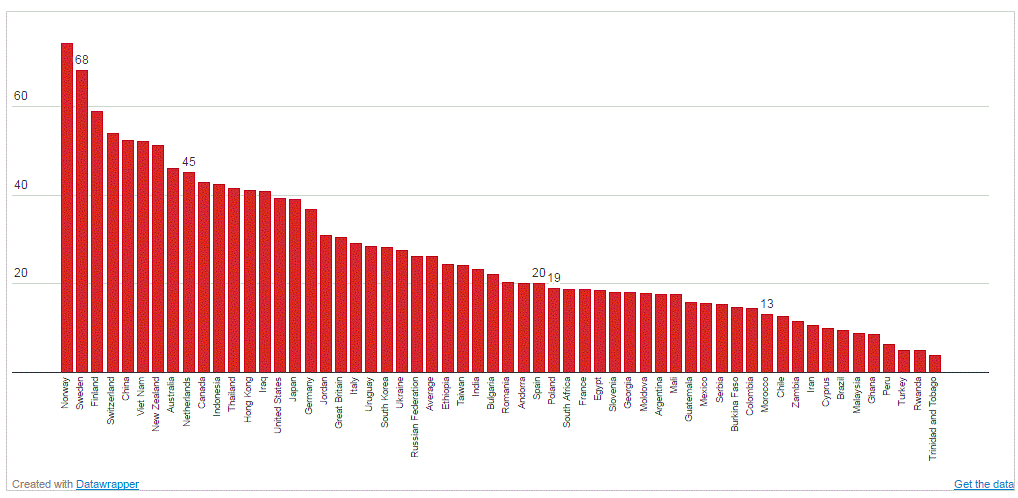
Trust Empirical View – Levels of Trust across Countries

ourworldindata – Levels of Trust by Country: ‘Generally speaking, would you say that most people can be trusted or that you need to be very careful in dealing with people?’ Possible Answers ‘Most people can be trusted’ or ‘Can’t be too careful’ – Max Roser1

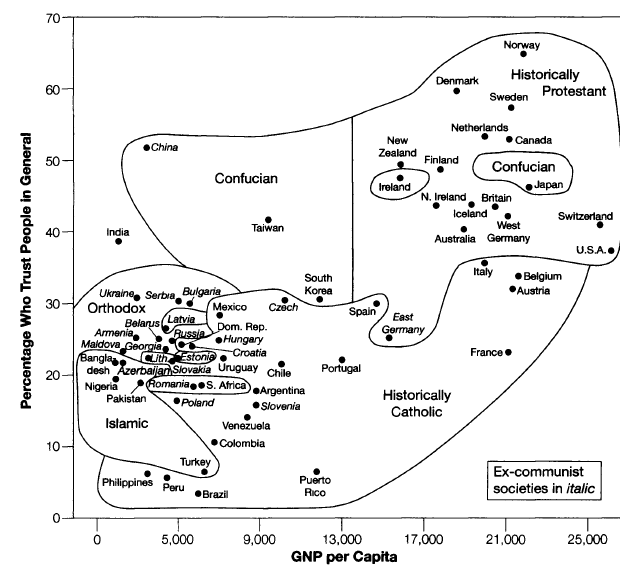
Trust 1

Correlates, Determinants & Consequences

Percentage of people who trust people in general vs GNP per capita – Beinhocker (2006)2

The Relationship Between Trust and Economic Performance – Beinhocker (2006)

Percentage of people expressing high level of trust in others (2008) vs. income inequality by Gini index (mid-2000s) – Max Roser3

Cơ hội và thách thức của thủy sản Việt Nam khi hội nhập

Thứ 4, 09/03/2016 | 16:02 GTM +07

(vasep.com.vn) Xuất khẩu thủy sản của Việt Nam đã có những bước tiến lớn trong gần 20 năm qua. Kim ngạch xuất khẩu thủy sản từ mức thấp 550 triệu USD năm 1995 đã có những bước tăng trưởng mạnh mẽ qua từng năm với mức tăng trưởng bình quân 15,6%/năm và đã đạt 7,8 tỷ USD năm 2014. Quá trình tăng trưởng này đã đưa Việt Nam trở thành một trong 5 nước xuất khẩu thủy sản lớn nhất thế giới, giữ vai trò chủ đạo cung cấp nguồn thủy sản toàn cầu.

Tiếp tục đọc “Cơ hội và thách thức của thủy sản Việt Nam khi hội nhập”

From Omen to Opportunity: How Cheap Oil Is Accelerating Sustainable Energy Investment

An increasingly unprofitable global oil market is driving fuel prices to historic lows and hemorrhaging investment in conventional energy sources. Breaking with tradition, cheap oil no longer foretells disaster for renewable energy companies. On the contrary, disillusioned fossil fuel investors are seeking high-growth opportunities—just in time to ride the renewables wave in the wake of the 2015 Paris climate talks.

worldwatch – Crashing out in February at $27 per barrel, crude oil prices have reached their lowest point in over 13 years, since the 2003 U.S.-led invasion of Iraq. Despite a modest recovery in March driven by expectations for reduced production, investors remain skeptical of underlying oil market fundamentals and are reducing their exposure. These selloffs have dragged down the stock prices of large conventional energy companies listed in the Standard & Poor’s 500 Index by 13 percent and have cost investors more than $703 billion since the record-high oil prices of June 2014.

Responding to these selloffs, oil companies have tightened their belts, decommissioning two-thirds of their rigs and sharply cutting investment in oil field exploration and development, while an estimated 250,000 oil workers have lost their jobs. A Wood Mackenzie report identified 68 major oil and natural gas projects—representing a combined value of $380 billion and output of 2.9 million barrels of oil equivalent (boe) per day—that have been put on hold since late 2014. Besides reducing operating costs, oil companies hope that these measures will have a stabilizing effect on the market by reducing productive capacity in the medium to long term. Tiếp tục đọc “From Omen to Opportunity: How Cheap Oil Is Accelerating Sustainable Energy Investment”

Bức tranh ngân hàng Việt Nam 10 năm qua

Gia Anh – Thứ Tư,  16/3/2016, 08:41 (GMT+7)

TPHCM, trung tâm kinh tế lớn nhất nước, cũng là nơi diễn ra nhiều cuộc sáp nhập ngân hàng những năm qua. Ảnh: Hồng Phúc

(TBKTSG Online) – Một báo cáo có tên “Ngân hàng thương mại Việt Nam: Từ những thay đổi về luật và chính sách giai đoạn 2006-2010 đến các sự kiện tái cơ cấu giai đoạn 2011-2015” của tác giả Nguyễn Xuân Thành – Chương trình Giảng dạy Kinh tế Fulbright TP.HCM, được ông Thành công bố ở dạng bản thảo đã điểm lại một số cột mốc quan trọng của hệ thống ngân hàng Việt Nam trong 10 năm qua.

Tiếp tục đọc “Bức tranh ngân hàng Việt Nam 10 năm qua”

The Hidden Consequences of the Oil Crash

Crude prices are at their lowest levels since 2003. Fifteen experts tell us what that means for the United States and the rest of the world.

By POLITICO Magazine January 21, 2016

Politico -For months, American drivers have been greeted at gas stations with a pleasant surprise: Gas prices have fallen by half, dropping an average of more than $2 a gallon since their most recent peak in 2011. President Barack Obama took a moment to bask in the credit last week in his State of the Union speech: “Gas under two bucks a gallon ain’t bad,” he said.Or maybe it is. Behind that drop is an even bigger collapse in the price of oil, from more than $100 a barrel in 2014 to under $27 this week. On Tuesday, the Dow fell 250 points amid fears about what will happen if the price of oil continues its slump, which will have effects far beyond consumers, beyond even the global market.

Oil prices drive not just economics, but geopolitics. Alliances rise and fall over petroleum. Expensive oil props up governments in Russia and Iran, provides stability in Middle Eastern countries and also offers a revenue stream to extremist groups in Nigeria and Iraq. Domestically, high-priced oil spurs innovation in alternative energy; it has also driven America’s shale boom. For all these reasons and more, the collapsing value of oil will have profound consequences around the world, with the potential to destabilize regimes, remake regions and alter the global economy in lasting and unforeseen ways. Tiếp tục đọc “The Hidden Consequences of the Oil Crash”

These 25 Companies Are More Powerful Than Many Countries


Going stateless to maximize profits, multinational companies are vying with governments for power. Who is winning?

FP
By Parag Khanna
Top 25 by David Francis
Illustration by Edel Rodriguez

At first glance, the story of Accenture reads like the archetype of the American dream. One of the world’s biggest consulting companies, which commands tens of billions of dollars in annual revenues, was born in the 1950s as a small division of accounting firm Arthur Andersen. Its first major project was advising General Electric to install a computer at a Kentucky facility in order to automate payment processing. Several decades of growth followed, and by 1989, the division was successful enough to become its own organization: Andersen Consulting.

Tiếp tục đọc “These 25 Companies Are More Powerful Than Many Countries”

Virus “lãi suất âm” và chiến tranh tiền tệ

Thanh Hương – Chủ Nhật, 14/2/2016, 21:09 (GMT+7)

Giảm lãi suất xuống mức cực thấp, thậm chí lãi suất âm, đang là một phong trào. Ảnh minh họa Internet

(TBKTSG Online) – Tờ Financial Times cùng nhiều tờ báo tài chính khẳng định rằng lãi suất âm chính là “tội đồ” lớn nhất của tình trạng rối loạn thị trường tài chính thế giới vài ngày qua, bên cạnh nhiều nguyên nhân khác như lãi suất trái phiếu, kinh tế Trung Quốc giảm tốc, cảnh báo suy thoái kinh tế Mỹ, nợ xấu, tình trạng ngặt nghèo của giá dầu…

Tiếp tục đọc “Virus “lãi suất âm” và chiến tranh tiền tệ”

Reforming Electricity Reforms? Empirical Evidence from Asian Economies

Executive Summary

Anupama Sen* Rabindra Nepal** Tooraj Jamasb*** & Tooraj Jamasb

February 2016

After more than two decades of attempts at electricity sector reform, there is a strong case for assessing empirical evidence on its outcomes, particularly for developing countries. Electricity reform programmes , implemented through the ‘standard’ or ‘textbook’ model, have their foundations in standard microeconomic theory and are based on the rationale that restructuring towards greater competition can lead to higher efficiency, maximise economic welfare, and transfer surplus to consumers. In practice, this has not always been the case, even in the OECD economies which pioneered the standard model.

This paper investigates the outcomes of the standard model for developing countries, by applying instrumental variable regression techniques on an original and previously untested panel dataset covering 17 non – OECD developing Asian economies spanning 23 years. While there is some cross – country literature on the effects of electricity reforms in developed and developing economies, there has been no systematic attempt thus far to examine their technical, economic and welfare impacts whilst accounting for cross – country institutional differences, for non – OECD Asian developing economies.

This paper fills a gap in the literature in the following ways: First, to our knowledge, this paper is the first to empirically assess the impact of electricity reforms on non – OECD Asian countries as a whole. Second, it applies econometric techniques to a new panel data set on 17 non – OECD developing Asian economies, from 1990 – 2013, which allows for cross – country comparisons whilst controlling for differing institutional and political contexts. Third, it draws the link between electricity reform and sector (technical) performance, economic impacts, and welfare indicators, assuming a cumulative impact of reform. In contrast with the theoretical literature, our results show a tension between wider economic impacts and welfare impacts for consumers: namely, the variables that are associated with a positive effect on economic growth appear to be associated with a negative impact on welfare indicators. Tiếp tục đọc “Reforming Electricity Reforms? Empirical Evidence from Asian Economies”