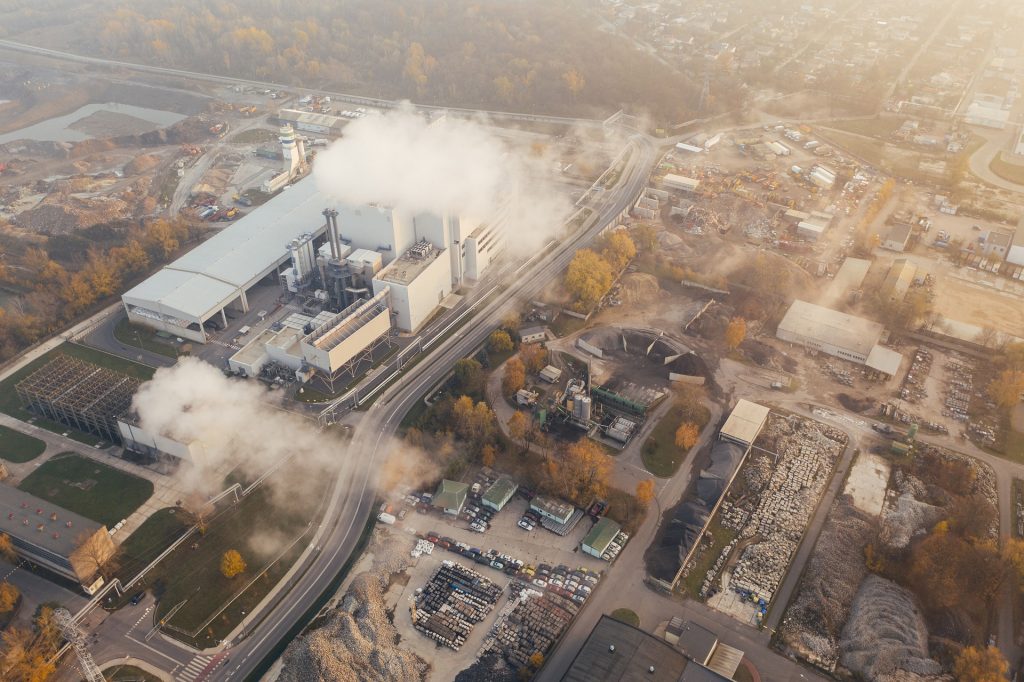
Vietnam’s largest wind power plant begins operation in central Ninh Thuan Province on April 16, 2021. Photo courtesy of Government’s Portal.
HCMC-based energy firm Trungnam Group Friday has put its wind power plant in central Ninh Thuan Province into operation, considered the country’s largest to date.
The plant, which spreads over an area of 900 hectares in Thuan Bac District, has 45 turbines with a total capacity of 151.95 megawatts that costs VND4 trillion ($173.4 million), the Government portal reported.
The wind power plant is combined with a 204 MW solar power plant to form the solar-wind farm complex considered the largest in Southeast Asia. The complex will supply a total 950 million kWh per year for the country’s grid.
The private energy company has added a total 1,064 MW to the national grid comprising hydropower, solar and wind power. It plans to have a renewable output of nearly 10,000 MW by 2027.
Tran Quoc Nam, chairman of Ninh Thuan, said the province is now taking the lead with 32 solar power projects with a total capacity of 2,257 MW, and three wind power projects with an accumulative capacity of 329 MW.
Vietnam has great potential for renewable energy with its long coastline and 2,700 hours of sunshine a year on average.
Solar power currently accounts for just 0.01 percent of the country’s total power output, but the government plans to increase the ratio to 3.3 percent by 2030 and 20 percent by 2050.
Vietnam aims to produce 10.7 percent of its electricity from renewable energy sources by 2030, mainly through solar and wind power projects.
(KTSG) – Điện mặt trời hiện chiếm hơn 4% tổng sản lượng điện cả nước và dự kiến sẽ góp trên 9% tổng sản lượng năm 2021. Với nhiều GW điện mặt trời và điện gió được bổ sung thêm, Việt Nam đang nhanh chóng trở thành nước đi đầu tại Đông Nam Á về năng lượng sạch. Điện mặt trời áp mái phần lớn đến từ doanh nghiệp thương mại và công nghiệp. Ảnh: H.P
Hệ thống năng lượng của Việt Nam đang thay đổi đáng kể trong hai năm qua, nhờ hàng tỉ đô la Mỹ từ nhà đầu tư tư nhân. Tăng từ 20 MW điện mặt trời đầu năm 2019 đến gần 20.000 MW – là một con số chưa từng có.
Tất nhiên, mở rộng quy mô nhanh là cần thiết để Việt Nam đạt được mục tiêu quốc gia về biến đổi khí hậu – theo Thỏa thuận Paris, giảm thải 27% lượng khí nhà kính vào năm 2030. Thành tựu về năng lượng sạch của Việt Nam đem đến nhiều lợi ích gồm tăng khả năng cạnh tranh toàn cầu, là điểm đến cho đầu tư nước ngoài. Nhiều chuyên gia tin rằng các hành động bảo vệ khí hậu trong thập kỷ này có vai trò thiết yếu để thúc đẩy vị thế chính trị và kinh tế của quốc gia.
Theo đó, Việt Nam nên mừng cho thành công gần đây, nhưng cũng nên thấy rằng còn nhiều điều cần làm nếu muốn cải thiện hơn nữa sức hấp dẫn trên bản đồ chính trị và kinh tế quốc tế – đặc biệt khi ngành năng lượng đang trải qua những thay đổi lớn.
Liệu Việt Nam có nắm bắt được cơ hội khổng lồ này để không chỉ đáp ứng mục tiêu về khí hậu mà còn củng cố vị trí về chính trị và kinh tế trên toàn cầu?
Lĩnh vực tư nhân đang thúc đẩy sự bùng nổ năng lượng sạch – và còn khao khát nhiều hơn nữa Lĩnh vực tư nhân đóng vai trò không thể thiếu trong bức tranh năng lượng sạch của Việt Nam. Đó là hàng trăm công ty đang đầu tư và phát triển các nhà máy năng lượng tái tạo – thậm chí đầu tư cho đường dây truyền tải và phân phối điện, cùng hàng ngàn doanh nghiệp đang mua điện tái tạo để tiêu thụ trực tiếp.
Trong số hơn 9.300 MW điện mặt trời mái nhà năm 2020, ước tính 85% đến từ doanh nghiệp thương mại và công nghiệp. Điển hình, theo khảo sát hơn 100 công ty của Chương trình Thúc đẩy đầu tư năng lượng sạch (CEIA(*)), nhu cầu dùng điện sạch của doanh nghiệp lên tới hơn 1.000 MW và họ đang chờ đợi chương trình thí điểm DPPA – Thỏa thuận mua bán điện trực tiếp được ban hành.
Bởi DPPA cho phép các giao dịch mua bán điện mặt trời và điện gió diễn ra trực tiếp giữa bên phát điện với bên dùng điện công nghiệp. Nhiều công ty cam kết hành động vì khí hậu đang thực hiện nhanh và mạnh hơn bao giờ hết, đồng thúc đẩy bởi nhu cầu của người tiêu dùng và các quỹ tuyên bố sẽ không đầu tư nếu như công ty không có hành động thuyết phục để bảo vệ chính mình và thế giới khỏi các rủi ro khí hậu.
Đó là hơn 1.000 công ty toàn cầu đang đặt ra các mục tiêu giảm phát thải thông qua sáng kiến Mục tiêu khoa học (SBTi), và một ví dụ khác là toàn bộ các ngành thống nhất về mục tiêu giảm carbon trong Hiến chương Liên hiệp quốc Hành động vì khí hậu trong ngành công nghiệp thời trang.
Các công ty có chuỗi cung ứng sâu và rộng ở Việt Nam, như Nike, Walmart, H&M, Apple và IKEA, yêu cầu các nhà sản xuất chuỗi cung ứng của họ có hành động giảm carbon từ quá trình vận hành.
Có thể thấy, các công ty toàn cầu lớn nhất từ nhiều lĩnh vực đang đưa yếu tố giảm phát thải và hành động vì khí hậu vào các quyết định lập kế hoạch và đầu tư. Nếu một quốc gia do dự trong việc giảm carbon trong lưới điện hoặc không quan tâm đến việc mở ra các lựa chọn mua bán năng lượng sạch cho người dùng năng lượng, thì có khả năng cao các công ty lớn sẽ xem xét dịch chuyển hoạt động hoặc chuỗi cung ứng của họ sang một quốc gia khác có nhiều nỗ lực hơn.
Thực tế, một nhóm gồm 29 thương hiệu thời trang và nhà sản xuất gần đây đã gửi thư tới nguyên Thủ tướng Nguyễn Xuân Phúc, nhấn mạnh những lợi ích cạnh tranh của các chính sách hỗ trợ năng lượng sạch và thúc giục triển khai thí điểm DPPA, một chương trình vốn được mong đợi từ lâu bởi các công ty muốn mua điện sạch với số lượng lớn.“Việc thực thi chương trình thí điểm DPPA sẽ cho phép ngành công nghiệp ở Việt Nam đạt được mục tiêu 100% năng lượng tái tạo trước các nước khác trong khu vực nhiều năm, giúp Việt Nam có lợi thế cạnh tranh mạnh mẽ khi các công ty đưa ra quyết định về nguồn cung cấp sản phẩm”, nhóm đề nghị.
Nhu cầu về điện sạch là rất lớn và cần được đưa vào quy hoạch phát triển điện lực quốc gia nếu Chính phủ muốn đặt mục tiêu cho Việt Nam trở thành một trung tâm lớn của nhiều ngành công nghiệp.Thêm lựa chọn, cạnh tranh về chi phí và hợp tácMay mắn thay, Việt Nam không phải là nơi đầu tiên đối mặt với thách thức cải thiện cấu trúc thị trường điện để giải quyết nhu cầu năng lượng sạch.
Các nguyên tắc và hướng tiếp cận chính đã được thực hiện hiệu quả tại nhiều thị trường mà Chính phủ và các bên liên quan tại Việt Nam có thể dựa vào để xây dựng, với ba trụ cột chính: thêm lựa chọn (cho người tiêu dùng điện), cạnh tranh về chi phí, và hợp tác.
Lựa chọn
Giống như người tiêu dùng của mọi sản phẩm, người mua điện tìm kiếm cho mình nhiều lựa chọn mua bán. Ví dụ, điện mặt trời mái nhà phù hợp với nhiều doanh nghiệp. Thỏa thuận mua bán điện (PPA), hay chương trình DPPA sắp tới là cần thiết cho các công ty trong nhiều lĩnh vực đang tìm kiếm năng lượng sạch.Chính phủ Việt Nam có thể hỗ trợ cải thiện các lựa chọn của người tiêu dùng điện bằng việc đảm bảo các chính sách và cơ chế chính sách như PPA, DPPA trở nên thường trực và là nền tảng lâu dài trong quy hoạch phát triển điện quốc gia. Hơn nữa, khi thị trường điện bán lẻ cạnh tranh sắp được khởi động, các lựa chọn cho năng lượng sạch cần được ưu tiên bởi tập đoàn Điện lực Việt Nam (EVN) và các cơ quan quản lý của Bộ Công Thương.
Cạnh tranh về chi phí
Rõ ràng năng lượng tái tạo ngày càng rẻ hơn so với các nguồn điện truyền thống và thị trường điện Việt Nam cần tạo ra một sân chơi bình đẳng cho nguồn điện mới. Điều tích cực là các bước quan trọng đang được thực hiện theo hướng này tại Việt Nam, như cơ chế đấu giá được lên kế hoạch cho năm 2021 và thí điểm DPPA sẽ cho phép người mua điện trong công nghiệp đàm phán trực tiếp với nhà máy phát điện. Điều này cũng sẽ cung cấp cho nhà sản xuất điện và người tiêu dùng nhìn thấy rõ ràng hơn các chi phí như sản xuất và truyền tải điện.
Hợp tác
Để đáp ứng nhu cầu tiêu thụ điện ngày càng tăng, dự kiến hơn 8% mỗi năm trong thập kỷ tới, Việt Nam cần khoảng 130 tỉ đô la Mỹ đầu tư vào cơ sở hạ tầng ngành điện. Việt Nam đã đưa ra nhiều tín hiệu tích cực, gồm Luật Đầu tư theo phương thức đối tác công tư, trong đó cho phép tư nhân đầu tư vào cơ sở hạ tầng điện, sẽ rất cần thiết cho nhu cầu này.Tuy nhiên, Việt Nam khó có thể bắt kịp với nhu cầu đó nếu thiếu sự hợp tác chặt chẽ giữa Nhà nước và tư nhân. Điều này đúng đối với các nhà đầu tư và phát triển cơ sở hạ tầng năng lượng và cả người tiêu dùng, đặc biệt là các công ty tiêu thụ điện lớn tại Việt Nam, các đơn vị có mục tiêu giảm phát thải khí nhà kính và có khả năng chi trả cho năng lượng sạch.Khi người tiêu dùng điện có thêm nhiều cơ hội lựa chọn năng lượng sạch với các tiếp cận thuận tiện, giá hợp lý – và Chính phủ tạo ra một môi trường thị trường minh bạch, cạnh tranh – Việt Nam sẽ đến lúc giữ vị trí dẫn đầu về năng lượng sạch và hành động vì khí hậu trong khu vực, đồng thời củng cố vị thế ảnh hưởng của quốc gia trong nhiều năm tới.
Tác giả (1 ) Evan Scandling là Giám đốc của Allotrope Partners và là đồng lãnh đạo Chương trình thúc đẩy đầu tư năng lượng sạch Việt Nam (CEIA Việt Nam). (2) Tiến sĩ Đào Thu Hằng là chuyên gia năng lượng bền vững của Viện Tài nguyên thế giới và đồng lãnh đạo CEIA Việt Nam. (3) Alex Perera là Phó giám đốc Chương trình Năng lượng toàn cầu của Viện Tài Nguyên thế giới và là đồng lãnh đạo CEIA toàn cầu.(*) Chương trình Thúc đẩy đầu tư năng lượng sạch (CEIA) là một sáng kiến đa quốc gia kéo dài nhiều năm do Phòng thí nghiệm Năng lượng tái tạo quốc gia Mỹ (NREL), Viện Tài nguyên thế giới (WRI), và Allotrope Partners đồng sáng lập và thực hiện, hoạt động thông qua hợp tác công – tư thúc đẩy các giải pháp năng lượng sạch tại các thị trường mới nổi trên thế giới.
All it will take is VND1 million ($43) per person per year for Vietnam to get its entire power supply from nuclear plants.
Sebastien Eskenazi
Lately there has been a few articles about how Vietnam will feed its growing energy demand. And I usually feel sad for Vietnam when I read them because they support either coal and gas which pollute a lot or solar and windfarms which take a lot of space and need coal and gas to provide power when they don’t work anyway.
Humans using too much space is actually the first environmental threat according to the WWF. And a good example of the need for coal and gas when you have too much solar or windfarms is Germany. In contrast France produces the majority of its electricity from nuclear power and emits a lot less CO2 per megawatt.hour than Germany.
Nông nghiệp, nông thôn bị lợi dụng, cày xới như thế nào?
Điện mặt trời áp mái nhà như một ‘cơn lốc’ tràn qua khắp các vùng nông nghiệp, nông thôn Nam Trung bộ và Tây Nguyên, chiếm đất sản xuất và gây nhiều hệ lụy…
Đầu năm 2020, Thủ tướng Chính phủ vừa ban hành Quyết định số 13/2020/QĐ-TTg về cơ chế khuyến khích phát triển điện mặt trời tại Việt Nam, gần như ngay lập tức, các nhà đầu tư khắp cả nước, như nằm chờ sẵn, chui lên từ đất lên, đồng loạt xuất hiện ở Nam Trung bộ và Tây Nguyên, biến nhiều diện tích đất chăn nuôi, trồng trọt, trang trại, thủy sản, thủy lợi, nông thôn… thành những dự án điện mặt trời và bằng mọi giá hoàn thành công trình, thực hiện mua bán điện với giá cực kỳ ưu đãi của Chính phủ mang lại hiệu quả, lợi nhuận lớn cho nhà đầu tư. Nhưng đổi lại các dự án điện mặt trời cũng tàn phá khủng khiếp các vùng sản xuất nông nghiệp, nông thôn.
Nhóm phóng viên Báo Nông nghiệp Việt Nam đã đi sâu tìm hiểu vạch trần những chiêu trò núp bóng nông nghiệp, nông thôn để thực hiện các dự án sai phạm, trục lợi chính sách. Cũng như sự làm ngơ, thiếu trách nhiệm, đùn đẩy trách nhiệm của các cơ quan, ban, ngành và chính quyền một số địa phương khu vực Nam Trung bộ và Tây Nguyên như thế nào?…
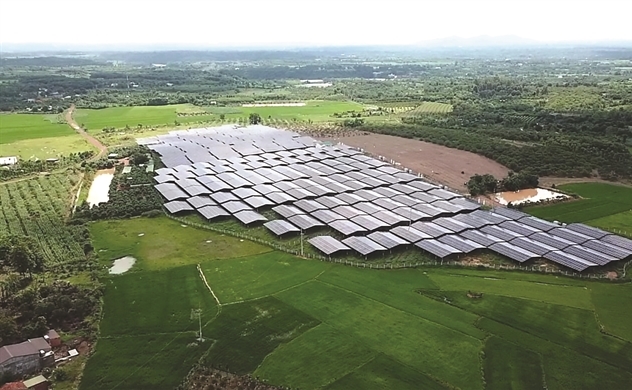
Hệ thống Điện mặt trời áp mái nhà trải dài hàng cây số tại huyện Chư Prông, Gia Lai.
Các mô hình điều tiết là sự tổ chức các hoạt động cần thiết khác nhau để cung cấp điện cho người tiêu dùng cuối cùng. Theo truyền thống, bốn hoạt động chính được xác định là: sản xuất (phát điện), truyền tải, phân phối và cung cấp. Tuy nhiên, nhiều hoạt động khác có thể được nhấn mạnh và phát triển mọt cách độc lập, chẳng hạn khi vận hành hệ thống (độc lập với truyền tải) hoặc đo đạc (độc lập với phân phối).
Mô hình điều tiết là gì?
Việc xác định mức độ phù hợp của việc phân tách mạng lưới độc quyền của các công ty thực hiện các hoạt động cạnh tranh có tầm quan trọng lớn khi thảo luận về các mô hình quản lý.
Vietnam needs to learn the right lessons from Germany’s experience – going from protests against renewable energy to becoming one of the top five nations in clean power.
Nguyen Dang Anh Thi
I choose to talk about Germany because most of the feed-in-tariff policies for Vietnam’s renewable energy have been designed using the German model and built with consultation from the Deutshe Gesellschaftür Internationale Zusammenarbeit (GIZ) or German Corporation for International Cooperation, an agency that provides services in the field of international development cooperation.
30 years ago, Germany issued the FIT policy for the first time to boost the selling of renewable electricity to the national grid. In the beginning, when the proportion of wind and solar power output made up just less than 0.1 percent of the nation’s total, there were already worries about renewable energy threatening safety and stability of the national power grid.
Back then, a group of power companies in Germany had released a joint statement creating pressure on the government, saying that renewable energy from solar, wind and hydropower plants should not exceed 4 percent of the total power output, even in the long run.
For decades, many entities in Germany had advocated thermal and nuclear power, and kept calling for delays in expanding the national power grid and delivering cautions on clean energy.
But the people of Germany had said yes big time to clean energy. Their voice, luckily, had been heard, and the government had listened to them with a long-time view, adopting consistent policies with transparency and integrity.
Nghị quyết số 55-NQ/TW của Bộ Chính trị về định hướng chiến lược phát triển năng lượng quốc gia của Việt Nam đến năm 2030, tầm nhìn đến năm 2045 (ngày 11/02/2020) khẳng định rằng: Phát triển năng lượng quốc gia phải phù hợp với thể chế kinh tế thị trường định hướng xã hội chủ nghĩa, xu thế hội nhập quốc tế; nhanh chóng xây dựng thị trường năng lượng đồng bộ, cạnh tranh, minh bạch, đa dạng hoá hình thức sở hữu và phương thức kinh doanh; áp dụng giá thị trường đối với mọi loại hình năng lượng. Khuyến khích và tạo mọi điều kiện thuận lợi để các thành phần kinh tế, đặc biệt là kinh tế tư nhân tham gia phát triển năng lượng; kiên quyết loại bỏ mọi biểu hiện bao cấp, độc quyền, cạnh tranh không bình đẳng, thiếu minh bạch trong ngành năng lượng. [153]
Bộ Chính trị ra quy định như vậy vì đặc điểm nổi trội nhất của cơ chế năng lượng tại Việt Nam là Nhà nước giữ độc quyền trong (1) hoạt động truyền tải, (2) điều tiết hệ thống điện quốc gia, (3) xây dựng và vận hành các nhà máy điện lớn [154]. Điều khoản độc quyền này có lẽ là rào cản lớn nhất cho việc cải tiến ngành năng lượng của Việt Nam.
*On the boil newsletter co-founded by 2 girls with a dream to see Vietnam become a leader in the fight against climate change. The newsletter delivers the information in a digestible format,
Global climate change and sustainability news?
Updates on the environment and sustainability projects in Vietnam?
Inspiring stories of climate leaders and their projects?
From Zero to hero, the various case of Vietnam’s renewable energy
In January, a humble “S-shaped” country in South East Asia became the talk of the town. Having been “chasing the sun”, Vietnam saw a boom in rooftop solar installations at the end of 2020. It beat all forecasts, even that of Bloomberg, who made an entire podcast episode featuring Vietnam’s race to green energy.
Before we get to the real meat of what happened, let us first take a step back to look at the whole relationship between energy and climate, and why moving to green energy matters.
All living things on the planet contain carbon [insert Sir. David Attenborough‘s voiceover here]. When organisms died hundreds of millions of years ago, their remains got buried deep under layers of sediment and rock. Under high heat and pressure, they were slow-cooked into carbon-rich deposits we now call fossil fuels, i.e. coal, oil and natural gas.
Fast forward to the 18th century. The Industrial Revolution unlocked the huge potential of fossil fuels as an abundant source of energy. Since then, fossil fuels have rapidly established themselves as the major source of power, supplying about 84% of global energy in 2019.
Now back to Chemistry 101: when we burn fossil fuels for energy, the carbon atoms (C) that have been stored away for millennia meet with oxygen (O), releasing an enormous amount of CO2. Unsurprisingly, 81% of total CO2 emissions from 1959 to 2019 comes from burning oil, coal, and natural gas. This is bad news for our friend Earth, as CO2 is a long-lived greenhouse gas capable of trapping heat from sunlight, causing global warming.
The answer is no…if 1) we move away from fossil fuels and into low-carbon, renewable energy (RE) and 2) we reduce energy consumption and increase energy efficiency. In this issue, we’ll zoom in on the first solution.
From 1965 to 2019, the share of renewables (e.g. solar, wind, hydropower) in the energy mix almost doubled from 6% to 11%. This seems…puny compared to that of fossil fuels. On the bright side, the recent net-zero emission targets set by the world’s major economies as well as big corporates in an effort to slow climate change are expected to accelerate renewables’ growth.
Vietnam is also encouraging a shift from fossil fuel to renewables, in order to meet its CO2 emission mitigation target.
By Duc Minh March 19, 2021 | 10:14 am GMT+7 VNExpressVinh Tan Power Plant 4 in the central province of Binh Thuan. Photo by Shutterstock/pDang86.Despite the associated environmental problems, Vietnam cannot do without coal-fired power plants for another 15 years at least, experts say.
There is no current alternative that can help Vietnam ensure energy security and maintain stable prices, they add.
There are several coal-fired plants in the pipeline, set to be be built by 2025, including the Nam Dinh 1 and Thai Binh 2 in northern Vietnam, and even after 2035 the country will still need a small number of coal-fired plants to keep prices from rising too high, the Institute of Energy says in a comment on the country’s latest energy development plan.
Low power demand coupled with oversupply of electricity at times have forced authorities to cut the capacity of renewable energy plants in order to avoid overwhelming the national grid, according to the Ministry of Industry and Trade (MoIT).
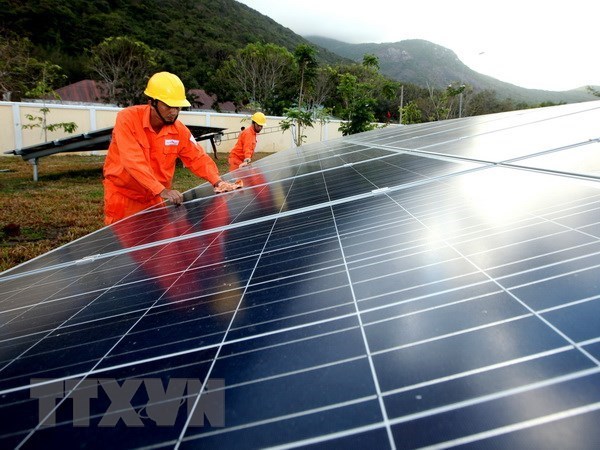
Low power demand coupled with oversupply of electricity at times have forced authorities to cut the capacity of renewable energy plants. (Photo: VNA)
A large amount of investments from social resources has been poured into developing renewable energy, particularly solar energy, over previous years in Vietnam, according to the ministry.
However, a boom in high-capacity renewable energy projects, mainly in central and southern Vietnam, has overloaded inter-regional transmission lines and caused oversupply at times, the ministry said in Document No 1226/BCT-DTDL sent to the National Assembly’s committees for Science, Technology and Environment, and Economic Affairs and the Office of the Government explaining its stance on the power capacity cut.
Additionally, domestic demand for power has fallen below normal levels due to the impact of COVID-19, which led to an oversupply of electricity during off-peak times such as holidays, weekends, and at noon, the ministry said.
According to the ministry, this is a very dangerous situation that adversely affects the safe operation of the national grid. Though the National Load Dispatch Centre (A0) has reduced the output of traditional energy to the minimum, the oversupply remains, so the centre had to make another cut to renewable energy capacity to prevent the electricity system from collapsing.
The ministry has ordered Vietnam Electricity (EVN) and A0 to calculate the required reduction of capacity at all renewable power plants in a transparent and fair manner, regardless of who their investors are.
The ministry added that it has received government approval onthe supplement of various power transmission line projects into planning while urging EVN to fast-track the progress of existing projects to raise the capacity of the national electricity network./. VNA
11 March (IEEFA Vietnam): Vietnam’s recently published draft power development plan for 2021-2030 (PDP8) has failed to acknowledge the importance of developing a more flexible system that can accommodate a changing technology mix, according to a new report from the Institute for Energy Economics and Financial Analysis (IEEFA).
“After a decade filled with disappointments from the fossil fuel industry, planners successfully tested the dynamism of renewable energy in Vietnam’s fast-growing market,” says report author IEEFA Director of Energy Finance Studies Asia, Melissa Brown.
“Many conventional coal and gas-power projects failed to progress during the development process, only managing to meet half of the targeted capacity for 2016-2020.
“Solar power developers however over-delivered by five times, and they have done so in a fraction of the time.
“This evidence would surely inform the next stage of Vietnam’s power development.
Tính đến ngày 1.1.2021 cả nước đã có 101.029 công trình điện mặt trời mái nhà. Ảnh: TL.Biến tướng trong đầu tư điện mặt trời kết hợp sản xuất nông nghiệp.
Trong 3 tháng cuối năm 2020, khu vực Tây Nguyên đặc biệt là các tỉnh Đắk Lắk, Gia Lai, Đắk Nông, Bình Phước xuất hiện nhiều nhóm nhà đầu tư thuê đất của dân để làm dự án điện mặt trời áp mái và hứa hẹn người dân chỉ cần ký giấy tờ do bên họ chuẩn bị sẵn thì sẽ nhận được tiền thuê đất hằng tháng khoảng 30 triệu đồng/ha.
Nhóm đầu tư này mua gom đất nông nghiệp của các hộ dân, rồi làm thủ tục xin đấu nối với Điện lực Đắk Lắk (PC Đắk Lắk). Điều kiện để được đấu nối là phải có dự án nông nghiệp (chăn nuôi, trồng trọt), tận dụng tầng mái công trình lắp pin năng lượng. Theo quy định của Tập đoàn Điện lực Việt Nam (EVN), các công trình điện mặt trời trên 1 MWp (điện đấu lưới) phải được Bộ Công Thương phê duyệt. Vì vậy, nhóm nhà đầu tư này thành lập thêm nhiều công ty con, chia nhỏ dự án (dưới 1 MWp) nhằm lách luật. Tiếp tục đọc “Băm đất nông nghiệp làm điện mặt trời”→
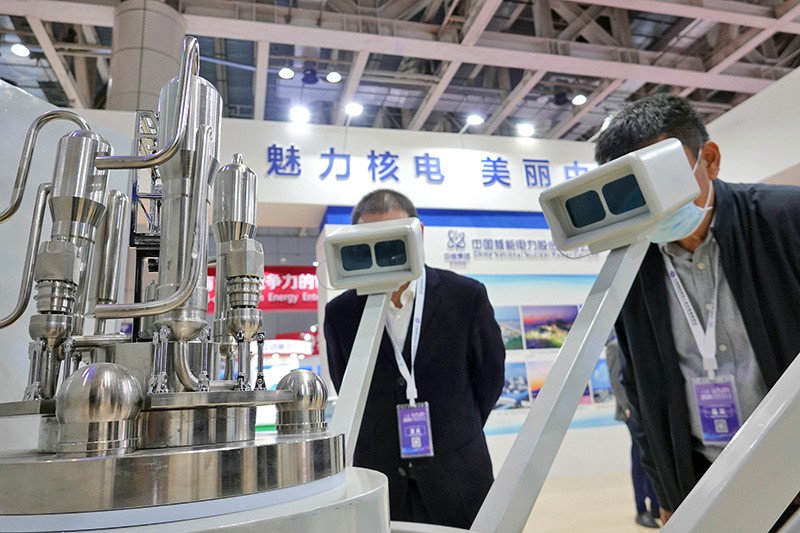
Amid the urgent need to decarbonize, the industry that delivers one-tenth of global electricity must consult the public on reactor research, design, regulation, location and waste.
Visitors to an industry exhibition in 2020 in China view a model nuclear-power reactor through augmented-reality headsets.Credit: Tang Ke/VCG via Getty
Ten years have passed since a catastrophic earthquake and tsunami damaged the Fukushima Daiichi nuclear power plant in Japan, triggering the worst nuclear accident since the Chernobyl disaster in 1986.
The accident struck at a time of renewed hope and untested optimism surrounding a new wave of nuclear-energy technologies and the part they might play in achieving a low-carbon future. It led to retrenchment, amid fresh concerns over the technological, institutional and cultural vulnerabilities of nuclear infrastructures, and the fallibility of humans in designing, managing and operating such complex systems. Tiếp tục đọc “Nuclear energy, ten years after Fukushima”→
LNG importers will bear climate-related risks of exporting countries, threatening energy security and electricity costs
The Texas energy crisis has become world news.
During last week’s extreme winter weather, surging electricity demand collided with falling generation, forcing the state’s grid operator to implement rolling blackouts. In many cases, blackouts lasted for over 24 hours, causing fuel and electricity supply shortages and disruptions throughout the gas supply chain. At least 4.5 million Texans were at one point without electricity and more than 30 deaths have been attributed to power losses, though the final toll could be much larger.
News of the Texas power crisis has spread throughout Asia, where energy growth markets such as Vietnam, the Philippines, and Bangladesh are considering U.S. liquified natural gas (LNG) imports as an alternative to coal-fired electricity generation. But the events in Texas have highlighted the risks inherent in LNG imports for both the energy transition and climate change adaptation.
Below are five lessons from the crisis for emerging markets in Asia.
Lesson 1. Gas/LNG volatility is here to stay.
It has been a tumultuous year in global LNG markets. The COVID-19 outbreak sent global LNG demand plummeting and Asian prices hit an all-time low of $1.85/MMBtu last May. U.S. LNG export facilities remained idle for much of the summer, oil and gas drilling fell by 40% internationally, and bankruptcies in the North American oil and gas sector soared to their highest level since 2016. Starting in the fall, a combination of production shut-ins, shipping delays, and cold weather caused Asian LNG prices to spike to a record high of $32.50/MMBtu.
The Texas energy crisis is another sign that volatility in global gas markets is likely to continue. High electricity demand combined with supply chain disruptions sent wholesale natural gas prices skyrocketing. At Texas’s Waha Hub, for example, prices jumped from $2.77 to $219, while spot prices in Oklahoma’s Oneok hub jumped to over $1,000/MMBtu. For gas producers able to keep wells operating, the Texas freeze was “like hitting the jackpot,” but for LNG exporters, power outages disrupted liquefaction trains and feedgas pipelines. Several LNG export terminals scaled back production, while Corpus Christi LNG and Cameron LNG went offline completely. Overall, 10 cargoes amounting to 1 billion cubic meters of gas were likely delayed from the already-volatile global LNG market.
Volatility in global gas markets is likely to continue
Lesson 2. Volatile prices can cause LNG-fired power plants in Asia and associated infrastructure to go under-utilised.
Volatile LNG prices create an increasingly challenging environment for price-sensitive emerging markets. High prices and difficulties sourcing gas can cause gas-fired power plants in importing countries to go underutilized. In turn, all the associated infrastructure – ports, regasification facilities, pipelines – are also at risk of being stranded. IEEFA recently estimated that volatile LNG prices put over $50 billion of natural gas projects at risk of cancellation in Vietnam, Bangladesh, and Pakistan.
Since the value of associated infrastructure is dominated by fixed costs, per unit natural gas prices depend largely on total gas demand. This means that to realize any economic benefits from imported gas, costs must be spread over a wider consumer base than currently exists in many south and southeast Asian countries. The decision to import LNG is therefore not an incremental one. Rather, it will lead to new sources of financial vulnerability resulting from long-term, large-scale fossil gas lock-in. Without major storage capacity, volatile LNG prices will be a constant threat to the affordability of gas and gas-powered electricity in import markets.
Lesson 3. LNG imports come at the cost of domestic energy security.
By importing greater volumes of LNG, Asian countries become more vulnerable to supply disruptions in global gas markets and geopolitical dynamics beyond their control. With increasingly severe and frequent weather events caused by climate change, Asian importers are not just assuming the risks of climate-related disruptions in their own country, they are also assuming risks of climate-related weather events in exporting countries. In Texas, generators were not required to invest in cold weather safeguards, leaving them vulnerable to unpredictable weather events.
LNG import infrastructure in Asia is highly vulnerable to extreme weather
LNG import infrastructure in Asia is also highly vulnerable to extreme weather. While numerous countries rely on floating storage and regasification units (FSRUs) as cheaper alternatives to land-based import terminals, FSRUs are difficult to operate in poor weather conditions. In 2018, Bangladesh announced it would cancel plans to build additional FSRUs because they were unreliable during the monsoon season. In Malta, the inoperability of FSRUs during storms has caused the complete shut-down of the country’s gas-fired power plants.
Lesson 4. Grid expansion and modernization must take centre stage.
Some commentators have suggested the solution to climate-related blackouts is to build more generation capacity, but all power sources are susceptible to outages when weather events occur. In Texas, 30,000MW of thermal capacity was forced offline – including 40% of natural gas capacity and a nuclear reactor – as well as 17,000MW of wind capacity. As a result, wholesale electricity prices skyrocketed to the state’s $9,000 per MWh cap, up from their average of $30.
Along with generation capacity, grid reliability depends largely on transmission infrastructure and interconnections to other areas. The Texas grid is highly isolated from surrounding power systems, limiting power imports from nearby markets. In small portions of the state connected to other grids, cities experienced brief blackouts compared to the rest of the state.
A greater emphasis on system-level planning in emerging Asian markets, rather than a myopic focus on generation, could improve the efficiency of existing generators, enable the installation of greater capacities of domestic renewable energy, and lower wholesale electricity prices during times of short supply.
Lesson 5. The energy transition is a humanitarian issue.
The COVID-19 pandemic and the Texas energy crisis have exacerbated the risks inherent in LNG imports and revealed the flaws of centralized generation capacity buildouts. In Texas, blackouts disproportionately affected low-income communities, while electricity bills for some households that maintained power spiked into the tens of thousands of dollars. The total cost of electricity sold in Texas from February 15-19 was $50.6 billion, up from $4.2 billion in the prior week. For Asian countries already grappling with high electricity prices, the risks of LNG imports and associated infrastructure lock-in are simply too high. Instead, reliability and resilience are key to keeping costs down and the lights on.
The winter storms that swept across the U.S., particularly Texas, upending the energy market and knocking out power for millions of people, have delivered a windfall for Macquarie Group, with the Australian bank lifting its profit outlook for 2021 by as much as 10 percent, just two weeks after warning that earnings would be “slightly down”.
“Extreme winter weather conditions in North America have significantly increased short-term client demand for Macquarie’s capabilities in maintaining critical physical supply across the commodity complex,” according to the company, which is the second-largest supplier of gas in North America after oil major BP, as quoted by Reuters.