Early Warning System Innovations in Vietnam: HOW SMS TECHNOLOGY CAN ENSURE EDUCATION CONTINUITY

Save the children

Disaster-prone Vietnam is susceptible to rapid-onset emergencies like storms, typhoons, and flooding annually. During these times, children are unable to go to school due to unsafe conditions and parents fearing for their children’s safety. Approximately 70% of the population is living in coastal and low-lying areas, resulting in high vulnerability to extreme weather events intensified by climate change and global warming.

As part of Save the Children in Vietnam’s risk reduction work, the country office has been working to improve the way hazard risk information is shared. Partnering with local government agencies and mobile companies, Save the Children initiated an SMS disaster early warning system that provides weather information to the vulnerable coastal provinces of Thua Thien Hue, Quang Nam, and Da Nang. Tiếp tục đọc “Early Warning System Innovations in Vietnam: HOW SMS TECHNOLOGY CAN ENSURE EDUCATION CONTINUITY”

Typhoon Tembin turns deadly in the Philippines; Vietnam faces threats around Christmas

By Kristina Pydynowski, AccuWeather senior meteorologist
December 24, 2017, 6:29:56 AM EST

accuweather_Typhoon Tembin will threaten more lives and property as it targets southern Vietnam around Christmas Day.

Tembin, which is being called Vinta in the Philippines, is being blamed for the deaths of at least 90 people as it crossed Mindanao with heavy rain and strong winds late this week.

Landslides that wiped out entire villages are being blamed for a majority of the deaths.

Tembin track 12 24 17

Floodwaters washed away homes, made some roads impassable and forced hundreds to evacuate.

RELATED: 
Interactive Philippines weather satellite
Vietnam weather center
15 photos recall the magnitude, devastation of natural disasters around the world in 2017
Tiếp tục đọc “Typhoon Tembin turns deadly in the Philippines; Vietnam faces threats around Christmas”

Typhoon Tembin: Flash floods, landslides kill over 100 in the Philippines

(CNN) A tropical storm that brought devastating flooding and landslides in the southern Philippines strengthened into a typhoon Sunday morning, according to the Philippine Atmospheric Geophysical Astronomical Services Administration.

Typhoon Tembin — known as Vinta in the Philippines — has killed at least 123 people, sweeping away residents and leaving communities buried in mud, authorities said.
After battering the southern island of Mindanao, Tembin slammed into another set of Philippine islands late Saturday.
Officials have given conflicting death tolls since the storm ravaged towns and displaced thousands.

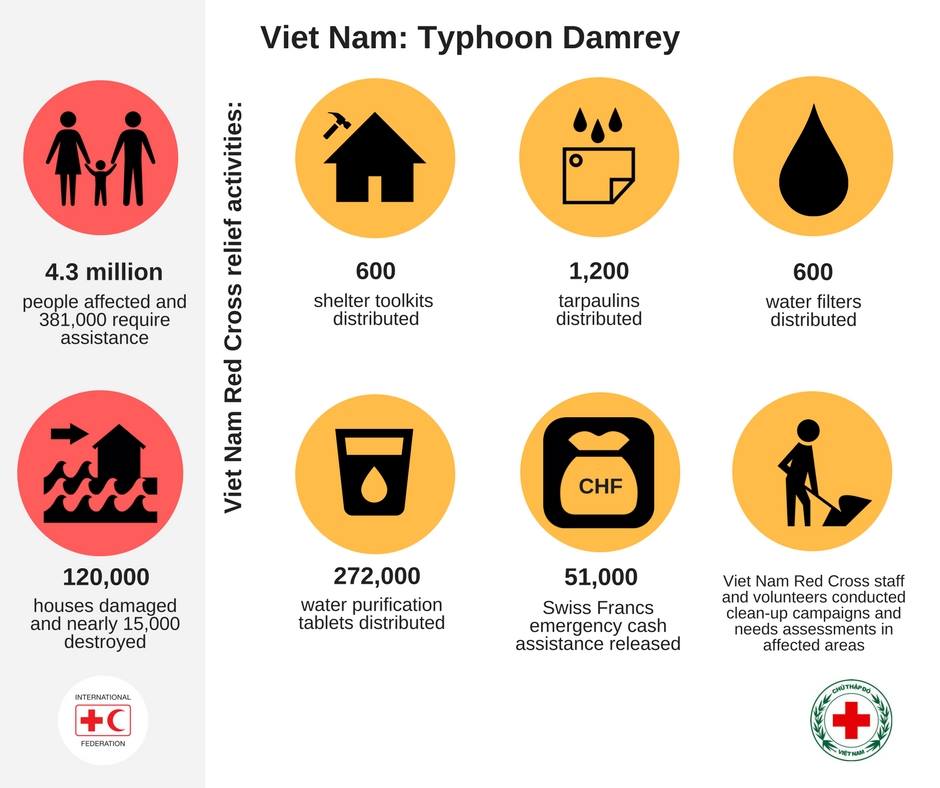
Vietnam Typhoon Damrey, International Red Cross response – Bão Damrey, con số và ứng phó của Chữ thập đỏ Quốc tế

From International Federation of Red Cross and Red Crescent Societies – IFRC

Hiệp hôi Chữ Thập Đỏ và Trăng lưỡi liềm đỏ quốc tế tại Việt Nam,

Thiệt hại

4,3 triệu người bị ảnh hưởng bởi bão

381, 000 nghìn người cần hỗ trợ

120,000 nghìn ngôi nhà bị hỏng và gần 15,000 nghìn nhà bị phá huỷ

Cứu trợ từ Chữ Thập Đỏ

600 bộ, dựng lều và  gia cố nơi ở

1,200 nhà bạt che mưa di động

600 lít nước lọc

272,000 viên lọc nước uống

51,000 Francs Thuỵ Sĩ

Hỗ trợ về người dọn dẹp, xây dựng, khắc phục hậu quả sau bão

Cứu trợ lũ lụt: Sao cứ là mì tôm, nước mắm?

(NLĐO) – LTS: Hằng năm, cùng với mưa bão, lũ lụt, các đoàn cứu trợ lại lên đường mang theo quà đa phần là quần áo cũ, mì tôm, gạo, nước mắm. Việc cứu trợ đó có đúng nơi, đúng người và thiết thực? Chia sẻ của chị Huệ Thi – một người dân vùng lũ ở Quảng Nam sẽ phần nào phản ánh tính thiết thực của việc cứu trợ hiện nay.

Cứu trợ lũ lụt: Sao cứ là mì tôm, nước mắm? - Ảnh 1.

Chia sẻ của chị Huệ Thi trên Facebook cá nhân về việc cứu trợ lũ lụt

Tôi sinh ra tại Đại Lộc – Quảng Nam, nơi mà hằng năm có ít nhất 1 trận bão hoặc cơn lũ. Dân quê tôi luôn ở trạng thái sẵn sàng ứng phó và chuẩn bị, đó cũng là lý do sao mà nhà cửa ở đây hầu như có gác hoặc xây kiên cố dù gia cảnh nhiều người còn khó khăn.

Lũ về thì mùa màng năm sau mới được phù sa bồi đắp tốt chứ không hẳn tiêu cực hoang tàn. Trời chuyển mưa dân quê đã biết dự đoán có lũ về hay không, tất nhiên lũ to nhỏ còn do thiên nhiên nhưng vẫn chủ động chuẩn bị mớ gạo mắm, đủ chống đói trong thời gian cả tuần. Tiếp tục đọc “Cứu trợ lũ lụt: Sao cứ là mì tôm, nước mắm?”

Vietnam: Typhoon Damrey leaves dozens dead, thousands homeless


https://www.youtube.com/watch?v=zjDB6S5AYdc

Di dân, tị nạn do biến đổi khí hậu có thể lên tới 1 tỉ người đến năm 2050

English: Climate Migrants Might Reach One Billion by 2050

Rome, 21 Tháng 8 2017 (IPS) – Hãy tưởng tượng thế giới có nhiều đến 1 tỉ người đối mặt với ảnh hưởng khắc nghiệt do hậu quả của biến đổi khí hậu, dẫn đến tình trạng hạn hán và/hoặc lũ lụt trầm trọng; thời tiết khắc nghiệt; tài nguyên thiên nhiên bị hủy diệt, đặc biệt là các vùng đất, đất trồng và nước; hệ quả từ điều kiện sống khắc nghiệt, thiếu ăn và nạn đói.

Mặc dù vẫn chưa có cơ sở từ các dự án nghiên cứu khoa học, nhưng tốc độ xảy ra quá trình biến đổi khí hậu đã được chứng minh có thể đưa tới viễn cảnh năm 2050, khi mà cứ 9 người sẽ có 1 người bị ảnh hưởng bởi quá trình này.

Gần đây, các dự báo giao động từ 25 triệu đến 1 tỷ người di cư vì môi trường đến năm 2050, di dân hoặc trong nước hoặc qua biên giới, vì những nhu cầu cơ bản thường trực hay tạm thời.  với 200 triệu người là ước tính được sử dụng nhiều nhất , thông tin từ Viện Môi trường và An ninh con người Đại học Liên Hợp Quốc (Institute for Environment and Human Security of the United Nations University).
Tiếp tục đọc “Di dân, tị nạn do biến đổi khí hậu có thể lên tới 1 tỉ người đến năm 2050”

Kế hoạch cứu nguy Đồng bằng sông Cửu Long

Không có khu vực đồng bằng nào trên thế giới bị đe doạ bởi biến đổi khí hậu trầm trọng như Sông Cửu Long. Liệu Việt Nam có hành động kịp thời để cứu nơi đây?

Loạt bài của Mongabay – Mongabay series

Tiếng Việt
Phần 1 – Liệu biến đổi khí hậu sẽ nhấn chìm Đồng bằng sông Cửu Long?
Phần 2 – Việt Nam cực kỳ lo lắng vì Trung Quốc và Lào xây đập trên Mekong
Phần 3 – Mẹ Thiên nhiên và huỷ diệt bởi thuỷ điện không phải là vấn đề duy nhất của Đồng bằng sông Cửu Long
Phần 4 – Kế hoạch cứu nguy Đồng bằng sông Cửu Long

English
Part 1 – Will climate change sink the Mekong Delta?
Part 2 – Vietnam sweats bullets as China and Laos dam the Mekong
Part 3 – Mother Nature and a hydropower onslaught aren’t the Mekong Delta’s only problems
Part 4 – A plan to save the Mekong Delta

Nước biển dâng và các đập trên thượng nguồn đang đe dọa và tấn công vùng đất màu mỡ này. Liệu Việt Nam có thể hành động kịp thời để ngăn chặn thảm hoạ này?

Kế hoạch ĐBSCL là sản phẩm của nhiều năm làm việc của các giới chức Hà Lan và Việt Nam, được hỗ trợ bởi một đơn vị hang loạt các chuyên gia từ cả hai quốc gia.

Đây là bản thiết kế chi tiết để giải quyết không chỉ những tác động của biến đổi khí hậu và các đập thượng nguồn mà còn giải quyết các hoạt động với tầm nhìn ngắn hạn của người Việt Nam.

Người nông dân trong khu vực cũng như các chi nhánh liên quan của chính phủ phải được thuyết phục để thực hiện kế hoạch.

Bài viết này là phần cuối của loạt bài nghiên cứu chuyên sâu, gồm bốn phần về các hiểm hoạ đối với đồng bằng sông Cửu Long và cách giải quyết. Đọc phần một, phần hai, phần ba và thứ tư. Tiếp tục đọc “Kế hoạch cứu nguy Đồng bằng sông Cửu Long”

Heat wave safety tips – An toàn trong bão nhiệt

National weather services

Stay Informed: Monitor local radio and television (including NOAA Weather Radio), internet and social media for information and updates.

How to response to excessive heat events
  •  Slow down: reduce, eliminate or reschedule strenuous activities until the coolest time of the day. Children, seniors and anyone with health problems should stay in the coolest available place, not necessarily indoors.
    • Dress for summer. Wear lightweight, loose fitting, light-colored clothing to reflect heat and sunlight.
    • Eat light, cool, easy-to-digest foods such as fruit or salads. If you pack food, put it in a cooler or carry an ice pack. Don’t leave it sitting in the sun. Meats and dairy products can spoil quickly in hot weather.
    • Drink plenty of water (not very cold), non-alcoholic and decaffeinated fluids, even if you don’t feel thirsty. If you on a fluid restrictive diet or have a problem with fluid retention, consult a physician before increasing consumption of fluids.
    • Use air conditioners or spend time in air-conditioned locations such as malls and libraries.
    • Use portable electric fans to exhaust hot air from rooms or draw in cooler air.
    • Do not direct the flow of portable electric fans toward yourself when room temperature is hotter than 90°F. The dry blowing air will dehydrate you faster, endangering your health.
    • Minimize direct exposure to the sun. Sunburn reduces your body’s ability to dissipate heat.

Tiếp tục đọc “Heat wave safety tips – An toàn trong bão nhiệt”

Localities urged to prepare for natural disasters

vietnamnews

Update: June, 02/2017 – 09:00

The front gate of a kindergarten in Chiềng Pha Commune, Thuận Châu District, Sơn La Province was destroyed by thunderstorm and hail last year. — VNA/VNS Photo Công Luật
Viet Nam News HÀ NỘI — Meteorology and agriculture experts have urged localities to take the initiative in responding to natural disasters, with Việt Nam’s weak preparations set to be tested by severe weather this year.

“It is predicted that there will be many more floods, flashfloods and landslides this year than last year, especially in the western-northern area,” said Hoàng Đức Cường, director of the National Centre for Hydro-Meteorology Forecasting (NCHMF) at a conference in Hà Nội on Thursday. Tiếp tục đọc “Localities urged to prepare for natural disasters”

INTERVIEW-Cash in on businesses to help boost disaster protection, says UN risk chief

by Sophie Hares | @SophieHares | Thomson Reuters Foundation

Wednesday, 24 May 2017 05:28 GMT

Natural disasters cost Việt Nam $1.7 billion

Update: April, 18/2017 – 09:15
A farmer of An Biên District in the Mekong Delta’s Kiên Giang Province is saddened by his withered rice field which was caused by a shortage of water and salt intrusion last year. Việt Nam is among the countries to be hit hardest by climate change, which is expected to exacerbate natural disasters in the country. — VNA/VNS Photo Trọng Đạt

HÀ NỘI — Việt Nam needs to improve the quality of weather forecasting and enhance international co-operation to prepare for natural disasters, Prime Minister Nguyễn Xuân Phúc has said.

The PM made the statement at a meeting to review disaster prevention and control in 2016 and layout tasks for 2017.

Nguyễn Xuân Cường, head of the Central Steering Commitee on Natural Disaster Prevention and Control, said, 2016 saw multiple extreme weather phenomena such as droughts, extreme cold weather, floods and storms, causing losses of VNĐ39.7 trillion (US$1.75 billion).

“Natural disasters struck from the beginning of the year to the end of the year, occurring in all regions with many types of natural disasters,” Cường said. Tiếp tục đọc “Natural disasters cost Việt Nam $1.7 billion”

Cities not ready for climate change: experts

vietnamnews

Update: April, 17/2017 – 09:00

A flooded alley in District 12, HCM City. High tides broke sewer No. 4 in the district’s Thạnh Xuân 25 Street during the rainy season in October last year, flooding the neighbourhood and disrupting the lives of residents. — VNA/VNS Photo Mạnh Linh

HA NOI – Most Vietnamese cities lack the capacity to confront climate change challenges, experts say, calling for greater preparedness efforts.

Cities have to be ready to adapt to new situations and unexpected developments, ensuring essential services to residents at all times, they add.

Surveys done by the Urban Development Agency under the Construction Ministry have found cities in mountainous areas particularly vulnerable to natural calamities. Tiếp tục đọc “Cities not ready for climate change: experts”

From dams to basins: mapping across scales

Tiếp tục đọc “From dams to basins: mapping across scales”