I am an attorney in the Washington DC area, with a Doctor of Law in the US, attended the master program at the National School of Administration of Việt Nam, and graduated from Sài Gòn University Law School. I aso studied philosophy at the School of Letters in Sài Gòn.
.
I have worked as an anti-trust attorney for Federal Trade Commission and a litigator for a fortune-100 telecom company in Washington DC.
I have taught law courses for legal professionals in Việt Nam and still counsel VN government agencies on legal matters.
I have founded and managed businesses for me and my family, both law and non-law.
I have published many articles on national newspapers and radio stations in Việt Nam.
In 1989 I was one of the founding members of US-VN Trade Council, working to re-establish US-VN relationship.
Since the early 90's, I have established and managed VNFORUM and VNBIZ forum on VN-related matters; these forums are the subject of a PhD thesis by Dr. Caroline Valverde at UC-Berkeley and her book Transnationalizing Viet Nam.
I translate poetry and my translation of "A Request at Đồng Lộc Cemetery" is now engraved on a stone memorial at Đồng Lộc National Shrine in VN.
I study and teach the Bible and Buddhism. In 2009 I founded and still manage dotchuoinon.com on positive thinking and two other blogs on Buddhism.
In 2015 a group of friends and I founded website CVD - Conversations on Vietnam Development (cvdvn.net).
I study the art of leadership with many friends who are religious, business and government leaders from many countries.
I have written these books, published by Phu Nu Publishing House in Hanoi:
"Positive Thinking to Change Your Life", in Vietnamese (TƯ DUY TÍCH CỰC Thay Đổi Cuộc Sống) (Oct. 2011)
"10 Core Values for Success" (10 Giá trị cốt lõi của thành công) (Dec. 2013)
"Live a Life Worth Living" (Sống Một Cuộc Đời Đáng Sống) (Oct. 2023)
I practice Jiu Jitsu and Tai Chi for health, and play guitar as a hobby, usually accompanying my wife Trần Lê Túy Phượng, aka singer Linh Phượng.
By Viet Anh January 5, 2021 | 11:54 am GMT+7 vnexpressPlastic waste at a private collecting site in Go Vap District, HCMC, August 2019. Photo by VnExpress/Thanh Nguyen.Vietnam should set up legal framework for recycling plastic waste, reduce plastic use and find new materials to replace non-recyclable plastics, according to experts.
“The best solution would be recycling as much plastic waste as you can,” George Huber, professor of chemical and biological engineering, University of Wisconsin-Madison, the U.S., said when asked about possible options for Vietnam.
In the U.S., there are hundreds of material recovery facilities (MRFs) where people can leave everything that can be recycled, he said.
Either workers or robots sort the materials, including plastic, and palletize them and they are later sold to secondary recycling people who do further sorting and turn them into pellets.
There is a whole market for these pellets for making new products.
For instance, there is a company called Placon that produces food and medical packaging and other types of plastic from MRFs.
They buy recycled PET bottles and thermoform them, thus keeping over one billion PET bottles out of landfills each year.
Huber said: “This is called closed-loop recycling. They produce the ecostar plastic which is a recycled plastic.”
Technologies used by companies like Placon are pretty similar, usually involving floating. They put plastics in water, and some float while others sink. They then purify the floating plastic and grind it to make pellets. There are many things that can be made from recycled plastic.
Highlighting another good recycling model, Professor Michael Braungart, founder of Internationale Umweltforschung GmbH, an environmental research institution based in Hamburg, Germany, said the U.S.’s Envision Plastics is the only company in the world that makes polypropylene approved by the U.S. Food and Drug Administration for making food-grade packaging.
In Italy, a company called Aquafil has reprocessed around 15,000 tons of nylon from driftnets in oceans to make clothing, carpets and other products, he said.
Associate Professor Duong Hai Minh of the department of mechanical engineering, National University of Singapore, said Vietnam could consider the option of converting plastic waste into aerogels, which are used in billion-dollar engineering applications such as heat and sound insulation, oil spill cleaning, fruit preservation, air pollution filtering, personal care products, and wastewater treatment.
He said this is a cost-effective and eco-friendly method since no toxic solvent is used or discharged into the environment, and it requires 70 percent less energy.
Aerogels can be reused and recycled.
Moreover, the technology can also be used on a range of wastes like paper, old clothes, rubber tires, fly ash, metal, and agricultural and food wastes.
For the first time aerogels have been made from PET, the same plastic used to make water and soft drink bottles.
“The technology might be available in April 2021,” Minh said.
He said there are various options for Vietnam for dealing with plastic that are used in Singapore such as incinerating or converting it into low-value products (chair, bag, umbrella, etc).
In incineration plants, waste is burned and the smoke quality is controlled to ensure it does not damage the air quality. The ash is used in construction as a less toxic option.
Huber said some plastics like pure PET and pure PE could be recycled but most could not, and there are also losses in the plastic recycling process. So any plastic recycling needs to be combined with long-term plans to deal with plastic wastes like incineration and landfills (where minimal leakage occurs), he said.
When incinerating, heat and energy could be recovered, then plastic does not leak into the environment and could be controlled in one location, he said.
There are companies in the U.S. burning plastic waste to generate electricity and heat and generating small volumes of ash that eventually go into landfills, he said.
“I think landfilling should be the less preferred option.”
Professor Carl Redshaw of the University of Hull, the U.K., said a number of technologies are being trialed for converting plastic waste into high-value useful products.
For instance, radiation-induced degradation, microbes, metal-based nanoparticles, and activated carbon could all turn waste into liquid fuel, pyrolysis (thermal degradation) could turn plastics into energy while the use of photo-catalysis (use of light to drive a reaction) has shown that even non-degradable plastics such as polyethylene could be converted into other useful materials, he said.
A recent report in a scientific journal illustrated how discarded drinking cups could be converted into other useful chemicals though most of these technologies are at an embryonic stage and require more investment, he added.
How to apply in Vietnam
Huber said the first step for Vietnam to recycle plastic wastes is to be able to sort them depending on their original components. Some would have to go to landfills or be burned, while the infrastructure to collect waste plastics has to be developed, he said.
If the country wants to have a similar system as the U.S., it needs to have secondary recyclers who could turn plastic into pellets and make products from them, he pointed out.
But all these involve a very large initial cost, and it takes five to eight years to recoup it before the operation becomes profitable, he said.
The legal framework is crucial, he said.
In the U.S., many material recovery facilities are owned by municipalities and states make laws. It is illegal to send certain kinds of plastics to landfills.
As for the burning option, Huber said companies need to have air pollution control equipment to make sure the smoke does not have any dangerous chemicals.
It is important that these facilities are designed in a way to minimize air pollution, he said.
In the U.S., the Environmental Protection Agency sets regulations.
Rules to prevent air pollution are vital, especially in developing countries, Huber said.
Dr Alex Ibhadon, reader in catalysis and reactor engineering, University of Hull, the U.K., said society needs plastics to create products and jobs.
Southeast Asia in general is producing more and more plastics while Europe is producing less and less, and it is not easy for Vietnam to close thousands of companies in the plastic industry, he pointed out.
Vietnamese people should reuse over and over again the plastics they already have, he said.
In the U.K., supermarkets need to produce reusable carrier bags and some charge customers for carrier bags as an encouragement to re-use, something Vietnam as a country could learn from, he said.
Experts said another way to reduce the plastics is by using new materials.
Braungart said Vietnam could learn from Novamont, an Italian company that makes plastics from starch for single use that easily degrades and is good for the environment.
It makes bioplastics from starches, cellulose, vegetable oils, and their combinations, and ideally Vietnam should decide that all the plastics ending up in the environment needs to be biodegradable, he said.
Redshaw said he and his colleagues produce polymers from renewable resources such as corn starch.
He said there are now a number of biodegradable polymers on the market like Sigma Aldrich’s poly (lactide), poly (glycolide) and their copolymers, and a number of biodegradable natural polymers.
A number of U.K. small enterprises have ongoing projects that they hope to bring to the market soon, he said.
“No doubt companies in countries such as Vietnam are thinking along these lines too.”
Vietnam needs to offer large incentives to entice the industrial sector, specifically the producers of petroleum-derived plastics, to invest in infrastructure that would allow them to make the switch to some of the greener alternatives, he said.
There is also a need to change people’s mindset on how to use plastic, and this could be achieved by good communication and having efficient protocols in place, he said.
Emphasizing the significance of the legal framework, Dr Ibhadon said the Vietnamese government should have a policy that makes plastic recycling a legally enforceable requirement and set up recycling centers throughout the country for various types of plastics.
It must take the lead in reducing plastic use and enforce recycling as a partnership between itself, plastic producers and consumers, he added.
On August 31, 1951, representatives of the United States and the Republic of the Philippines signed the Mutual Defense Treaty (MDT) in Washington. In recognition that “an armed attack in the Pacific Area on either of the Parties would be dangerous to [the] peace and safety” of both countries, the treaty declared that each state would “act to meet the common dangers in accordance with its constitutional processes.”i However, like most conventional defense treaties and standards, the MDT is not clear about the increasingly common unconventional gray zone threats that skirt the definition of war to avoid prompting a kinetic response. Since its inception, the United States’ commitment to the MDT regarding attacks on Philippine assets in contested waters in the South China Sea has been unclear. Along with the controversial policies of the administration of Philippine President Rodrigo Duterte, the uncertainty of the MDT has strained U.S.-Philippine relations and caused Philippine Defense Secretary Delfin Lorenzana to call for a review of the relevance of the MDT in October 2018 with the main goal of determining whether the government should “maintain it, strengthen it, or scrap it.”ii
What unfolded on Wednesday was a tableau of violence and mayhem that shocked the nation, one of the most severe intrusions of the Capitol since the British burned down the building in 1814.
Representative Jason Crow, Democrat of Colorado, and other lawmakers found themselves captive in the House chamber as a mob broke into the Capitol on Wednesday.Credit…Andrew Harnik/Associated Press
Published Jan. 6, 2021Updated Jan. 7, 2021, 12:01 p.m. ET
WASHINGTON — The mob of Trump supporters pressed through police barricades, broke windows and battered their way with metal poles through entrances to the Capitol. Then, stunningly, they breached the “People’s House” itself, forcing masked police officers to draw their guns to keep the insurgents off the chamber floor.
Các dự án LNG đều yêu cầu được bao tiêu dài hạn. Trong ảnh: Mặt bằng một dự án điện khí LNG hoàn chỉnh
Khó đàm phán
Trao đổi với phóng viên Báo Đầu tư mới đây, một quan chức của Cục Điện lực và Năng lượng tái tạo (Bộ Công thương) cho hay, Dự án Điện khí LNG Bạc Liêu đã không thể ký được PPA trong năm 2020. Như vậy, kỳ vọng về việc “đàm phán PPA ngay trong tháng 8/2020 và ký kết PPA vào cuối năm 2020” đã không thành hiện thực.
By Dat Nguyen January 5, 2021 | 08:31 pm GMT+7 vnexpressA worker installs solar power panels in Ninh Thuan Province, central Vietnam. Photo by VnExpress/Quynh Tran.The increasing solar power capacity has made it difficult for national utility Vietnam Electricity (EVN) to ensure stable power distribution nationwide.
The nature of solar power capacity, which accounts for 25 percent of the total, is to produce high volumes during the day and no production in the evening. This poses difficulties for EVN in operating the national grid, the national utility has said in a report.
There have been times when the grid was oversupplied during the low-demand hours between 10 a.m. and 2 p.m. when solar radiation is at peak, the report says.
On the contrary, when power demand is at the highest, the 5:30-6:30 p.m. period, solar power production falls to nearly zero and the traditional power generators have to be mobilized.
“The ratio of renewable power generation is increasing and with it comes instability in operation,” the report says.
Vietnam’s solar power capacity was roughly 16,500 megawatt by the end of last year, nearly 48 percent of it coming from rooftop panels and the rest from plants.
Solar power production reached 10.6 billion kilowatt-hours last year, accounting for 4.3 percent of total.
There was a surge in the number of solar power projects after the government offered an incentive feed-in tariff scheme to promote renewable energy production to meet rising demand in a fast-growing economy.
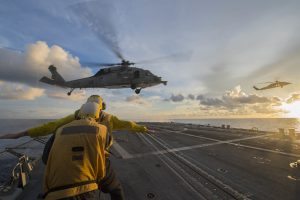
Sailors signal to an MH-60S Sea Hawk helicopter as it hovers over the flight deck of the guided-missile destroyer USS McCampbell during a training exercise in the South China Sea, July 22, 2016.Credit: Flickr/U.S. Navy
As the incoming Biden administration formulates its South China Sea strategy, one regional partner that looms large is Vietnam. Over the last few years, tensions between China and Vietnam in the South China Sea have remained high, impacting fishing and natural resource exploration in disputed waters. While the Biden administration is likely to continue the positive momentum in bilateral ties, it is less clear what specifically Hanoi seeks from Washington to help it effectively deter Beijing.
Mimi Vu, Dorothea Czarnecki and Nadia Sebtaoui, The Guardian
Criminal networks are depending on the chaos of Covid and Brexit. Now more than ever we need focus and international cooperation to prevent further tragedies
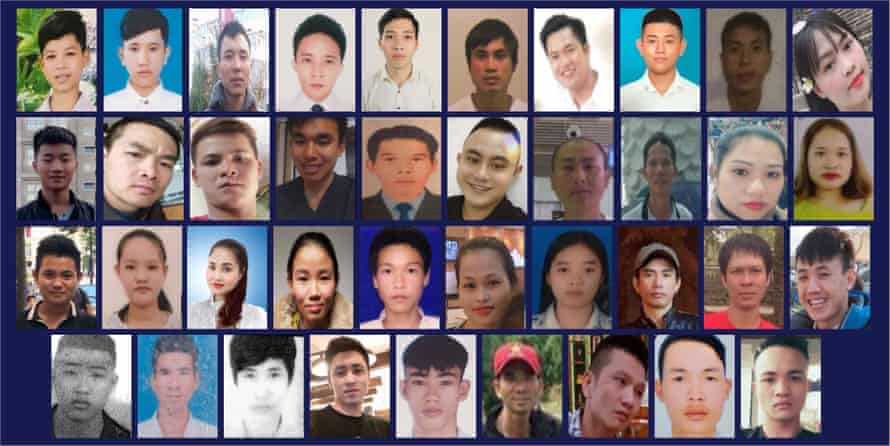
The 39 Vietnamese migrants who suffocated as they were being smuggled across the Channel in a sealed refrigeration trailer. Photograph: Essex PoliceSupported by
Fri 1 Jan 2021 08.30 GMT
Trials in the UK of the drivers and haulage organisers involved in the Essex lorry tragedy in which 39 Vietnamese migrants perished ended in guilty pleas and convictions. Vietnam also convicted the agents who brokered the victims’ journeys to the UK and sentenced them to terms of imprisonment.
A pictorial flashback captures Vietnam moving to a pandemic induced “new normal,” experiencing other trials, tribulations and triumphs in a year that has been like no other.
Smartphones are out in full force as thousands capture footage and photos of fireworks that explode above Hanoi’s iconic Sword Lake to welcome the very first moment of 2020. Photo by Tat Dinh.
The Indo-Pacific region is increasingly being viewed as a global centre of gravity, both for its economic and demographic potential, and the security challenges that could frustrate those possibilities. India—as a champion of the principle of ‘Free and Open Indo-Pacific’ or FOIP—has initiated engagements with its partners in the region, such as the Indo-Pacific Oceans Initiative (IPOI) that aims to ensure the security and stability of the region’s maritime domain. Even as the stakeholders have outlined a set of seven pillars for the initiative, there is still little clarity as to what can be expected from the IPOI. This paper offers recommendations for the IPOI to enable India play a more proactive and constructive role in the region.
Attribution: Premesha Saha and Abhishek Mishra, “The Indo-Pacific Oceans Initiative: Towards a Coherent Indo-Pacific Policy for India,” ORF Occasional Paper No. 292, December 2020, Observer Research Foundation.
Introduction
The Indo-Pacific region is a vast maritime zone where the interests of many players are engaged: India, Japan, France, and the United States, as well as medium and smaller powers like Australia, Indonesia, and South Africa; there are stakeholders from beyond the region, too.[1] In recent years, uncertainty has heightened in the region owing to China’s territorial expansionist agenda, concerns for the United States’ long-term commitment to Asia, as well as the limitations of existing multilateral institutions. Indeed, the Indo-Pacific is emerging as the new and expanded theatre of great-power contestation.
India has been championing the Free and Open Indo-Pacific (FOIP) idea, initiating forums like the Security and Growth for All in the Region (SAGAR) and the Indo-Pacific Oceans Initiative (IPOI). It engages with its Indo-Pacific partners either bilaterally, or on plurilateral and multilateral platforms, in a multitude of spheres including maritime security, Blue Economy, maritime connectivity, disaster management, and capacity building. However, India continues to lack a coherent Indo-Pacific strategy.
In April 2019, India set up an Indo-Pacific wing in the Ministry of External Affairs (MEA). The division is meant to integrate under one Indo-Pacific umbrella, the Indian Ocean Rim Association (IORA), the Association for Southeast Asian Nations (ASEAN) region, and the Quadrilateral of the US, Japan, Australia, and India.[2] An Oceania division was created in the MEA in September 2020 to bring India’s administrative and diplomatic focus on the region stretching from western Pacific (with the Pacific islands) to the Andaman Sea. This is the maritime space where China is trying to maintain its dominance and India is seeking to assert its own relevance.[3]
To promote its strategic interests in the Indian Ocean, India launched the SAGAR vision in 2015. On 4 November 2019, Prime Minister Narendra Modi launched the IPOI at the East Asia Summit in Bangkok. The main objective of the IPOI is to ensure the safety, security, and stability of the maritime domain,[4] and to do that, seven pillars have been laid out.[a] So far, however, little is known about what is to be expected out of the IPOI: Will new programmes be planned under the initiative, or is it simply an extension of India’s SAGAR vision?
This paper outlines specific recommendations for India to utilise the IPOI in playing a more proactive and constructive role in the Indo-Pacific. The authors have chosen to examine the IPOI as it is the most recent initiative introduced by PM Modi in the region. Moreover, given new developments—such as India extending an invitation to Vietnam to partner in this initiative—[5] IPOI appears to be India’s way of developing a mechanism for cooperating with like-minded countries to pursue a ‘free, open, inclusive and rules-based’ Indo-Pacific. IPOI is being built on the pillars of India’s ‘Act East’ policy (focusing on the Eastern Indian Ocean and the Western Pacific) and ‘Act West’ (focusing on the Western Indian Ocean).
Setting the Context
Against a volatile and fast-changing regional and global geopolitical landscape, the seas are becoming a crucial arena for most, if not all tensions. Non-traditional security threats—including natural disasters, human trafficking, illegal fishing, and maritime terrorism—compound the risks to regional maritime security and stability.[6] To begin with, one-third of the world’s trade and significant volumes of East Asia’s oil pass through the Eastern straits of Malacca, Sunda, Lombok-Makassar and the South China Sea (SCS). This necessitates security and stability, especially in the East Indian Ocean and the Western Pacific.
The Western Indian Ocean Region (WIOR), sitting at the intersection of Asia, Africa, and Europe, is gaining greater strategic importance. The region’s rich natural resource profile, estimated to be worth at least US$333.8 billion, has generated interest amongst the bigger world economies.[7] For India, the region is part of its strategic maritime frontier which extends from the Persian Gulf, to the East coast of Africa, and across the Malacca Strait. Significant traffic of container shipping transits the region and is home to some of the most vital and strategic maritime chokepoints such as Gulf of Aden, Bab-el-Mandeb, Mozambique Channel, Strait of Hormuz, and Cape of Good Hope. Running parallel to India’s increasing outreach to African countries under PM Modi, and the Navy’s role as a regional security partner, India has rightly identified the Western Indian Ocean as a region of primary interest.
India views the Indo-Pacific as a geographic and strategic expanse, with the ASEAN connecting the two great oceans—and at the heart of this conception lie the principles of inclusiveness, openness, ASEAN centrality, and unity. Security in the region must be maintained through dialogue, a common rules-based order, freedom of navigation, unimpeded commerce, and settlement of disputes in accordance with international law. Sustainable connectivity initiatives that promote mutual benefit should be continually fostered.[8]
From the beginning, India’s vision of the Indo-Pacific has focused on the region stretching eastwards from the country, with ASEAN as the focus. New Delhi is broadening the regional canvas covered in its Indo-Pacific policy to include the Western Indian Ocean and the Arabian Sea.[9] Delivering the valedictory address at the joint Indian Ocean Dialogue and the Delhi Dialogue in December 2019, External Affairs Minister S Jaishankar said: “India is increasing the area covered by its Indo-Pacific policy to include the Western Indian Ocean and Arabian Sea – this includes the neighbours in the Gulf, the island nations of the Arabian Sea and Africa. Stretching the geographical and therefore strategic area of the Indo-Pacific to encompass not merely a region stretching eastwards from India, which would have the ASEAN as the central focus, India is now incorporating the western Indian Ocean and Africa. There is room for a Western Indian Ocean version of this concept too.”[10]
With India recognising “both geographical extremities” of the Indo-Pacific spectrum, it is time to give equal weightage and consideration to the two sets of distinctive policies—the ‘Act East’ and the ‘Act West’—as part of its Indo-Pacific strategy.
Geostrategic Issues
This section explores the vision behind India’s IPOI initiative, outlines the responses of countries that have expressed interest to work with India under IPOI, and highlights the ways in which these countries are responding to China’s unilateral and belligerent behaviour in the Indo-Pacific. It will underscore the importance of the Quadrilateral initiative[b] within the IPOI construct.
India’s Indo-Pacific Oceans Initiative: The Vision
The IPOI is an open global initiative that draws on existing regional cooperation architecture and mechanisms. India has reached out to several countries to fast-track the IPOI; the MEA has forwarded a comprehensive note to Australia, Indonesia and Vietnam for their comments.[11] At the 17th Meeting of the India-Vietnam Joint Commission on Trade, Economic, Scientific and Technological Cooperation[c] held on August 2020, India and Vietnam agreed to enhance their bilateral cooperation in line with India’s IPOI and the ASEAN’s Outlook on Indo-Pacific to achieve shared security, prosperity and growth for all in the region. India invited Vietnam to collaborate on one of the seven pillars of the IPOI. This is significant against the backdrop of Chinese aggression in the Indo-Pacific region, in particular in its disputes in the South China Sea.[12] Even in the 15th East Asia Summit conducted in November 2020, EAM Jaishankar referred to the “synergy” between the ASEAN Outlook and India’s Indo-Pacific Oceans Initiative.[13]
The idea is that one or two countries could take the lead for a pillar, and other interested countries could join. This would make it a cooperative venture and accord it transparency and inclusivity. India, for its part, is prepared to take the lead in maritime security and disaster risk management. This was supposed to tie in with the 4th Maritime Security Workshop scheduled for February 2020 under the rubric of the East Asia Summit which India would have co-hosted with Australia and Indonesia.[d] PM Modi’s initiative also plans to build on the 2017 ASEAN Regional Forum statement against “Illegal, Unreported and Unlicensed Fishing”. India is prepared to host an event on this larger security issue since it concerns livelihood security and food security.[14]
Indeed, oceans are shared spaces where international cooperation is a prerequisite for security. For India, building partnerships will be vital to assist governments to ensure aligned and mutually supportive actions across all SDGs and unlock the productive potential of marine assets. A purposive partnership with like-minded countries is at the core of the IPOI.[15]
Response of partner countries
Countries like Australia, Vietnam, and the Philippines have expressed their willingness to cooperate with India on the IPOI. In the past, ASEAN countries have entered into cooperative frameworks that they have found to be focusing on specific issues or tasks. To be sure, ASEAN has also been party to such arrangements as the Five Power Defence Arrangement by the founding members of ASEAN—Malaysia and Singapore—with the UK, Australia, and New Zealand in 1971.[e] Other joint initiatives are listed in Table 1.
Table 1. Key Initiatives by ASEAN Countries
Countries
Joint Initiatives
Malaysia, Singapore, and Indonesia
MALSINDO – for maritime patrolling of the Strait of Malacca to curb piracy
Indonesia-Malaysia-Philippines Trilateral Patrol in the Sulu Sea
ROK, Turkey, Australia
Republic of Korea, Turkey, and Australia (MITKA)[f]
Australia, the Philippines, Papua New Guinea, New Zealand, and Timor Leste
South West Pacific Dialogue
Source: Authors’ own, using various sources
India is now looking to engage in “issue-based” alignments.[g] With its seven pillars outlined, the IPOI is indeed “task-oriented” as well. Indonesia, particularly, is dissatisfied with the ASEAN way of working and is searching for its role in any alternative regional grouping.[h]
Moreover, the ASEAN countries are also recalibrating their policy priorities especially within the Indo-Pacific rubric. The adoption of the ASEAN Outlook on the Indo-Pacific is an iteration of how a currently divided organisation like the ASEAN also wants to be part of the Indo-Pacific discourse. The Outlook lays out the core areas where ASEAN is looking to collaborate with other players of the region, among them: maritime cooperation, connectivity, and UN Sustainable Development Goals 2030.[16] These are in line with the seven pillars of the IPOI.[i]
Engagement with African littorals in the Western Indian Ocean Region (WIOR) will be vital to ensure that the Indo-Pacific region remains open and free for inclusive partnerships, within the parameters of sovereignty, equality, and a rules-based system. African littorals in the region can contribute to the Indo-Pacific discourse by offering a sub-regional view and definition of maritime security challenges, and championing local ownership of pathways towards workable solutions and achieving the SDGs.[17] India and other regional powers can build partnerships with WIOR littorals to build an inclusive maritime security architecture and steer the region into more organised waters.
The China Challenge
At a time when the world is grappling with the manifold impacts of the COVID-19 pandemic, China has been aggressively pursuing its sovereignty claims. It is working to establish itself as a major regional player by employing initiatives such as the Belt and Road Initiative (BRI) and the Asian Infrastructure Investment Bank (AIIB), as well as by adopting assertive security policies towards its neighbours.[18] Since May 2020, Chinese and Indian troops have been involved in a confrontation along the disputed Himalayan border. China’s ambitious military plans and its border skirmishes with New Delhi have forced India to recalibrate its China policy and envision a greater role for itself in the Indo-Pacific region.[19]
Most countries of the Indo-Pacific region have been at the receiving end of China’s encroachment and expansionist policies. Australia has accused China “of building an influence in the Pacific by currying favour with the region’s smaller nations like Tonga, Samoa and Vanuatu and funnelling cash into their infrastructure projects.”[20] In March 2020, a Chinese fishing boat — possibly belonging to the paramilitary maritime militia — collided with, and damaged, a Japanese destroyer in the East China Sea. In April 2020, Beijing declared new administrative districts in the Paracel and Spratly islands, the latest step in its bid to legitimise effective control over these areas. The same month, a Chinese coast guard ship sank a Vietnamese fishing boat in the South China Sea. In the South China Sea, large-scale land reclamation and militarisation activities have been taking place, which in turn have raised tensions in the region. For several days in August this year, the Pentagon reported that “China has escalated its previously announced exercise activities in the South China Sea by launching four medium-range missiles impacting the stretch between Hainan Island and the Paracel Islands.”[21]
India has always emphasised the need to ensure freedom of navigation and overflight in the SCS. It has taken a more vocal stand recently, declaring the SCS as a “global commons”[22] wherein all disputes should be settled in accordance with international law. In the East Asia Summit in November 2020, EAM Dr. Jaishankar stated, “the Code of Conduct negotiations should not be prejudicial to legitimate interests of third parties and should be fully consistent with UNCLOS”.[23] The Indian Navy has reportedly deployed one of its frontline warships in the South China Sea, after the June 15 clash with Chinese PLA troops in the Galwan Valley.[24] The Navy also deployed its frontline vessels along the Malacca Straits near the Andaman and Nicobar Islands and the route from where the Chinese Navy enters the Indian Ocean Region to keep a check on any Chinese naval activity. The Navy also held exercises in the Andamans and has deployed MiG-29K fighters in the islands. [25] Of late, India has viewed the Western Pacific as falling within the ambit of its maritime security interests. The focus on maritime issues is evident from the increase in maritime exchanges led by the Indian Navy, with countries such as Vietnam, Singapore, Indonesia, and Japan.
There has also been a steady increase of Chinese naval presence in the Indian Ocean, raising security concerns for India. According to Indian Naval Chief Admiral Karambir Singh, “There are four to six Chinese research vessels operating in the IOR beyond India’s EEZ in addition to over 600 Chinese fishing vessels that are in the IOR beyond India’s EEZ for every year since 2015-2019.”[26]
Countries like India—historically non-aligned—are now shifting their policy stance, shedding their wariness of irking Chinese sentiments, and entering into “issue-based alignments” with other players of the Indo-Pacific region. Therefore, like-minded countries of the Indo-Pacific region are working together in various minilateral and plurilateral platforms to maintain a peaceful global order. The world is also seeing a rise in middle-power coalitions, such as those of India, Australia, and Indonesia, as well as India, Australia, and France.
Locating the Quad
India has been engaging in various 2+2 dialogues.[j] Indeed, as the ongoing pandemic exposed the faultlines in multilateralism, there has been a proliferation of minilateral and plurilateral initiatives. The Quad, for example, is stepping up with the September 2019 Foreign Ministers Meeting, as well as the second Quad ministerial meeting in October 2020.[k] The Quad appears to be sending a signal to Beijing that they are solidifying around common security concerns, and extending to other issues including secure supply chains and a free and open Indo-Pacific.[27] Given Chinese aggressive expansionist policies, these forums have found it necessary to discuss security issues like the Chinese actions in the SCS and the East China Sea. Some ASEAN countries have also expressed that India needs to take a proper stand on the SCS dispute and not stick to the traditional position that “freedom of navigation should be maintained in the SCS”. [28]
However, the Quad countries should look to rally global support for countries like Vietnam and Malaysia who have recently lodged challenges[29] at the UN against China’s nine-dash line claims. There are reports that Vietnam, like the Philippines, is planning to take China to the International Arbitration Tribunal to hold it accountable for its vast claims. China has been trying to negotiate with the Philippines on their territorial dispute and has also been pushing Malaysia to agree to enter into bilateral consultations.[30] The Quad members should ensure that any discussion on the SCS takes place in multilateral platforms like the ASEAN or the EAS.
The Quad also needs to look at issues beyond the hard security realm: connectivity, blue economy, and capacity building, among others. They can work with India and organise maritime security workshops, maritime law workshops, and academic exchanges. They can collaborate on developing port infrastructure for greater connectivity with the Indian Ocean littorals through infrastructure development initiatives like Sagarmala, Blue Dot, the Expanded Partnership for Quality Infrastructure, Asia-Africa Growth Corridor. Helping Southeast Asian and South Pacific countries in building disaster-resilient infrastructure is another area where the Quad countries can collaborate on under PM Modi’s CDRI. The more advanced Navies of the four Quad countries can conduct workshops to provide training to the navies of the Southeast Asian countries, and workshops with the coast guards can also be organised. All four countries of the Quad need to work together to strengthen their influence in Southeast Asia.[l]
Meanwhile, in the West, the European Union, mainly led by France has been heavily invested in the maritime security aspects of the Western Indian Ocean. It has provided capacity building and training assistance to all the littorals in the region. France and UK have welcomed greater Indian participation in this region, mainly because of India’s sheer workforce and expertise in providing training to coast guards and maintenance and operation of ships. Given the Australia-India-France Trilateral held in September 2020, there are opportunities for more minilaterals like India-France-Australia, India-Japan-France, India-France-Kenya, and India-France-South Africa.
The Pillars of India’s IPOI
1. Maritime Security
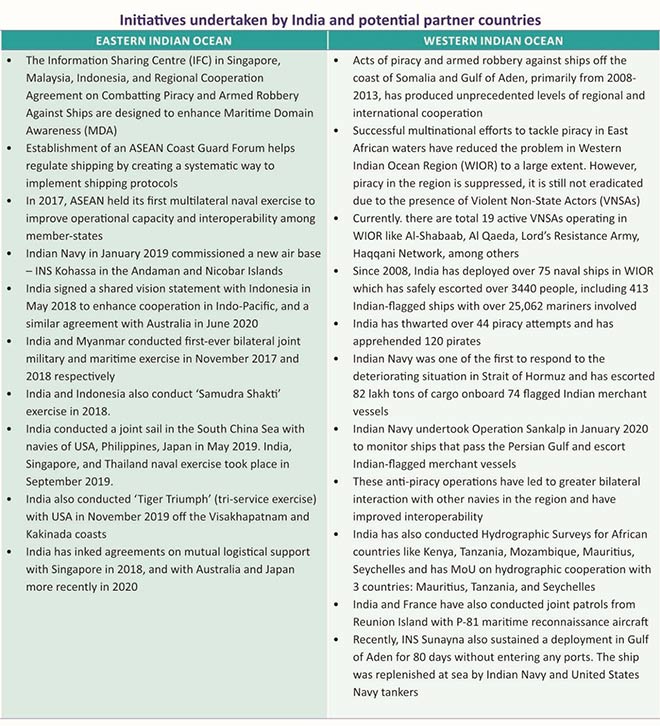
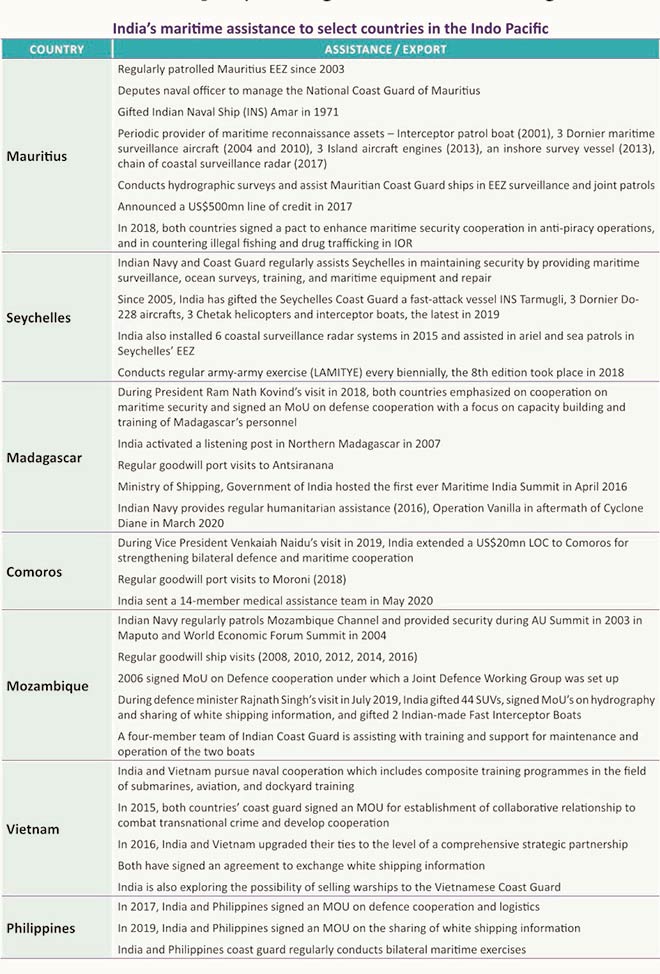
Over 90 percent of global trade is conducted through the maritime route, with a value that has grown from US$6 trillion to about US$20 trillion in 15 years.[31] Strategic stability in the Indo-Pacific thus depends on the ability to reap economic benefits from the oceans and to respond to the challenges therein. These challenges are multi-faceted: sea-borne terrorism; piracy in the waters of the Indian Ocean, Sulu Sea, and SCS; climate change; natural and man-made disasters; illegal, unreported, and unregulated (IUU) fishing; and maritime disputes and flashpoints like the SCS. These disputes hamper progress toward inclusive regional maritime security cooperation.[32] Despite problems posed by complex geography, varying levels of resources for maritime enforcement in littoral countries exacerbating the difficulties faced by law enforcement agencies, Southeast Asian and African governments have launched unilateral, bilateral, and multilateral initiatives to improve regional maritime security. (See Table 2.)
Table 2. Maritime Security
Source: Authors’ own, from various sources
2. Maritime Ecology and Maritime Resources
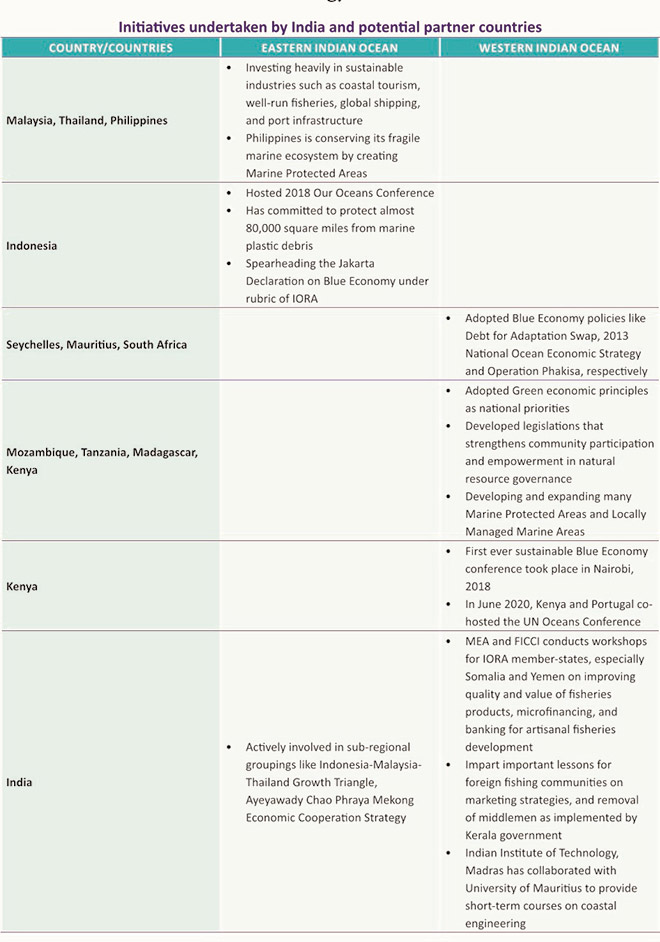
Blue Economy is increasingly being recognised as an important dimension to future sustainable development of oceans and their resources. However, resource exploitation, human-induced habitat degradation, and other form of anthropogenic activities and the effects of climate change have contributed to the drastic plunge in ocean health and ecosystem. In fisheries, for example, many countries across the Indo-Pacific have productive fisheries and strong laws governing them, yet these resources continue to remain vulnerable to destructive fishing practices and overfishing. In WIOR, 35 percent of the fish stocks are fully exploited in the region, whereas over 28 percent are overexploited.[33] Overfishing, foreign fishing, and IUU practices are also depleting fish stocks in the South China Sea and destroying habitat in the Coral Triangle that spans much of the Philippines, Malaysia, Indonesia, and Brunei.[34] To be sure, India and other countries have initiated programmes to arrest these issues. (See Table 3.)
Table 3. Maritime Ecology and Maritime Sources
Source: Authors’ own, from various sources
3. Capacity Building and Information Sharing
Effective maritime enforcement capacity begins with strong maritime domain awareness (MDA).[m] This capacity is vital for promoting marine safety, responding to vessels in distress, stopping illegal activity, tracking at-sea transshipments, and protecting waters from illegal incursions by foreign vessels. Most countries must rely on multilateral information-sharing.
The idea envisioned by India under its IPOI and SAGAR doctrine is to generate seamless, real-time, holistic picture of the wider Indo-Pacific region. This provides an opportunity for countries to work towards strengthening links between the Western and Eastern Indian Ocean through collective exercises.
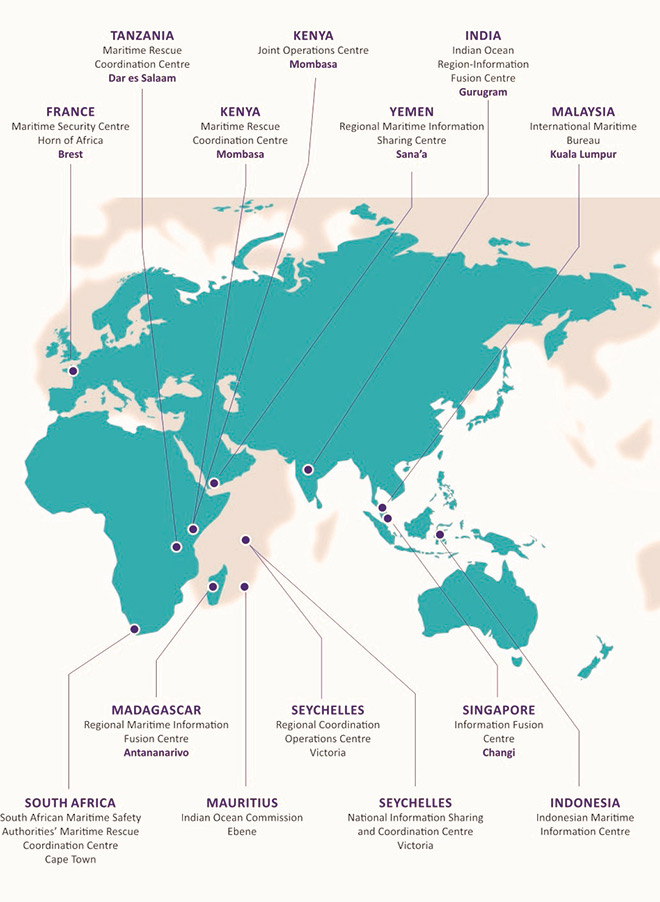
India has launched its own Indian Ocean Region-Information Fusion Centre (IFC-IOR), which has established linkages with over 18 countries and 15 maritime security agencies.[35] Information sharing can be done through direct communication and by sharing agreements between the respective maritime agencies or could find new mechanisms to work with regional information fusion centers. There are a host of regional centers dedicated to the surveillance of maritime spaces and sea lanes of communication across the Indo-Pacific.
Table 4. Capacity Building and Information Sharing
Source: Authors’ own, from various sources
Figure 1. Information-Sharing and Fusion Centres in the Indo-Pacific
Source: Authors’ own, from various sources
4. Maritime Connectivity
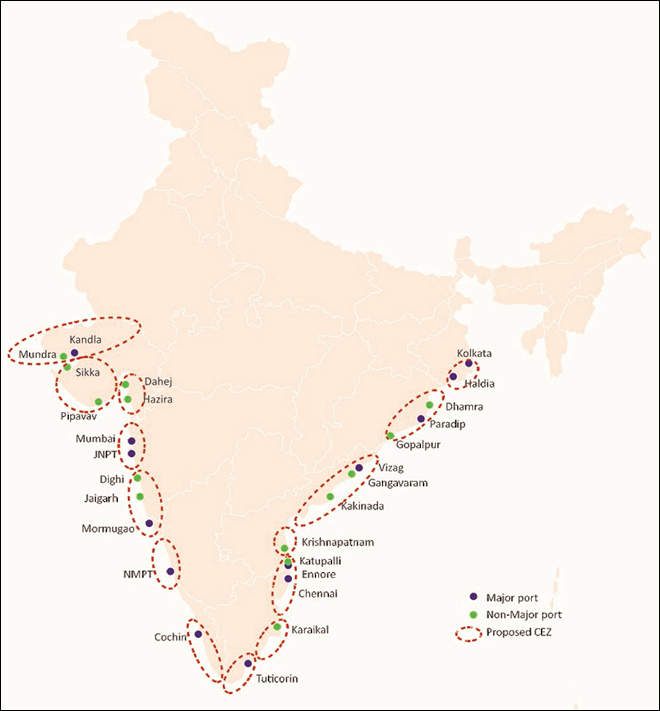
Connectivity and proper port infrastructure is the bedrock of maritime trade, shipping, and maritime transport. India’s east and west coast comprise 12 major ports along with several minor ones. Through its Sagarmala project, India is upgrading its physical infrastructure, digitisation process, adjusting its regulatory measures to overhaul the port infrastructure and operations in the country.[36]
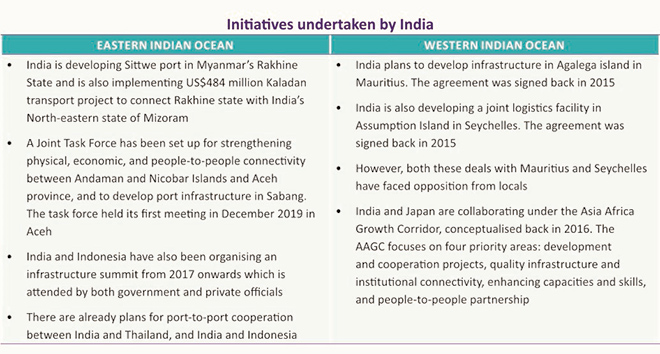
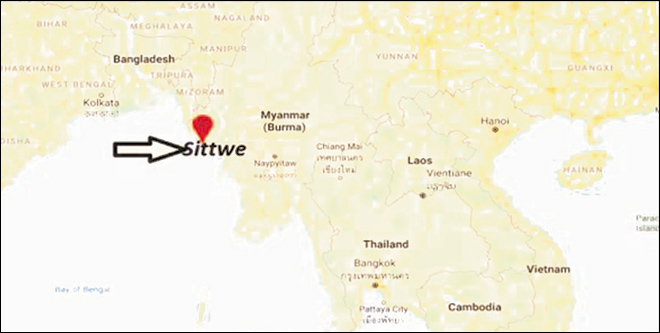
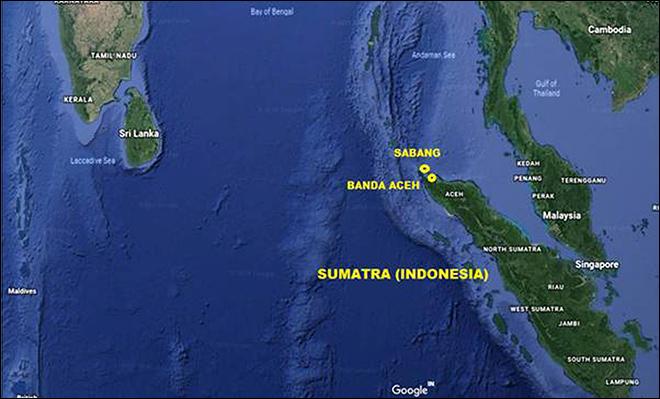
Some of the maritime connectivity initiatives undertaken by India are listed in Table 5, followed by three figures that detail the proposed ports and coastal EEZs under India’s Sagarmala project, the location of Sittwe port, and the location of Aceh and Sabang port.
Table 5. Maritime Connectivity
Source: Authors’ own, from various sources
Figure 2: Proposed ports and coastal economic zones under the Sagarmala project
Natural disasters like cyclones and tsunamis not only wreak havoc on the shores of the littorals but also have a detrimental impact on maritime trade and connectivity. This collective concern has emerged as a prospective arena for countries to collaborate on initiatives in disaster management. The ANI—which are in the Andaman Sea and close to these Southeast Asian littorals—are more vulnerable and thus classified under ‘Very High Damage Risk Zone,’ often experiencing intense seismicity.[37]
Table 6. Disaster Management
Source: Authors’ own, from various sources
Key Challenges
The Indo-Pacific is replete with maritime territorial disputes, from the Persian Gulf to the mid-Indian Ocean Chagos archipelago, to the Southwest Pacific. The most noteworthy of these disputes include the Senkakus/Diaoyutai (Japan- China); the Pratas Islands (Taiwan-China); the Paracels (China-Vietnam); Scarborough Shoal (China-Philippines); and the Spratly archipelago (China-Vietnam-Philippines-Malaysia-Brunei) and Kenya-Somalia territorial dispute.[38] These disputes make international collaboration difficult to consider; even agreements on sustainable fisheries management are elusive.
Another concern for the littorals of the eastern side will be the fear of irking Chinese sentiments, given their economic dependencies on China, and in the context of the worsening SCS disputes. Further, they have a sensitivity to working with a third country which can compromise their own sovereign stand and the principle of ASEAN centrality.[n]
Moreover, there are various limitations that are confronting the Indian Navy. Although it is now more networked and technologically enabled, the Navy continues to face budgetary constraints: its budgetary allocation has reduced from 18 percent of the defence budget in 2012-2013, to 13 percent in 2018.[39] This negatively impacts India’s future force planning and capability development. Coordination and building synergies between various stakeholders are a formidable task facing the Indian Navy.
It has not helped that India has a poor track record of converting capitals into deliverables or influence and needs to work towards bridging the gap between its commitment and implementation. Most of the IOR littorals lack the capacity to ensure the security of their declared maritime zones and look towards India to ensure its security and patrol the seas. However, such assistance would require sustained maritime deployments that would need assured budgetary support. Additionally, when it comes to allocation of resources, there is hardly any concept of prioritisation in the Ministry of Defence. There is also little dialogue between the Ministry of Defence and Ministry of External Affairs.[40]
Policy Proposals
India has stayed away from taking a definitive position on the contested power politics in the Indo-Pacific and has largely maintained cordial relations with most countries and stakeholders in the region. The IPOI seeks to promote a forum under which countries deliberate cooperative ways to secure maritime boundaries, promote free trade and sustainable use of marine resources. The IPOI echoes India’s plurilateral approach of engagement and focuses not only on ASEAN centrality, but also on Indo-Pacific connectivity, sustainable infrastructure and economic cooperation leading to regional integration.[41]
This section outlines specific proposals on how the IPOI’s pillars could work around such “cooperative, consultative, inclusive” framework. The aim is to offer a broad spectrum of policy areas and initiatives, from government-to-government to people-to-people. These policies are sufficiently broad to accommodate a wide range of activities and engagements, from highly informal conversations to institutionalised cooperation—both bottom-up and top-down initiatives. The core of these proposals are in the maritime domain, as it is expected to be the most obvious point of strategic convergence.
Government-to-Government
Track-1 maritime security dialogues and workshops over regional issues such as peacekeeping, counterterrorism, piracy, IUU fishing, humanitarian assistance, and disaster relief. The naval heads of Indonesia, Malaysia, Thailand, Singapore, Vietnam, Philippines, Australia, Japan France, South Africa, Kenya, Tanzania, Mozambique, Mauritius, Seychelles, Madagascar, Sri Lanka can participate in these events.
Meetings of Indian and ASEAN naval heads, initially on the sidelines of the ADMM Plus meetings, which can then be elevated to yearly formal meetings.
Coordinated patrols[o] conducted with the Indonesian Navy in the Sunda and Lombok straits, since these straits are strategically important for all three countries, for their interests in the Indian Ocean. These straits are being increasingly used for human trafficking. Additionally, there is a growing presence of Chinese vessels and submarines in these straits. [42]
An exercise involving the coast guards of the ASEAN countries. Considering that BAKAMLA (the Indonesian Coast Guard) is a new establishment, it is possible to provide training at the Indian naval war colleges.
The ASEAN countries could invite India to the ASEAN Coast Guard and Law Enforcement Forum, or India can initiate an India-ASEAN Coast Guard Forum where regular exercises and interactions between the Indian and the coast guards of the ASEAN countries can take place. Capacity building and training, exchange visits of delegations under this forum can be organised. Such exercises can also be conducted with the National Coast Guard of Mauritius, Seychelle’s Coast Guard, and Kenya’s Coast Guard. Just like India does with Mozambique, a team from Indian Coast Guard could be stationed in these other African countries to train their crews and provide support for the maintenance and operation of their naval ships.
In 2020, the EU Critical Maritime Route Wider Indian Ocean II (EU CRIMARIO-II) project was launched which supports regional countries’ endeavours to enhance maritime situational awareness in WIOR. The project is looking to expand its geographical scope towards South Asia and Southeast Asia. India is situated right in between the two key MDA stakeholders in the wider Indo Pacific i.e., IFC based in Changi, Singapore, and the EU CRIMARIO II. Both these organisations have launched their own information-sharing tools: IFC Singapore’s Information-Sharing System (IRIS) and EU CRIMARIO II’s Indian Ocean Regional Information Sharing (IORIS) platform. Since India has also launched its own Indian Ocean Region-Information Fusion Centre (IFC-IOR), there are ample opportunities for India to collaborate with these organisations.
Not only has India already become an observer to the Indian Ocean Commission (COI) in March 2020, and to the Djibouti Code of Conduct and its 2017 Jeddah Amendment, India is also posting naval liaison officers at the RMIFC in Madagascar and European Maritime Awareness in the Strait of Hormuz (EMASOH) in Abu Dhabi.[43] This will help deepen MDA in WIOR by monitoring maritime activities and promoting information-sharing and exchange.
India must invite naval liaison officers from African countries such as Kenya, Tanzania, Mozambique, Madagascar, South Africa to be posted at IFC-IOR. France has already deployed a liaison officer in December 2019, and Mauritius and Seychelles have expressed interest to deputise their liaison officers. In 2019, under the aegis of IFC-IOR, the Indian Navy hosted a maritime information-sharing workshop that was attended by delegates from around 29 countries across the Indo-Pacific.[44] This workshop led to a BIMSTEC Coastal Security Workshop in November 2019 that was attended by many countries. Because East African countries also depend on maritime trade for their economic development, such workshops could be hosted by Indian Navy for the Western Indian Ocean countries.
Deals can be entered into with the Indian shipyards like Mazagon Dock Limited in Mumbai, Cochin Shipyard Limited in Chennai, or Garden Reach Shipbuilders and Engineers in Kolkata to supply patrol vessels and coast guard ships to the Indonesian, Filipino, Vietnamese, and Kenyan coast guards. Countries can negotiate about implementing mandated fitting of Automatic Identification Systems (AIS) class-based transponders in all small boats that are used for illegal activities.
The naval exercises between countries with India and/or ASEAN Multilateral Naval exercise can introduce disaster preparedness, response, mitigation, and recovery.
People-to-people, civil society, and institutional/organisational linkages
Education exchanges and training exercises must be expanded to include all levels—from the academy to the senior staff colleges. Broader joint research on maritime studies involving think tanks and universities from India, Australia, Japan, and the ASEAN countries could strengthen bottom-up approaches to maritime security architecture-building.
Track-II workshops centered on capacity-building, maritime safety, and security for Indo-Pacific coast guards, to be led by India.
Workshops on both maritime domain awareness and UNCLOS familiarity amongst the maritime security practitioners of India, ASEAN, Australia, France, Japan, South Africa.[45] Given the ongoing SCS dispute, the importance of understanding and interpreting different regional views on how “freedom of navigation” applies to foreign military activity in exclusive economic zones cannot be ignored.
Indonesia, Malaysia, Thailand can be potential partners for India to work along with on many aspects of Blue Economy, primarily on sustainable use of ocean resources: reducing marine plastic debris, and curbing illegal, unreported, and unregulated fishing. Given that the dumping of marine plastic debris is one of the focus areas in India’s IPOI, India and Indonesia can form a Working Group along with other littorals like Malaysia and Thailand to deal with issues in the eastern Indian Ocean.
Apart from collaborations between the Indian Institute of Technology Madras (IITM) and University of Mauritius, coastal engineering courses could be undertaken by other IIMs and other universities in African countries such as University of Seychelles. India and other countries could explore not only short-term courses, but also developing Master of Science (MSC) and long-term higher-education courses on coastal management and coastal engineering techniques.
Future collaborations can happen between IITM and the Department of Aquatic Resources Management of Institut Pertanian Bogor, Indonesia for short-term courses on Aquatic resource management. There can be joint research conducted between these universities and institutes, to help small island nations in addressing their climate change challenges.
India can conduct theme-based seminars on topics such as “strengthening legal provisions for marine habitat conservation”, or “preservation of marine protected areas and locally managed marine areas”, “legal provisions of IUU fishing”, and exploring cooperation among marine law enforcement agencies of different countries across the Indo-Pacific.
Plastic waste leakage from municipal waste collection in cities across the Indo-Pacific countries is a vital challenge. The Alliance to End Plastic Waste and United Nations Habitat’s joint project to reduce plastic waste leakage currently targets six cities in Eastern Africa and Southern Asia: Nairobi and Mombasa in Kenya, Addis Ababa and Bahir Dar in Ethiopia, Thiruvananthapuram, and Mangalore in India. This project can be extended to include other cities in countries like Malaysia, Indonesia, Vietnam, Egypt, South Africa, and the Philippines.
Fisheries management workshops, one that is done for Somalia and Yemen (Somali-Yemen Sustainable Programme – SYDP), should be extended to other countries that have interest such as Seychelles, Kenya, and Tanzania.
India’s National Fisheries Development Board must look to expand linkages with the Kenya Marine and Fisheries Research Institute, Tanzania Fisheries Research Institute, and Seychelles Fishing Authority.
The ASEAN Working Group on Coastal and Marine Environment works as a forum for coordinating ASEAN initiatives on sustainable marine resource management. By consistently bringing together member states for project collaboration, ASEAN creates an environment of mutual understanding and solidarity in Southeast Asia. India’s National Fisheries Development Board can partner with this Working Group and host conferences on sustainable use of marine resources in the Eastern Indian Ocean. Further work can happen between India’s National Fisheries Development Board and the ASEAN Working Group on Coastal and Marine Environment on synchronising mandates that govern best practices in the blue economy and fisheries sectors.
There is tremendous potential in advancing maritime research in the Pacific for issues like sustainable energy and climate change. India’s contribution to knowledge and adaptation on resilience, adaptation and mitigation can lead to friendlier relations.
The IPOI could be used to establish greater structural linkages between IORA and other multilateral groupings or initiatives such as the Indian Ocean Tuna Commission (IOTC), Southern Indian Ocean Fisheries Agreement (SIOFA), the Inter-American Tropical Tuna Commission, Western and Central Pacific Fisheries Commission, and Southwest Indian Ocean Fisheries. [46]
The MEA along with the IORA Secretariat could also launch a Blue Economy Task Force that would comprise representatives from governments, private, and business sector, for sustained dialogue and follow up.
India should look to develop and popularise the concept of Green or Blue Bonds[p] as has been done successfully by Seychelles.
In areas of transportation of minerals that are recovered from deep seabed, storage and port facilities, India could look to develop and explore business opportunities with countries like South Africa, Seychelles, Mauritius, Malaysia, Singapore in infrastructure and logistics that may be required.
India’s National Disaster Management Authority (NDMA) can organise workshops and joint research programmes on awareness and best practices among countries.
The Naval War Colleges of the US, India, Australia, Japan, and Indonesia can collaborate and conduct structured programmes for the training of in-service military officers.
India can explore deputing retired naval and coast guard officers who have operational expertise for providing training on the ground and building stronger links with IPOI partner countries. This will bring the much-needed domain expertise and overcome capacity constraints within India’s own developmental programmes and initiatives.
Infrastructure development and connectivity
Indonesia is planning to host the Indo-Pacific Infrastructure Summit in 2021,[47] and this will be a great platform for India, Australia, Japan, and the US to attract partners for infrastructure development programmes. In recent years, all these countries have started or announced plans to deepen their economic engagement in the Indo-Pacific. The US has initiated the Infrastructure Transaction and Assistant Network and Blue Dot Network; Japan is working on its Expanded Partnership for Quality Infrastructure; Australia plans to build new regional economic connectivity in South Asia and has earmarked $25 million for the venture;[48] and India and Japan announced the Asia Africa Growth Corridor in 2017.
The ports of Thailand, Singapore, Malaysia, and Indonesia are more advanced than those on the eastern coast of India. Therefore, India-ASEAN Connectivity Summits can be organised by India where the port authorities of these countries can be invited.[q] India can also draw lessons from their experience.
A Chamber for Shipping to promote shipping cooperation between India, Indonesia, Vietnam, and the Philippines. As a business-to-business entity, the chamber could be a sub-unit of the existing trade and industry chambers of the two countries, or else a separate one.[49]
Conferences around the theme of promoting shipping cooperation between the countries of the Indo-Pacific.
India’s Sagarmala project should aim at collaborating with other regional connectivity initiatives like the Eastern Economic Corridor (EEC) of Thailand, the Sea Toll Highway of Indonesia, the ‘Build Build Build’ of the Philippines; and the ASEAN Masterplan on Connectivity 2025.
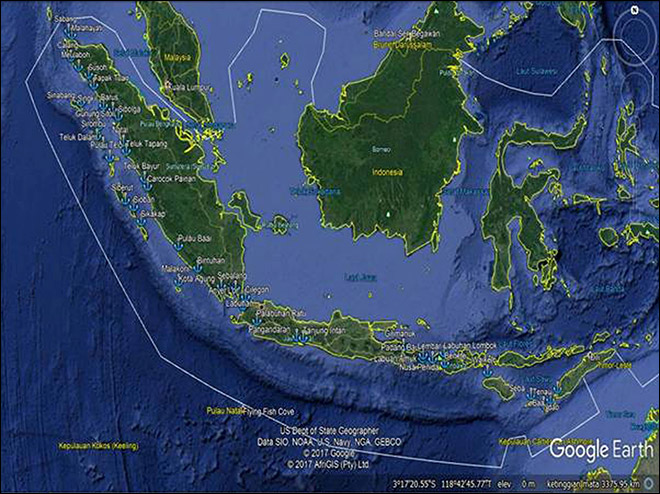
Prospects for greater connectivity with other ports in Western Sumatra besides Aceh and Sabang should be explored.[r] The development of India’s eastern ports and the creation of new ones in Enayam, Paradip, Sirkhadi and Sagar Island should provide greater opportunities for ports in Sumatra.[50] Both West Sumatra and Northern Sumatra border the Indian Ocean.
Figure 5: Ports bordering Western, Northern Sumatra and Southern Java
Source: Authors’ own, created on Google Maps
The Government of Thailand is putting emphasis in stepping up the infrastructure on the Ranong port, which is near South Asia. Thailand plans to develop Ranong as an international port, increase its connectivity with the Andaman coast, and link it with the multimodal transport of the BIMSTEC and Greater Mekong Subregion (GMS). The Trilateral Highway Project with India and Myanmar will be an important development for Ranong in terms of multimodal links with Myanmar and the Kolkata Port in India and India’s northeast.[51]
India can initiate talks on coastal shipping, cruise tourism with Thailand, Indonesia, and Malaysia under the ASEAN Maritime Forum, as well as with Mauritius and Seychelles under the Indian Ocean Commission.
India has adequate expertise and capacity for shipbuilding. India can strengthen inter-island water transport in the WIOR by developing the region’s inter-island ship services and foreshore ferry services just like it does in the Andaman and Nicobar Islands. There is enormous possibility of reciprocating this same technique in East African waters. India can explore the possibility of gifting small passenger ships to enhance inter-island connectivity between the Vanilla islands i.e., Seychelles, Mauritius, Madagascar, Comoros who can run it on their own. Indian entrepreneurs might be willing to run such ferry services if they are provided with some concessional financing.
Countries like Indonesia, Australia, Japan, Rwanda, United Kingdom, Maldives, Sri Lanka, Bhutan, Italy, Mexico, Fiji, and Mongolia are members of PM Modi’s recently launched Coalition for Disaster Resilient Infrastructure (CDRI). Other countries should also be encouraged to become members of this initiative, as they face challenges in building and/or retrofitting infrastructure to withstand disasters.[s] Alongside IORA, the CDRI could be another initiative where the countries can cooperate on medium-term economic outcomes.
Strengthening inter-ministerial coordination
India needs to look at Blue Economy with a holistic perspective by institutionalising the Ministry of External Affairs as the nodal point for dialogue, coordination, and research.
India ought to develop a Defence Diplomacy Fund that will require collaborative effort from the ministries of Defence, External Affairs, Commerce and Industry, and Shipping. The financial resources for such a Fund must be shared and allocated in a prudent manner.
Although the entire resource pool is going to be limited, the allocation which the Indian Navy will receive for foreign assistance has to be prioritised and shared with the relevant executing agencies.
If India wants to play a leading role in ensuring the safety, security, and stability of the maritime domain and convert its financial clout to strategic influence, it must push for a coalition of all the agencies concerned. Perhaps the National Security Council Secretariat or a proposed National Maritime Commission will be the most appropriate organisation to carry out such a role.[52]
The ministries of External Affairs and Defence should work with the academia as well as think tanks to work towards a broader perspective.
The engagement could be expanded to include defence educational and research institutions. Meetings should involve the broader civilian defence communities.
Conclusion
India’s vision for the Indo-Pacific is one in which freedom of navigation, overflight, sustainable development, protection of the maritime environment, and an open, free, fair, and mutually beneficial trade and investment system are guaranteed for all. The IPOI was launched by India in 2019 with the aim to manage, conserve, sustain, and secure the maritime domain. Since then, India has been working to strengthen practical cooperation with its like-minded partner countries to provide solutions to global challenges. It can hardly be overemphasised that the security, stability, peace, and prosperity of the vast Indo-Pacific region—accounting for 64 percent of the world’s population and 62 percent of global GDP—is vital for the world. Although every nation and region have their own imperatives and priorities, India, being one of the earliest proponents of the ‘free and open Indo-Pacific’ concept, has continued to urge partners to undertake cooperative endeavours to create a safe and secure maritime domain in the region.
Some challenges are likely to remain. For one, the smaller littorals, the ASEAN and African countries would be unwilling to get caught between great-power rivalries and also hesitant to be part of initiatives that would purposefully exclude any particular country. In this regard, the bottom-up approaches suggested under the various pillars can be a good starting point for the short term. In the medium and long term, other more formal measures can be embarked upon.
Given India’s sheer size, its capacities and widening interests, it will play a significant role in the post-COVID-19 global revival. Towards this end, building purposive partnerships with like-minded countries of the Indo-Pacific will continue to inform India’s plurilateral approach of engagement under the IPOI.
Endnotes
[a] The seven pillars are: Maritime Security; Maritime Ecology; Maritime Resources; Capacity Building and Resource Sharing; Disaster Risk Reduction and Management; Science, Technology and Academic Cooperation; and Trade Connectivity and Maritime Transport. (See, https://mea.gov.in/Portal/ForeignRelation/Indo_Feb_07_2020.pdf)
[c] The Joint Commission is co-chaired by India’s Minister of External Affairs S. Jaishankar and Pham Binh Minh, Deputy Prime Minister and Foreign Minister of Vietnam.
[d] The initiative is envisioned on the platform of the East Asia Summit, thereby underscoring ASEAN centrality. In India’s view, this means upholding ASEAN’s territorial integrity and sovereignty and the application of international law (UNCLOS) to the maritime domain.[d] See Surya Gangadharan, “Modi’s ‘Indo-Pacific Oceans Initiative’: India Reaches Out to Stakeholders”
[e] This was just after the formation of ASEAN in 1967.
[g] In the 2019 Raisina Dialogue, Former Indian Foreign Secretary Vijay Gokhale said, “The governments in Delhi might have been the last, but they have certainly moved away from the straitjacket of non-alignment—in practice if not in theory. The rhetoric too has changed under the present government. India is now ‘aligned.’ But the alignment is issue-based. It is not ideological. That gives us the capacity to be flexible, gives us the capacity to maintain our decisional autonomy.” (See, C. Raja Mohan, “Raja Mandala: Alliances and strategic autonomy,” The Indian Express, 15 January 2019, https://indianexpress.com/article/opinion/columns/ raja-mandala-alliances-and-strategic-autonomy-indian-foreign-policy5538447/)
[h] Indonesia is not alone. Other members of the ASEAN are similarly questioning the efficacy of ASEAN and are not shying away from other partnerships/ constructive engagements. Vietnam has become a close partner of India in many ways.
[i] India has long been a trusted Dialogue partner in the ASEAN and a member of other platforms involving its member countries, such as the East Asia Summit. Many countries like Vietnam and the Philippines have in various statements underlined the need for India to play a more active role in the Indo-Pacific region.
[j] These forums include those with the US and Australia, trilateral dialogues between India-Japan and the US, India-Japan-Australia (JAI), Russia-India-China, India-Australia-Indonesia, and the Quadrilateral meetings between India, Japan, Australia, and the US. Other possible new minilateral platforms are the India-Japan-Indonesia, and India-Australia-Vietnam.
[k] In the meeting, EAM S Jaishankar stressed the need for “upholding the rules-based international order, underpinned by the rule of law, transparency, freedom of navigation in the international seas, respect for territorial integrity and sovereignty and peaceful resolution of disputes.” See: “Opening remarks by EAM at 2nd Quad Ministerial Meeting in Tokyo, Japan”, Ministry of External Affairs Media Center, October 6, 2020, https://www.mea.gov.in/Speeches-Statements.htm?dtl/33097/Opening+remarks+by+EAM+at+2nd+Quad+Ministerial+Meeting+in+Tokyo+Japan
[l] The US Naval War College, the Naval War Colleges in India, the Royal Australian Naval War College, the Naval War College of Japan can do courses, training programs, exchange programs with the Defence University in Indonesia, SESKOAL (Staff College in Indonesia), National Defence Academy of Vietnam, Vietnam Maritime University, National Defence University of Malaysia.
[m] MDA is defined as the ability to gather, process, analyse, and share real-time information about what is occurring at sea.
[n] India would also need to consider how advantageous the principle of ‘ASEAN centrality’ is, or if it more in the realm of rhetoric.
[o] India has been conducting coordinated patrol with the TNI-AL (Indonesian Navy) from 2002 onwards, but these patrols take place at Port Blair under the aegis of Andaman and Nicobar Command. The closing ceremony of this patrol is usually hosted at Belawan, Indonesia. (See, https://www.indiannavy.nic.in/content/27th-india-indonesia-coordinated-patrol-corpat)
[p] A bond is a fixed income instrument that represents a loan made by an investor to a borrower (typically corporate or governmental). A green bond is a fixed income instrument designed specifically to support and fund climate-related or environmental projects, whereas a blue bond is a relatively new type of sustainability bond which finance projects related to ocean conservation.
[q] Including, for example, the Port Authority of Thailand, PELINDO of Indonesia along with the private players like Port of Singapore Authority (PSA), Evergreen, and DP (Dubai Port) World, Chambers of Commerce.
[r] These can include connectivity between Sibolga, Teluk Bayar, Bengkulu, Bandar Lampung, Cilacap, Belawan, Kota Cina in west Sumatra and Malahayati, Kuala Tanjung, Belawan in Northern Sumatra with the ports in eastern India like Kolkata–Haldia, Paradip, Visakhapatnam, Kattupalli, Chennai and Port Blair, along with the Krishnapatnam, Kamarajar and Tuticorin ports.
[s] Southeast Asian countries like Thailand, Malaysia, and Singapore; and African countries including South Africa, Mauritius, Seychelles, Madagascar, Comoros, Kenya, and Tanzania.
[1] Rory Medcalf, “The Evolving security order in the Indo-Pacific”, in Indo-Pacific Maritime Security: Challenges and Cooperation, ed. David Brewster (Canberra: National Security College, Australian National University, 2016), 7.
[6] Ambassador Ong Keng Yong, “Foreword” in ASEAN and the Indian Ocean: The Key Maritime Links, eds. Sam Bateman, Rajni Gamage and Jane Chan, RSIS Monograph (Singapore: S. Rajaratnam School of International Studies, 2017),1-2.
[12] Dipanjan Roy Choudhury, “India-Vietnam agree to strengthen Indo-Pacific partnership; explore closer cooperation in nuclear energy and space”, op.cit
[52] Setting up of a National Maritime Commission was proposed by Indian Chief of Naval Staff Admiral Karambir Singh while delivering a speech on the topic “Indian Ocean-Changing Dynamic-Maritime Security Imperatives for India” as part of a series.
The Central Tibetan Administration welcomed the Tibetan Policy and Support Act passed by the US Congress, calling it a historic move and a clear message to China
The US Congress has passed a law that reaffirms the right of Tibetans to select the successor to His Holiness Dalai Lama.(Sonu Mehta/HT PHOTO)
The US Congress has passed a bill that reaffirms the right of Tibetans to choose a successor to their spiritual leader, the Dalai Lama. The law has been described by Dharamshala, the seat of the Tibetan government-in-exile, as a historic move and a clear message to China.
The Tibetan Policy and Support Act of 2020 (TPSA), which was passed by the US Senate, calls for the establishment of a US consulate in Tibet’s main city of Lhasa and underlines the absolute right of Tibetans to choose a successor to the Dalai Lama.
The USS John S. McCain neared the contested Spratly Islands on Tuesday. Photo: US Navy via APThe US Navy sent a destroyer near the Spratly Islands in the disputed South China Sea on Tuesday to “challenge restrictions on innocent passage imposed by China, Vietnam, and Taiwan”.The operation came after the United States military warned in a document last week that it would be “more assertive” against Beijing. The document set out objectives for the US Navy, Marines and Coast Guard for 2021.
China had been counting on its biggest chipmaker to help the country eventually reduce its reliance on the likes of Intel (INTC) and Samsung (SSNLF). The United States just put those ambitions in jeopardy. Washington announced Friday that it will require US exporters to apply for a license before they can sell to Semiconductor Manufacturing International Corporation (SMIC). The US government claims that the chipmaker can use its tech to help China modernize its armed forces. SMIC (SIUIF) says it has no relationship with the Chinese military. But in a statement on Sunday, the company acknowledged that while the restrictions are unlikely to hurt its short-term operations, its loftier goals are in doubt. The new US rules will have “a material adverse effect” on its ability to develop highly advanced chips, it said.
Welcome to our final newsletter of 2020. We would like to take this opportunity to thank you for your support and interest in our work over the year. We will return in early January and in the meantime wish you an enjoyable festive break and every success in 2021.
New white paper: Digital trade in the Asia-Pacific
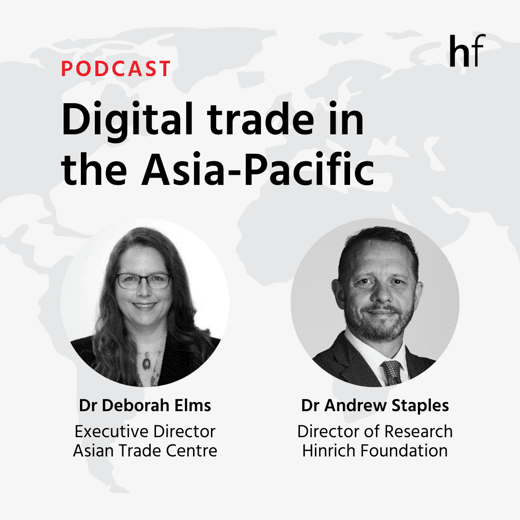
Deborah Elms 22 December 2020
As we move into 2021, what are the key issues facing digital trade in Asia? The Covid-19 pandemic has disrupted global trade and upended many longstanding business models. Firms are rapidly shifting to develop or expand digital capabilities to manage highly altered supply and demand pressures. Despite the growing importance of digital trade, the ability of governments to tackle a range of issues of relevance to managing the online environment still lags behind the speed of innovation for firms. Effective and efficient regulatory policies can support continuing economic growth in the digital economy. Given the overwhelming importance of small firms to every country in Asia, failure to create supportive policies will impede the region’s attempt to advance sustainable and inclusive development. This new paper from the Hinrich Foundation – the first in a series of six reports on digital trade in the Asia-Pacific authored by Dr Deborah Elms, Executive Director at the Asian Trade Centre – identifies eight issues that governments and firms across the region will need to tackle to reap the full benefits of the digital opportunity.
In this short podcast our Director of Research, Dr Andrew Staples, invites Dr Deborah Elms to provide an overview of paper and to highlight the importance of the RCEP agreement for digital trade in Asia.
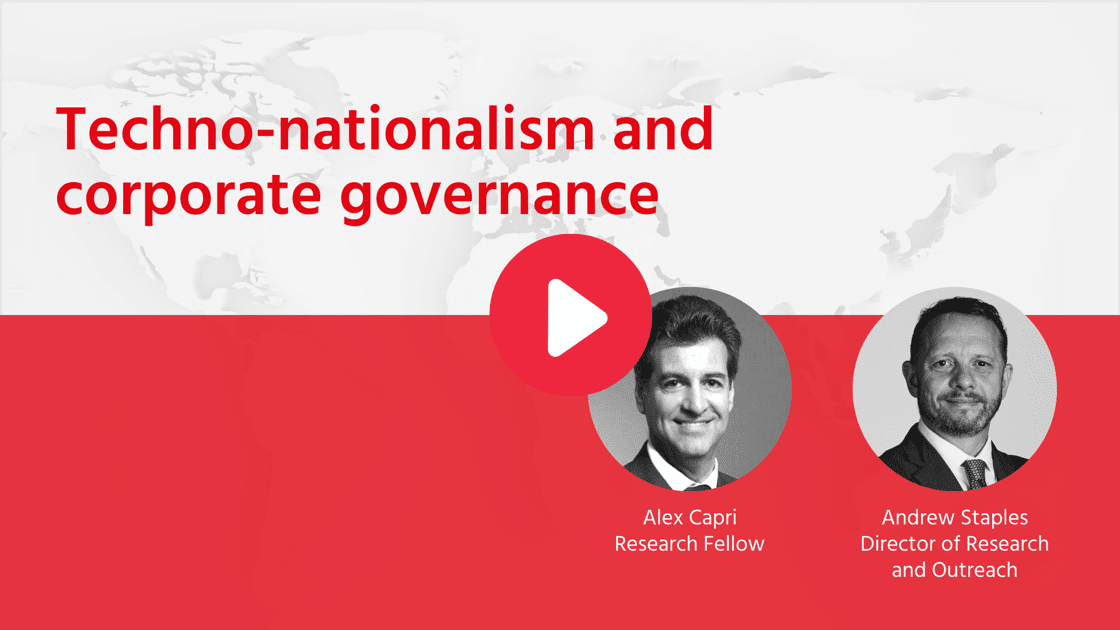
INTERVIEW WITH RESEARCH FELLOW Hinrich Foundation Research Fellow, Alex Capri, discusses his latest paper with Dr Staples. Released last week, Techno-nationalism and corporate governance examines how the US-China tech cold war has politicized the business environment for multinationals and the implications for corporate governance. Techno-nationalism, he observes, now requires firms to evaluate or restructure their cross-border operations to reduce risks.
IN CASE YOU MISSED IT While 2020 proved to be challenging for all of us, it was also a productive year for our research fellows. Please find below a selection of our most read articles and papers on the key issues impacting global trade in 2020 including the coronavirus pandemic, geopolitical tensions and the US-China trade war, the emergence of “techno-nationalism,” the US presidential election and the signing of the Regional Comprehensive Economic Partnership (RCEP).

 Plastic waste at a private collecting site in Go Vap District, HCMC, August 2019. Photo by VnExpress/Thanh Nguyen.Vietnam should set up legal framework for recycling plastic waste, reduce plastic use and find new materials to replace non-recyclable plastics, according to experts.


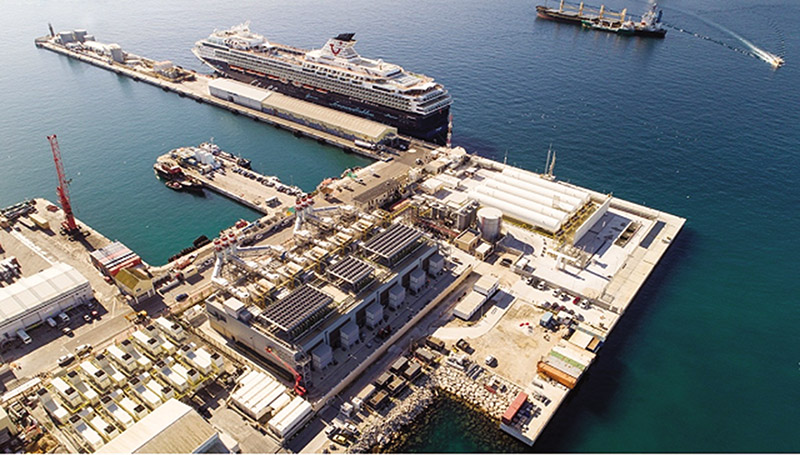
 A worker installs solar power panels in Ninh Thuan Province, central Vietnam. Photo by VnExpress/Quynh Tran.The increasing solar power capacity has made it difficult for national utility Vietnam Electricity (EVN) to ensure stable power distribution nationwide.




 Deborah Elms