
In coverage of the catastrophic Bhote Kosi flood, many mainstream western news outlets have failed to confidently state the significance of the climate crisis, or to cite the human-made structures that produce it.
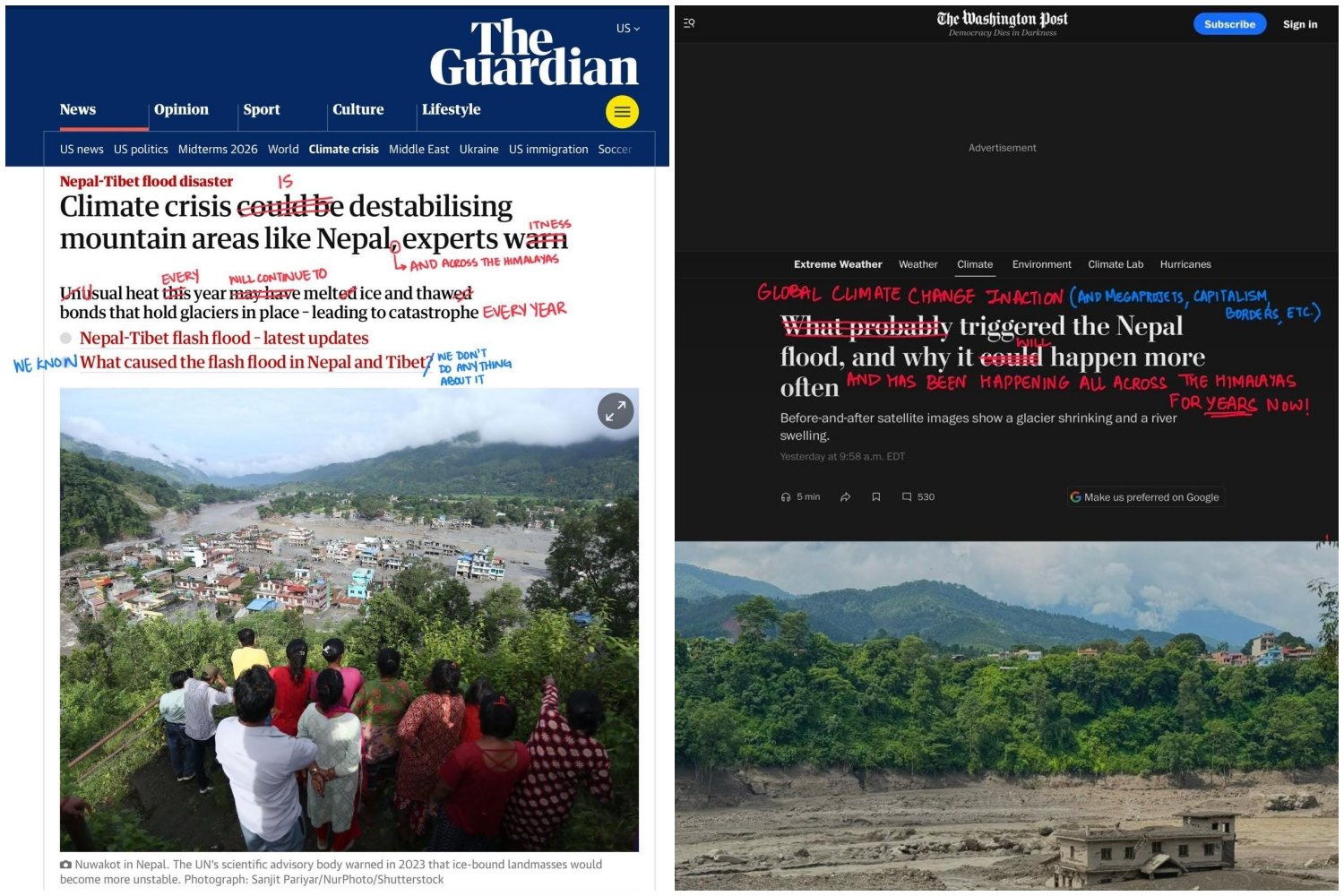
Headlines from The Guardian (left) and The Washington Post (right) covering the Nepal-Tibet flood, marked in red by designers and former Harvard classmates Fatima Hamdani and Bhavya Jain. Photos: FATIMA HAMDANI AND BHAVYA JAIN / INSTAGRAM
In coverage of the catastrophic Bhote Kosi flood, many mainstream western news outlets have failed to confidently state the significance of the climate crisis, or to cite the human-made structures that produce it.
Two days after catastrophic flooding began, designers and former Harvard classmates Bhavya Jain and Fatima Hamdani posted a carousel of headlines plucked from mainstream western news outlets on their Instagram.
By taking a red pen to each headline in the style of Alexandra Bell’s Counternarratives series, Hamdani and Jain called attention to journalists’ noncommittal tone, which served to obfuscate the connection between the Bhote Kosi flood and climate change.
The post went viral, with more than 32,000 likes at press time. In an accompanying article on Hamdani and Jain’s shared Substack, Climate Without Borders, they write that news agencies “quote survivors’ shock and panic” but not “experts’ warning from decades past on the climate crisis.”
“Ambiguity is always dangerous because it shies away from responsibility,” Jain tells me. “It is the work of the media to bring attention to evidence that has been ignored or years now.”
DENIALISM
While Hamdani and Jain call out mainstream western media for failing to establish a strong causal link between the flood, glacial collapse, and the warming atmosphere, some argue that western journalists are using climate change as “an explanation without evidence.”
That the Bhote Kosi flood is part of the broader climate crisis has been a common refrain over the past week, and one covered extensively by this paper. Glacial retreat and permafrost loss are well-recorded, documented impacts of climate change.
Scientists report that the collapse of the ice shelf on Langtang Lirung on 26 August was primarily because the bedrock below it gave way. Himalayan experts have linked the bedrock failure itself to the loss of permafrost in its fractures: ice that once cemented the rock has melted away due to record high temperatures this summer on the Tibetan Plateau.
Yet, scientific reports are dismissed both in the comments section and by some journalists, who sarcastically remark that climate change is “the all-purpose explanation for everything” or tentatively posit that “Glacier collapse and landslides are complex and can be caused by a number of factors.”
Climate change has become an increasingly politicised, polarising issue in international media, especially in countries experiencing culturally pervasive conservative blowback like the United States and Germany.
By noting the complexity of glacial collapse, pundits may hope to avoid taking a stand against partisan climate-deniers. Perhaps this is why Reuters, for instance, is still asking: “Was climate change to blame for the Nepal floods?”
However, this hesitance has the opposite effect. It amounts to an invitation for continued back-and-forth about whether burning fossil fuels is a significant factor in producing climate disasters — conversations that can quickly move away from harm, accountability, and reparation.
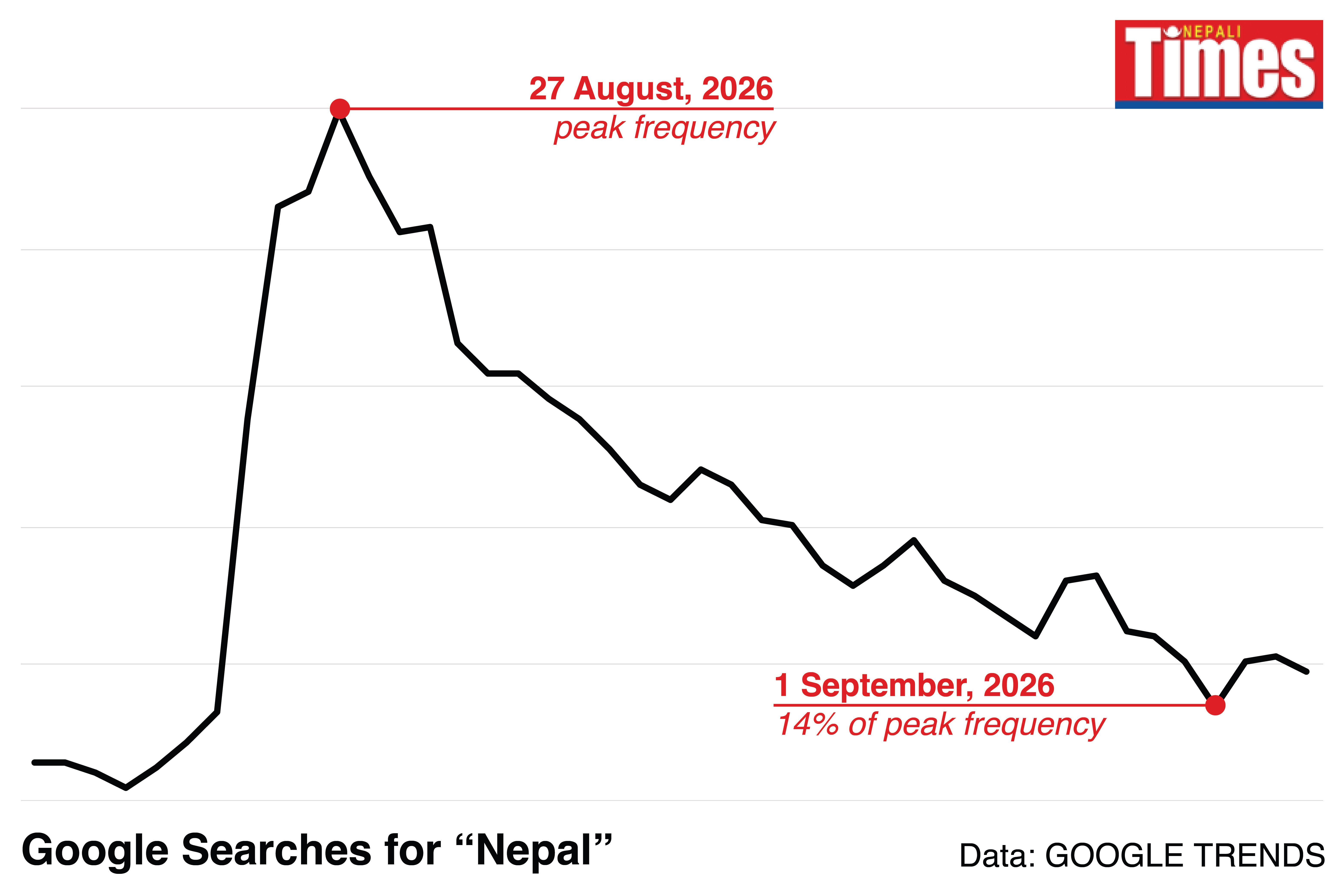
Worldwide, Google searches for “Nepal” have gone down by more than 80% since peaking on 27 August.
ACCOUNTABILITY
While confidently situating the Bhote Kosi flood within the climate crisis is necessary, it is also insufficient. Climate change is one link in a chain of impacts, not a root cause. The climate is not spontaneously choosing to change itself.
Overlapping structures of imperialism, colonialism, and modernity crafted and maintained by human-made choices weave the tangled web of heightened risks often referred to as the climate crisis. As a statement from the Kathmandu-based visual storytelling platform photo.circle reads, the climate crisis is “produced within a western capitalist imperialist world order that continues to push us all to the brink and beyond.”
Some argue that Nepal’s casualty rate was so high because of unregulated settlements along dynamic floodplains, not because of climate change. However, the human-made systems that have changed our climate are the same ones that push people to settle along vulnerable riverbanks. This is why, as Jain says, “the reporting needs to extend beyond disasters.”
Many voices, including from mainstream western news outlets, have looked through a wider lens to note that Nepal’s existential climate risks are disproportionate with its low greenhouse gas emissions. Observations like these are an entry point to deeper conversations about who is accountable and who carries the responsibility of repair.
However, when Ishan Tharoor writes in the New Yorker that these are “the floods Nepal didn’t cause,” he only goes so far as to reassign blame to the climate itself — and the climate itself cannot be held accountable.
As Hamdani tells me, “The aid sent by western governments is disproportionate to their emissions, it is they who have caused these fragile ecosystems to collapse.”
MOVING ON
The death toll in Nepal is approaching 1,000, and another 4,500 people missing. Meanwhile, Google searches worldwide for ‘Nepal’ peaked on the day after the floodwaters hit and have already decreased by more than 80% since then.
Just as with the 2015 earthquake in Nepal, the international media and global interest will move on to the next disaster.
But will the same conversations resurface when that next disaster hits, or will news outlets confidently state how climate change contributed? Will they push past the obvious fact that people on the front lines of the climate crisis are virtually never responsible for its brutality? Will they finally ask who is accountable, and who carries the responsibility of repair?
“Western media needs to identify these events as the canary in the coal mine,” Fatima Hamdani says. “While countries which have contributed little-to-nothing in global carbon emissions are on the front lines of the climate crisis, western countries will soon follow.”
Kaede Polkinghorne is an intern at Nepali Times.
If you are looking to support communities affected by the flood in Nepal, donate to the Prime Minister’s Disaster Relief Fund here. Additional information here.

 CVD
CVD 