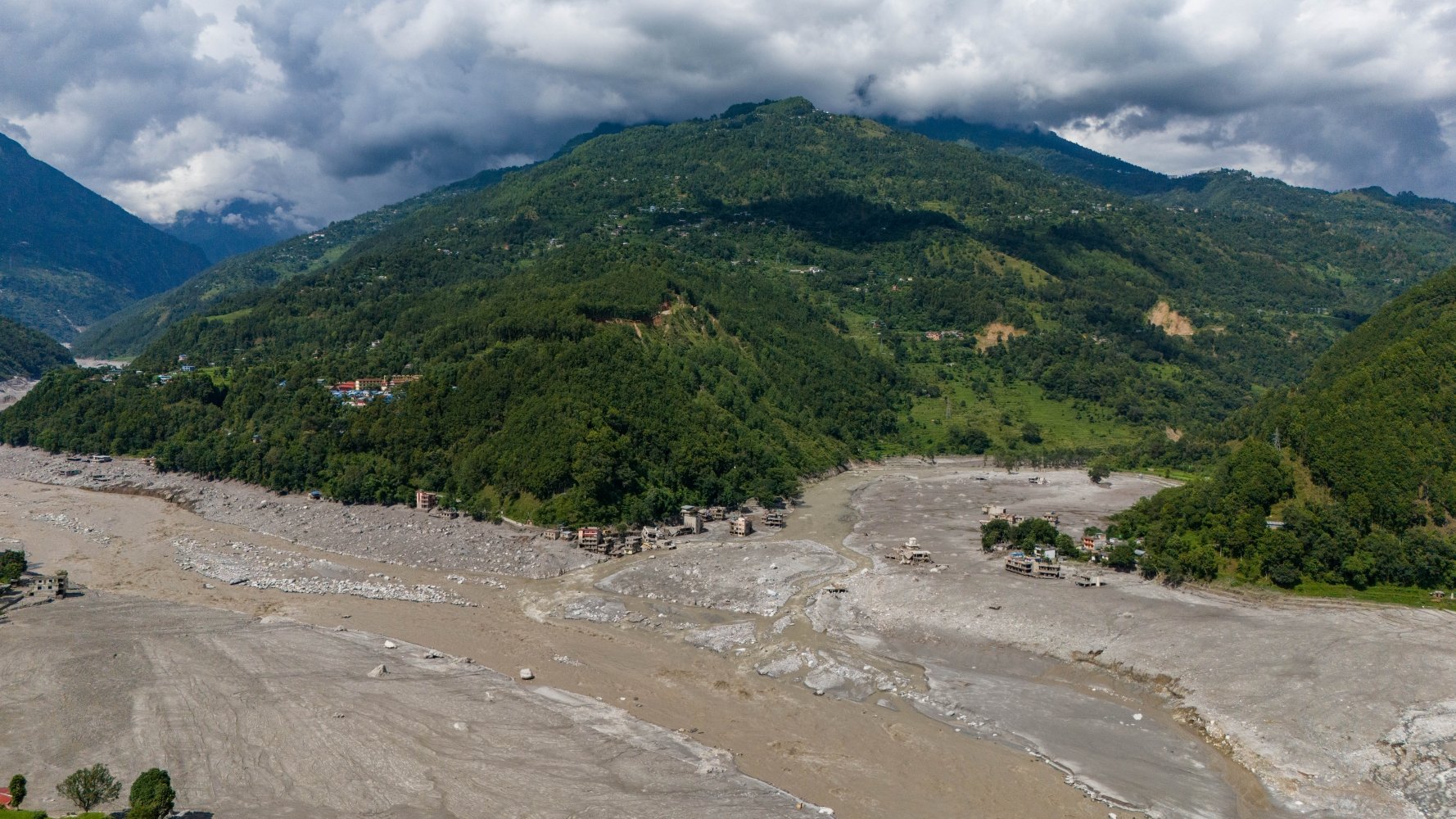
In coverage of the catastrophic Bhote Kosi flood, many mainstream western news outlets have failed to confidently state the significance of the climate crisis, or to cite the human-made structures that produce it.
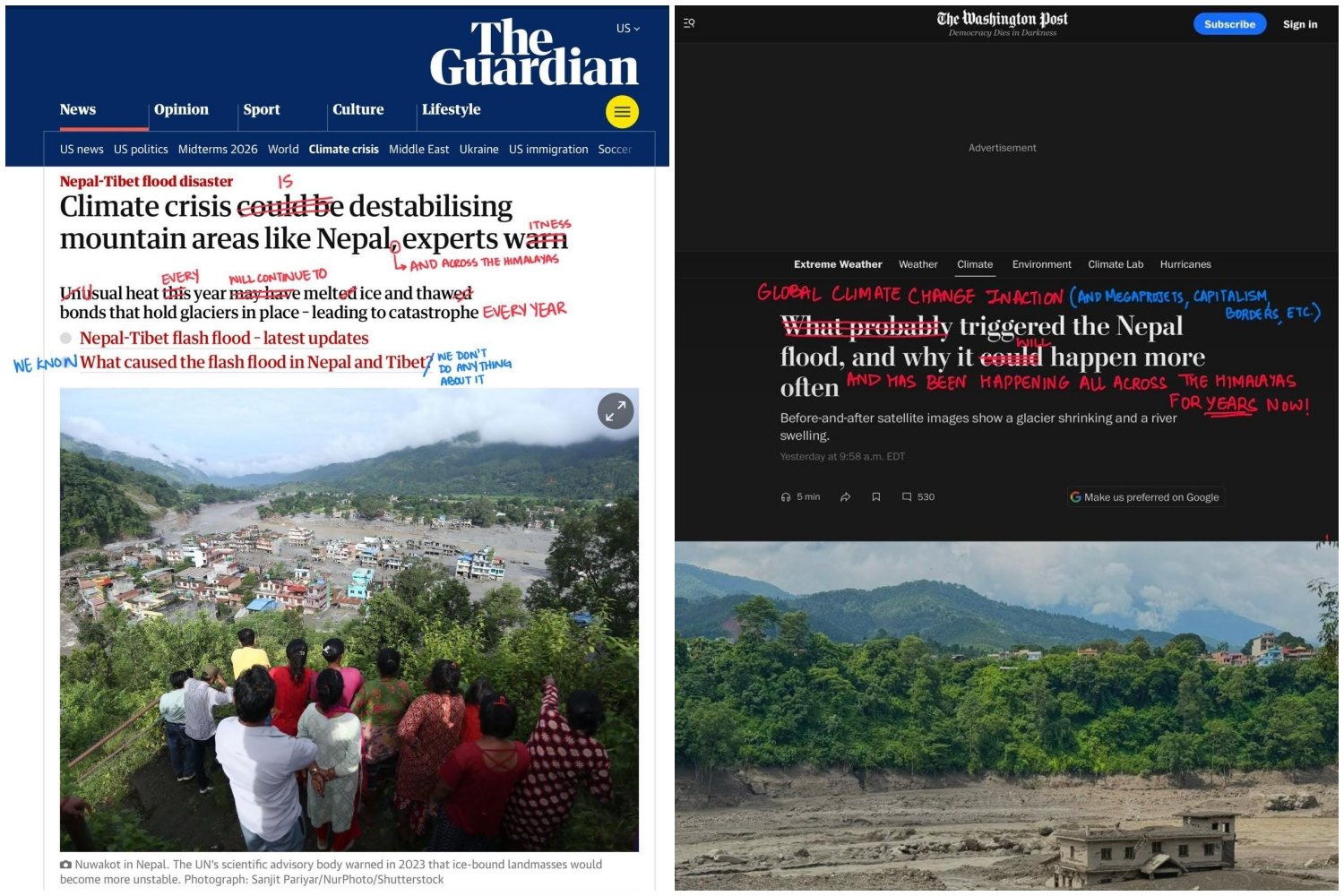
Headlines from The Guardian (left) and The Washington Post (right) covering the Nepal-Tibet flood, marked in red by designers and former Harvard classmates Fatima Hamdani and Bhavya Jain. Photos: FATIMA HAMDANI AND BHAVYA JAIN / INSTAGRAM In coverage of the catastrophic Bhote Kosi flood, many mainstream western news outlets have failed to confidently state the significance of the climate crisis, or to cite the human-made structures that produce it.
Two days after catastrophic flooding began, designers and former Harvard classmates Bhavya Jain and Fatima Hamdani posted a carousel of headlines plucked from mainstream western news outlets on their Instagram.
By taking a red pen to each headline in the style of Alexandra Bell’s Counternarratives series, Hamdani and Jain called attention to journalists’ noncommittal tone, which served to obfuscate the connection between the Bhote Kosi flood and climate change.
The post went viral, with more than 32,000 likes at press time. In an accompanying article on Hamdani and Jain’s shared Substack, Climate Without Borders, they write that news agencies “quote survivors’ shock and panic” but not “experts’ warning from decades past on the climate crisis.”
“Ambiguity is always dangerous because it shies away from responsibility,” Jain tells me. “It is the work of the media to bring attention to evidence that has been ignored or years now.”
DENIALISM
While Hamdani and Jain call out mainstream western media for failing to establish a strong causal link between the flood, glacial collapse, and the warming atmosphere, some argue that western journalists are using climate change as “an explanation without evidence.”
One phone call saved thousands of lives after river gauges were swept away on 26 August
Devesh Belbase·Aug 31, 2026·NEWS
Photo: SUMAN NEPALI
Going by the numbers Nepal uses to define danger, the flood of 26 August was unremarkable.
At 8:40am on 26 August, the automatic gauge on the Bhote Kosi on Nepal’s border with China recorded the water level at 1.62m. It was low, and falling.
That was the last reading of the Rasuwagadi station. The wall of water coming down the Lhende Khola destroyed the equipment before the next reading was due. The gauge at Syaphrubesi 15km downstream died when the water level reached 3.8m. Betrawati was knocked out at 3.55m. These were all below the prescribed Amber warning thresholds.
It was 4pm by the time the flood peaked at 6.57m in Devghat, 170km downstream on the Narayani River. That was the highest point measured during this flood event, but still below the Amber warning level of 7.3m (see charts).
Devghat is the last gauge on the river, and it stayed green throughout the flood of 26 August.
But upstream, hundreds of people had already been swept away the fury of the mudflow. Between Rasuwa to Chitwan, 22 concrete bridges were washed away, a dozen hydropower plants were damaged or destroyed, as were four of the flood monitoring stations built to protect them.
Imagine the escalating conflict between the US, Israel and Iran unfolding in a world powered mostly by wind, solar and batteries rather than oil and gas.
In today’s fossil-fuelled economy, markets react to Iran’s attacks on oil and gas facilities in the Gulf and the threat to close the strait of Hormuz. Oil prices jump. Governments brace for inflation. Around a fifth of the world’s traded oil passes through the narrow corridor, linking the Gulf states to the wider world. When tensions rise there, energy markets react instantly.
But in a world where most energy is generated domestically from renewables, would the same threat trigger the same global shock? Would instability in the Gulf still lead to more expensive food and fuel across the world? Or would the economic aftershocks look very different?
To understand what’s at stake, we need to first look at how today’s energy system is structured.
The strait of Hormuz is the narrow point between the Persian Gulf and the open ocean. AustralianCamera / shutterstock
A system built on chokepoints
For about a century, the global economy has depended on fossil fuels produced by a few producers in the Middle East. Chokepoints like the strait of Hormuz carry enormous strategic weight.
“Steady and pragmatic decarbonisation, rapid clean-energy expansion combined with cautious emission targets, continued coal use to protect energy security and industrial growth.”
China’s leadership has published a draft of its 15th five-year plan setting the strategic direction for the nation out to 2030, including support for clean energy and energy security.
The plan sets a target to cut China’s “carbon intensity” by 17% over the five years from 2026-30, but also changes the basis for calculating this key climate metric.
Medicines and cosmetics use substances derived from nature. But Bioprospecting can turn into biopiracy. More and more companies are patenting natural ingredients making billions. It can come at a cost to the environment and traditional communities living in biodiversity-rich regions.
Walmart, the biggest single buyer of goods in the world, has lowered its emissions intensity and sent emissions-reducing ripples throughout its global supply chain. Joe Raedle/Getty Images
The Trump administration has given corporations plenty of convenient excuses to retreat from their climate commitments, with its moves to withdraw from the Paris Agreement, roll back emissions regulations, and scale back clean-energy incentives.
Visions of planting walls of trees to block the expansion of the desert have long been promoted but never realized. The green wall myth persists today even though it is premised on outdated understandings of desertification. We review the history of the idea of green walls and focus on two sets of contemporary initiatives to assess their outcomes: peri-Saharan programs (Algeria’s Green Dam and Great Green Wall in sub-Saharan Africa) and China’s Three Norths Shelterbelt Program. This review reveals a mixed record of technical success with low rates of the establishment of monocultures of fast-growing trees vulnerable to disease. While there is evidence for reduced wind erosion in some areas, afforestation is also associated with reduced soil moisture and lowering of water tables. Social impacts include increased water scarcity for people and livestock in some cases, and resource enclosures that particularly work against pastoralist livelihoods.
Green walls refer to continuous bands of planted trees stretching across single or multiple countries in dryland regions. As socioecological projects, green walls invoke powerfully attractive images of maintaining life over the assumed sterility of the desert through human ingenuity and effort. A wall of planted trees is envisioned to hold back an expansionary desert from degrading the productivity of the lands behind the wall. Despite the persistent discursive power of this image, its scientific foundation rests on now discredited understandings of desertification.1Desertification, scientifically understood as land degradation due to human mismanagement, is less a regional phenomenon across a broad front than a highly localized phenomenon in areas of greater and more persistent human pressures. The power of the green wall vision is illustrated by its persistent use in promotions of a diverse array of dryland afforestation initiatives with different afforestation patterns (e.g., shelterbelts, scattered woodlots and larger afforested blocks, and agroforestry) and goals (ecological rehabilitation, carbon sequestration, and improved climate resilience). In short, green wall rhetoric mobilizes support and empowers certain actors rather than describing actual dryland afforestation practices.2This article focuses on the vision, practices, and effects of these programs.
This review was written during a period of global enthusiasm for trees and mobilization for mass afforestation, with the World Economic Forum’s Trillion Trees initiative the most prominent example (https://www.1t.org/) but also a wide range of other afforestation efforts across the globe (3). While the arborocentrism of this moment has a long history (see below), concerns about climate change and an interest in increasing the sequestration of industrial carbon has led to a rapid rise of tree planting initiatives. The world’s drylands could be seen as “empty” and thus important “untapped” landscapes to store carbon. Through a consideration of the empirical record of green wall programs, this article outlines reasons to be cautious. Trees are often not suited for the arid zones where they are planted and, even if they are established, may have negative ecological and social impacts (4). By ignoring the need for ecological and social monitoring of afforestation impacts, green wall enthusiasm has often worked to hide the mixed record of these initiatives.
As the name suggests, liquefied natural gas (LNG) involves turning gas into liquid form — a process known as liquefaction. Liquefaction does not alter the chemical makeup of gas, which is comprised of mostly methane plus varying amounts of different impurities, but it does make it denser. This enables ships and other carriers to move more gas over oceans between locations that lack direct pipeline connectivity.
In the early 2010s, the coal industry attracted a large wave of investment, banking on surging coal imports from China and India.
When this growth didn’t materialise, coal oversupply and depressed prices sent major companies bankrupt with significant value destruction for shareholders.
The LNG industry risks repeating the coal industry’s mistakes, as investment levels outstrip future demand, with potentially more severe consequences for the capital-intensive industry.
Peddling a ‘supercycle’ for coal in the 2010s
In the early 2010s, the coal industry was on the rise. Global trade had tripled between 1990 and 2011, with the 2000s experiencing “the largest growth in coal demand in history – greater than the previous four decades combined”. This growth was expected to accelerate after China and India entered the global coal import market (Figure 1). Between 2011 and 2012, global coal imports increased by 13% and coal prices doubled (Figure 2).
The world is facing an unprecedented housing crisis. According to the latest UN-Habitat estimates, 318 million people are homeless, while 2.8 billion people—over a third of the global population—lack access to adequate housing. Behind these stark figures lie deep inequalities that undermine social progress and human dignity.
Adequate housing is more than shelter, it is a foundation for stability, health, education, and opportunity. Without a safe and secure home, individuals are more vulnerable to poverty, exclusion, and poor health outcomes. Homelessness also carries a heavy social cost, eroding trust, cohesion, and the potential for societies to thrive.
The housing challenge is global but manifests differently across contexts. In rapidly urbanizing regions, millions live in informal settlements or slums, where basic services are scarce and conditions unsafe. Today, 1.1 billion people live in such informal settlements, with 90 percent concentrated in Africa and Asia. Conflict, economic inequality, climate change, and natural disasters are major drivers of displacement and housing insecurity, pushing millions into precarious living conditions.
The urgency of the crisis was underlined at the UN-Habitat Assembly in Nairobi (29–30 May 2025), where Member States adopted the UN-Habitat Strategic Plan for 2026–2029. The plan places affordable housing, secure land tenure, and access to basic services at the heart of global priorities. Leaders called for bold and coordinated action, stressing that housing must be treated as a human right and a cornerstone of sustainable development.
The right to adequate housing is embedded in international human rights instruments and explicitly tied to the 2030 Agenda for Sustainable Development. Goal 11 commits the international community to make cities and human settlements inclusive, safe, resilient, and sustainable. Addressing homelessness and housing insecurity is therefore essential to achieving the SDGs and ensuring that no one is left behind.
Tackling homelessness and inadequate housing requires integrated strategies at local, national, and global levels:
Scaling up affordable housing initiatives through innovative financing, public-private partnerships, and policy reforms.
Expanding social protection systems to prevent families from falling into homelessness.
Investing in resilient housing solutions to adapt to the realities of climate change and disasters.
Strengthening community-based models such as cooperatives and housing associations that empower people to participate in shaping their own futures.
Homelessness is not inevitable. With coordinated action and commitment, the global community can reverse these trends. As the world prepares for the Second World Summit for Social Development in Doha, 4-6 November 2025, the message is clear: accelerating social progress requires that every person has access to a safe, secure, and dignified place to call home.
In the area you have selected (Vietnam) tsunami hazard is classified as medium according to the information that is currently available. This means that there is more than a 10% chance of a potentially-damaging tsunami occurring in the next 50 years. Based on this information, the impact of tsunami should be considered in different phases of the project for any activities located near the coast. Project planning decisions, project design, and construction methods should take into account the level tsunami hazard. Further detailed information should be obtained to adequately account for the level of hazard.
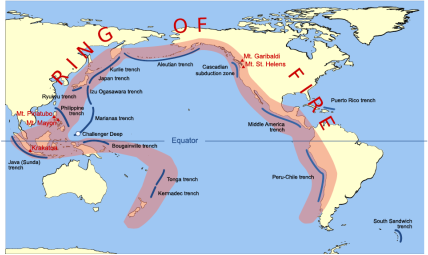
Pacific “Ring of Fire” (enlarged graphic). Source: Adapted from U.S. Geological SurveyDownload Image
Climate change impact: The areas at risk of tsunami will increase as global mean sea level rises. According to the IPCC (2013), global mean sea level rise depends on a variety of factors, and estimates for 2100 range from ~20 cm to nearly 1 m. However, regional changes in sea level are difficult to predict. Projects in low-lying coastal areas such as deltas, or in island states should be designed to be robust to projected increases in global sea level.
Thousands of people march in the sidelines of the COP30 UN Climate Change Conference in Belém, Brazil on Nov. 15, 2025.Pablo Porciuncula—AFP via Getty Image
by Brian Mukhaya Brian Mukhaya is the Africa Program Manager at Clean Air Task Force.
Ten years after the landmark Paris Agreement, the world is still trying to solve two crises as if they were separate: climate change and economic development. That’s a dangerous illusion. Climate progress cannot succeed if billions of people remain in poverty, without electricity, stable food systems, or the means to build better lives. And development, if it ignores climate risk, is little more than a short-term fix that will collapse under the weight of future disasters.
I saw this tension firsthand at COP30 in Belém, Brazil, the annual UN climate summit. The energy there was unmistakable—a mixture of urgency and frustration. Delegates from across Africa reminded the world that promises made in Paris have not been kept. Wealthy nations pledged to support developing countries as they cut emissions and adapted to rising temperatures. Yet, a decade later, those commitments remain largely unfulfilled.
At COP29 in Baku last year, developed countries agreed to mobilize at least $300 billion annually by 2035 for developing countries’ climate action, part of a broader aspirational target of $1.3 trillion per year. While this represents a tripling of the previous $100 billion goal, representatives from developing countries remain skeptical. More fundamentally, the $300 billion commitment falls far short of actual needs. The Independent High-Level Expert Group on Climate Finance estimates that developing countries (excluding China) need approximately $2.7 trillion annually by 2030 to meet climate and nature-related goals. The gap between promise and reality remains vast—and widening
But money is only part of the problem. Even when funding arrives, it often misses the mark. A new analysis by the Clean Air Task Force looked at 52 African countries’ climate and development plans. It found that the two rarely intersect. Climate strategies focus on emissions and energy transitions, while national development plans emphasize job creation and economic growth—but without embedding climate targets. The result is a patchwork of policies that fail to deliver either lasting prosperity or real emissions cuts.
As Bill Gates noted in a recent memo, global climate policy increasingly risks sidelining development altogether. Today, more than 600 million Africans lack access to electricity, while 900 million do not have clean cooking technologies—conditions that undermine productivity, constrain public services, and contribute to preventable deaths.
Crucially, this should not be understood as an either/or dilemma. Wealthy nations already recognize that decarbonization must go hand in hand with economic growth to be politically viable at home. The same is true globally. Emerging and developing economies cannot be expected to choose between climate progress and economic progress. Insisting on a tradeoff between the two as a trade-off is both unrealistic and unjust.
When climate and development are treated as separate silos, everyone loses. Fragmented planning leads to inefficient allocation of scarce resources, missed opportunities for infrastructure investments with broad benefits, and policies that fail to produce either meaningful emissions reductions or durable socio-economic progress. Importantly, this is not a challenge restricted to Africa but a blind spot in international climate governance. Even wealthy countries are discovering that climate action divorced from economic realities is politically unsustainable. When climate action appears to threaten economic growth, job creation, or living standards, political support erodes quickly.
As negotiations in Belém draw to a close, one truth should be clear: climate and development are not competing agendas—they are the same story. Sustainable development is the foundation of lasting climate progress. And climate resilience is the only path to enduring prosperity. Any strategy that treats them separately is doomed to fail.
Development without climate action is a short-term fix. And climate action without development is an empty promise.
Satellite images show how data centers are changing America’s landscape
Business insider
Data centers across the street from residential housing are not an uncommon scene in Virginia.
There are over a thousand planned or existing data centers across the US, according to a BI investigation.
Major tech companies are racing to construct even more as the AI boom continues. But at what cost?
Satellite images show where these facilities are cropping up and why they’re a nuisance to many.
Build, baby, build. That’s the mantra behind the AI boom sweeping America.
This year, alone, Amazon, Meta, Microsoft, and Google are projected to spend about $320 billion in capex, mostly for AI infrastructure, according to an analysis of financial statements by Business Insider.
At the heart of this AI infrastructure growth are data centers that house the specialized hardware and high-speed networking equipment, driving the intensive computations behind large language models. However, AI needs more.
Because AI learns by processing increasingly large amounts of data, improving it requires more computational power, which in turn necessitates more data centers.
A BI investigation found 1,240 data centers across America are already built or approved for construction by the end of 2024.
Global Forest Watch’s (GFW) deforestation alerts provide information about loss of tree cover in near-real-time, making them a critical tool for those working to combat deforestation. Existing alerts on GFW have been used to help Indigenous and local communities protect their forests, halt and prosecute environmental crimes and protect threatened wildlife.
However, in the past, alerts only let users know there’s been a disturbance without identifying a cause, other than a few limited classes such as fires.
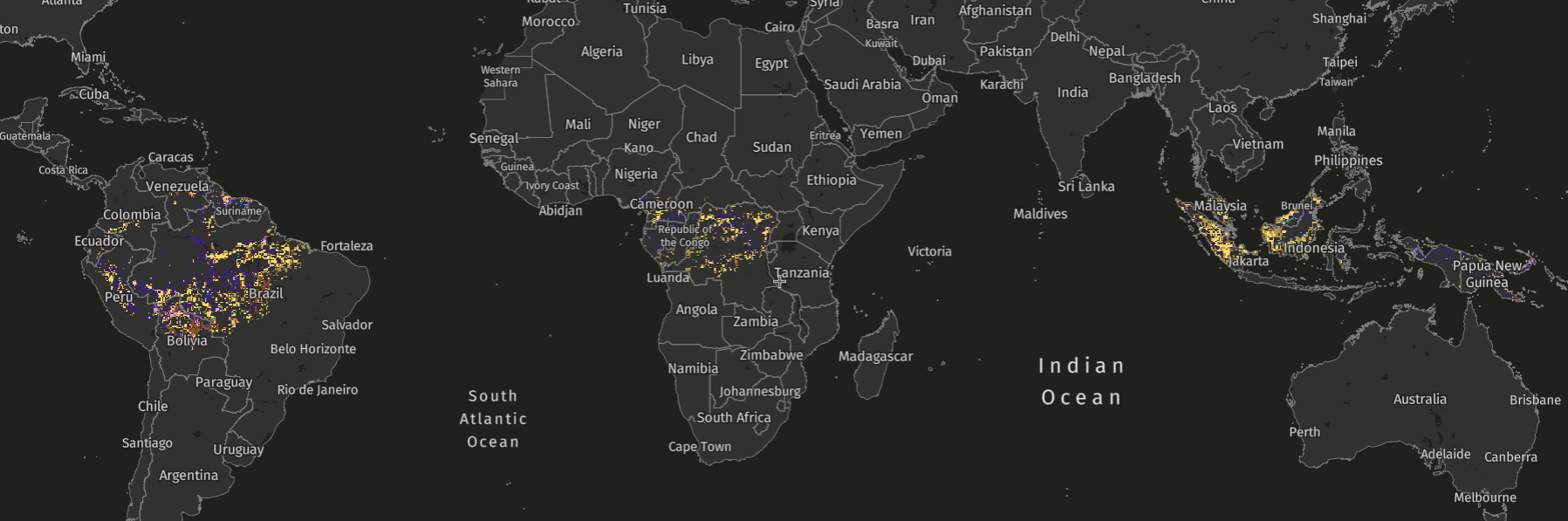
Now, new drivers of deforestation alerts data is available on GFW that shows the causes of alerts across the tropics. This innovative data set uses an AI method to assign drivers to GFW’s integrated deforestation alerts in the three major forested regions in the tropics, allowing users to see what’s driving loss in near-real-time in these regions for the first time.
Critically, this information helps users distinguish between tree cover loss from natural and human causes, enabling more targeted action from those managing forests and reducing the need for costly field visits. Further, the data also provides more rapid information to estimate ecological impacts and supports better understanding of carbon emissions related to forest disturbances.
Almost exactly 10 years ago, a remarkable thing happened in a conference hall on the outskirts of Paris: After years of bitter negotiations, the leaders of nearly every country agreed to try to slow down global warming in an effort to head off its most devastating effects.
The core idea was that countries would set their own targets to reduce their climate pollution in ways that made sense for them. Rich, industrialized nations were expected to go fastest and to help lower-income countries pay for the changes they needed to cope with climate hazards.
So, has anything changed over those 10 years? Actually, yes. Quite a bit, for the better and the worse. For one thing, every country remains committed to the Paris Agreement, except one. That’s the United States.