Nikkei – 50 years ago a major event in the history of money occurred — the “Nixon shock” of August 15, 1971. The “floating exchange rate system” that became the norm after this spurred the development of the global postwar economy. However, it has also frequently caused crises in emerging countries. Recently “digital currencies” have begun to spread, and there are signs that the reserve currency system based on the dollar may be changing. How will the future of currency impact the global economy?
ILO – With support from ILO ENHANCE, the Vietnam Association of Seafood Exporters and Producers (VASEP) has produced a video to highlight the importance of preventing and eliminating child labour from production and processing activities among fishery enterprises and communities, promoting the enforcement of related regulations and requirements.
U.S. President Nixon shakes hands with Chinese President Mao Zedong (Feb. 21, 1972, AP)
nikkei – Feb. 21 marks the 50th anniversary of U.S. President Richard Nixon’s trip to China, a turning point in international relations.
Washington and Beijing joined together to counter the Soviet Union, but China did not democratize as the U.S. hoped. It has now become an economic and military powerhouse under the one-party rule of the Communist Party. A half-century after the handshake that changed the world, cooperation has turned to confrontation. The U.S.-China relationship and global affairs have all undergone tumultuous change.
People stand in line to withdraw U.S. dollars and euros from an ATM in St. Petersburg on Feb. 25. (Dmitri Lovetsky/AP)
Russia’s invasion of Ukraine and the financial reckoningimposed on Moscow in response are proof that the triumphant globalization campaignthat began more than 30 years ago has reached a dead end.
Foreign Ministry spokeswoman Le Thi Thu Hang. Photo courtesy of the ministryVietnam has urged China to respect its exclusive economic zone (EEZ) and continental shelf after Beijing announced drills in the East Sea.
The Hainan Maritime Safety Administration announced March 4 the establishment of a no-go zone for military drills in the East Sea (known internationally as the South China Sea), the southwest of Hainan Island, saying the drills would start from the same day and last until March 15.
Zaporizhzhia nuclear power plant in southern Ukraine. The two tall smokestacks are at a coal-fired generating station about 3km beyond the nuclear plant. Photo credit: Ralf1969 via Wikimedia Commons.
As the Russian invasion of Ukraine began to unfold, Russia’s swift occupation of the Chernobyl reactor complex and the surrounding exclusion zone sparked widespread speculation and concern.[1] The concern was not limited to whether the occupation would cause further radioactive release from Chernobyl;[2] it also included possible Russian military action against other Ukrainian nuclear facilities. These fears were further accelerated when Russian forces shelled and apparently occupied the Zaporizhzhia nuclear power complex near Enerhodar, Ukraine.[3] There have also been reports of attacks on a former Radon disposal site near Kyiv.[4]
World leaders have expressed concerns, and the UN Security Council held an emergency meeting on Friday to discuss the issue. At the meeting, the US ambassador told the emergency session that the assault on the Zaporizhzhia nuclear power plant “represents a dire threat to the world.” [5] The IAEA’s Board of Governors passed a resolution that deplored the Russian invasion and urged Russia to allow Ukraine to continue to control its nuclear facilities. The board’s resolution was similar to a UN General Assembly resolution passed on March 3rd.[6] Despite the high levels of concern the reactors at Zaporizhzhia do not appear to have been damaged and there has been no reported radiation release from the facility.
The Río de la Plata and the city of Buenos Aires, Argentina. A report has warned of the contamination of the world’s rivers by active pharmaceutical ingredients (APIs), especially in developing countries. Copyright: Dan DeLuca/Flickr, (CC BY 2.0).
Pharmaceutical pollution in the world’s rivers is threatening environmental and human health and the attainment of UN goals on water quality, with developing countries the worst affected, a global study warns.
Active pharmaceutical ingredients (APIs) could be contributing to antimicrobial resistance in microorganisms, and may have unknown long-term effects on human health, as well as harming aquatic life, according to the report published in Proceedings of the National Academy of Sciences.
APIs – the chemicals used to make pharmaceutical drugs – can reach the natural environment during their manufacture, use and disposal, according to the study.
“Early results suggest that some of the more polluted mixes are extremely toxic to plants and invertebrates.”
Alistair Boxall, Department of Environment and Geography, University of York, UK
Researchers say they monitored 1,052 sampling sites along 258 rivers in 104 countries, representing the “pharmaceutical fingerprint” of 471 million people linked to these areas.
The highest cumulative concentrations of APIs were seen in Sub-Saharan Africa, South Asia and South America, with the most contaminated sites found in low-to-middle income countries where waste water management infrastructure is often poor, the report says.
Plugging existing, significant, gaps in care services could generate almost 300 million jobs and create a continuum of care that would help to alleviate poverty, encourage gender equality, and support care for children and the elderly, says new ILO report released ahead of International Women’s Day.
GENEVA (ILO News) – Persistent and significant gaps in care services and policies have left hundreds of millions of workers with family responsibilities without adequate protection and support, yet meeting these needs could create almost 300 million jobs by 2035, according to a new International Labour Organization (ILO) report.
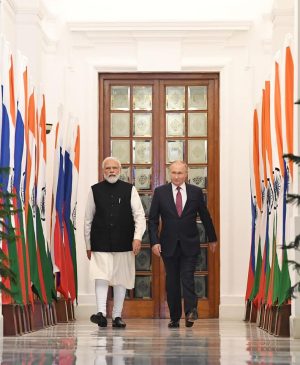
India’s Prime Minister Narendra Modi with Russian President Vladirmir Putin during the summit in New Delhi, India on December 6, 2021.Credit: Facebook/ Ministry of External Affairs, India
Russia’s invasion of Ukraine on February 24 has put India in a particularly difficult spot. Since the conflict between Moscow and the U.S. over Ukraine began escalating late last year, India has avoided taking sides. But with Moscow’s invasion of Ukraine, that cautious approach will become increasingly untenable for New Delhi. It could hurt India’s interests in the long-run.
For over 30 years, Ukraine has been a popular destination for Indians to study medicine, dentistry, and nursing. Now many of them are left stranded in a war zone.
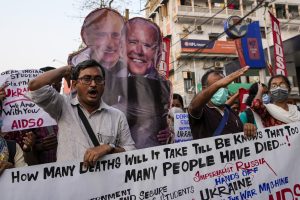
Activists of All India Democratic Students Organization shout slogans during a protest against the Russian invasion on Ukraine, in Kolkata, India, Thursday, March 3, 2022.Credit: AP Photo/Bikas Das
The tragic death of an Indian medical student, Naveen Shekharappa Gyanagoudar, in war-torn Ukraine, due to Russian shelling, has roiled India while spotlighting the desperation of thousands of Indians to rush to study in this east European nation every year.
zing – Phụ nữ nhận quà dịp 8/3 có thể nhắc nhở người đàn ông tặng rằng cử chỉ lịch lãm trong một ngày không thể cứu vãn được hành vi vô duyên suốt 364 ngày còn lại trong năm.
Cameron Shingleton, Giảng viên đại học, là tác giả cuốn sách “Những điều bạn chưa biết về trai Tây” (NXB Trẻ 2017) được viết bằng tiếng Việt. Sinh ở Melbourne, Australia, anh tốt nghiệp tiến sĩ ở Đại học Melbourne. Trong 5 năm sống ở TP.HCM, Cameron đã học tiếng Việt và tìm hiểu sự khác biệt trong văn hóa Đông – Tây.
Australia, nơi tôi sinh ra và lớn lên, không kỷ niệm Ngày Quốc tế Phụ nữ. Nhiều năm trước, khi lần đầu đến Việt Nam để học tiếng Việt, tôi mới có những trải nghiệm đầu đời về ngày 8/3. Lạ lẫm, bối rối nhưng thú vị và có ý nghĩa là những gì tôi cảm nhận được.
Two sisters use a smartphone of their parents for online studying in Vietnam’s southern Can Tho City, September 2021. Photo by VnExpress/Duc Duy
The Ministry of Information and Communications has put forward a plan to give each poor family a tablet if they cannot afford one.
In a draft circular it is putting forward for feedback, the ministry said each poor family should be given a tablet in case they have not received it from any other benefactors or charity programs.
Recent public pushback shows that Vladimir Putin could be meeting his match – not just with Ukrainians, but also his own people who are tiring of constant wars.
FILE PHOTO: Russian President Vladimir Putin and Turkish President Tayyip Erdogan leave after their joint news conference following the talks in Moscow, Russia March 5, 2020. Sputnik/Mikhail Klimentyev/Kremlin via REUTERS
ANKARA (Reuters) – Turkish President Tayyip Erdogan urged his Russian counterpart Vladimir Putin on Sunday to declare a ceasefire in Ukraine, open humanitarian corridors and sign a peace agreement, his office said.
NATO member Turkey shares a maritime border with Russia and Ukraine in the Black Sea and has good ties with both. Ankara has called Russia’s invasion unacceptable and offered to host talks, but has opposed sanctions on Moscow.
The newest report from the Intergovernmental Panel on Climate Change (IPCC) paints a troubling picture: Climate change is already impacting every corner of the world, and much more severe impacts are in store if we fail to halve greenhouse gas emissions this decade and immediately scale up adaptation.
Following on the first installment of the IPCC’s Sixth Assessment Report, Working Group II’s contribution, released on February 28, 2022, draws from 34,000 studies and involved 270 authors from 67 countries. It provides one of the most comprehensive examinations of the intensifying impacts of climate change and future risks, particularly for resource-poor countries and marginalized communities. The 2022 IPCC report also details which climate adaptation approaches are most effective and feasible, as well as which groups of people and ecosystems are most vulnerable.
UN Secretary-General Antonio Guterres called the report “an atlas of human suffering and a damning indictment of failed climate leadership.
Here are six takeaways from the report:
1. Climate impacts are already more widespread and severe than expected.
Climate change is already causing widespread disruption in every region in the world with just 1.1 degrees C (2 degrees F) of warming.


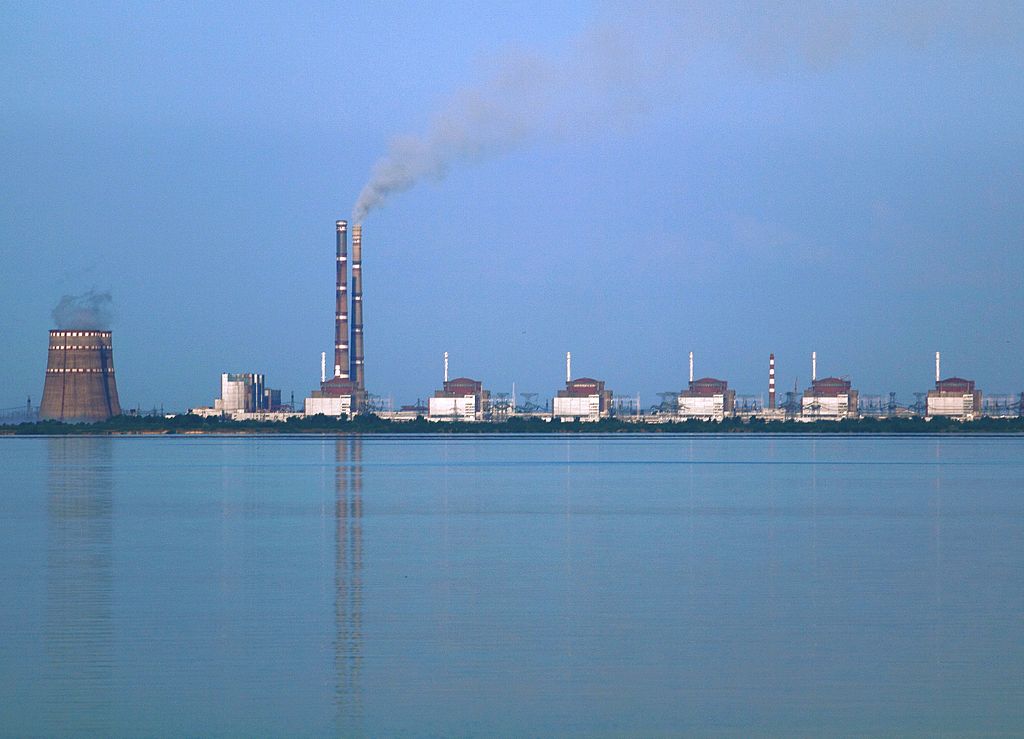 Zaporizhzhia nuclear power plant in southern Ukraine. The two tall smokestacks are at a coal-fired generating station about 3km beyond the nuclear plant. Photo credit: Ralf1969 via Wikimedia Commons.



 CVD
CVD 