UNODC.org
 Hanoi (Viet Nam), 29 August 2017
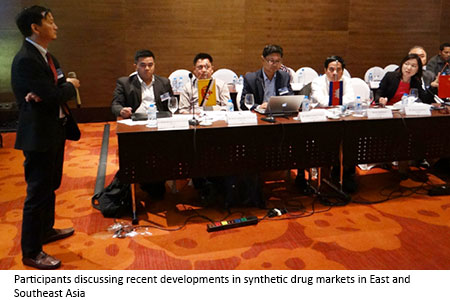
 – East and Southeast Asia are at the heart of the global synthetic drug trade, with some drugs manufactured and trafficked in and from the region causing serious public health problems in the region and other parts of the world, said the United Nations Office on Drugs and Crime (UNODC) at a high level in Hanoi, Viet Nam, with the ASEAN group of states, Australia, Canada, China, Japan, the Republic of Korea, the United States, and the European Union.
The region has recently been acknowledged to be the largest methamphetamine market, with seizures surpassing the total for North America. Most countries in the region have reported record meth seizures in recent years, and the number of people admitted for methamphetamine treatment has also been on the rise for several years in a row.
“Methamphetamine use is on the increase across Viet Nam, not only among young drug users in major cities, but also industrialized areas, villages and communities,” said Hoang Anh Tuyen, Deputy Director of the Standing Office on Drugs and Crime (SODC) of the Ministry of Public Security of Viet Nam. “We will not be able to cope unless market demand is addressed and we make progress on trafficking into the country with our neighbours.”
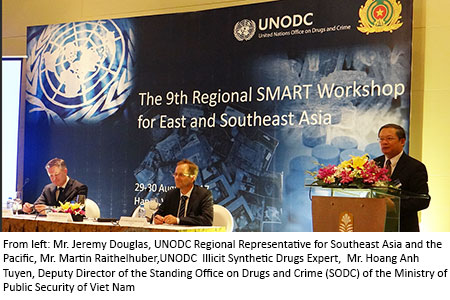
“High purity methamphetamine from East and Southeast Asia is increasingly available in elsewhere, and synthetic drugs like fentanyl have become a serious public health problem in Canada and the United States where the number of drug overdose deaths have been rapidly increasing”, said Jeremy Douglas, UNODC Regional Representative for Southeast Asia and the Pacific. “These drugs are cheap to produce, powerful compared to other more traditional drugs, and easy to traffic and mix into existing drug markets. The profit potential for transnational organised crime is also far higher than for drugs like heroin.”
Data discussed at the conference confirmed that there is no sign of slowing down in the expansion of the regional methamphetamine market. In 2016, 31 metric tons of crystal meth and 335 million meth tablets were seized in the region. “There is no other region that is showing year-on-year increases like East and Southeast Asia, and yet it has been happening every year for the last decade,” said Martin Raithelhuber, Illicit Synthetic Drugs Expert with UNODC.
To support countries to better respond to synthetic drug challenges UNODC has brought together national authorities to candidly exchange information and discuss solutions. Mr. Raithelhuber highlighted that, “Flows of synthetic drugs and related chemicals within and from the region are complex, and enhanced coordination and information sharing among is vital.” He further added that “We will continue to provide technical assistance to help countries address these challenges together.”
Click here to learn more about UNODC’s work on Drugs and precursors.
Click here to learn more about the UNODC Global SMART (Synthetics Monitoring: Analyses, Reporting and Trends) Programme.
Click here to learn more about the Asia and Pacific Amphetamine-Type Stimulants Information Centre.
Đăng bởi Đào Thu Hằng
I'm from Hanoi, Viet Nam.
I'm an author of Dot Chuoi Non (dotchuoinon.com/author/hangbelu/), a blog on Positive thinking, founded by Dr. Tran Dinh Hoanh, an attorney in Washington DC.
I'm a co-founder of Conversations on Vietnam Development - cvdvn.net, a virtual think tank. I am a co-founder of two companies in Viet Nam working on children education services. I advise companies on STEAM education, English language education for children and students in Vietnam.
I'm studying the Buddha's teaching and the teaching of Jesus. I practice mindful living including meditation.
I hold a PhD on Sustainable Energy Systems from University of Lisbon and Aalto University.
I graduated from Hanoi University of Technology on Environmental Engineering. I obtained a Master degree of the same major from Stanford University and Nanyang Technological University.
My English-language blog at: hangbelu.wordpress/.
I play table tennis as a hobby.
Xem tất cả bài viết bởi Đào Thu Hằng


 CVD
CVD 