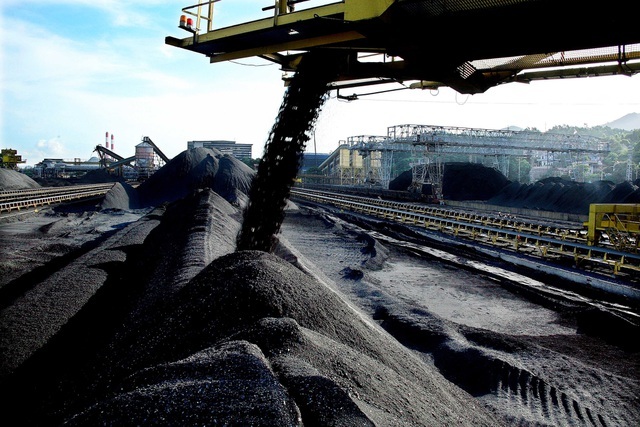
The slow development of a waste collection, transport and treatment system in Vietnam is caused mostly by limited financial resources.
According to the Directorate General of Environment, 13,000 tons of waste is generated every day in HCM City, including 8,300 tons of domestic waste, 1,500-2,000 tons of industrial waste, 1,200-1,600 tons of waste from construction works, 22 tons of medical waste and 2,000 tons of sludge of different kinds.
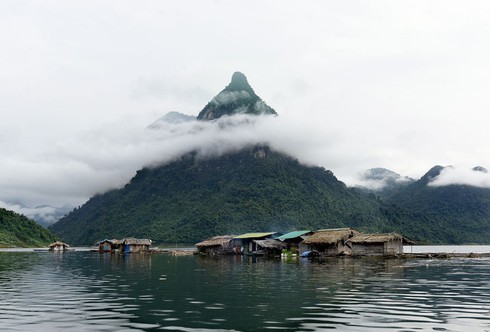
110 kilometers from Tuyen Quang city, the Na Hang eco-tourism area has emerged as a tourist destination popular for its unspoiled beauty and unique ethnic culture.
Na Hang lake (Photo: baobackan.org.vn)
‘Na Hang’ in the Tay ethnic language means ‘the last field’. Na Hang wins points for its vast green fields, limestone mountains, primeval forest, and giant lake.
The Na Hang eco-tourism area stretches over 15,000 hectares, more than half of which is water. The Na Hang–Lam Binh reservoir, which connects with Ba Be National Park, is the biggest reservoir in Vietnam’s northern region.
“The death penalty could be considered for such act in accordance with the Penal Code. In this very urgent situation, when the whole country is trying hard to fight Covid-19, it is necessary to strictly punish such acts for deterrence.”
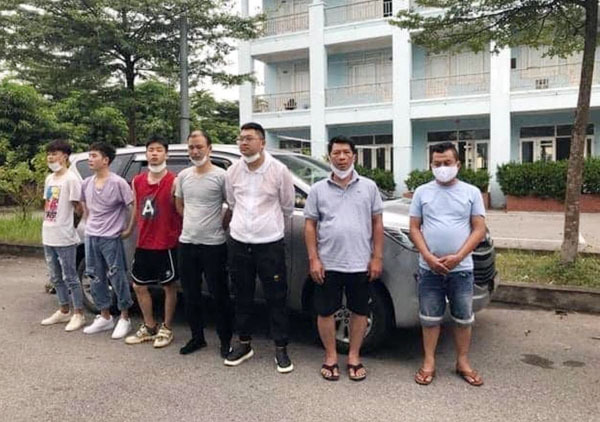
Chinese people who illegally entered Vietnam are detected by traffic police on Noi Bai – Lao Cai expressway. (Photo: Lao Cai newspaper)
This is the opinion of National Assembly (NA) deputy Bui Van Phuong, member of the NA Economic Committee, vice head of the NA delegation of Ninh Binh province in response to the proposal of the HCM City Center for Disease Control (HCDC): “It is necessary to impose heavy sanctions against people who illegally enter the country, to consider imposing special criminal penalties on those who give a hand to illegal entry.”
Bloomberg News August 17, 2020, 4:00 AM GMT+7 Updated on
Tensions rise as president highlights tough-on-China stances
Topics range from TikTok to Taiwan jet sales to Hong Kong
The almost daily drumbeat of tensions between the U.S. and China shows little sign of letting up, while touching on everything from the coronavirus to trade to defense issues to monetary policy.
President Donald Trump has made his tough positions on China a key element in the lead-up to the U.S. presidential election, now less than three months away, and he seems intent on keeping the pressure on.
The hawks in Donald Trump’s administration are on the ascent. Do not expect the US to u-turn on this march towards a harsher stance on China, say Steven R Okun and James Green.
A WeChat logo is displayed on a mobile phone as a woman walks past as she talks on her mobile phone at a taxi rank in this picture taken on Jul 21, 2016. (Photo: REUTERS/Siphiwe Sibeko)
SINGAPORE: Last week’s suite of actions by the United States against WeChat and TikTok were among the most significant developments since March 2018 when US President Donald took formal action in retaliation for China’s unfair trade practices.
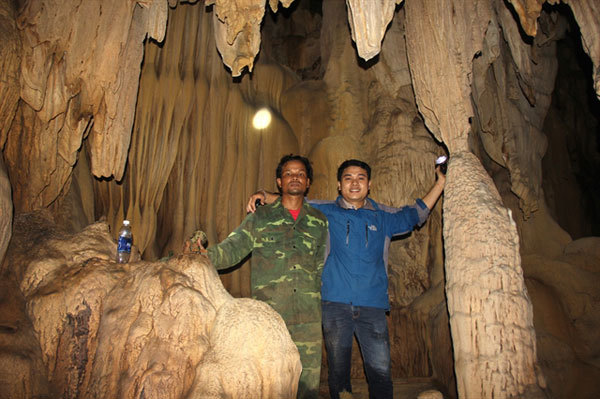
A large cave has been discovered in Tria Village, Huong Son Commune, Huong Hoa District in the central province of Quang Tri, according to Do Van Binh, the director of provincial Department of Culture, Sports and Tourism.
Locals in Tria Village, Huong Son Commune, Huong Hoa District in the central province of Quang Tri have informed the local authority about the discovery of a new cave in the area.
Binh told VN News he was informed by phone by a local about the cave. However, it was unclear by whom and when it was discovered.
On the night of December 27, 1972 during the “Hanoi-Dien Bien Phu in the air” campaign, an American B-52 bomber was shot down by Vietnamese soldiers and part of it landed where it still remains today in Huu Tiep Lake in Ngoc Ha Ward, Ba Dinh District. Ms. Doan Thi Hien, a local who was a witness of the plane crash, said Battalion 72 of Regiment 285 of Hai Phong Air Defense shot down the B-52 bomber.
Vietnam has increasingly imported coal and crude oil during the social distancing period for thermal power plants.
Statistics from the General Department of Vietnam Customs show that in July, Vietnam imported nearly 4.4 million tonnes of coal at the cost of VND1.4m (USD60) a tonne. In the first seven months, Vietnam imported a total of 36 million tonnes for USD2.5bn.
Former Deputy Minister of Transport Nguyen Hong Truong has been prosecuted and arrested for investigation of the acts of violating regulations on the use of state property, causing loss and waste according to Article 219, Penal Code 2015.
Former Deputy Minister of Transport Nguyen Hong Truong
According to VietNamNet’s source, the Investigation Police Agency under the Ministry of Public Security has prosecuted Mr. Nguyen Hong Truong, former Deputy Minister of Transport, for breaching the regulations on the use of state assets, causing waste and losses. The investigation agency has also applied procedural measures against 3 other defendants, including former Minister of Transport Dinh La Thang.
“Bệnh nhân 832″, 37 tuổi, ở Quảng Trị, chiều nay được xác định tử vong vì suy tim trên nền bệnh lý nặng và mắc Covid-19.
Thứ trưởng Y tế Nguyễn Trường Sơn, Trưởng Bộ phận thường trực đặc biệt chống dịch Covid-19 của Bộ Y tế tại Đà Nẵng, chiều 11/8 xác nhận “bệnh nhân 832” qua đời và là ca tử vong thứ 16 kể từ đầu dịch.
A Vietnam Coast Guard crewman looks out near a patrol ship being built at a shipyard in Danang in July 2014. Japan has signed a ¥36.6 billion deal with Vietnam to provide the Southeast Asian country with six patrol boats to boost its maritime law enforcement capabilities. | REUTERS
Japan has signed a ¥36.6 billion ($345 million) loan agreement with Vietnam to provide the Southeast Asian country with six patrol boats to boost its maritime law enforcement capabilities, as Beijing steps up its claims in the South China Sea.
China’s Ministry of Foreign Affairs spokesperson Wang Wenbin during a daily briefing at the Ministry of Foreign Affairs in Beijing. Photo / AP
As tensions between Taiwan and China continue to escalate, satellite images reportedly show amphibious armoured vehicles and mobile missile launchers massing at military bases near the island nation.
Though Taiwan, a country of 25 million people, is happy as an independent democracy, Beijing insists it is a “breakaway province” and “inviolate” Chinese territory, repeatedly stating it will use force to bring the island back under China’s control.
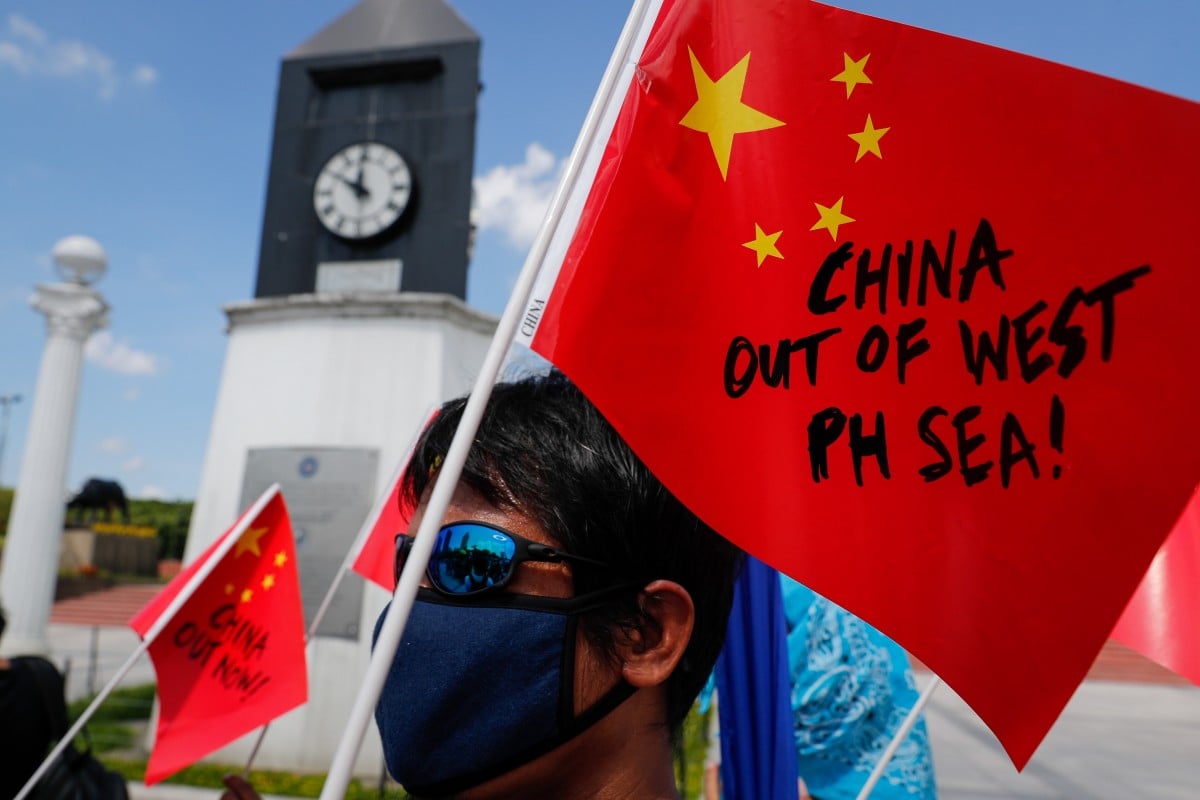
A protest in Manila against China’s actions in the South China Sea. Photo: EPA
The Philippine navy chief has called for a diplomatic protest to be filed against the presence of two Chinese research ships in a disputed area of the South China Sea.
Vice-Admiral Giovanni Bacordo told the Foreign Correspondents Association of the Philippines on Monday the Chinese vessels had been near the Reed Bank for “about a week already” and that due to their speed of “about three knots” the navy had concluded they were “conducting surveys”. Tiếp tục đọc “South China Sea: Philippine navy chief warns of Chinese ‘provocation’”→
What a difference two months can make. In May, Taiwan Semiconductor Manufacturing Co. (TSMC), the world’s largest chipmaker, lost the business of Huawei Technologies—its biggest Chinese customer and the source of 13% of its revenue—as a casualty of geopolitical jockeying between superpowers. But TSMC shareholders took the loss in stride. And by late July, after a stumble by rivalIntel, TSMC’s stock had risen almost 50% since May, making it one of the world’s 10 most valuable companies.
May’s low and July’s high have something in common: They both reflect TSMC’s distinctive role in the global tech economy. Although far from a household name, TSMC controls roughly half of the world’s contract chip manufacturing. Brand-name companies that design their own chips—most notably Apple—rely on TSMC’s world-class production so they don’t have to spend tens of billions to build their own factories. Crack open your iPhone and you’ll find a chip from TSMC. If you could crack open an American guided missile, you’d likely find one there too. Its prowess has elevated TSMC to No. 362 on the Global 500, with $35 billion in revenue. Today it gets 60% of sales from the U.S. and about 20% from mainland China.
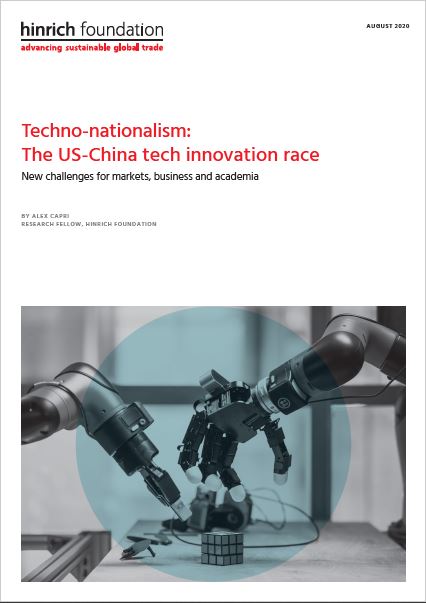
Techno-nationalism: The US-China tech innovation race New challenges for markets, business and academia BY ALEX CAPRI RESEARCH FELLOW, HINRICH FOUNDATION, 20202
The US-China tech innovation race is challenging the laissez-faire economic model. State interventionism, techno-nationalism and US tech funding initiatives are increasing. This paper outlines the implications for markets, academia, research organizations, and governments of the US-China competition to achieve innovation advantage.
A US-China tech innovation race has sparked a paradigm shift in global trade and commerce that is challenging the long-standing primacy of the world’s open trading system.
Current thinking is tilting towards increased state activism and interventionism, not only in the technology landscape but in many of the industries of the future.
Driving this change is techno-nationalism: a mercantilist-like behavior that links tech innovation and enterprise directly to the national security, economic prosperity and social stability of a nation.
In response to decades of Beijing’s innovation-mercantilism, the US has embarked on its own innovation offensive. Washington’s future tech funding initiatives could surpass the scale of the “moonshot” projects last seen during the space race with the former Soviet Union.
Download “Techno-nationalism: The US-China tech innovation race” by Alex Capri
The innovation race involves a broad range of emerging and foundational technologies that will define the industries of the future, including:
Artificial Intelligence (AI) and machine learning
Quantum computing and information systems
Robotics
Energy storage
Semiconductors
Next generation communication (including 5G and 6G)
Hypersonics.
Underlying themes: US techno-nationalism and innovation
As Washington and its allies ramp up techno-nationalist initiatives, core themes will drive the paradigm shift.
Public-private partnerships (PPP) – Technology alliances and government-funded initiatives will play an increasingly important role in advancing long-term innovation in the US, the EU and other traditionally open markets.
Avoiding the China innovation model – The US and EU innovation agendas will not seek to emulate China’s centralized, authoritarian system of techno-nationalism, but, rather, to turbo-charge markets and leverage entrepreneurial ecosystems, as well as academic and defense establishments.
Balancing tensions between MNEs, markets and techno-nationalism – Multinational enterprises (MNEs) will remain the primary drivers of R&D and innovation in free markets and play a vital role in PPP initiatives. They will be pulled into the US-China technology war in a variety of ways which will require a careful balancing of market forces, the interests of MNEs and the needs of state actors.
Multilateral technology alliances – US techno-nationalist policy will increasingly align with the security, economic and ideological objectives of the EU and other historic allies. This will produce more cooperation between the US and its partners.
Section I – The US-China innovation race: The role of the state
This section examines trends for public-spending in R&D and innovation and reviews a series of techno-nationalist funding initiatives from the US government.
It analyzes state activism in free markets and why governments are uniquely qualified to promote innovation and “blue-sky” technologies in ways that the private sector cannot.
Finally, Section I spotlights a historic example of techno-nationalism: SEMATECH and the US semiconductor public-private partnership, which led to a technological leapfrog by the US semiconductor industry, past Japan, in the 1990s.
Section II – MNEs, markets and governments: Navigating new complexities
Section II focuses on non-state actors and their increasingly complex role in public-private partnerships. It explores the tensions between open market forces, multinational companies, and techno-nationalist state activism.
To highlight these tensions, the report analyzes Facebook’s “Libra initiative and Beijing’s efforts to reduce dependency on the US dollar via the digital Yuan, and the challenges those create for MNEs. A US semiconductor sector case study illustrates how state activism can have detrimental effects on markets and backfire on the very parties it is looking to protect.
Section II concludes with an analysis of how open-sourced innovation could be a game-changer in the US-China technology war, particularly regarding future 5G wireless competition.
Section III – Academia and techno-nationalism: Open versus closed systems
Universities, research organizations and academia have become hot zones in the US-China innovation race. Human capital development is key to conducting leading-edge R&D and driving innovation.
Section III looks at how US export controls are affecting R&D activities at universities. It highlights the rules-based frameworks that universities must build to handle increasing government funding into academia.
The section showcases China’s Thousand Talents program and highlights its challenges for public-private partnerships involving academia. It also discusses why the US, in particular, should keep its human capital and innovation pipeline open as it pertains to foreign students, fundamental research programs and, ultimately, why an open system (despite China’s exploitation of it) is better than a closed one.
Finally, section III looks at how some inevitable strategic decoupling between Chinese and US entities will result in the ring-fencing of more “sensitive” R&D activities within the US defense establishment.
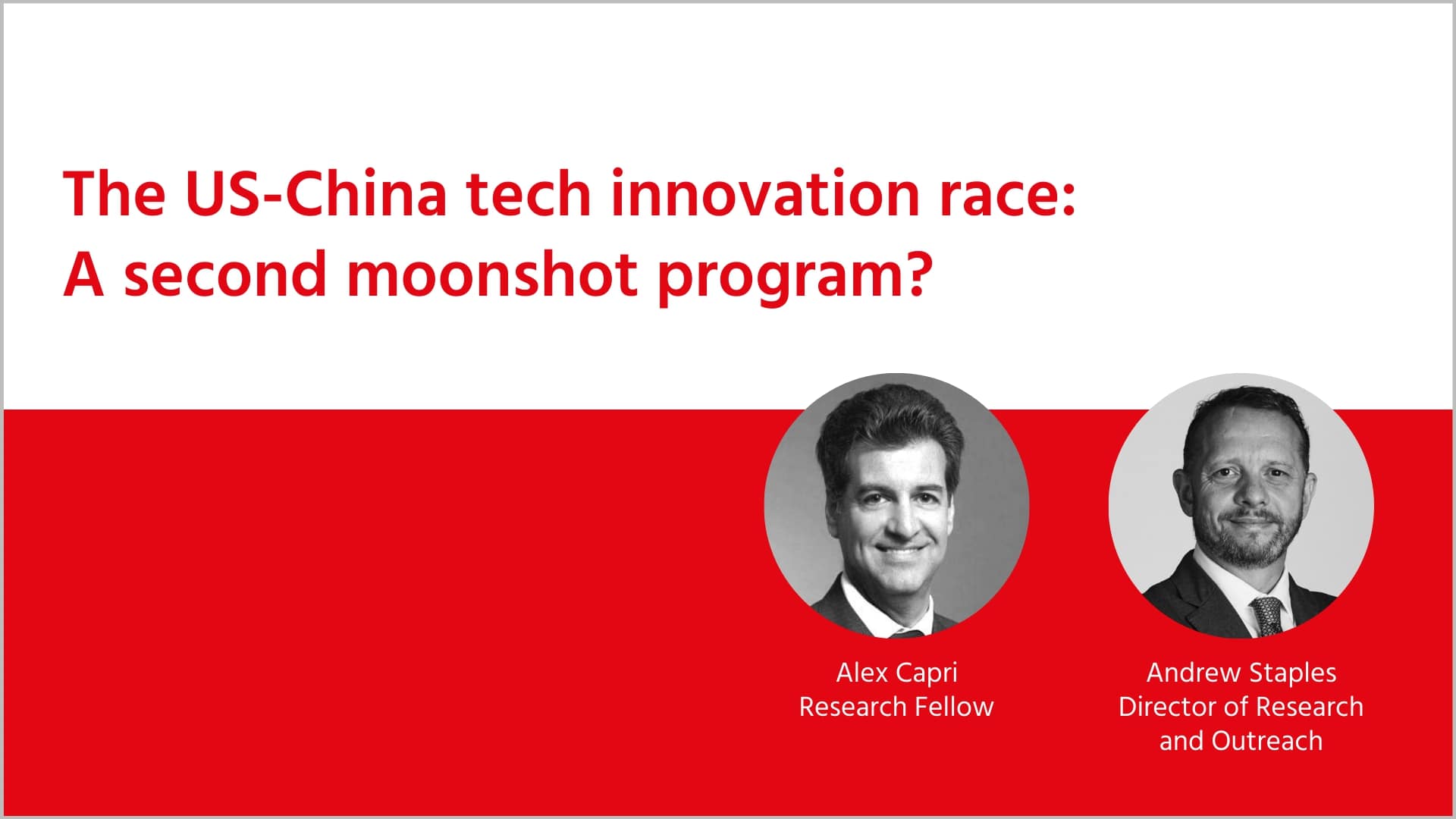
Listen to a summary of the report in this podcast featuring Alex Capri and Andrew Staples, Director of Research and Outreach.
Alex Capri is a Research Fellow at the Hinrich Foundation with over 20 years of experience in value chains, logistics and global trade management, both as an academic and a professional consultant.








/cloudfront-ap-southeast-2.images.arcpublishing.com/nzme/JOTZLHCVLRAELOW36A36GMN27U.jpg)





 CVD
CVD