
- US assistant secretary of state hints at punitive action against state firms accused of ‘bullying’ regional neighbours
- Beijing has clashed repeatedly with rival claimants to the resources of the disputed waterway

Several Chinese state-owned companies could be hit with US sanctions for their roles in expanding the nation’s presence in the disputed waters of the
During a speech at the Centre for Strategic and International Studies on Tuesday, Stilwell named state-owned China Communications Construction Company (CCCC), which has helped to develop many of the man-made islands in the South China Sea, and
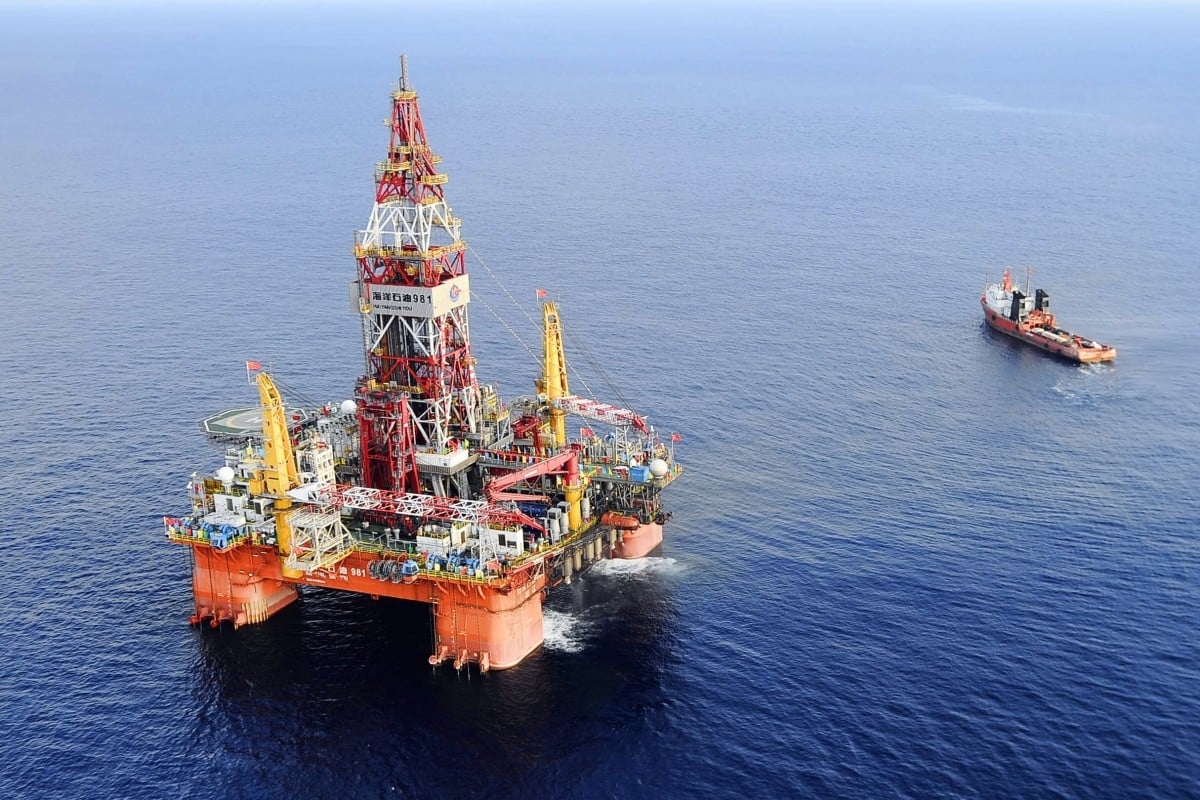
, which has positioned a massive drilling rig in disputed waters also claimed by Vietnam.
While he did not say what the sanctions might involve, US Senator Marco Rubio earlier pushed for sanctions against a number of Chinese state-owned companies – including CNOOC, CCCC and two of its subsidiaries – demanding the US government block their assets in the US and exclude company officials from doing business in the US.
Stilwell’s comments came after
, raising the risk of a possible confrontation between the two countries.
Beijing claims most of the South China Sea and its offshore resources based on its so-called nine-dash line, but many of its neighbours, including Vietnam, the Philippines, Malaysia and Brunei, hold opposing views.
Observers said any sanctions would depend on how the US and Southeast Asian countries defined China’s actions.
“Agreement between the US and Southeast Asian countries about when and where China can be considered to be acting unlawfully … sets the stage for negotiations or judicial action by the aggrieved states,” said Jay Batongbacal, an international maritime affairs professor at University of the Philippines.
“For example, if CNOOC were to try to award exploration blocks over an area of Malaysia’s continental shelf, Malaysia and the US would be justified in taking legal action against CNOOC, if CNOOC had other business with them,” he said.
This could be more damaging as many Chinese state-owned companies have been actively involved in the
,
’s plan to boost global investment and infrastructure.
For example, CNOOC owns onshore projects in the US states of Texas, Colorado and Wyoming, as well as in the Gulf of Mexico, while its subsidiary has shares in a number of oil projects in the US.
CCCC has worked closely with Southeast Asian countries, and in December won a US$10 billion deal to build an international airport outside Manila under the belt and road programme.
Soon after the Philippines filed a lawsuit against China in The Hague in 2013, Beijing launched unprecedented dredging in the Spratly Islands in the South China Sea to create seven artificial islands, International Financial News, a newspaper affiliated with Chinese Communist Party mouthpiece People’s Daily, reported in 2015.
In May 2014, shadowed by as many as 86 Chinese vessels, including a navy frigate and two amphibious landing ships, the US$1 billion Haiyang Shiyou 981 drilling rig was moved to waters near the Paracel Islands in South China Sea.
Beijing said the rig was operating within its territory, but Hanoi said its position was within Vietnam’s exclusive economic zone. It also accused Beijing of using bullying tactics and trying to ram Vietnamese fishing boats in the energy-rich waters.
The drilling platform was removed in July the same year, which Beijing said was in line with its original plans.
Beijing has been widely criticised for its island-building and militarisation of the South China Sea. Chinese state-owned companies have been widely involved in the development, with satellite images analysed by defence consultancy IHS Jane’s showing Tianjin Dredging Company – a CCCC subsidiary – as playing a part in developing coral atolls – including Mischief, Suba and Fiery Cross reefs – into larger islands that are now home to airstrips and military installations.
Additional reporting by Holly Chik

 CVD
CVD 