
Besides school closures and dragon fruit bánh mì, the Covid-19 epidemic has also inspired a plethora of whimsical coronavirus-themed songs, videos and parodies. Tiếp tục đọc “V-pop song about Coronavirus is going viral”
Tháng: Tháng Ba 2020
Environmental damage to coral reefs in South China Sea
Date: February 27, 2020
Source: James Cook University
Summary: New research reveals the unseen environmental damage being done to coral reefs in the hotly contested South China Sea, as China and other nations jostle for control of the disputed sea lanes.
New research reveals the unseen environmental damage being done to coral reefs in the hotly contested South China Sea, as China and other nations jostle for control of the disputed sea lanes.
Professor Eric Wolanski and Dr Severine Chokroun from James Cook University in Australia are physical oceanographers, researching the distribution, circulation, and physical properties of water.
In a new scientific paper, they argue that the disputed Spratly Islands in the South China Sea are in even more serious trouble than first believed.
“The Spratlys are the sites of a military build-up and gross overfishing, mainly by China. Reefs and islands have been destroyed to construct military outposts to further territorial claims,” said Professor Wolanski. Tiếp tục đọc “Environmental damage to coral reefs in South China Sea”
A plague of locusts has descended on East Africa. Climate change may be to blame.
Human activity has made an ocean circulation pattern misbehave—triggering a weird confluence of events that has caused the infestations.
Desert locusts have swarmed into Kenya by the hundreds of millions from Somalia and Ethiopia, where such numbers haven’t been seen in a quarter-century. The insects are decimating farmland, threatening an already vulnerable region.
East Africa is in the midst of a crisis that sounds like something out of the Book of Exodus: A plague of locusts is spreading across the region, threatening the food supply of tens of millions. City-sized swarms of the dreaded pests are wreaking havoc as they descend on crops and pasturelands, devouring everything in a matter of hours. The scale of the locust outbreak, which now affects seven East African countries, is like nothing in recent memory. Tiếp tục đọc “A plague of locusts has descended on East Africa. Climate change may be to blame.”
The Future Energy Show Vietnam 2020 to take place in Ho Chi Minh City
Returning on 8-9 July 2020 to The Adora Center, Ho Chi Minh City, The Future Energy Show Vietnam 2020, co-located with The Power & Electricity Show Vietnam, The Energy Storage Show Vietnam, The Smart Energy Show Vietnam and The Solar Show Vietnam, will bring together policy makers, regulators, investors and financiers, utilities, power producers, project developers, renewable energy vendors, with the business owners and land developers to discuss the future of energy in Vietnam.
Tiếp tục đọc “The Future Energy Show Vietnam 2020 to take place in Ho Chi Minh City”
Vietnam approves MOU on establishing China-ASEAN Center
Source: Xinhua| 2020-02-29 21:57:15|Editor: xuxin
HANOI, Feb. 29 (Xinhua) — The Vietnamese government issued a resolution on Friday to approve the Memorandum of Understanding (MOU) on Establishing the China-ASEAN Center signed in 2017, Vietnam News Agency reported Saturday. Tiếp tục đọc “Vietnam approves MOU on establishing China-ASEAN Center”
Family of retired Sydney baker jailed in Vietnam say Australia needs to do more
As Chau Van Kham, a member of a banned pro-democracy group, prepares for his final appeal, his son fears he will die jail

Tiếp tục đọc “Family of retired Sydney baker jailed in Vietnam say Australia needs to do more”
Vietnam joins ASEAN effort to combat IUU fishing
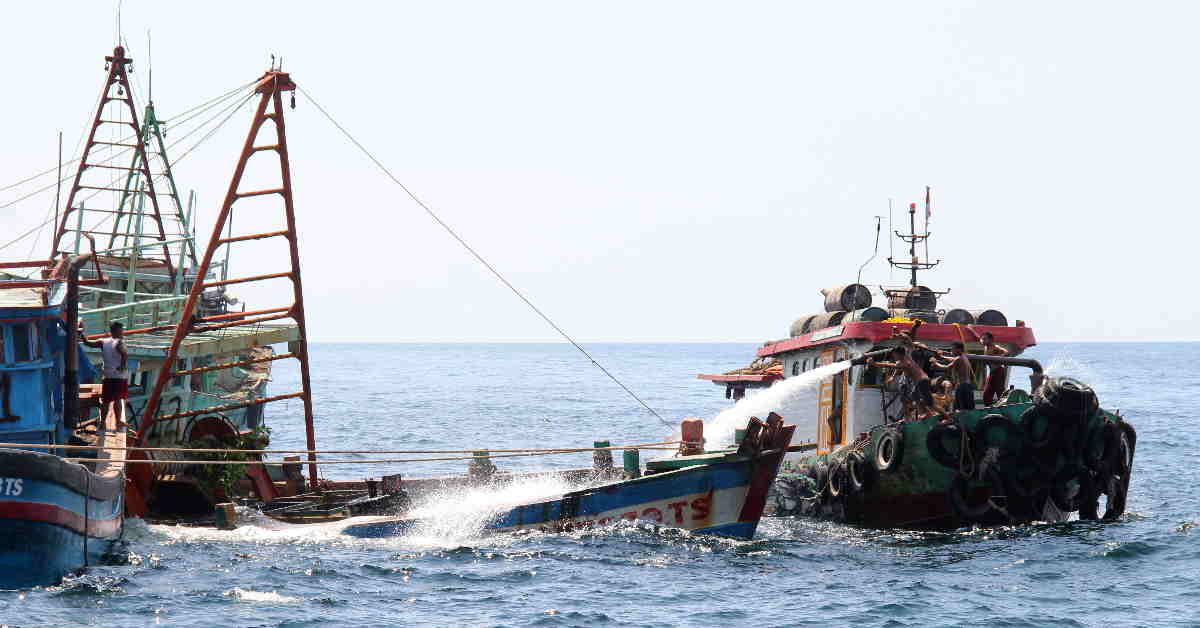
This file photo shows Indonesian authorities sinking a Vietnamese fishing boat at Datuk island, in West Kalimantan on 4 May, 2019. (AFP Photo)
Vietnam: Shipping firms in troubled waters as coronavirus hits trade
 Vietnamese shipping firms are reporting falling revenues after the coronavirus outbreak brought trade-related activities to a standstill in China.
Pham Hong Manh, manager of Hai Phong shipping firm T.S. Container Lines, said his company has reduced shipping from China since January 19.
It used to ply up to 13 times a month to Chinese ports, but the figure was down to eight last month and to seven this month, he said.
Ships are docking at other ports outside China, which accounts for 40 percent of international shipping in Vietnam, but this pushes up costs, he said.
“Our shipments have fallen by 30 percent year-on-year due to the outbreak. We estimate our losses at millions of dollars.”
Vietnam’s biggest shipping firm, Vinalines, is also struggling as shipping activities in China and some other countries have dwindled. Many of its ship are lying idle in ports.
The company, formally known as the Vietnam National Shipping Lines, estimated shipments in the first six months could fall by 15 percent year-on-year.
Its revenues could fall by VND992 billion ($42.7 million) and profits by VND224 billion ($9.6 million) in the period, it estimated further.
The epidemic outbreak has meant there are fewer personnel to operate ports in China, resulting in less traffic to all countries, including Vietnam.
Quy Nhon Port in central Vietnam now operates only 20 days a month instead of 30, with shipments falling by 15 percent. Last month it handled 100,000 tonnes less than targeted.
Vietnamese ports handled 655 million tonnes of cargo last year, up 14 percent from 2018, according to the Vietnam Maritime Administration.
Source: VN Express
Hanoi ranked world’s seventh most polluted capital city in 2019

Haze shrouds Hanoi sky over Pham Van Dong Street, Cau Giay District, in the morning of December 13, 2019. Photo by VnExpress/Gia Nghia.
Hanoi has become the world’s seventh most polluted capital city, even worse than Beijing, a new IQ AirVisual report says.
The city’s worsening air quality saw its average PM2.5 level last year rise to 46.9 micrograms per cubic meter of air from 40.8 in 2018, according to a report released this week by Switzerland-based air quality monitor, IQAir AirVisual.
Tiếp tục đọc “Hanoi ranked world’s seventh most polluted capital city in 2019”
Vietnam Airlines, whose revenues have been hit badly by the Covid-19 epidemic, has cut the salaries of senior managers by 40 percent this year.
Mid-level managers’ salaries have been reduced by 20- 30 percent, Duong Tri Thanh, the CEO of the carrier, said.
Vietnam To Counter China With Asean Backing On Mekong River Region

Thailand’s Prime Minister Prayut Chan-O-Cha, left, hands over the gavel for ASEAN chairmanship to … [+]
LILLIAN SUWANRUMPHA/AFP VIA GETTY IMAGES
Vietnam took over the rotational chair of Asean, or the Association of Southeast Asian Nations, in January 2020, so it’ worth noting that Hanoi’s second foremost foreign policy priority after the South China Sea is reportedly the Mekong River region. While the South China Sea, where more than one-third of global shipping passes, is considered an overall Asean concern, the Mekong region is left to the five riparian countries in mainland Southeast Asia to deal with in view of China’s upstream hydropower dams that have led to frequent droughts and depleted fish stocks in downstream communities, especially in Cambodia and Vietnam.
Tiếp tục đọc “Vietnam To Counter China With Asean Backing On Mekong River Region”
How our planet became more urbanised than ever
Over three-quarters of the world’s population now live in urban areas, according to the JRC’s new Atlas of the Human Planet.
The Atlas will be officially launched on Monday at the 10th session of the World Urban Forum in Abu Dhabi.
With data spanning four decades and nearly 240 countries and territories, the Atlas shows how humans have settled on Earth and urbanised the planet.
From 1975-2015, the share of people living in urban areas has increased from 69% to 76%.
Across the globe, the number of countries and territories with less than 50% of total population living in urban areas has fallen from 48 in 1975 to 36 in 2015. Tiếp tục đọc “How our planet became more urbanised than ever”
 CVD
CVD 