Hundreds of whales wash up dead on New Zealand beach

WELLINGTON: More than 400 whales were stranded on a New Zealand beach on Friday (Feb 10), with hundreds already dead as volunteers tried to refloat the survivors, the Department of Conservation said.

Andrew Lamason, spokesman for the department, said it was one of the largest mass beachings recorded in New Zealand, where strandings are relatively common.

Lamason said 416 pilot whales beached themselves overnight at Farewell Spit in the Golden Bay region at the northern tip of South Island.

He said about 70 per cent had perished and attempts were underway to get the remaining whales offshore at high tide but the outlook was gloomy.

“With that number dead, you have to assume that the rest are in reasonably poor nick as well,” he told Radio New Zealand. “So we’re sort of preparing ourselves for a pretty traumatic period ahead.”

Taiwanese woman jailed for shark fins’ haul in Costa Rica

SAN JOSE: A Costa Rican court has sentenced a Taiwanese business owner to prison over a fishing haul of illegally hacked-off shark fins destined for sale abroad, officials and environmentalists said on Thursday (Feb 9).

The businesswoman, identified by her last name of Tseng, was ordered to spend six months behind bars. The verdict was handed down on Monday by the court in the western port city of Puntarenas.

It was the first criminal sentence in the country against the practice of shark finning, which involves slicing off a shark’s fins before dropping the live fish back in the sea. Unable to swim effectively, the wounded creature faces a grim future: suffocating, starving or being eaten.

Shark fins fetch a high price in Asia, where they are often used in soups served on special occasions.

Tseng’s was “a historic sentence,” said Gladys Martinez, lawyer for the Interamerican Association for Environmental Defense (AIDA).

Her case began in October 2011, when her fishing boat, the Wan Jia Men 88, was found with 151 sharks aboard. Their fins had been chopped off.

She was initially acquitted in 2014, but the matter went to appeal, and the Puntarenas court this week found her responsible for damage to Costa Rica’s natural resources.

The Central American country, known for its biodiversity, has ratified several treaties for the protection and sustainable use of marine resources.

Pope Francis Rebukes Myanmar Over Treatment of Rohingya

A Rohingya refugee camp in Cox’s Bazar, Bangladesh. The United Nations estimates that about 69,000 Rohingya Muslims have fled to Bangladesh from Myanmar since October. Credit Allison Joyce/Getty Images

Pope Francis on Wednesday issued a fresh rebuke against Myanmar over its repression of the Rohingya minority group, just days after a United Nations report concluded that security forces had slaughtered and raped hundreds of men, women and children in a “campaign of terror.”

“They have been suffering, they are being tortured and killed, simply because they uphold their Muslim faith,” Francis said of the Rohingya in his weekly audience at the Vatican.

He asked those present to pray with him “for our Rohingya brothers and sisters who are being chased from Myanmar and are fleeing from one place to another because no one wants them.”

Continue reading on  New York Times

U.S. General Seeks ‘a Few Thousand’ More Troops in Afghanistan

Gen. John W. Nicholson Jr. testified before the Senate Armed Services Committee on Thursday. Credit Alex Wong/Getty Images

WASHINGTON — The commander of the American-led international military force in Afghanistan told Congress on Thursday that he needed a few thousand additional troops to more effectively train and advise Afghan soldiers.

“I have a shortfall of a few thousand,” Gen. John W. Nicholson Jr. said in a sober assessment of the United States’ longest-running war, during testimony to the Senate Armed Services Committee.

President Trump has said little about Afghanistan, speaking mainly instead of the need to defeat the Islamic State in Iraq and Syria. The American-led international force that is helping the Afghans has about 13,300 troops today, 8,400 of which are American.

Continue reading on New York Times

Trump and Abe to Talk: Why They Are Meeting and What They’ll Discuss

Prime Minister Shinzo Abe of Japan during a ceremony at a base north of Tokyo last year. He will meet with President Trump on Friday in the Oval Office. Credit Eugene Hoshiko/Associated Press

HONG KONG — Prime Minister Shinzo Abe of Japan, the first world leader to meet Donald J. Trump after the election in November, plans to meet with the president in Washington on Friday in the Oval Office. Mr. Abe is then planning to fly to Mr. Trump’s Mar-a-Lago resort in Palm Beach, Fla., to play golf with the president.

Why are they meeting?

Mr. Abe wants to talk to Mr. Trump about trade and economic issues, which have already been the subject of some critical Twitter postings and remarks from the president.

Mr. Abe is also eager to pursue a closer personal relationship with Mr. Trump, with whom he shares some ideological leanings, including a resistance to immigration.

In Letter to China, Trump Says He Wants ‘Constructive Relationship’

President Xi Jinping of China in Lima, Peru, last year. The fact that President Trump and Mr. Xi have not talked since Mr. Trump took office in January has drawn increasing scrutiny. Credit Cris Bouroncle/Agence France-Presse — Getty Images

HONG KONG — President Trump has sent a letter to his Chinese counterpart saying he looked forward to developing a “constructive relationship” with Beijing, the latest in a series of conciliatory signals by the new administration after months of heated rhetoric aimed at America’s largest trading partner.

The letter, dated Wednesday, also thanked China’s president, Xi Jinping, for a message he sent congratulating Mr. Trump on his inauguration and conveyed wishes to the Chinese people for the Lunar New Year, the White House said in a two-sentence statement.

It is unclear whether the letter was meant as a substitute for an anticipated phone conversation between the two leaders or as an ice-breaking prelude to such a call. Before his inauguration, Mr. Trump and his cabinet appointees made comments and took actions that alarmed Beijing and pointed to rocky ties between the world’s two biggest economies.

Since his inauguration, Mr. Trump has spoken by phone with about 20 foreign leaders. Usually highly scripted affairs, many of those calls have been anything but. The president’s conversation last month with Malcolm Turnbull, the prime minister of Australia, turned contentious when Mr. Turnbull urged Mr. Trump to honor an agreement made under President Barack Obama to accept 1,250 refugees from an offshore detention center.

Continue reading on  New York Times

But arguably no bilateral relationship is more important than the one between Beijing and Washington, and the fact that Mr. Trump and Mr. Xi have not talked since Mr. Trump took office in January has drawn increasing scrutiny.

“78 triệu mảnh ruộng manh mún thì nông nghiệp không thể hiệu quả”

Đâu là “nút thắt” đang cản trở tái cơ cấu nông nghiệp Việt Nam?…

“78 triệu mảnh ruộng manh mún thì nông nghiệp không thể hiệu quả”
Bộ trưởng Bộ Nông nghiệp và Phát triển nông thôn Nguyễn Xuân Cường.

VNE – BẠCH DƯƠNG

“Hiện cả nước có tới 78 triệu mảnh ruộng nhỏ lẻ, manh mún. Nền tảng sản xuất như vậy thì nông nghiệp không thể nào phát triển hiệu quả được”, Bộ trưởng Bộ Nông nghiệp và Phát triển nông thôn Nguyễn Xuân Cường nói với VnEconomy, trong cuộc trao đổi về chủ đề, đâu là “nút thắt” đang cản trở tái cơ cấu nông nghiệp Việt Nam?
Tiếp tục đọc ““78 triệu mảnh ruộng manh mún thì nông nghiệp không thể hiệu quả””

‘Việc khai ấn ở đền Trần Tức Mặc là một xuyên tạc lịch sử’

08/02/2017 14:15 GMT+7

TTO – Chuyện khai ấn – phát ấn ngày một tràn lan trên nhiều tỉnh thành. Nhiều tệ nạn cũng sinh ra từ đó…

Đầu tiên là Nam Định nâng cấp lễ hội làng Tức Mặc thành lễ hội cấp quốc gia. Sau đó “đẻ” ra chuyện khai/phát ấn ở đền Trần Thương (Nhân Đạo, Lý Nhân, Hà Nam), đền Trần Tam Đường (Tiến Đức, Hưng Hà, Thái Bình), ở khu văn hóa núi Bài Thơ (TP Hạ Long, Quảng Ninh), khu di tích Hoàng thành Thăng Long (Hà Nội)… Tiếp tục đọc “‘Việc khai ấn ở đền Trần Tức Mặc là một xuyên tạc lịch sử’”

Đắk Lắk: Lãnh đạo tỉnh gặp mặt văn nghệ sĩ, trí thức và báo chí đầu năm

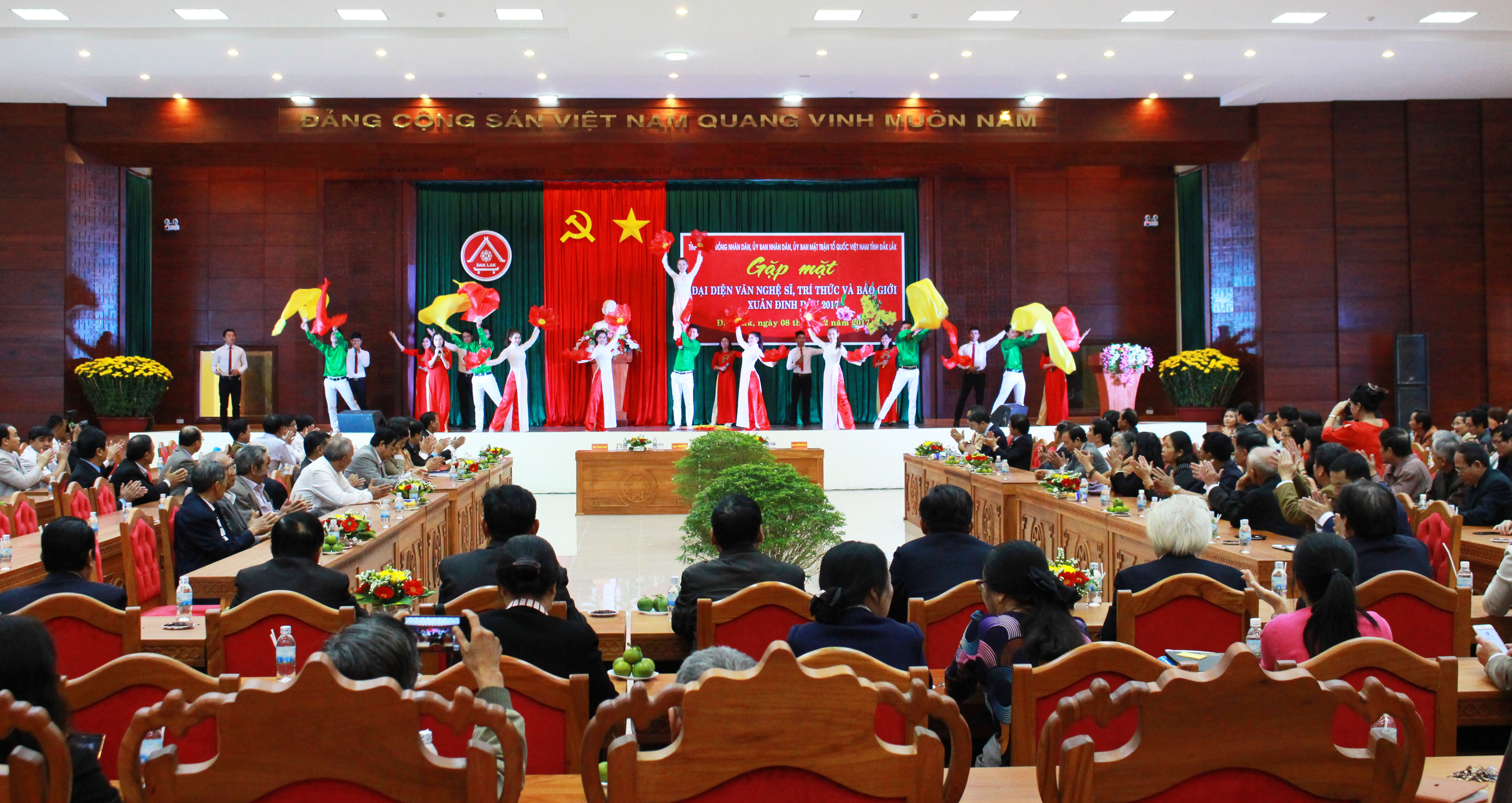
Sáng ngày 8/2/2017, lãnh đạo tỉnh Đắk Lắk đã tổ chức gặp mặt đầu Xuân Đinh Dậu 2017 với hơn 400 đại biểu, là những đại diện của giới văn nghệ sĩ, trí thức và các cơ quan báo đài thường trú trên địa bàn tỉnh.

Toàn cảnh gặp mặt
Toàn cảnh gặp mặt

Tại buổi gặp mặt, ông Nguyễn Hải Ninh, Ủy viên dự khuyết Trung ương Đảng, Phó Chủ tịch thường trực UBND tỉnh Đắk Lắk thông báo về các thành tựu cơ bản năm qua tỉnh đã đạt được trên nhiều lĩnh vực: Tiếp tục đọc “Đắk Lắk: Lãnh đạo tỉnh gặp mặt văn nghệ sĩ, trí thức và báo chí đầu năm”

Donald Trump and China on dangerous collision course, say experts

The Guardian

Report says ties between the two nuclear-armed countries could deteriorate into an economic or military confrontation

Chinese news papers showing US president Donald Trump at a newsstand in Shanghai.
Chinese news papers showing US president Donald Trump at a newsstand in Shanghai. Photograph: Aly Song/Reuters

A highly combustible cocktail of Donald Trump’s volatility and Xi Jinping’s increasingly aggressive and autocratic rule threatens to plunge already precarious US-China relations into a dangerous new era, some of the world’s leading China specialists say in a new report.

For the last 18 months a taskforce of prominent China experts, some of whom have dealt with Beijing for more than 50 years, hahes been formulating a series of recommendations on how the incoming White House should conduct relations with the world’s second largest economy.

The group’s report, which was handed to the White House on Sunday and will be published in Washington DC on Tuesday, says ties between the two nuclear-armed countries could rapidly deteriorate into an economic or even military confrontation if compromise on issues including trade, Taiwan and the South China Sea cannot be found.

Continue reading on The Guardian

China likely to build on reef near Philippines: Minister

In an interview with AFP, Delfin Lorenzana said he believed China would eventually reclaim Scarborough Shoal, just 230 kilometres from the main Philippine island of Luzon.

Beijing has already built up a number of islets and reefs in the Spratly Islands in the South China Sea, installing military facilities on several of them.

Analysts say similar installations on nearby Scarborough Shoal could give China effective military control over the disputed Sea – something the US has said it is not prepared to accept. Tiếp tục đọc “China likely to build on reef near Philippines: Minister”

‘Irrational’ Coal Plants May Hamper China’s Climate Change Efforts

The China Kingho Energy Group’s coal-to-gas plant in Chuluqay, Xinjiang, China, in 2014. Credit Benjamin Haas/Bloomberg

YINING, China — When scientists and environmental scholars scan the grim industrial landscape of China, a certain coal plant near the rugged Kazakhstan border stands out.

On the outside, it looks like any other modern energy plant — shiny metal towers loom over the grassy grounds, and workers in hard hats stroll the campus. But in those towers, a rare and contentious process is underway, spewing an alarming amount of carbon dioxide, the main greenhouse gas accelerating climate change.

The plant and others like it undermine China’s aim of being a global leader on efforts to limit climate change.

The plant, in the country’s far west, converts coal to synthetic natural gas. The process, called coal-to-gas or coal gasification, has been criticized by Chinese and foreign scholars and policy makers. For one thing, it is relatively expensive. It also requires enormous amounts of water, which exacerbates the chronic water crisis in northern China. And worst of all, critics say, it emits more carbon dioxide than traditional methods of energy production, even other coal-based ways.

Continue reading on New York Times

The 30-Years War in Vietnam

Viet Minh in battle in Dien Bien Phu, Vietnam. Credit Collection Jean-Claude Labbe/Gamma-Rapho, via Getty Images

It should go without saying that the Vietnam War is remembered by different people in very different ways. Most Americans remember it as a war fought between 1965 and 1975 that bogged down their military in a struggle to prevent the Communists from marching into Southeast Asia, deeply dividing Americans as it did. The French remember their loss there as a decade-long conflict, fought from 1945 to 1954, when they tried to hold on to the Asian pearl of their colonial empire until losing it in a place called Dien Bien Phu.

The Vietnamese, in contrast, see the war as a national liberation struggle, or as a civil conflict, depending on which side they were on, ending in victory in 1975 for one side and tragedy for the other. For the Vietnamese, it was above all a 30-year conflict transforming direct and indirect forms of fighting into a brutal conflagration, one that would end up claiming over three million Vietnamese lives.

The point is not that one perspective is better or more accurate than the other. What’s important, rather, is to understand how the colonial war, the civil war and the Cold War intertwined to produce such a deadly conflagration by 1967.

Continue reading on New York Times

Debate Flares Over China’s Inclusion at Vatican Organ Trafficking Meeting

New York times, 

Dr. Huang Jiefu, co-chairman of the National Organ Donation and Transplantation Committee of China, at a meeting on organ trafficking at the Vatican on Tuesday. Credit Andrew Medichini/Associated Press

BEIJING — A politely worded but testy debate has flared over a Vatican conference on human organ trafficking, with a group of ethicists warning that China will use the participation of its most senior transplant official to convince the world that it has overhauled its organ procurement system.

In a letter to the Pontifical Academy of Sciences in Rome, where the two-day Summit on Organ Trafficking and Transplant Tourism began on Tuesday, 11 ethicists wrote: “Our concern is with the harvesting and trafficking of organs from executed prisoners in China.”

China has admitted that it extracted organs from death row prisoners for decades, in what critics have called a serious violation of the rights of inmates who cannot give genuine consent. Since Jan. 1, 2015, Chinese officials have said they no longer use prisoners’ organs, though doubts persist.

Continue reading on New York Times