South China Sea: Philippine navy chief warns of Chinese ‘provocation’

SCMP

  • Vice-Admiral Giovanni Bacordo calls for diplomatic protest against presence of two Chinese research ships near the disputed energy-rich Reed Bank
  • Chinese navy has been trying to provoke its Philippine counterparts into firing ‘the first shot’, he says
A protest in Manila against China’s actions in the South China Sea. Photo: EPA
The Philippine navy chief has called for a diplomatic protest to be filed against the presence of two Chinese research ships in a disputed area of the South China Sea.

Vice-Admiral Giovanni Bacordo told the Foreign Correspondents Association of the Philippines on Monday the Chinese vessels had been near the Reed Bank for “about a week already” and that due to their speed of “about three knots” the navy had concluded they were “conducting surveys”. Tiếp tục đọc “South China Sea: Philippine navy chief warns of Chinese ‘provocation’”

Semiconductors are a weapon in the U.S.-China trade war. Can this chipmaker serve both sides?

BY EAMON BARRETT

August 10, 2020 5:30 PM GMT+7

What a difference two months can make. In May, Taiwan Semiconductor Manufacturing Co. (TSMC), the world’s largest chipmaker, lost the business of Huawei Technologies—its biggest Chinese customer and the source of 13% of its revenue—as a casualty of geopolitical jockeying between superpowers. But TSMC shareholders took the loss in stride. And by late July, after a stumble by rival Intel, TSMC’s stock had risen almost 50% since May, making it one of the world’s 10 most valuable companies

May’s low and July’s high have something in common: They both reflect TSMC’s distinctive role in the global tech economy. Although far from a household name, TSMC controls roughly half of the world’s contract chip manufacturing. Brand-name companies that design their own chips—most notably Apple—rely on TSMC’s world-class production so they don’t have to spend tens of billions to build their own factories. Crack open your iPhone and you’ll find a chip from TSMC. If you could crack open an American guided missile, you’d likely find one there too. Its prowess has elevated TSMC to No. 362 on the Global 500, with $35 billion in revenue. Today it gets 60% of sales from the U.S. and about 20% from mainland China. 

Tiếp tục đọc “Semiconductors are a weapon in the U.S.-China trade war. Can this chipmaker serve both sides?”

Techno-nationalism and the US-China tech innovation race

Techno-nationalism: The US-China tech innovation race
New challenges for markets, business and academia

BY ALEX CAPRI
RESEARCH FELLOW, HINRICH FOUNDATION, 20202

Published 03 August 2020

The US-China tech innovation race is challenging the laissez-faire economic model. State interventionism, techno-nationalism and US tech funding initiatives are increasing. This paper outlines the implications for markets, academia, research organizations, and governments of the US-China competition to achieve innovation advantage.

A US-China tech innovation race has sparked a paradigm shift in global trade and commerce that is challenging the long-standing primacy of the world’s open trading system.

Current thinking is tilting towards increased state activism and interventionism, not only in the technology landscape but in many of the industries of the future.

Listen to a discussion with Alex Capri related to this report.

Techno-nationalism

Driving this change is techno-nationalism: a mercantilist-like behavior that links tech innovation and enterprise directly to the national security, economic prosperity and social stability of a nation.

In response to decades of Beijing’s innovation-mercantilism, the US has embarked on its own innovation offensive. Washington’s future tech funding initiatives could surpass the scale of the “moonshot” projects last seen during the space race with the former Soviet Union.

Download “Techno-nationalism: The US-China tech innovation race” by Alex Capri

GET THE REPORT

Andrew Staples and Alex Capri from the Hinrich Foundation discuss why US tech funding initiatives could surpass the scale of the “moonshot” projects.

AC US China Innovation Race Pre Launch Video With Border

Share this video on TwitterLinkedIn and Facebook.

The innovation race involves a broad range of emerging and foundational technologies that will define the industries of the future, including:

  • Artificial Intelligence (AI) and machine learning
  • Quantum computing and information systems
  • Robotics
  • Energy storage
  • Semiconductors
  • Next generation communication (including 5G and 6G)
  • Hypersonics.

Underlying themes: US techno-nationalism and innovation

As Washington and its allies ramp up techno-nationalist initiatives, core themes will drive the paradigm shift.

  • Public-private partnerships (PPP) – Technology alliances and government-funded initiatives will play an increasingly important role in advancing long-term innovation in the US, the EU and other traditionally open markets.
  • Avoiding the China innovation model – The US and EU innovation agendas will not seek to emulate China’s centralized, authoritarian system of techno-nationalism, but, rather, to turbo-charge markets and leverage entrepreneurial ecosystems, as well as academic and defense establishments.
  • Balancing tensions between MNEs, markets and techno-nationalism – Multinational enterprises (MNEs) will remain the primary drivers of R&D and innovation in free markets and play a vital role in PPP initiatives. They will be pulled into the US-China technology war in a variety of ways which will require a careful balancing of market forces, the interests of MNEs and the needs of state actors.
  • Multilateral technology alliances – US techno-nationalist policy will increasingly align with the security, economic and ideological objectives of the EU and other historic allies. This will produce more cooperation between the US and its partners.

Structure of the report

The report comprises three sections:

Download the report.

Section I – The US-China innovation race: The role of the state

This section examines trends for public-spending in R&D and innovation and reviews a series of techno-nationalist funding initiatives from the US government. 

It analyzes state activism in free markets and why governments are uniquely qualified to promote innovation and “blue-sky” technologies in ways that the private sector cannot.

Finally, Section I spotlights a historic example of techno-nationalism: SEMATECH and the US semiconductor public-private partnership, which led to a technological leapfrog by the US semiconductor industry, past Japan, in the 1990s.

Section II – MNEs, markets and governments: Navigating new complexities

Section II focuses on non-state actors and their increasingly complex role in public-private partnerships. It explores the tensions between open market forces, multinational companies, and techno-nationalist state activism.

To highlight these tensions, the report analyzes Facebook’s “Libra initiative and Beijing’s efforts to reduce dependency on the US dollar via the digital Yuan, and the challenges those create for MNEs. A US semiconductor sector case study illustrates how state activism can have detrimental effects on markets and backfire on the very parties it is looking to protect. 

Section II concludes with an analysis of how open-sourced innovation could be a game-changer in the US-China technology war, particularly regarding future 5G wireless competition.

Section III – Academia and techno-nationalism: Open versus closed systems

Universities, research organizations and academia have become hot zones in the US-China innovation race. Human capital development is key to conducting leading-edge R&D and driving innovation.

Section III looks at how US export controls are affecting R&D activities at universities. It highlights the rules-based frameworks that universities must build to handle increasing government funding into academia.

The section showcases China’s Thousand Talents program and highlights its challenges for public-private partnerships involving academia. It also discusses why the US, in particular, should keep its human capital and innovation pipeline open as it pertains to foreign students, fundamental research programs and, ultimately, why an open system (despite China’s exploitation of it) is better than a closed one.

Finally, section III looks at how some inevitable strategic decoupling between Chinese and US entities will result in the ring-fencing of more “sensitive” R&D activities within the US defense establishment.

Listen to a summary of the report in this podcast featuring Alex Capri and Andrew Staples, Director of Research and Outreach.

Share this podcast TwitterLinkedIn and Facebook.

***

This report is part of a series of Hinrich Foundation papers, authored by Alex Capri, that review the implications of rising US-China techno-nationalism for global trade and international businesses. The two papers focused on Semiconductors at the heart of the US-China tech war and Strategic US-China decoupling in the tech sector.SHARE


Alex Capri Research Fellow

AUTHOR

Alex Capri

FOLLOW

Alex Capri is a Research Fellow at the Hinrich Foundation with over 20 years of experience in value chains, logistics and global trade management, both as an academic and a professional consultant.

COVID-19: Vietnam reports 29 new cases, another fatality – Total 84 cases

Chia sẻ | FaceBookTwitter Email Copy LinkInterested009/08/2020    18:43 GMT+7

Vietnam has confirmed 29 new coronavirus cases and another fatality of the disease, all closely tied to Da Nang outbreak, the Ministry of Health said in its August 9 update at 18.00hrs.

19 cases aged 7 to 85 were registered in Da Nang City, the epicenter of the outbreak. They include 8 people who had close contact with COVID-19 patients, 3 patients given treatment at Da Nang Hospital, three caregivers, a medical worker, a servant, along with three others.

Tiếp tục đọc “COVID-19: Vietnam reports 29 new cases, another fatality – Total 84 cases”

THE US AND THE MEKONG REGION: COOPERATION FOR SUSTAINABLE AND INCLUSIVE ECONOMIC GROWTH

By Satu Limaye, East West Center

HONOLULU (29 July 2020)—In recent years, relations with Southeast Asia have emerged as an important pillar of US engagement with the Indo-Pacific region. The Association of Southeast Asian Nations (ASEAN) is central to US foreign policy in the region, with a growing focus on the five countries bound together by the Mekong River—Cambodia, Lao PDR, Myanmar, Thailand, and Vietnam.

Fishing boats are unloaded on Tonle Sap Lake, which is fed by the Mekong River in Cambodia. Conservationists warn that dam construction on the Mekong could threaten the food supply of more than 40 million people who rely on fish from the river as an important source of protein. Photo: Jason South/Fairfax Media/Getty Images.

As they emerge from a tumultuous history, these countries must confront new elements of great-power competition even as their youthful populations push for economic growth and integration into the wider region and the world. Among other impacts, urbanization, infrastructure expansion, and climate change all affect the Mekong River, the natural resources along its banks, and the 240 million people who live in the region.

Tiếp tục đọc “THE US AND THE MEKONG REGION: COOPERATION FOR SUSTAINABLE AND INCLUSIVE ECONOMIC GROWTH”

Vietnam confirms 11th Covid-19 death

VNE – By Chi Le    August 9, 2020 | 05:44 pm GMT+7

Vietnam confirms 11th Covid-19 death
A medical staff takes samples of a person to test for the novel coronavirus in Quang Nam Province on August 9, 2020. Photo by VnExpress/Dac Thanh.

A 55-year old woman in Da Nang is the country’s 11th Covid-19 fatality, the Healthy Ministry confirmed Sunday afternoon.

“Patient 456”, a resident of the central city’s Hai Chau District, was admitted to the Hoan My-Da Nang General Hospital on July 28 and tested positive for the novel coronavirus on July 29. She’d had hypertension for years.

Tiếp tục đọc “Vietnam confirms 11th Covid-19 death”

Bên này ảo vọng

Hồ Đình Ba

BÊN NÀY ẢO VỌNG

Tiểu thuyết luận đề

Gia cảnh bất thường           

Sau khi ra khỏi phòng vé, Trung đi tìm số chiếc xe đò sẽ đưa anh về lại Tịnh Biên, Tây Ninh. Lúc anh sắp bước lên, xe đã gần đầy khách, một anh bán vé số chống nạng trờ tới, mời mua ; sẵn còn ít tiền lẻ, Trung mua ba tấm rồi bước lên xe và ngồi xuống ghế ; mười phút sau xe lăn bánh khởi hành.                  

Suốt cuộc hành trình từ ngã tư An Sương đi Tây Ninh, anh miên man nghĩ về năm ngày phép anh vừa trải qua với gia đình. Trung đã có bốn ngày tròn để ở bên vợ và con anh, thằng Phương sáu tuổi năm nay vào lớp năm trường tiểu học. Nhưng thật ra anh không được những giờ phút hạnh phúc trọn vẹn với gia đình : vợ anh Tiên Phụng là chị bếp của cha xứ Giuse Cù Long Mạch và hai ngày nay cô rất bận rộn với việc nấu tiệc cho giáo xứ kỷ niệm 10 năm cha xứ được truyền chức linh mục, sau đó được điều về đây làm cha xứ. Những ngày này Tiên Phụng về rất khuya, mệt mỏi và lạnh lùng. Cô trò chuyện với Trung cho có lệ, sau đó họ làm tình nhưng rất thụ động, thờ ơ như một búp bê bằng sáp lạnh, không còn sự đáp ứng sôi nổi, nhịp nhàng như khi cô chưa sinh thằng Phương. Tiếp tục đọc “Bên này ảo vọng”

More than 500 dams planned inside protected areas: Study

Mongabay.com

by on 5 August 2020

Bến nước mười ba

Vĩnh An

BẾN NƯỚC MƯỜI BA


Trong nhờ đục chịu bến chồng,
Khôn nhờ dại chịu bờ không bến bờ”


Chương 1

Gia phong hiển hách 


Hôm nay là ngày nghỉ việc theo “tua” nên ông trưởng phòng kỹ thuật ga xe lửa Hòa Hưng Phạm Tiến Phong có thể ngồi lâu giờ trước ly cà phê đen nóng mà vợ ông, bà Mai Dung, sáng nào cũng pha sẵn cho ông trước khi ông đi làm. Ông rút điếu thuốc thứ ba nhìn lên bàn thờ Phật với hình Đức Phật khép mắt ngồi thiền dưới gốc bồ đề rồi lan man suy nghĩ.     Tiếp tục đọc “Bến nước mười ba”

Mỹ quan ngại hoạt động ‘gây bất ổn’ của Trung Quốc ở Biển Đông

07/08/2020    09:03 GMT+7 vietnamnet

Điện đàm với người đồng cấp Trung Quốc, Bộ trưởng Quốc phòng Mỹ đã bày tỏ quan ngại về hoạt động ‘gây bất ổn’ của Bắc Kinh ở Biển Đông và gần Đài Loan.

Bắt cóc con tin chớp nhoáng tại PhápPhilippines thành vùng dịch Covid-19 lớn nhất Đông Nam ÁTrung Quốc sẽ ra sao nếu thảm họa ập xuống sông Dương Tử?

Theo hãng tin Reuters, thông tin trên được Lầu Năm Góc công bố hôm 6/8. Đây là cuộc điện đàm đầu tiên giữa ông Esper và Bộ trưởng Quốc phòng Trung Quốc Ngụy Phượng Hòa kể từ tháng 3 tới nay. Cuộc điện đàm diễn ra trong lúc quan hệ hai bên đang ở mức thấp nhất trong hàng chục năm qua.

Tiếp tục đọc “Mỹ quan ngại hoạt động ‘gây bất ổn’ của Trung Quốc ở Biển Đông”

Analysis: Vietnam’s leadership flex shows how to drive electricity reform

Người Sài Gòn vật lộn chống ngập suốt đêm

07/08/2020    09:47 GMT+7

Chiều và tối qua người dân Sài Gòn phải vật lộn chống ngập trong trận mưa lớn nhất năm. 

Sài Gòn mưa tầm tã, xe máy ngập lút yên, ô tô chết máy xếp hàng dàiThi công dự án chống ngập gần 500 tỷ, mặt đường Nguyễn Hữu Cảnh bị nứtNgười Sài Gòn ngã nhào khi bơi giữa đường ngập

23h tối 6/8, tuyến đường Phan Huy Ích (quận Bình Tân và Gò Vấp) vẫn ngập sâu. Cả đoạn đường dài nước ngập hơn nửa mét khiến hàng loạt phương tiện bị chết máy. Người dân bì bõm dẫn bộ phương tiện, rẽ sóng để tìm đường về nhà.

Tiếp tục đọc “Người Sài Gòn vật lộn chống ngập suốt đêm”

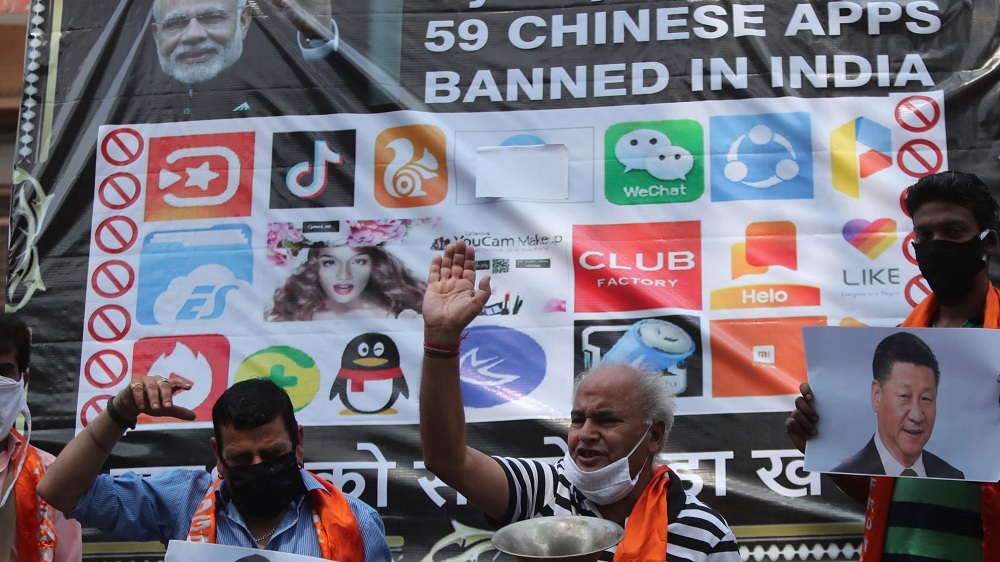
Trump Issues Executive Orders Against Chinese Owners Of TikTok And WeChat

Aug 6, 2020,09:51pm EDT

Jack Brewster Forbes Staff Business I’m a news reporter for Forbes.

Updated Aug 6, 2020, 10:33pm EDT

President Trump signed an executive order on Thursday that will prohibit Americans from doing business with ByteDance, the company that owns TikTok, and a similar order that bans transactions involving WeChat, a social messaging app, with its owner, Tencent, beginning September 20, in an effort to bar the China-owned social media platforms from the U.S. due to national security concerns.

Tiếp tục đọc “Trump Issues Executive Orders Against Chinese Owners Of TikTok And WeChat”

Vietnam reports second-largest daily hike in COVID-19 cases with 43 new patients – total 713 patients

Wednesday, August 05, 2020, 18:30 GMT+7 Tuoitre

Vietnam reports second-largest daily hike in COVID-19 cases with 43 new patients
A health worker disinfects an area visited by a novel coronavirus disease (COVID-19) patient in Vietnam. Photo: Tr. T. / Tuoi Tre

Vietnam documented a total of 43 new cases of novel coronavirus disease (COVID-19) on Wednesday, including 42 local infections and one imported patient who was quarantined upon arrival, the second-largest single-day increase in cases since January.

Vietnam reported two new coronavirus patients on Wednesday morning, both registered in the central province of Quang Nam and traced to Da Nang, a neighboring city that is the country’s outbreak epicenter.

Tiếp tục đọc “Vietnam reports second-largest daily hike in COVID-19 cases with 43 new patients – total 713 patients”

Australia’s Morrison says US-China war no longer inconceivable

Al Jareeza

Prime minister also says stronger Indo-Pacific alliance with like-minded nations is a ‘critical priority’ for Australia.

Australia's Scott Morrison, standing, walks past China's Xi Jinping during the G20 leaders' meeting in Japan last year [File: Lukas Coch via EPA]
Australia’s Scott Morrison, standing, walks past China’s Xi Jinping during the G20 leaders’ meeting in Japan last year [File: Lukas Coch via EPA]

Australia’s Prime Minister Scott Morrison has said his government held a less dramatic view of US-China strategic tensions than a predecessor who warned of a potential “hot war” before US presidential elections in November, but added that a conflict is no longer inconceivable.

Tiếp tục đọc “Australia’s Morrison says US-China war no longer inconceivable”