The United States dominates global investment banking: does it matter for Europe?

Europe’s banks are in retreat from playing a global investment banking role, and this trend is likely to continue in the future. What will be the consequences and what should be the policy response?

By: and Date: March 7, 2016

BRUEGEL

Highlights

For the full references and the annex, please see the PDF version of this publication.

  • In the aftermath of the global financial crisis, the market share of US investment banks is increasing, while that of their European counterparts is declining. We present evidence that US investment banks are on the verge of taking over pole position in European investment banking. Meanwhile, since 2015, Chinese investment banks have overtaken American and European investment banks in the Asia-Pacific market.
  • Credit rating agencies and investment banks are the gatekeepers of the capital markets. The European supervisory institutions can effectively supervise the European operations of these US-managed players. On the political side, we suggest that the European Commission should continue to view its, albeit declining, banking industry as a strategic sector. The Commission, the European Central Bank and the Bank of England should jointly develop a strategic agenda for the EU-US Regulatory Dialogue.
  • Finally, corporates rely on investment banks to issue new securities. We recommend that the big European corporates should cherish the (few) remaining European investment banks, by giving them at least one place in otherwise US- dominated banking syndicates. That could help to avoid complete dependence on US investment banks.

Tiếp tục đọc “The United States dominates global investment banking: does it matter for Europe?”

Nonproliferation and Nuclear Energy: The Case of Vietnam

Is Vietnam diverting its civilian know-how to create an indigenous nuclear weapons program? Not yet, says the CSS’ Oliver Thränert, but increased tensions or overt conflict with China could lead Hanoi to develop its own nuclear deterrent.

By Oliver Thränert for Center for Security Studies (CSS)

ISN – For many years, the international nuclear non-proliferation regime has been in deep crisis. This became apparent most recently when the ninth Review Conference of the Parties to the Treaty on the Non-Proliferation of Nuclear Weapons (NPT) in May 2015 ended without a common final document. At the same time, a number of threshold countries are planning to begin using nuclear energy for peaceful purposes. In a time of increasing international tensions, some of them might build on know-how acquired through their civilian programs to safeguard their national security needs through a nuclear weapons program in the near future. Vietnam is an interesting case in point. Irrespective of certain delays in the development of its peaceful nuclear program, the country has progressed quite far. At the same time, it is engaged in an increasingly precarious conflict with its main neighbor, nuclear-armed China. Currently, there are no signs of a Vietnamese nuclear weapons program. In the framework of the nuclear non-proliferation regime, the country is a model of transparency and cooperation. But it is uncertain whether this will always remain the case. On the contrary, Hanoi might change its policy if the conflict with China should come to a head while the NPT continues to be weakened.

Vietnam’s strategic situation

Vietnam might complete its first nuclear reactor within a few years, ahead of ambitious neighbors such as Indonesia or Malaysia. The country’s main motivations are its growing energy requirements and the desire to diversify its energy sources. Considerations of prestige may also be a factor. As a threshold nation, Vietnam aims to achieve the same level as Asia’s developed nations. With a view to China, Hanoi probably also wishes to demonstrate the high level of global confidence that the country enjoys in sensitive matters of security policy. Tiếp tục đọc “Nonproliferation and Nuclear Energy: The Case of Vietnam”

“Chợ bom” đã bớt cưa bom

22/03/2016 13:41 GMT+7

TTO – Nhiều người cho rằng sau vụ nổ kinh hoàng ở Hà Đông, dân kinh doanh phế liệu là vỏ bom mìn ở “chợ bom” xã Diễn Hồng, huyện Diễn Châu tỉnh Nghệ An đã biết sợ.

“Chợ bom” đã bớt cưa bom
Phế liệu bom mìn tại các cơ sở kinh doanh phế liệu ở Diễn Hồng năm 2005 – Ảnh: Vũ Toàn
Sau vụ nổ kinh hoàng ở Hà Đông (Hà Nội), chúng tôi tìm đến “chợ bom” ở xã Diễn Hồng, huyện Diễn Châu (Nghệ An) – nơi mà trước đây sắt, thép phế liệu, trong đó có bom, đạn đều được họ mua tuốt luốt (bài “Chợ… bom” , Tuổi Trẻ ngày 25-5-2005). Tiếp tục đọc ““Chợ bom” đã bớt cưa bom”

Deadly blast in Hanoi allegedly caused by man opening bomb with blow torch, police said

By Ha An – Minh Chien, Thanh Nien News

HANOI – Sunday, March 20, 2016 16:26

The large crater caused by the blast in Hanoi on March 19. Photo: Minh Chien

The large crater caused by the blast in Hanoi on March 19. Photo: Minh Chien

thanhniennews: The Ministry of Public Security has found traces of explosives and bomb debris at the site of a blast in Hanoi on Saturday that killed four people, injured 10 others and damaged more than 120 houses.

The explosion at about 3.10 p.m. at a scrap metal trading business seriously tore through 36 houses and damaged 95 others, and left a large crater in Van Phu residential area, Ha Dong District, the police said. Many vehicles along the street were damaged too.

Although the police was yet to officially pinpoint the cause of the blast, they speculated that it was ignited when the shop owner tried to cut open a bomb using a blow torch.

One of the perished victims was Pham Van Cuong, 42, who had rent the house for his scrap metal shop since 2013 and reportedly often used a blow torch to cut large scrap metal pieces, police said.

Tiếp tục đọc “Deadly blast in Hanoi allegedly caused by man opening bomb with blow torch, police said”

Project RENEW’s Prosthetics and Orthotics Mobile Outreach Program

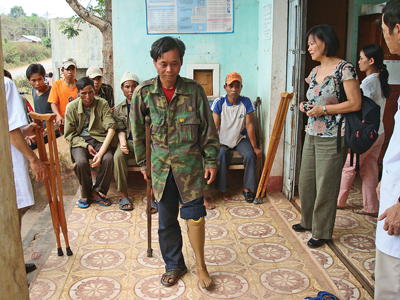
LM – Project RENEW established a mobile outreach program to provide prostheses, orthotics and education to explosive remnants of war survivors in the remote communities of Vietnam.

Susan Eckey, Former Deputy Director General for Humanitarian Affairs, Norwegian Ministry of Foreign Affairs, visits with the P&O team. Photo courtesy of Dang Quang Toan/Project RENEW.

Susan Eckey, Former Deputy Director General for Humanitarian Affairs, Norwegian Ministry of Foreign Affairs, visits with the P&O team.
Photo courtesy of Dang Quang Toan/Project RENEW.

According to a 2014 report compiled by Vietnam’s Department of Labour, Invalids and Social Affairs, Quang Tri province currently has 37,292 persons with disabilities, 13,023 of whom were disabled by Agent Orange and 5,094 by explosive remnants of war (ERW).1,2,3 Disabled persons living in rural areas often live in poverty and do not have access to basic services. For those with injuries resulting from unexploded ordnance (UXO), prosthetics are difficult to obtain. Tiếp tục đọc “Project RENEW’s Prosthetics and Orthotics Mobile Outreach Program”

Donald Trump: Ác mộng sắp thành hiện thực

BẦU CỬ TỔNG THỐNG MỸ 2016:

09/03/2016 06:16 GMT+7

TTCT – Lịch sử chính trị Mỹ từng có nhiều người lập dị ứng cử tổng thống. Nhưng có lẽ chưa ai như Donald Trump: bị thiên hạ cả trong lẫn ngoài Đảng Cộng hòa gán cho đủ loại tên xấu, từ “kẻ bất tài bịp bợm” tới một gã “Frankenstein”, nhưng lại liên tục dẫn đầu, nhiều cơ may đại diện cho một đảng lớn trong cuộc đua vào Nhà Trắng.

Donald Trump: Ác mộng sắp thành hiện thực
“Ác mộng” của phe Cộng hòa sắp thành hiện thực -AP

Tiếp tục đọc “Donald Trump: Ác mộng sắp thành hiện thực”

Chiến lược xoay trục, tái cân bằng của Mỹ đối với châu Á – Thái Bình Dương

Thứ tư, 20 Tháng 1 2016 16:58

(LLCT)Cho đến khi kết thúc Chiến tranh lạnh, Mỹ vẫn coi châu Âu là trọng điểm chiến lược. Từ khi Bush (cha) lên cầm quyền, đồng thời với tăng cường thêm lực lượng ở châu Âu, Mỹ bắt đầu chuyển trọng tâm chiến lược toàn cầu sang khu vực châu Á – Thái Bình Dương (CATBD) với mục đích duy trì địa vị siêu cường trong thế kỷ mới. Chiến lược đối với CATBD của chính quyền B.Clintơn bắt đầu rõ nét hơn. Bản tuyên bố toàn diện nhất về chính sách mới đối với khu vực đã được Winston Lord trình bày trước Ủy ban Đối ngoại Thượng viện: Đối với Mỹ, không có khu vực nào quan trọng hơn CATBD và không có khu vực nào khác có tầm quan trọng như thế đối với Mỹ trong thế giới mới.

Tiếp tục đọc “Chiến lược xoay trục, tái cân bằng của Mỹ đối với châu Á – Thái Bình Dương”

“We might give them a few.” Did the US offer to drop atom bombs at Dien Bien Phu?

21 February 2016
Fredrik Logevall

Editor’s note: It was 1954, and the surrounded French garrison was facing defeat in what would become known as the First Indochina War. What happened next has been a source of controversy for decades. The author of a 2013 Pulitzer Prize-winning book on Vietnam gives his view, drawing on the array of materials that have slowly emerged.

thebulletin – It is one of the most tantalizing questions of the long and bloody struggle for Vietnam: Did US Secretary of State John Foster Dulles in the spring of 1954 offer French foreign minister Georges Bidault two atomic bombs for use against Viet Minh positions near the beleaguered French garrison at Dien Bien Phu in remote northwestern Vietnam? For decades historians have investigated the matter, with no consensus emerging. But what does the evidence actually say? The time is right for a fresh look.

At first glance, it might seem odd that the United States would even contemplate providing large-scale military aid to the French army; after all, what did America care if imperial France lost one of its colonies in remote Asia? But this was the depths of the Cold War. Anxious to prevent the “fall” of another Asian nation to communism soon after the so-called “loss of China” and a bloody three-year stalemated war against communist forces in Korea, the United States was willing to send weaponry to aid the French—even if there was considerable doubt among experts as to how committed Viet Minh leader Ho Chi Minh really was to advancing the cause of global communism. (“Isn’t he first and foremost a nationalist?” many analysts speculated.) Ultimately, the United States had gambled on staying with the imperial status quo and propping up a repressive French regime in Indochina, to the point that by early 1954 Washington covered the lion’s share of the cost of the war effort. Tiếp tục đọc ““We might give them a few.” Did the US offer to drop atom bombs at Dien Bien Phu?”

Mỹ không thể và không làm thay được ASEAN

07:30 AM – 17/02/2016 TN
Hội nghị cấp cao đặc biệt Mỹ - ASEAN khai mạc sáng ngày 16.2 theo giờ VN tại Sunnylands (California, Mỹ) - Ảnh: Reuters

Hội nghị cấp cao đặc biệt Mỹ – ASEAN khai mạc sáng ngày 16.2 theo giờ VN tại Sunnylands (California, Mỹ) – Ảnh: Reuters

‘Chính ASEAN phải có tiếng nói quan trọng và quyết định trong các vấn đề của chính mình và khu vực. Mỹ và quan hệ Mỹ – ASEAN chỉ giúp thúc đẩy chứ không thể và không làm thay được ASEAN’, theo Đại sứ VN tại Indonesia.

Ngày 16.2 (giờ Việt Nam), tại Sunnylands, California, Mỹ, bắt đầu diễn ra các hoạt động chính thức của cuộc họp Thượng đỉnh ASEAN – Mỹ. Thanh Niên trân trọng giới thiệu đến bạn đọc bài viết của ông Hoàng Anh Tuấn, Đại sứ Việt Nam tại Indonesia. Tiếp tục đọc “Mỹ không thể và không làm thay được ASEAN”

Nữ giáo sư gốc Việt Caroline Kiều Linh và cuốn sách Transnationalizing Viet Nam

Transnationalizing Viet Nam Community, Culture, and Politics in the Diaspora

Kieu-Linh Caroline Valverde

“Bridging Asian Studies and Asian American Studies, Transnationalizing Viet Nam is a rich and nuanced study of transnational linkages between Viet Nam and its diaspora in the United States. Through fascinating case studies of Vietnamese popular music productions, Internet virtual communities, diasporic art and community politics, Kieu-Linh Caroline Valverde provides a rare glimpse into how Vietnamese have connected their worlds and made meanings for themselves.”
Yen Le Espiritu, Professor of Ethnic Studies, University of California, San Diego

temple.edu – Vietnamese diasporic relations affect—and are directly affected by—events in Viet Nam. In Transnationalizing Viet Nam, Kieu-Linh Caroline Valverde explores these connections, providing a nuanced understanding of this globalized community. Valverde draws on 250 interviews and almost two decades of research to show the complex relationship between Vietnamese in the diaspora and those back at the homeland.

Arguing that Vietnamese immigrant lives are inherently transnational, she shows how their acts form virtual communities via the Internet, organize social movements, exchange music and create art, find political representation, and even dissent. Valverde also exposes how generational, gender, class, and political tensions threaten to divide the ethnic community.

Transnationalizing Viet Nam paints a vivid picture of the complex political and personal allegiances that exist within Vietnamese America and shape the relations between this heterogeneous community and its country of origin.


Revving up the Rebalance to Asia

  • Photo courtesy of  sama093 from https://www.flickr.com/photos/sama093/16927401365/
    JAN 26, 2016

    The events of this month have reminded Americans that Asia is a region of both great opportunity and significant risk. In just the first two weeks of the year, North Korea conducted its fourth nuclear test, China began flying aircraft to airfields constructed on disputed features in the South China Sea, and Taiwan’s opposition candidate surged towards a victory in elections that will likely draw fire from Beijing. Tiếp tục đọc “Revving up the Rebalance to Asia”

Let China win. It’s good for America.

January 15

Joshua Kurlantzick is a senior fellow for Southeast Asia at the Council on Foreign Relations.

When Chinese officials announced in 2013 that they would open an Asian Infrastructure Investment Bank to primarily fund big construction projects across the Pacific, they launched a slow-motion freak-out in Washington. As they went around the world inviting governments to join, Obama administration officials pressured their allies in Asia, Europe and elsewherenot to. The AIIB, headquartered in Beijing, would allow China to expand its influence throughout Asia, the White House fretted. “We are wary about a trend toward constant accommodation of China,” one Obama aidecomplained to the Financial Times after Britain joined 56 other nations in signing up to fund power plants, roads, telecommunications infrastructure and other ventures. It was a rare public critique of a U.S. ally.

Tiếp tục đọc “Let China win. It’s good for America.”

CSIS: Asia-Pacific Rebalance 2025

Capabilities, Presence, and Partnerships
Contributor: Ernest Bower, Victor Cha, Heather Conley, Zack Cooper, Ryan Crotty, Melissa Dalton, Bonnie Glaser, Rebecca Hersman, Murray Hiebert, Christopher Johnson, Thomas Karako, Stephanie Sanok Kostro, Gregory Poling, Richard Rossow, John Schaus, Sharon Squassoni, Nicholas Szechenyi, Denise Zheng
JAN 19, 2016
In 2015, Congress tasked the Department of Defense to commission an independent assessment of U.S. military strategy and force posture in the Asia-Pacific, as well as that of U.S. allies and partners, over the next decade. This CSIS study fulfills that congressional requirement. The authors assess U.S. progress to date and recommend initiatives necessary to protect U.S. interests in the Pacific Command area of responsibility through 2025. Four lines of effort are highlighted: (1) Washington needs to continue aligning Asia strategy within the U.S. government and with allies and partners; (2) U.S. leaders should accelerate efforts to strengthen ally and partner capability, capacity, resilience, and interoperability; (3) the United States should sustain and expand U.S. military presence in the Asia-Pacific region; and (4) the United States should accelerate development of innovative capabilities and concepts for U.S. forces.
Publisher CSIS/Rowman & Littlefield
ISBN 978-1-4422-5916-4 (pb); 978-1-4422-5917-1 (eBook)

Trung Quốc và chiến tranh Triều Tiên (1950 – 1953)

  •   NGUYỄN THỊ MAI HOA
  • Thứ tư, 23 Tháng 7 2014 10:50

VHNA – Là cuộc xung đột cục bộ đầu tiên của thời kỳ chiến tranh Lạnh, dù đã tạm khép lại, song chiến tranh Triều Tiên (1950-1953) kịp để vô số hệ lụy. Vượt qua giới hạn thông thường của một cuộc đấu tranh thống nhất đất nước bằng con đường vũ trang, chiến tranh Triều Tiên hàm chứa những mâu thuẫn lớn của cuộc đối đầu Đông – Tây. Đằng sau mỗi sự kiện, mỗi diễn biến của cuộc chiến, đều có bàn tay, bóng dáng và những dự liệu, những kế hoạch ngầm định của các cường quốc.