Chuyên mục: Biến đổi khí hậu – Climate change
Dự án Thủy lợi Cái Lớn – Cái Bé và Nghị quyết 120
(Diễn đàn trí thức) – Các bước phê duyệt Dự án Hệ thống thủy lợi Cái Lớn–Cái Bé phải tuân thủ nghiêm túc Luật Đầu tư công và Nghị quyết 120.
- Những âu lo về dự án 3000 tỷ cống Cái Lớn-Cái Bé
- Anh trai Bí thư Huyện Krông Pắk lấn chiếm hồ thủy lợi
Theo thông tin có được, Hội đồng thẩm định báo cáo tác động môi trường (ĐTM) sẽ họp trong những ngày cuối tháng 8/2018 để xem xét phê duyệt báo cáo ĐTM của Dự án Thủy lợi Cái Lớn – Cái Bé. Nếu đúng như vậy, thì quả thật rất đáng tiếc và không đúng với Nghị quyết 120/NQ-CP ngày 17/11/2017 của Chính phủ
Tiếp tục đọc “Dự án Thủy lợi Cái Lớn – Cái Bé và Nghị quyết 120”
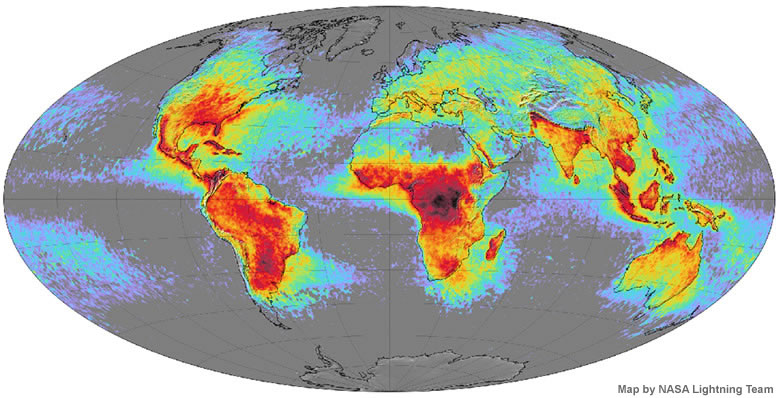
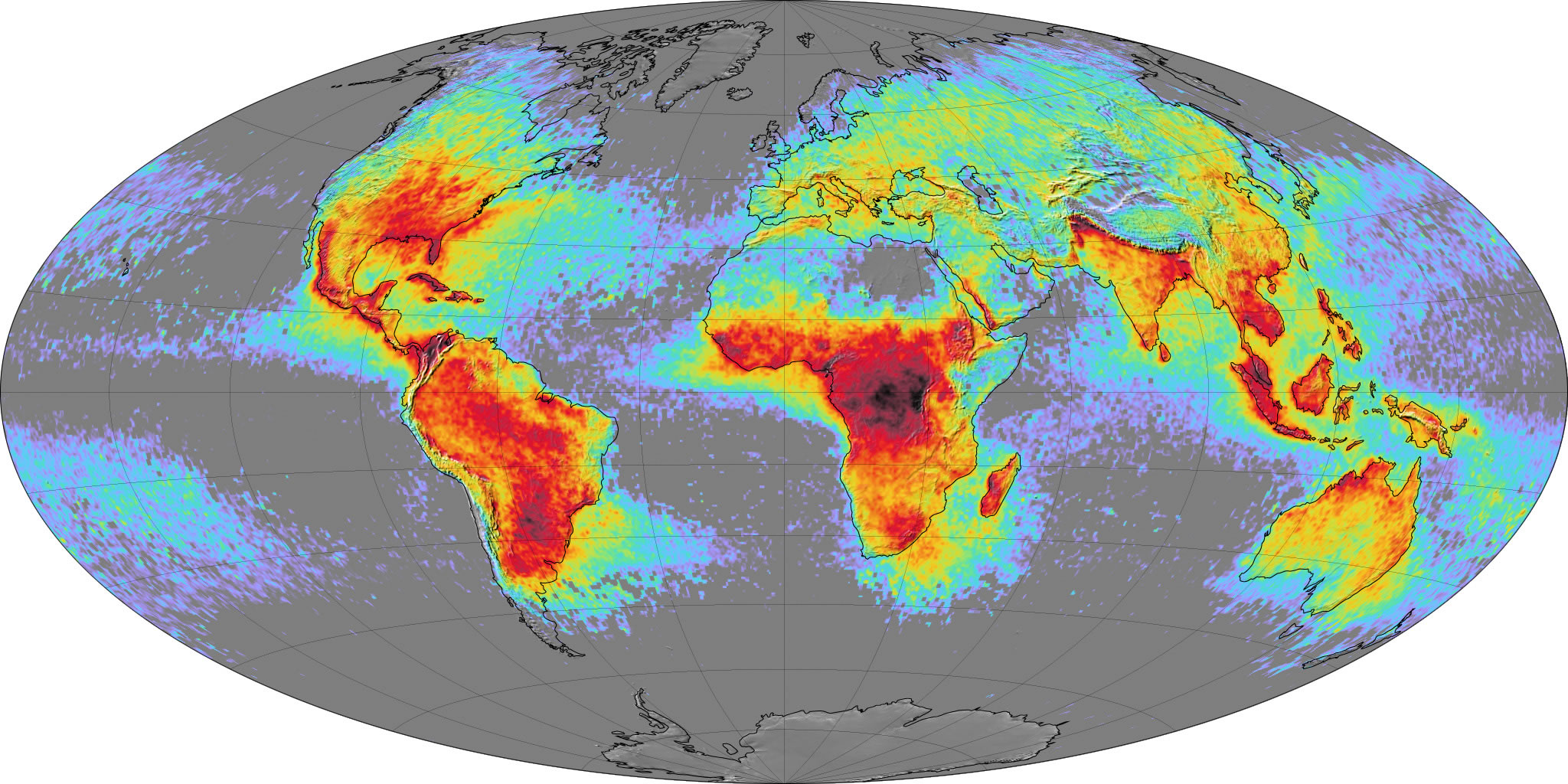
World Lightning Map: Lightning is not uniformly distributed across the Earth.
Article by: Hobart M. King, Ph.D., RPG


World Lightning Map: The map above shows the average yearly counts of lightning flashes per square kilometer based on data collected by NASA’s Lightning Imaging Sensor on the Tropical Rainfall Measuring Mission satellite between 1995 and 2002. Places where less than one flash occurred (on average) each year are gray or light purple. The places with the largest number of lightning strikes are deep red, grading to black. Enlarge.
What is Lightning?
Lightning is a sudden high-voltage discharge of electricity that occurs within a cloud, between clouds, or between a cloud and the ground. Globally, there are about 40 to 50 flashes of lightning every second, or nearly 1.4 billion flashes per year. These electrical discharges are powerful and deadly.
Tiếp tục đọc “World Lightning Map: Lightning is not uniformly distributed across the Earth.”
Thunderstorm activity and research on lightning position in Vietnam
Vietnam is situated in the centre of the Asian thunderstorm region – one of three thunderstorm centres in the world. This article gives an overview of thunderstorm activity in Vietnam and results from the research on lightning position over the past year in Institute of Geophysics under the Vietnam Academy of Science and Technology.
Tiếp tục đọc “Thunderstorm activity and research on lightning position in Vietnam”
Thảm họa phát triển sông Mekong đang diễn ra thế nào?
Chiến lược lớn mà Trung Quốc dành cho sông Mekong sẽ tác động ra sao tới con sông và các nước hạ nguồn? Dòng sông Mekong từ lâu đã mang một màu sắc kỳ bí của những cuộc phiêu lưu, những chuyên gia về hoang dã, và các nhà khoa học luôn bị mê hoặc bởi dòng chảy và những thác nước của dòng sông này, cùng với những chú cá heo nước ngọt đang có nguy cơ tuyệt chủng, cá đuối khổng lồ và những con cá sấu Siamese. Sự đa dạng sinh học của dòng sông này chỉ đứng sau sông Amazon. Tiếp tục đọc “Thảm họa phát triển sông Mekong đang diễn ra thế nào?”
Công trình Hiệu quả Năng lượng – Góc nhìn toàn diện: Thiết kế – Xây dựng – Vận hành
Công trình cần được Thiết kế – Xây dựng – Vận hành như thế nào để đảm bảo tối ưu hóa tiện nghi cho người sử dụng trong khi vẫn hiệu quả về sử dụng tài nguyên (năng lượng, nước, vật liệu….) và giảm tác động đến môi trường? Điều này đòi hỏi sự tham gia của tất cả các bên ngay từ giai đoạn ban đầu trong quá trình hình thành đến khi kết thúc các dự án xây dựng.
Bộ Quy chuẩn Kỹ thuật Quốc gia về Công trình Hiệu quả năng lượng (QCVN 09:2017/BXD) do Bộ Xây dựng ban hành năm 2018 là phiên bản cập nhật của QCVN 09:2013/BXD do thực trạng áp dụng những năm vừa qua còn ở mức rất thấp. Song song cập nhật, điều chỉnh trong hành lang pháp lý từ phía cơ quan nhà nước, mỗi dự án xây dựng cần có sự tham gia từ tất cả các bên tham gia (đơn vị đầu tư, nhà thầu, tư vấn, thi công xây dựng, vận hành….) ngay từ khâu hoạch địch mục tiêu bền vững cho đến khi thiết kế, vận hành và kết thúc vòng đời công trình để đạt được tiêu chí bền vững, hiệu quả năng lượng và tài nguyên. Tiếp tục đọc “Công trình Hiệu quả Năng lượng – Góc nhìn toàn diện: Thiết kế – Xây dựng – Vận hành”
Brace yourself for more record heat
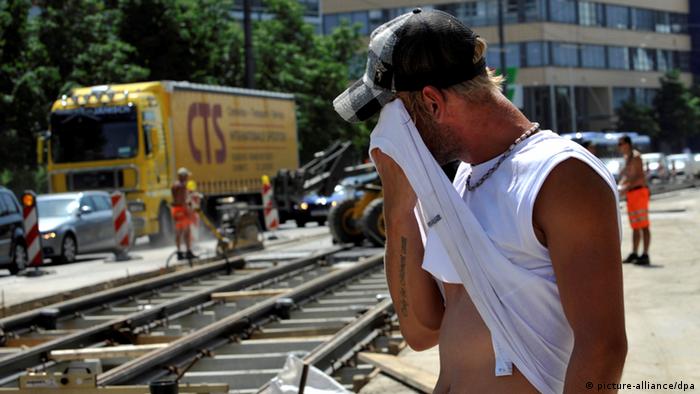
Current high temperatures in the northern hemisphere are set to continue. Climate change means we’re likely to experience very hot summers more often — even though we’re already struggling with health consequences now.
Europe is in the throes of a heat wave, and it’s not letting up — on the contrary. More hot air is coming over from Africa, and is even bringing desert dust with it.
Southwestern European countries are being hit especially hard. Authorities in Portugal issued a nationwide health warning, including for dust from the Sahara. Warnings were also issued for 40 of Spain’s 50 provinces. The southeastern Portuguese town of Beja is expected to see a peak of 47 degrees Celsius (117 degrees Fahrenheit) on Saturday.
Tiếp tục đọc “Brace yourself for more record heat”
Early Warning System Innovations in Vietnam: HOW SMS TECHNOLOGY CAN ENSURE EDUCATION CONTINUITY
Disaster-prone Vietnam is susceptible to rapid-onset emergencies like storms, typhoons, and flooding annually. During these times, children are unable to go to school due to unsafe conditions and parents fearing for their children’s safety. Approximately 70% of the population is living in coastal and low-lying areas, resulting in high vulnerability to extreme weather events intensified by climate change and global warming.
As part of Save the Children in Vietnam’s risk reduction work, the country office has been working to improve the way hazard risk information is shared. Partnering with local government agencies and mobile companies, Save the Children initiated an SMS disaster early warning system that provides weather information to the vulnerable coastal provinces of Thua Thien Hue, Quang Nam, and Da Nang. Tiếp tục đọc “Early Warning System Innovations in Vietnam: HOW SMS TECHNOLOGY CAN ENSURE EDUCATION CONTINUITY”
Losing Earth: The Decade We Almost Stopped Climate Change
Editor’s Note
This narrative by Nathaniel Rich is a work of history, addressing the 10-year period from 1979 to 1989: the decisive decade when humankind first came to a broad understanding of the causes and dangers of climate change. Complementing the text is a series of aerial photographs and videos, all shot over the past year by George Steinmetz. With support from the Pulitzer Center, this two-part article is based on 18 months of reporting and well over a hundred interviews. It tracks the efforts of a small group of American scientists, activists and politicians to raise the alarm and stave off catastrophe. It will come as a revelation to many readers — an agonizing revelation — to understand how thoroughly they grasped the problem and how close they came to solving it. Jake Silverstein
Giảng dạy các chủ đề gây tranh cãi – Hướng dẫn dành cho giáo viên (P1)
English: Teaching Controversial Issues: A guide for teachers
Tại sao cần giảng dạy các chủ đề gây tranh cãi?
Điều quan trọng là tạo cơ hội cho các bạn trẻ học giao tiếp với nhau bằng cách tập trung vào những chủ đề mà các bạn có quan điểm khác nhau. Bằng việc tổ chức thảo luận trong một không gian an toàn, các bạn có thể thu được kiến thức và hiểu biết về các chủ đề, và đánh giá một cách nghiêm túc những giá trị và thái độ của riêng mình. Qua đó, người trẻ phát triển các kỹ năng cần thiết để các em xây dựng năng lực đương đầu với những hoàn cảnh khó khăn trong cuộc sống riêng và trong cộng đồng của chính mình.:
GIỚI THIỆU
Tài liệu hướng dẫn này sẽ đề cập:
- Các chủ đề gây tranh cãi là gì
- Vì sao nên giảng dạy các chủ đề gây tranh cãi
- Giá trị của cách tiếp cận giáo dục công dân toàn cầu
- Hướng dẫn và các chiến lược trên lớp để nắm bắt và khám phá các chủ đề gây tranh cãi
- Một vài hoạt động thực hành để giảng dạy các chủ đề gây tranh cãi.
Chúng ta có thể không biết tương lai của người trẻ ngày nay có gì, nhưng chúng ta có thể chắc chắn rằng người trẻ sẽ phải đối mặt với những quyết định về hàng loạt các vấn đề gây ra những phản ứng mạnh mẽ, đa dạng và thường mâu thuẫn nhau. Nếu người trẻ trở thành những công dân địa phương và toàn cầu hiệu quả có thể đóng vai trò quan trọng trong việc tạo ra một thế giới bình đẳng không nghèo đói, thì tất cả người trẻ nên có cơ hội tham gia vào các chủ đề gây tranh cãi một cách thích hợp.
Tiếp tục đọc “Giảng dạy các chủ đề gây tranh cãi – Hướng dẫn dành cho giáo viên (P1)”
No more dams, float solar panels instead: experts
After studying alternatives to mitigate the impacts of pending dam projects in Laos and Cambodia, experts say, just say NO.
The catastrophic collapse of a dam during unusually heavy rain on July 24 in Laos’ southern Attapeu Province has greatly enhanced the importance of two separate reports by the California-based National Heritage Institution (NHI) on two massive dam projects planned by Laos and Cambodia that would fatally degrade the vital core of the world’s most productive riverine ecosystems and its agriculturally rich Delta.
One report, in fact, specifically addresses the threat posed by plans to construct nearly a dozen massive hydropower dams on the the Xe Kong, the very river system bore the brunt of the upstream dam collapse. Within a couple of days of the dam collapse one of its tributaries the Xe Kong swelled to just short of the 11.5 meters “alarm” level at a measuring station some 287 kilometers downstream in Cambodia. Some 3,000 people narrowly escaped the rushing mass of water, while some 27 are said to be dead and hundreds more are missing.
Both studies were led by Gregory Thomas, an American with extensive experience studying fisheries and sediment issues on tributary river dams in Vietnam and Laos, and more than a dozen international and regional co-authors and contributors.
The first report, The NHI’s Sambor Alternatives Assessment, was prepared under a 2014 Memorandum of Understanding with the Cambodia Ministry of Mines and Energy and submitted in December 2017.
Tiếp tục đọc “No more dams, float solar panels instead: experts”
Mekong Delta’s splendors now a relic of the past
VNE – By Dang Hung Vo July 26, 2018 | 10:11 am GMT+7
Development policies have all but destroyed the natural bounty that the delta was blessed with.

In 1954, when the French withdrew from Hanoi and peace reigned once more in our capital, I was only 8 years old. Where I am from, students could only study up to 3rd grade. Our teacher, originally from the south, was a child of the Mekong Delta.
He often told us stories about his hometown, about how it needed no dam to tame the Mekong River unlike our Red River since the Mekong people had learned to live with the behemoth. Tiếp tục đọc “Mekong Delta’s splendors now a relic of the past”
Các cách dạy về biến đổi khí hậu ở trường học
English: 5 Ways to Teach About Climate Change in Your Classroom
Có một thực tế: năm 2016, trái đất đạt ngưỡng nhiệt độ cao nhất trong lịch sử, vượt ngưỡng kỉ lục năm 2014, 2015. Trái đất của chúng ta đang nóng lên, nhiệt độ đang tăng nhanh và các nhà khoa học tin rằng nó sẽ đe dọa đến con người và thế giới tự nhiên. Một thực tế khác là: những nhà giáo dục cần phải giúp học sinh của mình học về biến đổi khí hậu gây ra bởi tác động của con người. Nhưng bằng cách nào chúng ta khuyến khích và truyền cảm hứng cho các em về chủ đề này?
1. Nhảy vào!
Nước đang nóng lên và đang nóng lên. “Chỉ có cách lao vào mà dạy!” Kottie Christie – Blick, giáo viên lớp 9 tại một vùng ngoại ô New York, ủy viên Cơ quan Quản lý Khí quyển và Đại dương Quốc gia Mỹ (NOAA – National Oceanic and Atmosspheric Administration) và tư vấn về giáo dục biến đổi khí hậu. Christie-Blink cho biết, chủ đề này rất quan trọng, không cho phép chậm trễ: “Hãy bắt đầu ngay bây giờ”, bà thúc giục, hãy tiến lên và học nhiều hơn.
Bruce Taterka, giáo viên trung học phổ thông tại Mendham New York nói, “Lúc ban đầu tôi không biết nhiều. Tôi phải tự dạy cho chính mình, đó là điều các giáo viên phải thường làm.” Qua nhiều năm, thầy Taterka được nhận vào các chương trình tập huấn giáo viên trong rừng mây của đất nước Ecouador, trên tàu con thoi dành cho nghiên cứu tại Vịnh Mexico Dốc phía Bắc dãy Alaska, và những nơi khác, đầu tiên Taterka học về ảnh hưởng của biến đổi khí hậu.
Tiếp tục đọc “Các cách dạy về biến đổi khí hậu ở trường học”
Are rural youth in the Mekong region losing interest in farming?
Smallholder farmers in the Mekong region face increasingly insecure farming livelihoods as land resources are drawn into the hands of developers. SEI is exploring what this means for the future of rural youth and farming.
The livelihoods of millions of smallholder farmers in the Mekong region are tied to their land. But the demands for land for large-scale agriculture, industrial and energy development schemes such as monoculture plantations, special economic zones, and hydropower projects are taking away land from smallholders, giving rise to more landless farmers and increasing land inequality.
Meanwhile, national policies often fail to protect the rights of smallholder farmers who are poorly positioned to compete with these developers and to benefit from the outcomes of the investments.
This indicates a precarious future for smallholder farming-based livelihoods in the Mekong Region, the situation exacerbated by the failure of current labour markets to provide decent, secure jobs for the increasing number of landless people. Tiếp tục đọc “Are rural youth in the Mekong region losing interest in farming?”
Environmental changes in the Mekong Delta spell trouble for farmers
phys.org
July 23, 2018, University of Illinois at Urbana-Champaign
The Mekong Delta is home to 15 million people, many of whom rely on the delta’s rich soil and water resources for farming and fishing. But their livelihoods are being threatened by rising sea levels, droughts, dams, and other hydrological shifts. A new article from researchers at the University of Illinois and Iowa State University explains the challenges.
Tiếp tục đọc “Environmental changes in the Mekong Delta spell trouble for farmers”