Climate change hits women’s health harder. Activists want leaders to address it at COP28

Mamta Kumari, a farm worker, takes a brief break between harvesting wheat on a farm in Nanu village in Uttar Pradesh state, India, on Oct. 17, 2023. As the annual U.N.-led climate summit known as COP is set to convene later this month in Abu Dhabi, experts are urging policymakers to respond to climate change’s disproportionate impact on women and girls, especially where poverty makes them more vulnerable. (Uzmi Athar/Press Trust of India via AP)

BY UZMI ATHAR, PRESS TRUST OF INDIA, AP, Updated 9:02 AM GMT+7, November 21, 2023

NEW DELHI (AP) — Manju Devi suffered in pain for two months last year as she worked on a farm near Delhi, unable to break away from duties that sometimes had her standing for hours in the waist-deep water of a rice paddy, lifting heavy loads in intense heat and spraying pesticides and insecticides. When that pain finally became too much to bear, she was rushed to a hospital.

Tiếp tục đọc “Climate change hits women’s health harder. Activists want leaders to address it at COP28”

Khi nào người dân được lựa chọn mua điện từ các đơn vị bán lẻ trực tiếp?

thanhnien.vn 14/11/2023 19:43 GMT+7

Mặc dù Đảng và Nhà nước chủ trương xóa bỏ độc quyền đối với ngành điện, và Tập đoàn Điện lực Việt Nam (EVN) không còn độc quyền sản xuất điện, nhưng người dân và doanh nghiệp hiện chỉ có một lựa chọn duy nhất là mua điện của EVN. Thế độc quyền đó có thể thay đổi không, và sẽ thay đổi như thế nào?

Lộ trình tiến tới thị trường bán lẻ điện cạnh tranh

Xóa độc quyền trong ngành điện được tính đến từ hơn 10 năm trước theo 3 cấp độ: thị trường phát điện cạnh tranh, thị trường bán buôn điện cạnh tranh và thị trường bán lẻ điện cạnh tranh. Từ năm 2012, thị trường phát điện cạnh tranh chính thức vận hành với 32 nhà máy tham gia. Đến năm 2020, số đơn vị tham gia đã có hơn 100 nhà máy. Đến nay, EVN không còn độc quyền phát điện, chỉ sở hữu 37%, các doanh nghiệp tư nhân sở hữu 42%, còn lại do các doanh nghiệp nhà nước khác, các dự án BOT nắm giữ và một tỷ lệ nhỏ khoảng 1% là điện nhập khẩu. 

Tiếp tục đọc “Khi nào người dân được lựa chọn mua điện từ các đơn vị bán lẻ trực tiếp?”

Vietnam recommended to regulate Minimum Energy Performance Standard for air conditioners

vietnamnet.vn

The cooling sector is a major source of energy consumption and greenhouse gas emissions.

People shop for air conditioners at an electronics supermarket in the northern province of Hưng Yên.—VNA/VNS Photo Phạm Kiên

Việt Nam is recommended to regulate minimum energy performance standard (MEPS) for air conditioners’ seasonal energy efficiency ratio, chillers, variable refrigerant flow, and cars’ mobile air-conditioning systems in the country’s National Green Cooling Programme.

Besides, the country should also switch to greener refrigerants such as R290 or R717, enforce and comply with policies through robust monitoring and verification, Anant Shukla, expert of the Consultancy Consortium, said at a consultation workshop held on Tuesday in Hà Nội.

The workshop was co-organised by the Department of Climate Change under the Ministry of Natural Resources and Environment and the Southeast Asia Energy Transition Partnership to provide technical assistance for the project “In-depth study and survey to develop the National Green Cooling Programme”.

Tiếp tục đọc “Vietnam recommended to regulate Minimum Energy Performance Standard for air conditioners”

Vietnam will struggle to meet 2030 offshore wind goal, top official says

Reuters.com

HANOI, Nov 9 (Reuters) – Vietnam will have a hard time reaching its offshore wind power target for 2030, a top executive at a state-owned energy company said, with foreign investors also warning of multiple regulatory hurdles that would need to be cleared.

The Southeast Asian country has good offshore wind power potential given strong winds and shallow waters near densely populated areas, according to the World Bank, which estimates the sector could add at least $50 billion to Vietnam’s economy.

Offshore wind is also a priority for Group of Seven (G7) members that have promised funds to boost the country’s renewable energy sources and reduce its reliance on coal.

Tiếp tục đọc “Vietnam will struggle to meet 2030 offshore wind goal, top official says”

Thailand’s forest communities fall victim to country’s climate promises

devex.com

Greenhouse gas emissions can be offset by carbon sinks such as forests, but expanding these areas can put Indigenous communities, reliant on the forests, at risk.

By Rebecca L. Root // 11 October 2023

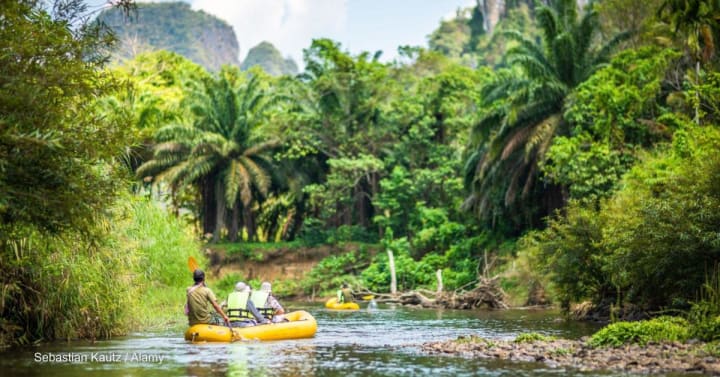
Khao Sok rainforest in Thailand. Photo by: Sebastian Kautz / Alamy

From Khao Sok National Park in the southwest to Phu Chi Fa Forest Park in the north, forests cover around 30% of Thailand’s total area. Approximately 23 million people live near or in these lush green landscapes, depending on them for sustenance and livelihoods. But that’s now at risk, due to both climate change-related threats and the policies implemented to protect the forests.

Warangkana Rattanarat, Thailand country director for The Center for People and Forests, warned that the arrival of El Niño earlier this year has caused long droughts and less rain, damaging crops and other forest resources. This has affected the availability of food, as well as the income local people can derive from forest resources, she added.

The country has also experienced floods and the highest temperatures on record this year, impacting forests and the communities within them. In the GermanWatch Global Climate Risk Index 2021, Thailand ranked at number nine globally for long-term climate risks.

Additionally, there are land and tenure rights issues for Indigenous forest communities to contend with, and national climate commitments that have the potential to negatively impact such communities, said experts.

Tiếp tục đọc “Thailand’s forest communities fall victim to country’s climate promises”

The Interdependence of Climate Security and Good Governance: A Case Study from Pakistan

Climateandsecurity.org

By Ameera Adil and Faraz Haider

Last year, Pakistan faced the most devastating floods in the history of the country, which is notable because the country lies on a geographical floodplain. The Indus is an ancient and powerful river. The floodplain of the river covers nearly half of Pakistan, where most of the country’s population resides. When the Indus breathes, as rivers do, the lives and livelihoods on the floodplains are quietly absorbed by the water. 

Climate change had a significant role to play in the 2022 floods. The affected areas received 900mm of rainfall between June to August, which is nearly 350 percent more than the long-term average. Tiếp tục đọc “The Interdependence of Climate Security and Good Governance: A Case Study from Pakistan”

Why the Global Stocktake is a Critical Moment for Climate Action

UNFCCC.int

Climate Change

The global stocktake is a critical turning point in our battle against the escalating climate crisis – a moment to take a long, hard look at the state of our planet and chart a better course for the future.

“The global stocktake is an ambition exercise. It’s an accountability exercise. It’s an acceleration exercise,” said UN Climate Change Executive Secretary Simon Stiell. “It’s an exercise that is intended to make sure every Party is holding up their end of the bargain, knows where they need to go next and how rapidly they need to move to fulfill the goals of the Paris Agreement.”

What is the global stocktake?

Tiếp tục đọc “Why the Global Stocktake is a Critical Moment for Climate Action”

Climate Change History – PM of the UK, Margaret Thatcher – Speech to UN (Nov. 8, 1989)

Prime Minister of the UK, Margaret Thatcher studied chemistry at Oxford, and worked briefly as a research chemist before becoming a barrister

Mr President, it gives me great pleasure to return to the Podium of this assembly. When I last spoke here four years ago, on the 40th anniversary of the United Nations, the message that I and others like me gave was one of encouragement to the organisation to play the great role allotted to it.

Of all the challenges faced by the world community in those four years, one has grown clearer than any other in both urgency and importance—I refer to the threat to our global environment. I shall take the opportunity of addressing the general assembly to speak on that subject alone.

INTRODUCTION

Tiếp tục đọc “Climate Change History – PM of the UK, Margaret Thatcher – Speech to UN (Nov. 8, 1989)”

Fukushima wastewater issue will further divide a nation, split families, and cause ‘atomic divorce’

thebulletin.org By Maxime Polleri | October 17, 2023

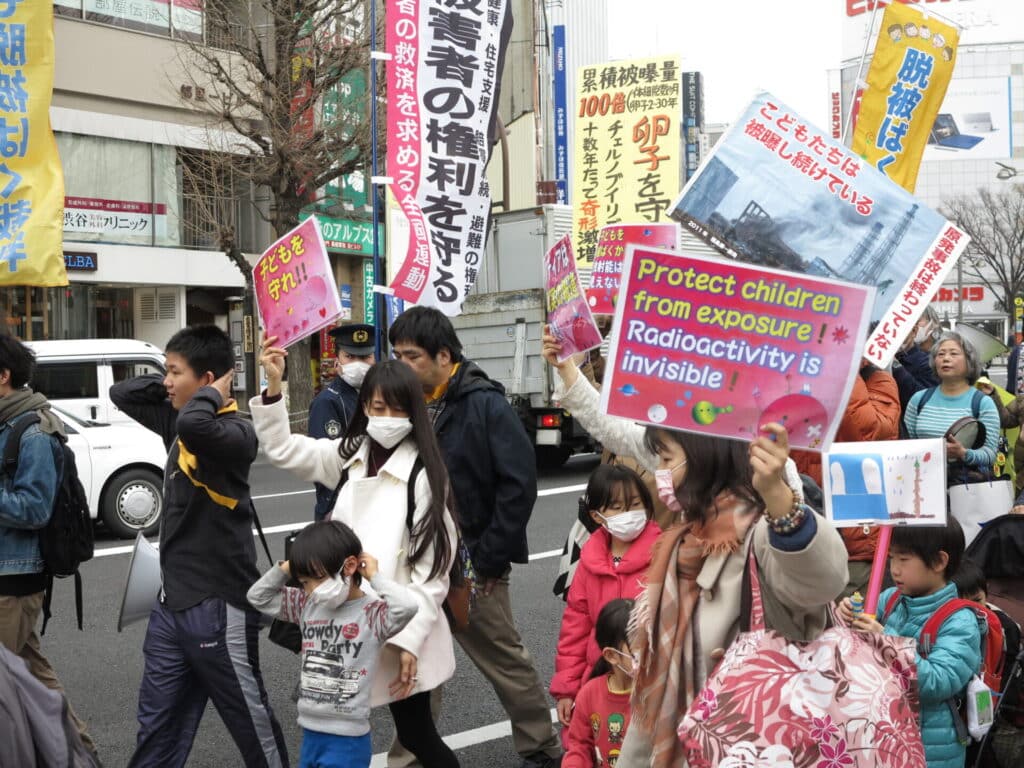
 Mothers march in Tokyo against radiation exposure risks five years after the Fukushima nuclear disaster on March 5, 2016. (Photo by Maxime Polleri)Share

In a bid to dispel seafood worries around the release of Fukushima nuclear wastewater into the ocean, Japan’s Prime Minister Fumio Kishida ate an array of sashimi late in August; the raw fish ranged from flounder to sea bass caught in the Fukushima area. It is “safe and delicious,” he joyfully declared during a public relations effort to revitalize the fishing industry, which has been affected by a Chinese seafood ban and consumer anxieties over the wastewater release.

Many applauded Kishida’s comment, which echoes the same government narrative around post-Fukushima food safety, as well as his firm support for the release of tritium-contaminated water—a discharge process that the International Atomic Energy Agency stated complies with operational safety limits for radiation.

But as someone who studied the aftermath of the Fukushima nuclear disaster for more than a decade, I believe that this decision will irreversibly erode public trust and create irreparable long-lasting tensions. During my years of research in Japan as an anthropologist, I witnessed first-hand how state policies around Fukushima’s economic recovery are fragmenting communities, which constitutes an enduring catastrophe of its own.

Tiếp tục đọc “Fukushima wastewater issue will further divide a nation, split families, and cause ‘atomic divorce’”

Why Is Britain Retreating from Global Leadership on Climate Action?

Yale Environment 360

Prime Minister Rishi Sunak announcing last month that the U.K. will delay the phaseout of gasoline and diesel cars.
Prime Minister Rishi Sunak announcing last month that the U.K. will delay the phaseout of gasoline and diesel cars. JUSTIN TALLIS / POOL VIA AP

While Britain has long been a leader in cutting emissions, Prime Minister Rishi Sunak is now implementing a stunning reversal of climate-friendly policies, with new plans to “max out” oil production. Business leaders have joined environmentalists in condemning the moves.

BY FRED PEARCE • OCTOBER 17, 2023

In 1988, British Prime Minister Margaret Thatcher became the first world leader to take a stand on fighting climate change. Last month, exactly a quarter-century later, her successor Rishi Sunak tore up a cross-party consensus on the issue that had survived the intervening eight general elections and replaced it with a populist assault on what had been his own government’s environmental policies.

Thatcher, who trained as a chemist before entering politics, took her stand at a packed meeting of the country’s most prestigious science body, the Royal Society, on September 27, 1988. She told the assembly that “we are creating a global heat trap which could lead to climate instability” and promised action to curb global warming and achieve “stable prosperity”.

Tiếp tục đọc “Why Is Britain Retreating from Global Leadership on Climate Action?”

Amazon River hits lowest level in over a century

reuters.com

The Amazon River fell to its lowest level in over a century on Monday at the heart of the Brazilian rainforest as a record drought upends the lives of hundreds of thousands of people and damages the jungle ecosystem.

Rapidly drying tributaries to the mighty Amazon have left boats stranded, cutting off food and water supplies to remote villages, while high water temperatures are suspected of killing more than 100 endangered river dolphins.

Advertisement · Scroll to continue

Tiếp tục đọc “Amazon River hits lowest level in over a century”

24 hours with … climate negotiator Vicente Paolo Yu III

eco-business.com

Brokering for the environment for the G77, the biggest negotiating bloc of low-income countries, comes with both challenges and triumphs, says the Filipino lawyer. He shares what it is like to spend sleepless nights at the climate meetings, ahead of COP28.

Vice Yu COP24
Vicente Paolo Yu III, known by his nickname Vice, at COP24 in Katowice, Poland in 2018. Image: Vice Yu

By Hannah Alcoseba Fernandez

It is 12 midnight on the last Saturday before the conclusion of the world’s biggest climate summit. 

The Conference of the Parties (COP) to the United Nations Framework Convention on Climate Change (UNFCCC) are two-week gatherings that have been held yearly for almost three decades in a bid to make major resolutions to combat worsening impacts of global warming.

The crowd of delegates from nearly 200 countries, dozens of world leaders and hundreds of the biggest companies and nonprofits has dissipated. At the venue, negotiators, however, are huddling in a room to grapple with the final wording of text that could potentially shift the discourse on climate change for the long term. Most of them have not eaten a proper meal, and are surviving on energy bars and the water served for free at the venue.

This is a typical scene into the last hours at  the COPs, said Vicente Paolo Yu III, coordinator for the biggest negotiating bloc of low-income countries at the conference, the Group of 77 (G77) and China. The Asian superpower is not classified a developed country under international standards and has provided consistent support to the G77 on climate issues.

Tiếp tục đọc “24 hours with … climate negotiator Vicente Paolo Yu III”

Sạt lở đất – Thiên tai hay nhân tai?

Phóng sự VTV24 năm 2020

[VOV2] – Các hoạt động nhân sinh đang làm trầm trọng thêm các hình thái bất thường của thời tiết và đã đến lúc không thể chỉ nói rằng thảm hoạ xảy ra là do thiên tai, mà trong nhiều trường hợp cần phải nói đến là do cả nhân tai.

Chỉ trong vòng hơn 2 tháng qua, cả nước đã xảy ra 47 trận sạt lở đất, đá gây thiệt hại nghiêm trọng về người và tài sản. Điều đáng nói, không chỉ khu vực Tây Nguyên, Nam Bộ, Tây Bắc, mà ngay cả Hà Nội cũng đã xuất hiện những trận sạt lở lớn. Vậy đâu là nguyên nhân gây ra tình trạng này? Cần có những giải pháp hữu hiệu nào để phòng tránh những vụ sạt lở tương tự?

Trong cuộc trao đổi với phóng viên VOV2, PGS.TS Trần Tân Văn, nguyên Viện trưởng Viện Khoa học địa chất và khoáng sản Việt Nam, Bộ Tài nguyên và Môi trường đã có những nhận định và phân tích khá thẳng thắn xung quanh vấn đề này.

PGS.TS Trần Tân Văn, nguyên Viện trưởng Viện Khoa học địa chất và khoáng sản Việt Nam, Bộ Tài nguyên và Môi trường
Tiếp tục đọc “Sạt lở đất – Thiên tai hay nhân tai?”