Climate migrants are earning more. Why are their kids dropping out?

mekongeye.com By Võ Kiều Bảo Uyên 18 August 2025 at 16:13

Childcare, red tape and separation from parents stand in the way of school for children of millions of Mekong Delta migrants

HO CHI MINH CITY, VIET NAM – In a 12-square-meter rented apartment lined with pink Hello Kitty wallpaper, Thúy Hằng, 37, continually ponders whether to bring her six-year-old daughter from the rural Mekong Delta to the city.

Hằng works at an Adidas supplier factory and her husband at a wood processing factory. The couple left their two daughters with the grandparents in Đồng Tháp province, when the girls were only infants.

Source: Mapbox

For years, Hằng has dreamed of reuniting with her children. She decorated the room, inquired about schools and had the funds ready, but could not figure out childcare. The couple work until 7-8pm, and public schools close at 4:30pm.

In the past decade, more than one million people have left the Mekong Delta for industrial zones in Ho Chi Minh City – as the region faces mounting environmental stress.

Once considered Viet Nam’s rice bowl, the delta now grapples with sediment loss, saltwater intrusion and soil erosion – the results of upstream dams, rampant sand mining and climate change.

Tiếp tục đọc “Climate migrants are earning more. Why are their kids dropping out?”

Floods and Migrants of Vietnam’s Mekong Delta: 25 Lessons from the Data

mekongeye.com

By Le Thu MachHoang Long Cao and Vu The Cuong

11 February 2022 at 10:10 (Updated on 25 April 2022 at 14:37)

Data on agricultural, hydropower, saltwater intrusion and rainfall patterns in Vietnam Mekong Delta explains where the country’s food comes from, why it’s disappearing and what can be done about it.

The fertile Mekong Delta is a crucial region for Vietnam’s continued food and economic security but a variety of factors have wreaked havoc on how Vietnam grows food, catches fish and ultimately survives a radically changing environment. Here, reporters analyze 20 years of data on agricultural, hydropower, saltwater intrusion and rainfall patterns in Vietnam’s Mekong Delta (VMD) to explain where the country’s food comes from, why it’s disappearing and what can be done about it.

1. Disappearing waters

Vietnam’s flood plains are disappearing, and fish, rice and people along with it. The flood peak in Tan Chau and Chau Doc in 2020 is only about 60% of that in 2002. From now on, VMD will have to wait from 50 to 100 years to have a big flood season. Within 15 years, the amount of fish caught in An Giang has plummeted by two-thirds.

Tiếp tục đọc “Floods and Migrants of Vietnam’s Mekong Delta: 25 Lessons from the Data”

Mekong Delta disappears under its residents’ feet

mekongeye.com

By Nhung Nhung 9 November 2021 at 19:14

It took thousands of years for the Mekong Delta to come into existence. It might take humans just a few more decades to undo it.

See also Aral Sea: The world 4th largest sea that dried up in 40 years

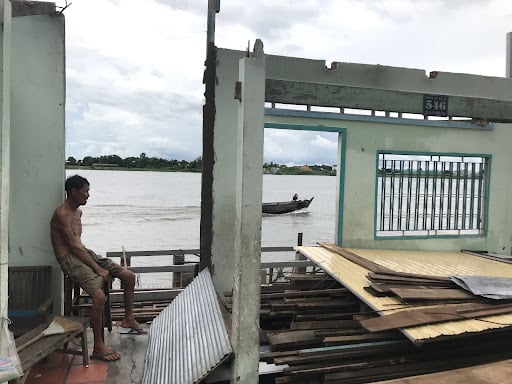
One summer evening, Le Phi Hai lost his house to the Tien River, one of the two main branches of the Mekong River flowing through the delta in Vietnam. Three summers later, at almost exactly the same hour, the river claimed his house again.

The first time erosion bit into his soil, Hai, now 66, was watching Euro 2016 on his small TV screen. At around 3am, as Cristiano Ronaldo missed a critical penalty shot in Portugal’s match against Austria thousands of miles away, a strange bubbling sound roared from the backyard of Hai’s low brick home in the riverside town of Hong Ngu. As the noise grew to a louder dull rumble, drowning out the screams of the match commentators, he left his TV and walked outside for a quick check. After a few steps, he heard a thunderous “Th-rump!” Suddenly Hai saw his bed, tables, chairs, and finally the TV, with Ronaldo’s face on screen, slump down into a void that had appeared under his feet. The backyard where he was standing became a tiny islet surrounded by turgid water, and down it went.

Tiếp tục đọc “Mekong Delta disappears under its residents’ feet”

Mekong Infrastructure Tracker

Resources for understanding the dynamic economic, social, environmental, and political impact of development in the Mekong region

PROJECT INFO

The Mekong Infrastructure Tracker platform is the premier resource for researchers to track, monitor, and quantify the development of energy, transportation, and water infrastructure assets and the social, economic, and ecological changes they bring to South East Asia. The Mekong Infrastructure Tracker was developed with support from the USAID Mekong Safeguards activity led by The Asia Foundation, with funding provided by USAID. Find data by browsing or searching, build new geographic information products, and explore existing maps and apps.

More information https://www.stimson.org/project/mekong-infrastructure/?utm_source=Mekong+Eye&utm_campaign=65dedd4c28-EMAIL_CAMPAIGN_2018_01_10_COPY_01&utm_medium=email&utm_term=0_5d4083d243-65dedd4c28-527526165

Overcoming threats to the Mekong’s forests and people

Five countries strive to meet the challenge of forest governance. This special report covers progress, problems and promising solutions.

EU

Overcoming threats to the Mekong’s forests and people was produced with the financial support of the European Union. Its contents are the sole responsibility of RECOFTC and do not necessarily reflect the views of the European Union.


RECOFTC’s work is made possible with the continuous support of the Swiss Agency for Development and Cooperation (SDC) and the Swedish International Development Cooperation Agency (Sida).

Monitoring the Quantity of Water Flowing Through the Upper Mekong Through Natural (Unimpeded) Conditions

pactworld.org

The Eyes on Earth report, Monitoring the Quantity of Water Flowing Through the Upper Mekong Through Natural (Unimpeded) Conditions,  published this week by Pact, shows that deviations from normal flow patterns began to occur with the operation of the first large hydropower dam on the Upper Mekong mainstream in 2012. Using satellite data on the Upper Mekong from 1992 to 2019, matched against daily measurements of river height downstream at Chiang Saen, Thailand, the research shows unusual fluctuations in recent years. The report concludes that cooperation between China and the Lower Mekong countries to simulate the natural flow cycle of the Mekong could potentially improve low-flow conditions and benefit all communities in the Mekong River Basin.

(Credit: Love Khong Chiam Facebook - facebook.com/pg/ฮักเด้อโขงเจียม-1319709694817122)

Mekong River dams could slice 0.3 pct off Vietnam’s GDP: report

vnexpress.net

By Phan Anh   March 31, 2020 | 11:27 am GMT+7

Mekong River dams could slice 0.3 pct off Vietnam's GDP: report

A satellite image on January 3, 2020, shows Xayaburi Dam sitting astride the Mekong River, which has turned blue due to drought and other factors reducing sediment, near the town of Xayaboury, Laos. Photo by Reuters.

Hydropower dams on the Mekong River are expected to reduce Vietnam’s GDP by 0.3 percentage points due to their impact on fisheries and agriculture.

Sand overexploitation of Mekong River raises worries for Mekong Delta

vietnamnet

The loss of sand has caused erosion and increased salinity as well as subsidence in the Mekong Delta.
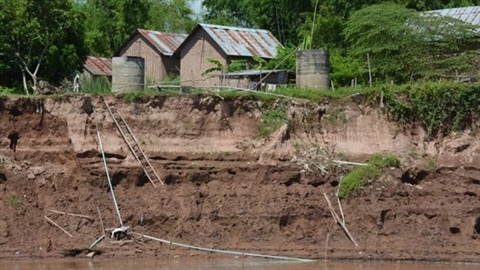
The studies of the Mekong River by Prof Stephen Darby from Southampton University found that within several years, the river bed fell by several meters on a section of hundreds of kilometers in length.

Sand overexploitation of Mekong River raises worries for Mekong Delta

Tiếp tục đọc “Sand overexploitation of Mekong River raises worries for Mekong Delta”

Mekong Delta stays alert for severe drought

By Hoang Nam   January 4, 2020 | 04:45 pm GMT+7

Mekong Delta stays alert for severe drought

A farmer in a paddy field hit by drought in the Mekong Delta’s province of Soc Trang, June 2019. Photo by VnExpress/Thanh Nguyen.

Vietnam’s Mekong Delta is bracing severe drought and salinity in the coming months, and local authorities have been told to take every step possible to mitigate the damage.

For this dry season, which has already started in southern Vietnam and normally lasts until late April, drought conditions are likely to be more severe, resulting in more salinity in the delta, which spreads over 40,577 square kilometers (15,670 square miles).

The nation’s most fertile region for long, the Mekong Delta has been called the Vietnam’s rice granary. It is also the nation’s aquaculture hub.

Tiếp tục đọc “Mekong Delta stays alert for severe drought”

Gravest threat to Mekong delta today is sediment starvation not rising seas

wwf.panda.org

Posted on 10 December 2019

New research shows that the increasing vulnerability of the Mekong delta to floods, salt intrusion and erosion is caused by insufficient sediment in the river not climate-induced rise in sea levels.

Published in the journal Nature Scientific Reports, the findings of the Rise and Fall Project at Utrecht University are clear: the growing threat to the Mekong Delta – and the communities, cities, rice fields and biodiversity that depend on it – posed by higher tides and salt intrusion is almost entirely due to the loss of river sediment because of upstream dams and sand mining in the delta.

Rising tides in the delta have major ramifications for flooding in subsiding and increasingly vulnerable cities, and river bank erosion. While sea level rise and climate change have received most attention in relation to the sinking and shrinking of the Mekong delta, the research shows that in the last 20 years, they have driven less than 5% of these trends.
Tiếp tục đọc “Gravest threat to Mekong delta today is sediment starvation not rising seas”

Vietnam – “Rise and Fall” toward a sustainable Mekong Delta

>> Bài liên quan: Biện pháp đo độ cao mới cho thấy biến đổi khí hậu có thể nhanh chóng nhấn chìm đồng bằng sông Cửu Long

Netherlandandyou.nl

Hanoi, 24 October 2019 – The Mekong Delta is one of the most vulnerable deltas to climate change, particularly sea level rise. However, the social and economic developments in the region also have a significant impact on the land. Urbanisation, land-use transformation, intensification of economic activities and human protection against natural disasters has led to the large-scale extraction of fresh groundwater, heavy loading of infrastructure, upstream dykes and dam construction as well as loss of habitat and biodiversity. These human activities have accelerated the sediment starvation, salinisation, land subsidence and erosion. The Rise and Fall research program, a cornerstone in the Vietnam – the Netherlands delta collaboration, addresses these challenges with the Dutch multi-disciplinary approach in delta management by following four lines of research: fresh groundwater reserves, saline intrusion to surface water, land subsidence and governance. This research program plays an important role in the development of strategies and policies for the sustainable development of Mekong Delta with the significant findings as follow.

Mekong delta is much lower than previously assumed

Tiếp tục đọc “Vietnam – “Rise and Fall” toward a sustainable Mekong Delta”

VƯỢT QUA THAY ĐỔI KHÍ HẬU Ở ĐÔNG NAM Á BẰNG KỸ THUẬT CỔ ĐIỂN VÀ HIỆN ĐẠI

mekong-cuulong.blogspot.com

Số đập tăng vọt trong lưu vực Mekong, như đập nầy ở Thái Lan, được dự đoán là sẽ thay đổi lưu lượng sông trong những năm sắp đến, có khả năng làm nhiều vùng trở nên khó sống. [Ảnh: Jack Kurtz/Zuma]
Keo Yeun gật đầu với 2 thanh sắt rồi với vũng nước đục ngầu gần đó. Vừa nhún vai vừa nói: “Nó không phải là phép thần thông. Tôi đang làm thí nghiệm về nước để sống còn.” Tiếp tục đọc “VƯỢT QUA THAY ĐỔI KHÍ HẬU Ở ĐÔNG NAM Á BẰNG KỸ THUẬT CỔ ĐIỂN VÀ HIỆN ĐẠI”

Liệu kế hoạch mới cho phát triển năng lượng của Thái Lan có làm thay đổi hiện trạng vùng Mê kông

English:  Will Thailand’s New Power Development Plan Change the Mekong Status Quo?

Thái Lan đang tiến đến một lịch trình mới nhất cho Kế hoạch phát triển năng lượng quốc gia. Một bước ngoặt đột ngột của những báo cáo thông tin mâu thuẫn cho thấy một sự tranh luận nội bộ sôi động về việc trục của Thái Lan sẽ lớn đến đâu trong việc xoay hướng đến năng lượng tái tạo nội địa và đi xa khỏi năng lượng nhập khẩu từ các nước láng giềng Lào và Myanmar. Kế hoạch phát triển năng lượng (PDP), được chỉnh sửa mỗi 3 năm, được phát hành vào tháng 9 năm 2018. Việc phát hành hợp thời như giá công nghệ thay thế như năng lượng gió và mặt trời đang thấp kỷ lục và đang tiếp tục giảm. Đưa đến nhu cầu liên tục cho sự mở rộng của ngành điện, Thái Lan và các quốc gia khác ở khu vực Mekong đang ở vị trí tốt để tân dụng lợi thế của giá cả thấp này nếu những chính sách đúng được đưa ra.
Tiếp tục đọc “Liệu kế hoạch mới cho phát triển năng lượng của Thái Lan có làm thay đổi hiện trạng vùng Mê kông”

Community-based tourism and new livelihoods in Vietnam

Visitors to Camn Thanh in round bottom boats operated by locals as part of their community-based tourism. Credit: HanoiTV.vn

By Tran Thuy Binh

Can Thanh, Vietnam, September 17, 2018

Despite knowing the damage she was causing, Nguyen Thi Vang still walks through the coral reef in the Tam Hai sea to collect seaweed for her daily meals. “When I walk, I heard its broken sound and I feel painful,” said Nguyen. “Yet I need seaweed.”

When seaweed dies it floats on the water. But due to high demand locals pick the seaweed while it is still alive, walking over and often breaking parts of the coral reef. While the harvest season traditionally starts in May, Nguyen and other locals collect earlier. “People from other communes come and if we do not harvest they will collect it all,” said Nguyen. Tiếp tục đọc “Community-based tourism and new livelihoods in Vietnam”