I am an attorney in the Washington DC area, with a Doctor of Law in the US, attended the master program at the National School of Administration of Việt Nam, and graduated from Sài Gòn University Law School. I aso studied philosophy at the School of Letters in Sài Gòn.
.
I have worked as an anti-trust attorney for Federal Trade Commission and a litigator for a fortune-100 telecom company in Washington DC.
I have taught law courses for legal professionals in Việt Nam and still counsel VN government agencies on legal matters.
I have founded and managed businesses for me and my family, both law and non-law.
I have published many articles on national newspapers and radio stations in Việt Nam.
In 1989 I was one of the founding members of US-VN Trade Council, working to re-establish US-VN relationship.
Since the early 90's, I have established and managed VNFORUM and VNBIZ forum on VN-related matters; these forums are the subject of a PhD thesis by Dr. Caroline Valverde at UC-Berkeley and her book Transnationalizing Viet Nam.
I translate poetry and my translation of "A Request at Đồng Lộc Cemetery" is now engraved on a stone memorial at Đồng Lộc National Shrine in VN.
I study and teach the Bible and Buddhism. In 2009 I founded and still manage dotchuoinon.com on positive thinking and two other blogs on Buddhism.
In 2015 a group of friends and I founded website CVD - Conversations on Vietnam Development (cvdvn.net).
I study the art of leadership with many friends who are religious, business and government leaders from many countries.
I have written these books, published by Phu Nu Publishing House in Hanoi:
"Positive Thinking to Change Your Life", in Vietnamese (TƯ DUY TÍCH CỰC Thay Đổi Cuộc Sống) (Oct. 2011)
"10 Core Values for Success" (10 Giá trị cốt lõi của thành công) (Dec. 2013)
"Live a Life Worth Living" (Sống Một Cuộc Đời Đáng Sống) (Oct. 2023)
I practice Jiu Jitsu and Tai Chi for health, and play guitar as a hobby, usually accompanying my wife Trần Lê Túy Phượng, aka singer Linh Phượng.
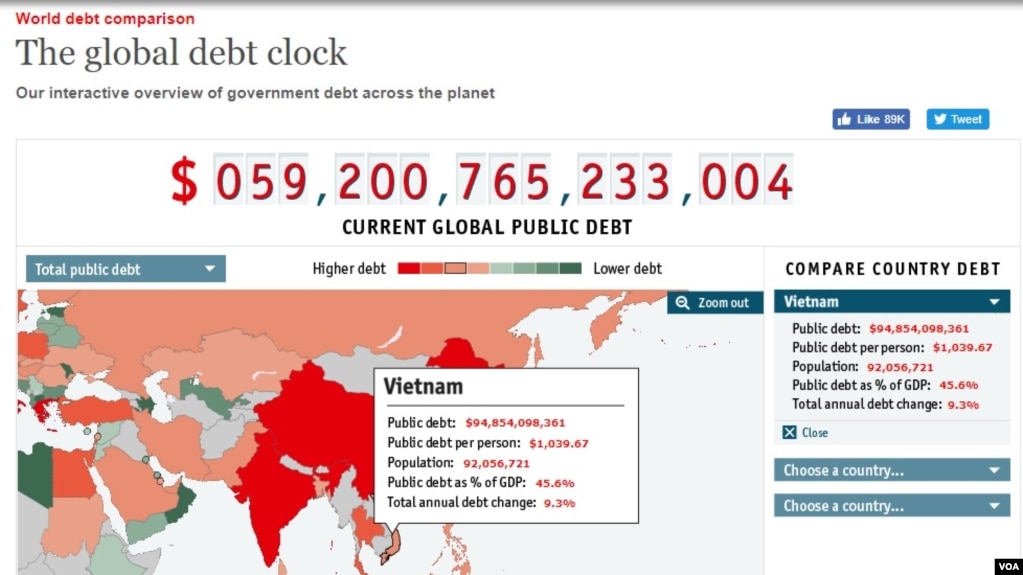
Đồng hồ nợ công của tạp chí The Economist nêu con số nợ công của Việt Nam vào ngày 16/7/2017 là hơn $94 tỉ. (Hình: Trích từ website của The Economist)
Andy Mukherjee – cây bút bình luận về kinh tế và tài chính của Bloomberg – trong một bài báo gần đây có tựa đề “(Nền kinh tế) Việt Nam không còn là con cá bé nữa”, đã tỏ ra ngạc nhiên xen lẫn thán phục về “hệ thống ngân hàng sạch hơn về nợ xấu, cổ phần hóa các doanh nghiệp Nhà nước đang diễn ra mạnh mẽ, sự tham gia và chuỗi sản xuất điện thoại thông minh trong bối cảnh tình hình kinh tế toàn cầu đang tốt hơn là những yếu tố đang giúp cho kinh tế Việt Nam khởi sắc mà dấu hiệu là thị trường chứng khoán Việt Nam có tăng trưởng đột biến” (Bài “Kinh tế Việt Nam có dấu hiệu khởi sắc”, VOA tiếng Việt 29/11/2017). Tiếp tục đọc “Kinh tế Việt Nam khởi sắc hay ngược lại?”→
Kinh tế Việt Nam có một năm khởi sắc với tốc độ tăng trưởng cao và kinh tế vĩ mô ổn định. Tốc độ tăng trưởng kinh tế GDP năm 2017 không những đạt kế hoạch đề ra mà còn là tốc độ tăng cao ấn tượng trong vòng 7 năm trở lại (đạt mức 6,81%). Các khu vực kinh tế lớn đều có những đóng góp đáng kể vào thành tích tăng trưởng chung, sự cải thiện tích cực trong tiêu dùng và sức mua; gia tăng mạnh mẽ của cầu đầu tư do tín dụng tăng cao và giải ngân vốn FDI tăng mạnh, xuất siêu hàng hoá từ quý II/2017, giải ngân vốn đầu tư NSNN tăng tốc từ những tháng cuối năm, đều là các yếu tố quan trọng giúp năm 2017 có được mức tăng trưởng ấn tượng này. Tiếp tục đọc “Các điểm nổi bật trong tăng trưởng kinh tế Việt Nam năm 2017”→
NDĐT – Chiều 18-4, UBND tỉnh Đác Nông tổ chức họp báo thông tin chính thức về vụ vệc cơ sở thu mua nông sản của bà Nguyễn Thị Thanh Loan, ở thôn 13, xã Đác Wer, huyện Đác R’lấp, tỉnh Đác Nông dùng bột lõi pin con ó nhuộm mầu làm đen phế phẩm cà-phê và các tạp chất khác thành thực phẩm rồi đem bán ra thị trường. Tiếp tục đọc “Ba tấn cà phê trộn bột pin Con Ó đã được bán ra thị trường”→
Abstract: This review recommends possible extension and/or realignment of economic corridors to enhance their effectiveness and efficiency in advancing economic integration in the Greater Mekong Subregion. The economic corridor approach was adopted by the Greater Mekong Subregion (GMS) countries in 1998 to help accelerate subregional development. The development of economic corridors links production, trade, and infrastructure within a specific geographic area. The review of these corridors was conducted to take into account the opening up of Myanmar and ensure that there is a close match between corridor routes and trade flows; GMS capitals and major urban centers are connected to each other; and the corridors are linked with maritime gateways. The review came up with recommendations for possible extension and/or realignment of the corridors, and adoption of a classification system for corridor development. The GMS Ministers endorsed the recommendations of the study at the 21st GMS Ministerial Conference in Thailand in 2016.
In emerging East Asia, agricultural output has expanded dramatically over recent decades, primarily as a result of successful efforts to stimulate yield growth. This achievement has increased the availability of food and raw materials in the region, drastically diminished hunger, and more generally provided solid ground for economic development. The intensification of agriculture that has made this possible, however, has also led to serious pollution problems that have adversely affected human and ecosystem health, as well as the productivity of agriculture itself. In the region that currently owes the largest proportion of deaths to the environment, agriculture is often portrayed as a victim of industrial and urban pollution, and this is indeed the case. Yet agriculture is taking a growing toll on economic resources and sometimes becoming a victim of its own success. In parts of China, Vietnam, and the Philippines—the countries studied in The Challenge of Agricultural Pollution—this pattern of highly productive yet highly polluting agriculture has been unfolding with consequences that remain poorly understood. With large numbers of pollutants and sources, agricultural pollution is often undetected and unmeasured. When assessments do occur, they tend to take place within technical silos, and so the different ecological and socioeconomic risks are seldom considered as a whole, while some escape study entirely. However, when agricultural pollution is considered in its entirety, both the significance of its impacts and the relative neglect of them become clear. Meanwhile, growing recognition that a “pollute now, treat later” approach is unsustainable—from both a human health and an agroindustry perspective—has led public and private sector actors to seek solutions to this problem. Yet public intervention has tended to be more reactive than preventive and often inadequate in scale. In some instances, the implementation of sound pollution control programs has also been confronted with incentive structures that do not rank environmental outcomes prominently. Significant potential does exist, however, to reduce the footprint of farms through existing technical solutions, and with adequate and well-crafted government support, its realization is well within reach.
• The Challenge of Agricultural Pollution : Evidence from China, Vietnam, and the Philippines.
• Quality of So-Called Organic Fertilizers in Vietnam’s Market.
• Impact of China’s Increasing Demand for Agro Produce on Agricultural Production in the Mekong Region.
• Facilitating aquaculture productivity in Vietnam: Perspectives from awareness of households and the climate change.
• The Institutional Capacity for Forest Devolution: The Case of Forest Land Allocation in Vietnam.
• The politics of swidden: A case study from Nghe An and Son La in Vietnam. Tiếp tục đọc “World Bank: New research on development issues in Vietnam – Volume 10, number 5 (2018 April 17)”→
Rev. James Swarts, President of the Rochester chapter of Veterans For Peace, was a member of the VFP tour group which traveled Viet Nam for 18 days recently, with stops in Ha Noi, the former DMZ and Khe Sanh, Da Nang, My Lai (on the 50th anniversary of the massacre there), and Sai Gon.
Statements by Pres. Donald Trump and U.S. government (and British and French) officials to justify American military actions in Syria are painful reminders not only of lies we were told about Viet Nam a half century ago. We heard echoes of those same lies regarding Afghanistan, Iraq, Libya, Syria, and many other places in the world that are now much worse off after our military actions — actions that were illegal, no matter how we try to parse the meanings of the documents and international agreements that we signed. Tiếp tục đọc “Rev. James Swarts: Remarks at Spring Action 2018”→
Link đến kho sách xưa của miền Nam Việt Nam trước 1975, cùng ca nhạc, và hình ảnh (khoảng cuối bài), của Giáo Sư Huỳnh Chiếu Đẳng, chủ blog Quán Ven Đường
Trong những năm gần đây ông xuất hiện với trang web Quán Ven Đường trên mạng Internet như một người thầy tận tụy hướng dẫn “Computer phổ cập cho người già” với tinh thần bất vụ lợi hoàn toàn.
Theo yêu cầu của người viết bài này, Giáo sư Huỳnh Chiếu Đẳng (có thể là bút danh của ông) đành gửi đến ít lời giới thiệu vỏn vẹn khiêm tốn về mình. Ông là một nhà giáo thuần túy, đã dạy các môn vật lý & hóa học, trước cũng như sau năm 1975.
China unveiled the concept for the Twenty-First Century Maritime Silk Road (MSR) in 2013 as a development strategy to boost infrastructure connectivity throughout Southeast Asia, Oceania, the Indian Ocean, and East Africa. The MSR is the maritime complement to the Silk Road Economic Belt, which focuses on infrastructure development across Central Asia. Together these initiatives form the One Belt One Road (OBOR) initiative designed to enhance China’s influence across Asia. Tiếp tục đọc “China’s Maritime Silk Road: Strategic and Economic Implications for the Indo-Pacific Region”→
HO CHI MINH CITY (Reuters) – The United States is seeking to send thousands of immigrants from Vietnam back to the communist-ruled country despite a bilateral agreement that should protect most from deportation, according to Washington’s former ambassador to Hanoi.
U.S. Ambassador to Vietnam, Ted Osius, speaks during a news conference in Hanoi, Vietnam November 2, 2017. Picture taken November 2,2017. REUTERS/Kham
A “small number” of people protected by the agreement have already been sent back, the former ambassador, Ted Osius, told Reuters in an interview.
Deputy Prime Minister Truong Hoa Binh will oversee an urgent investigation into bribes to speed up customs clearance procedures at ports in the northern city of Hai Phong.
Customs officers in Haiphong found to have taken bribes
The request was made following an article published on Lao Dong Newspaper on April 9.