Animated Map Showing The Radioactive Cloud Moving Through Europe After The 1986 Chernobyl Disaster

https://giphy.com/gifs/cloud-disaster-nuclear-26gsuGjZdVtbwUwZq

britishbusinessenergy

The animated map above shows the radioactive cloud that moved through Europe following the Chernobyl nuclear disaster on 26 April 1986. The Chernobyl accident remains the worst nuclear accident in history and is one of only two events classified as a “level 7 major accident” (the other being the 2011 Fukushima disaster in Japan).

Overall, the initial explosion killed 2 people, with 28 more firemen and employees dying as a result of acute radiation syndrome over the coming months.

Estimates of the total number of deaths caused by the release of radiation vary widely from a low of 4,000 in a UN study up to 200,000 according to Greenpeace.


July Was the Hottest Month in Recorded History

scientificamerican.com 

After a record-breaking heat wave in Europe and the Arctic, last month edged out July 2016

July Was the Hottest Month in Recorded History
People play and refresh themselves in a fountain at the Museumplein square in Amsterdam during the heat wave on July 25, 2019. Credit: Robin Utrecht Getty Images

In what may be the week’s most unsurprising news, scientists have officially announced that this past July was the hottest month ever recorded on Earth.

According to data released yesterday by the Copernicus Climate Change Service, a program of the European Centre for Medium-Range Weather Forecasts, last month edged out July 2016, the previous record-holder, for the title.

Last month was 0.04 degree Celsius, or about 0.07 degree Fahrenheit, warmer than July 2016. And it was more than 1 F warmer than the average July between 1981 and 2010.
Tiếp tục đọc “July Was the Hottest Month in Recorded History”

Hai phần ba con sông trên thế giới không còn được chảy tự do nữa

English: Two-thirds of Earth’s longest rivers no longer free-flowing

  • Chỉ một phần ba trong số 242 con sông dài nhất thế giới vẫn có dòng chảy không gián đoạn suốt chiều dài, đa số các con sông không gián đoạn nằm ở những vùng hẻo lánh ở Bắc Cực, lưu vực sông Amazon, và lưu vực sông Congo, theo như một nghiên cứu sắp xuất bản trên tạp chí Nature.
  • Nhóm chuyên gia quốc tế thực hiện nghiên cứu này, dẫn đầu bởi Gunther Grill thuộc ĐH McGill (Canada) xác định rằng trong số 91 con sông có chiều dài hơn 1000 ki-lô-mét (khoảng 600 dặm) đổ ra biển, chỉ còn 21 dòng vẫn có dòng chảy không bị cản trở từ thượng nguồn ra đến biển.
  • Các con đập và những hồ đập chứa nước là nguyên nhân lớn nhất cản trở dòng chảy của sông, các nhà nghiên cứu tuyên bố. Hiện tại trên thế giới đã có gần 60000 đập lớn, và có đến 3700 đập thủy điện lớn nữa đang trong quá trình lên kế hoạch hoặc đang xây dựng.
  • Những con sông khỏe mạnh mang lại nhiều lợi ích cho con người, từ hoạt động vui chơi đến đảm bảo lương thực. Đảm bảo sự liên kết của những con sông tự do còn lại trên thế giới cũng mang tính tối quan trọng để bảo tồn đa dạng sinh học của những hệ thống nước ngọt.

Tiếp tục đọc “Hai phần ba con sông trên thế giới không còn được chảy tự do nữa”

How China’s Belt and Road Initiative could lead Vietnam away from renewable energy and towards coal

SCMP

Even as China turns away from coal-fired power domestically, its financial institutions continue to fund coal plants overseas, including in countries like Vietnam, which have great potential for wind and solar power generation

Published: 4:00pm, 11 Jun, 2019

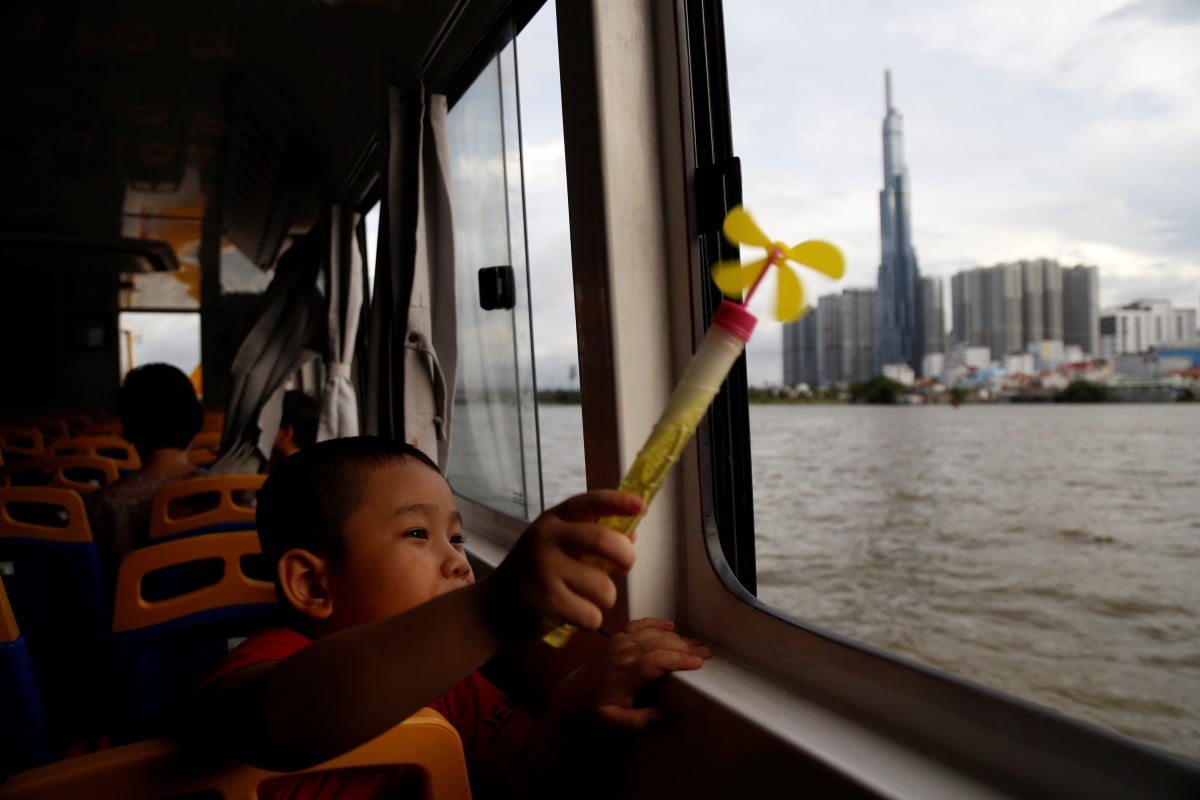
A a child on a Saigon waterbus brandishes a pinwheel as he passes Landmark 81, Vietnam’s tallest building, in Ho Chi Minh City on June 6. While Vietnam has enormous potential for wind and solar power generation, funding for coal-power electricity plants under China’s Belt and Road Initiative could derail its renewable energy push. Photo: Reuters

Tiếp tục đọc “How China’s Belt and Road Initiative could lead Vietnam away from renewable energy and towards coal”

Innovative methods could transform Vietnam’s robusta farms into carbon sinks


China moves to suspend some history tests for U.S. college credit by 2020

(Reuters) – Beijing on Thursday ordered a suspension of history exams run by a U.S. non-profit for students seeking credit at American colleges, as the ruling Communist Party cracks down on educational material it deems unfriendly.

FILE PHOTO: Students study ahead of the entrance exam for postgraduate studies, at a library in Zhengzhou University in Zhengzhou, Henan province, China December 13, 2017. REUTERS/Stringer

The suspension of Advanced Placement (AP) tests will hit secondary school students looking to ease the academic workload at U.S. universities by earning credit for some college courses, enabling them to graduate faster.
Tiếp tục đọc “China moves to suspend some history tests for U.S. college credit by 2020”

Too little, too late for US ‘recommitment’ to Mekong countries? China’s already there

scmp

  • As Beijing floods the Mekong with much-needed cash, the US finds itself pushing back against the tide to retain influence
  • But some nations in the region think the competition can work to their advantage
The Greater Mekong Subregion is a 2.6 million sq km area that covers five Asean countries as well as China’s Guangxi region and Yunnan province. Photo: AFP

US officials say Secretary of State Mike Pompeo will “recommit” the United States to supporting the five countries along Southeast Asia’s longest river, the Mekong, when he makes his first duty visit to Bangkok in July. Tiếp tục đọc “Too little, too late for US ‘recommitment’ to Mekong countries? China’s already there”

The World Health Organization’s decision about traditional Chinese medicine could backfire

nature.com

Traditional therapies have been included in a global diagnostic compendium. That comes with risks.
 PDF version
A man wearing 'walnut' glasses is treated with smoking wormwood to relieve his oculomotor paralysis.

There is little substantial evidence for the efficacy of many treatments in traditional Chinese medicine.Credit: VCG/Getty

Donkeys are a hot item in Africa. In the past few years, prices for the animals and their hides have jumped so high that people have been stealing them. Some countries, including Niger, Tanzania and Botswana, have resorted to banning exports to preserve their donkey populations. And last month, Nigeria’s government moved to make the killing and export of donkeys illegal there. Tiếp tục đọc “The World Health Organization’s decision about traditional Chinese medicine could backfire”

A Fake Zuckerberg Video Challenges Facebook’s Rules

SAN FRANCISCO — Two weeks ago, Facebook declined to remove a doctored video in which the speaker of the House, Nancy Pelosi, seemed to drunkenly slur her speech. Over the weekend, two British artists released a doctored video of Facebook’s chief executive, Mark Zuckerberg, as a sly comment on the spread of false information online.

Posted to the Facebook-owned social network Instagram, the video shows Mr. Zuckerberg speaking directly into the camera, boasting of nefarious motives behind his online empire.

“Imagine this for a second: one man, with total control of billions of people’s stolen data, all their secrets, their lives, their futures,” he appears to say. “I owe it all to Spectre. Spectre showed me that whoever controls the data controls the future.”

The video is easily recognizable as a fake, in part because the voice paired with the image sounds only marginally like Mr. Zuckerberg. And Spectre is a reference to a fictional, evil organization in James Bond lore. But it serves both as a piece of digital commentary and as a test of the way Facebook handles the spread of false information on its social network.

Tiếp tục đọc “A Fake Zuckerberg Video Challenges Facebook’s Rules”

Update to New Draft Policy on Feed-in-Tariffs Post-30 June 2019 for Solar Power Projects in Vietnam

bakerMackenzie

Recent developments

On 22 February 2019, the Ministry of Industry and Trade of Vietnam (MOIT) released an updated draft (the New Draft) of the Decision of the Prime Minister on the mechanism for encouraging the development of solar power projects in Vietnam (the Draft Decision). Significantly, the Draft Decision provides for a 2nd Feed-in-Tariff (FiT) at rates varying by location for application from 1 July 2019. Compared to the first draft, released on 29 January 2018 (First Draft), there have been certain revisions to, among other parts, the proposed tariff rates and irradiance regional classifications.

Given that the current Decision 11 of the Prime Minister providing for the FiT of 9.35 US cents per kWh is in effect only until 30 June 2019, the Draft Decision would provide for a new FiT program for an additional 2 years from 1 July 2019 through 30 June 2021, for solar power projects in Vietnam.1
Tiếp tục đọc “Update to New Draft Policy on Feed-in-Tariffs Post-30 June 2019 for Solar Power Projects in Vietnam”

Training a Single AI Model Can Emit As Much Carbon As Five Cars

Futurism.com 

Researchers at the University of Massachusetts, Amherst, found that training large artificial intelligence models produces an astonishing amount of carbon emissions — an unexpected cost to the environment.

The process puts out the equivalent amount of carbon dioxide as five lifetime emissions of the average American car, as calculated by MIT Technology Review. That’s more than 626,000 pounds of carbon dioxide — as much as flying from New York to London and back every week for nearly three years.

Carbon Footprint

Tiếp tục đọc “Training a Single AI Model Can Emit As Much Carbon As Five Cars”

As more developing countries reject plastic waste exports, wealthy nations seek solutions at home

Plastic waste from Australia in Port Klang, Malaysia. Malaysia says it will send back some 3,300 tons of nonrecyclable plastic waste to countries including the U.S., U.K., Canada and Australia. AP Photo/Vincent Thian

Less than two years after China banned most imports of scrap material from abroad, many of its neighbors are following suit. On May 28, 2019, Malaysia’s environment minister announced that the country was sending 3,000 metric tons of contaminated plastic wastes back to their countries of origin, including the United States, Canada, Australia and the United Kingdom. Along with the Philippines, which is sending 2,400 tons of illegally exported trash back to Canada, Malaysia’s stance highlights how controversial the global trade in plastic scrap has become. Tiếp tục đọc “As more developing countries reject plastic waste exports, wealthy nations seek solutions at home”

Roman amphitheaters act like seismic invisibility cloaks

technologyreview.com

The discovery may explain how these buildings have survived for so long in earthquake zones.

Roman amphitheaters are among the most ancient human constructions on Earth. These structures are remarkably well preserved in various places across the ancient Roman empire.

That’s especially remarkable because much of this territory is seismically active: it sits on the tectonic boundary between the Eurasian and African plates and has experienced numerous earthquakes that have destroyed other types of buildings. So just how these amphitheaters have survived for 2,000 years is something of a puzzle.

Today we get a potential answer thanks to the work of Stéphane Brûlé and colleagues at Aix-Marseille University in southern France. These guys have studied the way that certain structures buried in the ground, or sitting on top of it, can modify the way seismic waves travel through the Earth. In particular, they have studied “seismic invisibility cloaks” that can steer seismic waves around specific regions and thereby protect them.

Tiếp tục đọc “Roman amphitheaters act like seismic invisibility cloaks”

One Step Forward, Two Steps Back: Fossil fuel subsidies and reform on the rise

SHARE
Fossil fuels

During the past decade, there has been widespread agreement about the benefits of reforming subsidies to fossil fuels, as endorsed by international commitments and discussions within international forums. Encouragingly, between 2012 and 2016, fossil fuel subsidies (FFS) to consumers almost halved, from USD 504 billion to USD 260 billion. This reduction was due to a combination of reform efforts alongside a decrease in international prices for crude oil, which provided a window of opportunity for action and allowed governments to implement long-awaited reform plans. Tiếp tục đọc “One Step Forward, Two Steps Back: Fossil fuel subsidies and reform on the rise”

In Vietnam’s booming energy sector coal reigns, but renewables play catch-up

Reuters

HANOI/SINGAPORE (Reuters) – Vietnam has become a hot spot for energy investors eying a spend of up to $150 billion over the coming decade to meet surging power demand, with coal set to dominate despite signs of a government effort to go green.

FILE PHOTO: Power-generating windmill turbines are pictured at a wind park in Bac Lieu province, Vietnam, July 8, 2017. REUTERS/Kham/File Photo

With a population nudging 100 million and annual GDP growth around 7%, Vietnam has forecast power generation will need to rise from about 47,000 megawatts (MW) currently to 60,000 MW by 2020 and 129,500 MW by 2030.

Reuters Graphic

To meet these targets the country will need to add more than neighbor Thailand’s total installed capacity by 2025 and its electricity sector will likely be bigger than Britain’s by the mid-2020s.

“Vietnam is a big growth story for the coal industry. Coal demand will be extremely strong,” said Pat Markey, Managing Director of Sierra Vista Resources, a Singapore-based commodity advisory.
Tiếp tục đọc “In Vietnam’s booming energy sector coal reigns, but renewables play catch-up”