This Buddhist Monk Is An Unsung Hero In The World’s Climate Fight

 01/22/2016 04:04 pm ET
  • Jo ConfinoExecutive Editor, Impact & Innovation, The Huffington Post

The architect of the historic Paris climate negotiations credits the teachings of Thich Nhat Hanh with helping broker the deal.

huffingtonpost – DAVOS, SWITZERLAND — One of the guiding forces behind the scenes of theParis climate agreement is an 89-year-old Vietnamese Zen Buddhist monk.

Christiana Figueres, who led the climate talks, has credited Thich Nhat Hanh with having played a pivotal role in helping her to develop the strength, wisdom and compassion needed to forge the unprecedented deal backed by 196 countries.

Figueres, the executive secretary of the United Nations Framework Convention on Climate Change, says the teachings of Thay, as he is known to his hundreds of thousands of followers around the world, “literally fell into my lap” when she was going through a deep personal crisis three years ago.

She says the Buddhist philosophy of Thay, who is currently recovering from a serious stroke, helped her to deal with the crisis while also allowing her to maintain her focus on the climate talks.

CYRUS MCCRIMMON VIA GETTY IMAGES
Vietnamese Buddhist monk Thich Nhat Hanh.

Figueres said she realized that “I have to have something here, because otherwise I can’t deal with this and do my job, and it was very clear to me that there was no way that I could take a single day off,” she told The Huffington Post this week at the World Economic Forum’s annual meeting in Davos, Switzerland.

“This has been a six-year marathon with no rest in between,” she said. “I just really needed something to buttress me, and I don’t think that I would have had the inner stamina, the depth of optimism, the depth of commitment, the depth of the inspiration if I had not been accompanied by the teachings of Thich Nhat Hanh.” Tiếp tục đọc “This Buddhist Monk Is An Unsung Hero In The World’s Climate Fight”

In Asia, supporting women farmers crucial to fighting poverty, hunger and climate change

Oxfam International – Tue, 12 Jan 2016 11:35 GMT

Thomsonreutersfoundation – At the first Asia Women Farmer Forum, women farmers from 14 developing countries came together to exchange experiences on securing their right to land and enhancing their resilience in the face of climate change. Diah Dwiandani/Oxfam

On that same evening, in Colombo, Sri Lanka, women farmers from 14 developing countries – leaders and climate experts in their own right – were getting ready to head back home. They had just attended the first Asia Women Farmer Forum organized by Oxfam as part of its Asia GROW Campaign to bring women together to discuss the challenges they have faced in securing their rights and enhancing their resilience in a changing climate.

“A woman farmer who goes to bed hungry is just wrong,” said Janice Ian Manlutac, Resilience lead for Oxfam in Asia, “But this is a daily reality in many Asian countries, where women make up 50 per cent of the total agricultural workforce.”

Norly Grace Mercado, Oxfam’s Asia GROW Campaign Coordinator, added: “Women have far less access than men to productive resources like land, livestock, education, and agricultural extension and financial services. Our research has also shown that women farmers work up to 16 hours in the field but only share 10 per cent of the profit.”

To put faces to numbers, participants of the forum shared their struggles and, most importantly, their stories of courage in the face of unfavorable odds. Tiếp tục đọc “In Asia, supporting women farmers crucial to fighting poverty, hunger and climate change”

Powering the Internet with renewable energy

December 3, 2015

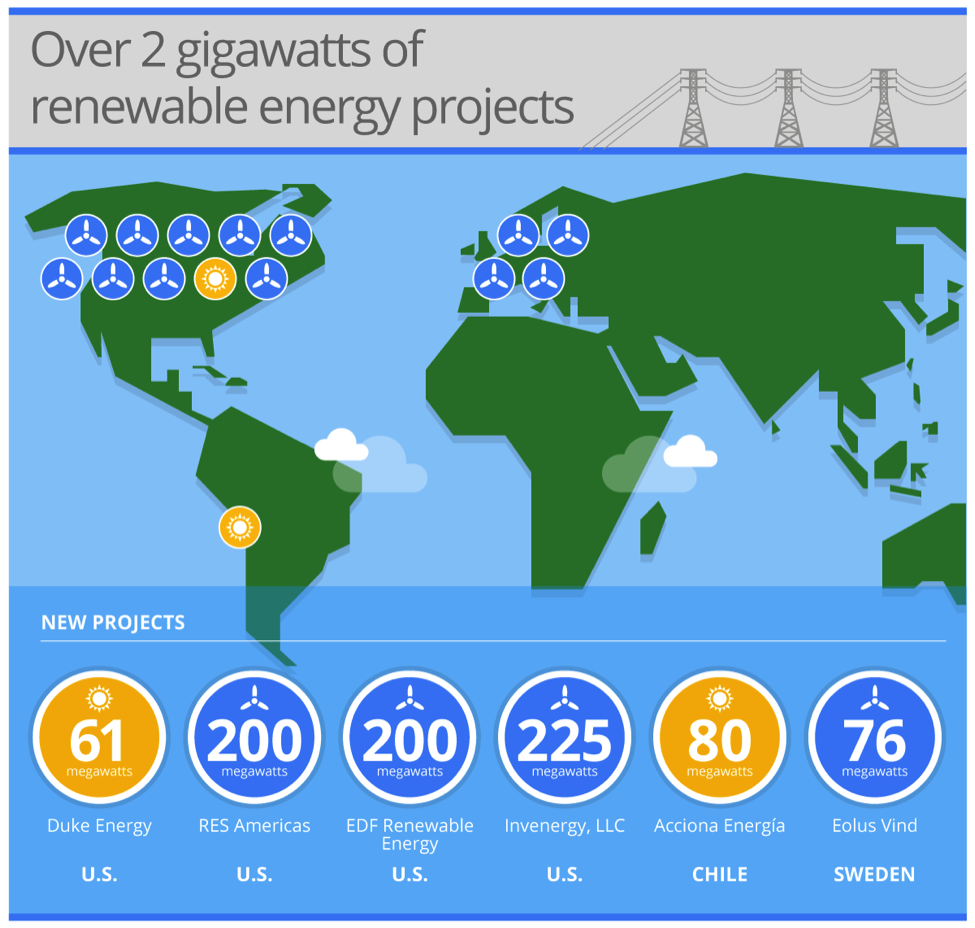
Googleblog – Today we’re announcing the largest, and most diverse, purchase of renewable energy ever made by a non-utility company. Google has already committed to purchase more renewable energy than any other company. Now, through a series of new wind and solar projects around the world, we’re one step closer to our commitment to triple our purchases of renewable energy by 2025 and our goal of powering 100% of our operations with clean energy. 842 MW of renewable energy around the world Today’s agreements will add an additional 842 megawatts of renewable energy capacity to power our data centers. Across three countries, we’re nearly doubling the amount of renewable energy we’ve purchased to date. We’re now up to 2 gigawatts—the equivalent to taking nearly 1 million cars off the road. These additional 842 megawatts represent a range of locations and technologies, from a wind farm in Sweden to a solar plant in Chile.

These long-term contracts range from 10-20 years and provide projects with the financial certainty and scale necessary to build these wind and solar facilities—thus bringing new renewable energy onto the grid in these regions. For our part, these contracts not only help minimize the environmental impact of our services—they also make good business sense by ensuring good prices. Our commitment to a sustainable energy future Since we opened our very first owned data center in 2006, we’ve been working to promote renewable and sustainable energy use in several ways:

  • First, we’re building the world’s most efficient computer infrastructure by designing our data centers to use as little energy as possible.

Tiếp tục đọc “Powering the Internet with renewable energy”

Carbon capture analyst: ‘Coal should stay in the ground’

Date:December 2, 2015

Source:University of Michigan

Summary:Serious flaws have been found in a decade’s worth of studies about the best way to reduce greenhouse gas emissions and stabilize the climate, report experts in a new article.

Serious flaws have been found in a decade’s worth of studies about the best way to reduce greenhouse gas emissions and stabilize the climate.

sciencedaily – The findings, from the University of Michigan, are released as world leaders at COP21 attempt to negotiate the globe’s first internationally binding climate agreement.

The U-M researchers have found that most economic analysis of carbon capture and storage, or CCS, technology for coal-fired power plants severely underestimates the technique’s costs and overestimates its energy efficiency. CCS involves sucking carbon out of coal-fired power plants’ flue gases, compressing it and then injecting it deep underground.

The new analysis puts the cost of reducing carbon emissions with CCS-equipped coal plants higher than any previous study — and most importantly, higher than wind and comparable to solar power. It’s the first study to confront the so-called ‘energy loop’ inherent in the CCS process. Tiếp tục đọc “Carbon capture analyst: ‘Coal should stay in the ground’”

International Climate Negotiations Glossary

CSIS – This glossary provides an overview of terms used by negotiators and others when discussing international climate negotiations. While several excellent climate glossaries exist—including from the U.S. Environmental Protection Agency and the United Nations Framework Convention on Climate Change (UNFCCC)—that provide technical definitions of terms, this glossary also provides the political and economic context for understanding the developments leading up to the Conference of Parties 21 (COP 21) in Paris in December 2015. At COP 21, Parties to the UNFCCC will be negotiating an international agreement that provides the framework for greenhouse gas emission reduction beyond the year 2020.

A | B | C | D | E | F | G | H | I | J | K | L | M | N | O | P | Q | R | S | T | U | V | W | X | Y | Z Tiếp tục đọc “International Climate Negotiations Glossary”

Obama’s nuclear play

Allen Greenberg | Nov 29, 2015

Here’s a nice bit of irony:

Energybiz – James Hansen, the scientist who was first to raise the alarm about climate change, fueling calls to shut down coal-fired power plants, will later this week urge the expansion of nuclear power.

In other words, depending on how things work out, utilities that were forced to close down or convert their coal-powered operations because of Hansen’s work, could soon find themselves thanking him for encouraging policymakers and regulators to approve plans to build new nuclear plants.

Hansen will issue his call in Paris, during the two-week climate conference that kicks off Monday. The conference is expected to draw some 20,000 attendees, including President Obama and 120 or so other world leaders.

Also read: First U.S. small modular reactor inches ahead

The hope of the climate talks is to keep global temperatures from rising more than 2 degrees Celsius compared to pre-industrial levels. Few, however, expect the conference to deliver anything meaningful. That’s because the pledges being made to cut greenhouse gas emissions are voluntary and are unlikely to be enough to stave off environmental catastrophe. Tiếp tục đọc “Obama’s nuclear play”

How clean is clean coal?

16 November 2015Articles and blogs
Ilmi Granoff and Sam Pickard

ODI – The coal industry argues that more efficient and less polluting ‘advanced coal’ will help reduce carbon emissions and other pollution. What we can’t forget, ahead of next week’s World Coal Association meeting and OECD talks on coal policy, is that there are cheaper and cleaner options.

Burning coal generates about 40% of fossil fuel emissions. Current G7 and Chinese plants, alongside a dramatic expansion of coal power planned in the developing world, stand to blow our carbon budget.

To address this threat, the coal industry proposes replacing the most polluting coal technologies with advanced ‘high-efficiency, low emissions’ coal technologies. It claims that this will reduce emissions enough to keep global mean temperature under two degrees while taking advantage of coal as a cheap energy source.

Some also advocate that ‘climate finance’ should cover the price mark-up from conventional to advanced coal. For this to make sense, advanced coal would either need to be cleaner or cheaper than the alternatives – it is neither.

Advanced coal pollutes far more than alternatives Tiếp tục đọc “How clean is clean coal?”

China Burns Much More Coal Than Reported, Complicating Climate Talks

Finding the Silver Pipelining in the Keystone XL Decision

  • Photo courtesy of rickz from https://www.flickr.com/photos/rickz/2113212191/in/photolist-4dJLmX-8AaSq8-4R2T6-ogvPnb-cHW8qL-9c4B2L-H8U2t-6YX1eb-6YWZVG-6YX1J7-4ZLHta-P4pxK-P3MCu-P4py8-P4ABV-P432S-P432b-P4ABR-P3Mgd-6YSZz2-axSvq-6hmrrn-P4ABK-5btKCU-BmhUs-9YT
    Nov 6, 2015
     CSIS – Today President Obama, after seven long years of study and deliberation, rejected TransCanada’s request for a Presidential Permit for its Keystone XL pipeline – a 1,179 mile pipeline designed to bring up to 830,000 barrels per day of Canadian oil to an integrated pipeline system in the United States. Despite the Obama administration’s protestations to the contrary, the decision to deny the permit is rumored to have been made for quite some time and the timing of today’s decision appears to be a calculated step to win the president and the administration additional support from the environmental community before heading off to Paris for the UN climate negotiations at the end of this month. The president asserted that approving Keystone XL would undercut the U.S. role as a climate leader, when in reality the decision likely carries more weight in domestic rather than international circles. Indeed, U.S. leadership on climate is more firmly supported by the suite of action it has taken as part of the Climate Action Plan.

    Tiếp tục đọc “Finding the Silver Pipelining in the Keystone XL Decision”

Vietnam: Fossil fuel subsidies need to be phased out

Jun 18, 2014

imageUNDP VN – Ha Noi, 18 June 2014 – “Fossil fuel subsidies should be phased out and a price set on carbon,” the UN Development Programme (UNDP) in Viet Nam has recommended in a discussion paper launched today.

The paper, “Green Growth and Fossil Fuel Fiscal Policies in Viet Nam – Recommendations for a Roadmap for Policy Reform” argues that despite the Government’s commitment towards green growth and restructuring the energy sector including price reform, there are still substantial indirect subsidies on fossil fuels in the country.

According to the paper, Viet Nam’s energy prices are low compared to other countries in the region. Although there have been significant price increases, average retail prices remained the same during 2008-2013, and are in fact lower than the previous five-year period, when measured against 2002 prices taking into account inflation. Tiếp tục đọc “Vietnam: Fossil fuel subsidies need to be phased out”

Buddhist Leaders Call For Climate Change Action At Paris Talks

“The earth is not just our environment. The earth is our mother.”

Headshot of Lydia O'Connor
General Assignment Reporter
<span class='image-component__caption' itemprop="caption">The Dalai Lama joined with 11 other Buddhist leaders to urge the phasing out of fossil fuels.</span>
Huffingtonpost – The Dalai Lama joined with 11 other Buddhist leaders to urge the phasing out of fossil fuels.

A dozen Buddhist authorities, in what they’re calling an unprecedented effort, appeal to world leaders to take strong climate change action at next month’s Paris conference.

In the letter released Thursday and titled “Buddhist Climate Change Statement to World Leaders,” the Dalai Lama and 11 other signatories urge the phasing out of fossil fuels and movement toward 100 percent use of renewable energy. This letter, the authors note, is the first time this so many Buddhist leaders have united to take a stance on a global issue. Tiếp tục đọc “Buddhist Leaders Call For Climate Change Action At Paris Talks”

Renewables to lead world power market growth to 2020

GLOBE-NET: ISTANBUL, 2 October – Renewable energy will represent the largest single source of electricity growth over the next five years, driven by falling costs and aggressive expansion in emerging economies, the IEA said Friday in an annual market report.

Pointing to the great promise renewables hold for affordably mitigating climate change and enhancing energy security, the report warns governments to reduce policy uncertainties that are acting as brakes on greater deployment.

Renewables are poised to seize the crucial top spot in global power supply growth, but this is hardly time for complacency,” said IEA Executive Director Fatih Birol as he released the IEA’s Medium-Term Renewable Energy Market Report 2015 (MTRMR) at the G20 Energy Ministers Meeting.

“Governments must remove the question marks over renewables if these technologies are to achieve their full potential, and put our energy system on a more secure, sustainable path.”

Renewable electricity additions over the next five years will top 700 gigawatts (GW) – more than twice Japan’s current installed power capacity. Tiếp tục đọc “Renewables to lead world power market growth to 2020”