Mapped: Asia’s Biggest Sources of Electricity by Country

element.visualcapitalist.com

Mapped: Asia’s Biggest Sources of Electricity by Country

Mapped: Asia’s Biggest Sources of Electricity by Country

The International Energy Agency (IEA) predicts that Asia will account for half of the world’s electricity consumption by 2025, with one-third of global electricity being consumed in China.

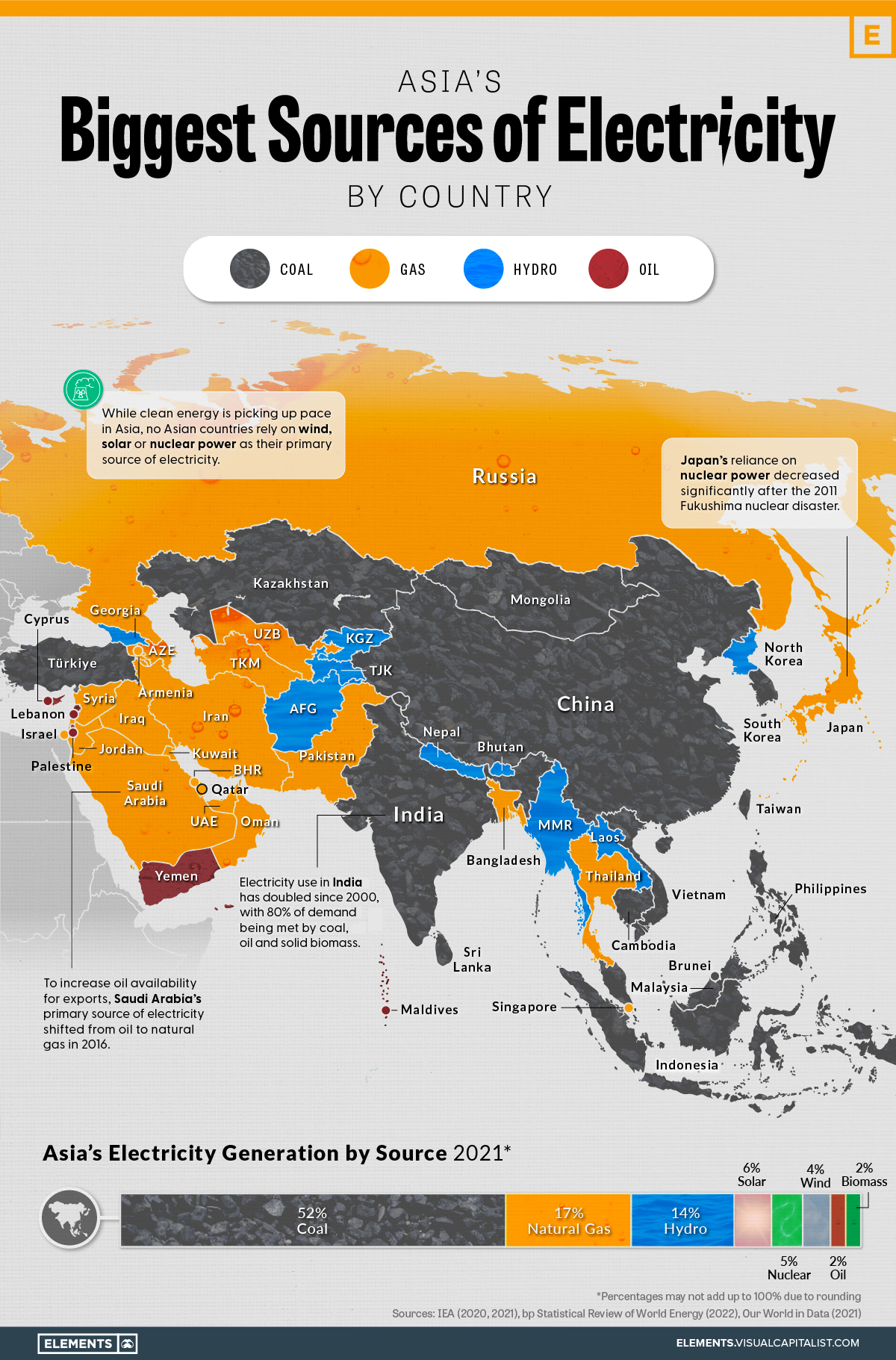
To explore how this growing electricity demand is currently being met, the above graphic maps out Asia’s main sources of electricity by country, using data from the BP Statistical Review of World Energy and the IEA.

A Coal-Heavy Electricity Mix

Although clean energy has been picking up pace in Asia, coal currently makes up more than half of the continent’s electricity generation.

No Asian countries rely on wind, solar, or nuclear energy as their primary source of electricity, despite the combined share of these sources doubling over the last decade.

 % of total electricity mix, 2011% of total electricity mix, 2021 
Coal55%52% 
Natural Gas19%17%
Hydro12%14%
Nuclear5%5%
Wind1%4%
Solar0%4%
Oil6%2%
Biomass1%2%
Total Electricity Generated9,780 terawatt-hours15,370 terawatt-hours

The above comparison shows that the slight drops in the continent’s reliance on coal, natural gas, and oil in the last decade have been absorbed by wind, solar, and hydropower. The vast growth in total electricity generated, however, means that a lot more fossil fuels are being burned now (in absolute terms) than at the start of the last decade, despite their shares dropping.

Following coal, natural gas comes in second place as Asia’s most used electricity source, with most of this demand coming from the Middle East and Russia.

Zooming in: China’s Big Electricity Demand

Tiếp tục đọc “Mapped: Asia’s Biggest Sources of Electricity by Country”
What is just energy transition? And why is it important?

UNDP

November 3, 2022

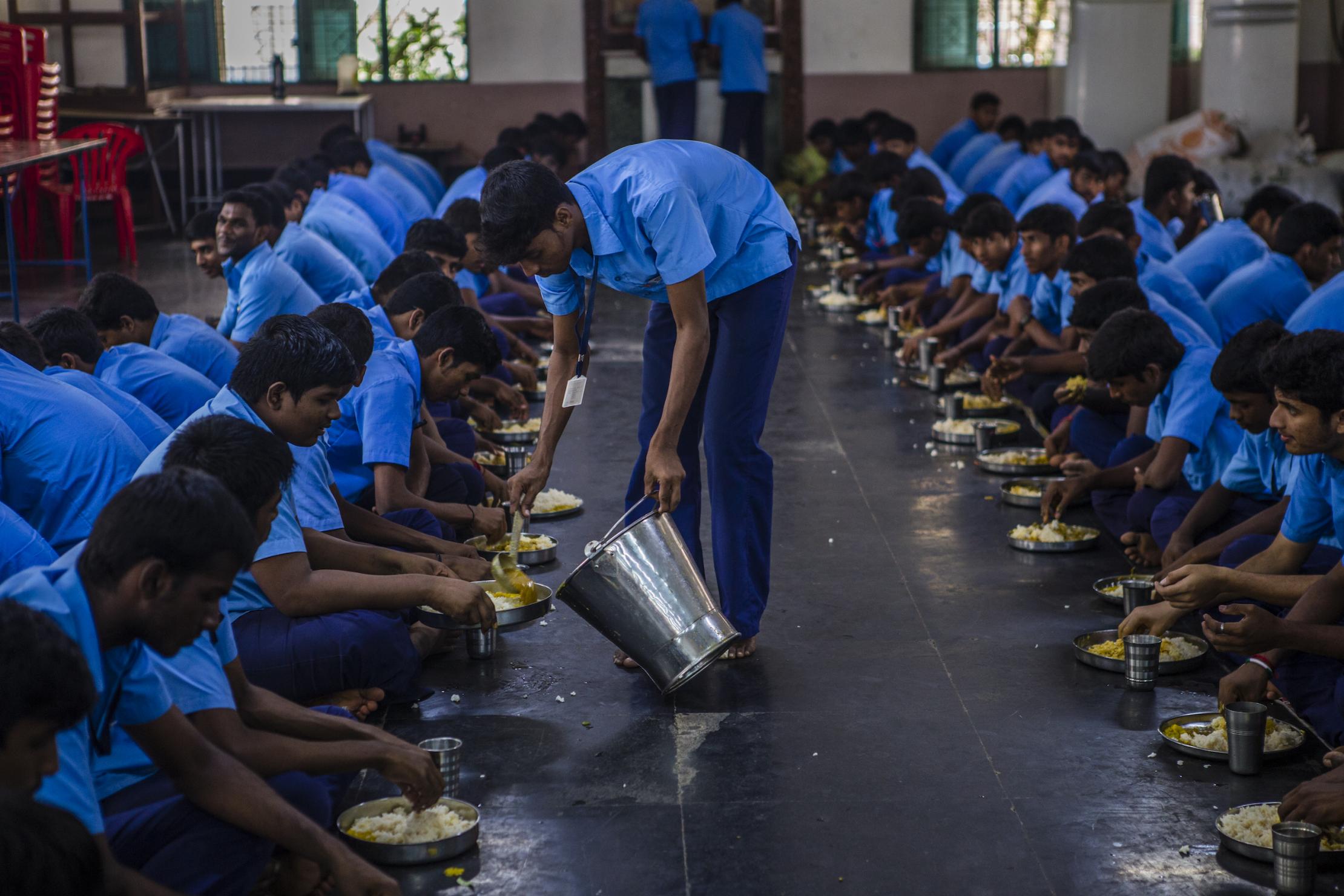
Students from India eat lunch cooked with the steam generated from a solar energy-based steam generator

Photo: Prashanth Vishwanathan/UNDP India

Since the industrial revolution, fossil fuels have powered extraordinary growth and development, albeit with huge costs to our climate. As a direct result, we are today in a climate emergency.

To avert catastrophe, we must now radically switch to a sustainable, net-zero future. This transition needs to happen fast, but it also has to happen in a fair and inclusive way.

If done right, the transition offers immense opportunities: a systems change in which all communities, workers, and countries are lifted up.

Promisingly, momentum around “just transition” is gathering pace. We are seeing it emerge in the global dialogue around decarbonization and net zero. More countries are referencing it in their short and long-term climate plans. Partners are coming together, and coalitions are forming.

So what’s it all about?

What is “just transition”?

The concept of “just transition” has been around since the 1980s, when it was used in a movement by US trade unions to protect workers affected by new water and air pollution regulations. 

In recent years, the concept has gained traction with reference to meeting climate goals by ensuring the whole of society – all communities, all workers, all social groups – are brought along in the pivot to a net-zero future.

Tiếp tục đọc “What is just energy transition? And why is it important?”

Tình trạng di cư, sự chênh lệch về mức sống là thách thức lớn cho ĐBSCL

HƯƠNG MAI  –  Thứ ba, 02/08/2022 17:54 (GMT+7)

laodong.vn

Sự khác nhau về mức sống và cơ hội việc làm dẫn đến việc người dân từ ĐBSCL di cư lên các đô thị và khu công nghiệp ở TP.Hồ Chí Minh, Đông Nam Bộ.

Tình trạng di cư, sự chênh lệch về mức sống là thách thức lớn cho ĐBSCL

Trong công bố báo cáo kinh tế thường niên năm 2022 về tình hình kinh tế ĐBSCL và những vấn đề quan trọng của vùng, ở phương diện xã hội, thách thức đầu tiên của ĐBSCL là thiếu việc làm ở nông thôn.

Tỉ lệ thiếu việc làm trong độ tuổi lao động của ĐBSCL năm 2020 là 3,47%, cao thứ 2 toàn quốc, chỉ sau Tây Nguyên; tỉ lệ thiếu việc làm ở khu vực nông thôn ĐBSCL cao gấp đôi so với khu vực thành thị (3,97% so với 1,87%).

Tiếp tục đọc “Tình trạng di cư, sự chênh lệch về mức sống là thách thức lớn cho ĐBSCL”

Country Climate and Development Report for Vietnam

worldbank.org

Vietnam CCDR Report

Vietnam is increasingly seeing its development affected by climate change and now faces critical questions about how to respond. The Vietnam Country Climate and Development Report proposes that Vietnam shift its development paradigm by incorporating two critical pathways – resilient pathway and decarbonizing pathway – that will help the country balance its development goals with increasing climate risks.

After more than two decades of steady growth, Vietnam has set an ambitious goal of reaching high-income status by 2045. It has been recognized in the 2021-2030 Socioeconomic Development Strategy that the country’s economic transformation will greatly depend on better management of natural capital – the extensive stocks of agricultural, forest, and mineral resources that have helped drive development.

Yet Vietnam, with over 3,200 km of coastline and many low-lying cities and river delta regions, is one of the most vulnerable countries in the world to climate change. Climate change impacts  – mainly higher and more variable temperatures and sea level rise  – are already disrupting economic activity and undermining growth. Initial calculations suggest that Vietnam lost $10 billion in 2020, or 3.2 percent of GDP, to climate change impacts.

Tiếp tục đọc “Country Climate and Development Report for Vietnam”

Brace yourself for more record heat

DW

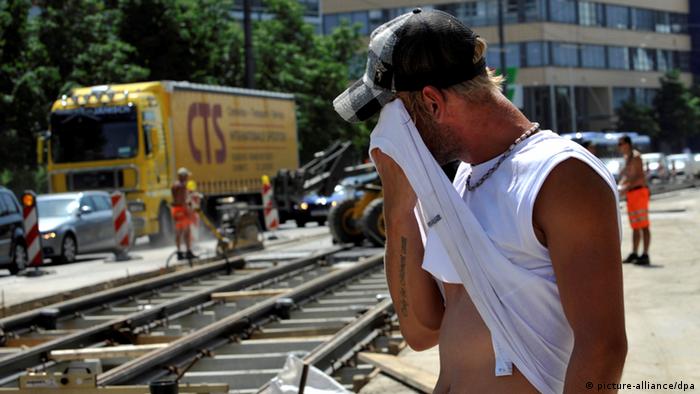
Current high temperatures in the northern hemisphere are set to continue. Climate change means we’re likely to experience very hot summers more often — even though we’re already struggling with health consequences now.

    
Bildergalerie : Sommer / Abkühlung (picture-alliance/dpa)

Europe is in the throes of a heat wave, and it’s not letting up — on the contrary. More hot air is coming over from Africa, and is even bringing desert dust with it.

Southwestern European countries are being hit especially hard. Authorities in Portugal issued a nationwide health warning, including for dust from the Sahara. Warnings were also issued for 40 of Spain’s 50 provinces. The southeastern Portuguese town of Beja is expected to see a peak of 47 degrees Celsius (117 degrees Fahrenheit) on Saturday.
Tiếp tục đọc “Brace yourself for more record heat”

Losing Earth: The Decade We Almost Stopped Climate Change

NYtimes

Editor’s Note

This narrative by Nathaniel Rich is a work of history, addressing the 10-year period from 1979 to 1989: the decisive decade when humankind first came to a broad understanding of the causes and dangers of climate change. Complementing the text is a series of aerial photographs and videos, all shot over the past year by George Steinmetz. With support from the Pulitzer Center, this two-part article is based on 18 months of reporting and well over a hundred interviews. It tracks the efforts of a small group of American scientists, activists and politicians to raise the alarm and stave off catastrophe. It will come as a revelation to many readers — an agonizing revelation — to understand how thoroughly they grasped the problem and how close they came to solving it. Jake Silverstein

Bản đồ hoá hiện trạng nước mặt toàn cầu: Mapping long-term global surface water occurrence

ec.europa.eu_In an article published in Nature on 7 December 2016, JRC scientists describe how, in collaboration with Google, they have quantified changes in global surface waters and created interactive maps which highlight the changes in the Earth’s surface water over the past 32 years.

The data show that the impacts of climate on where and when surface water occurs can be measured, and that the presence of surface water can be substantially altered by human activities.The data show that the impacts of climate on where and when surface water occurs can be measured, and that the presence of surface water can be substantially altered by human activities.
©EU/Google 2016

Based on over three million satellite scenes (1 823 Terabytes of data) collected between 1984 and 2015, the Global Surface Water Explorer was produced using 10 000 computers running in parallel. The individual images were transformed into a set of global maps with a 30-metre resolution, which enable users to scroll back in time to measure the changes in the location and persistence of surface water globally, by region, or for a specific area. The maps are available for all users, free of charge. Tiếp tục đọc “Bản đồ hoá hiện trạng nước mặt toàn cầu: Mapping long-term global surface water occurrence”

The Food Security Solution

May 20, 2016

CSIS – In a world that has become increasingly interconnected and chaotic, with more displaced persons since World War II, and with an array of humanitarian disasters that has outstripped the international community’s budgets and capacity to respond, why should global food security remain an imperative development priority? Why has the United States invested so heavily, to the tune of $5.6 billion over the past five years, in agricultural development and nutrition to reduce extreme poverty?

Agriculture’s Economic Power

Agriculture is the primary source of employment and income for 70 percent of the world’s rural poor, and it contributes more than a third of gross domestic product (GDP) in many of the least developed countries. In light of evidence that GDP growth originating in agriculture can be four times more effective than growth in other sectors in raising incomes of the extremely poor, the economic leverage of agriculture for development is hard to dispute.

Aligning foreign assistance with country-led strategies for agricultural growth is the most effective approach to achieving results for vulnerable smallholder farmers, their families, and their communities. Government ownership is critical to sustaining development investments and to ensuring a sound policy environment for private-sector engagement. In order for agriculture to reach its potential to generate employment, raise smallholder incomes, and catalyze markets, both the will of country leadership to dedicate resources and the ability of local and international private companies to invest along the value chain are required. In some cases, this translates into tough policy reforms that take time to understand, to implement, and to enforce.

National Security Risks Tiếp tục đọc “The Food Security Solution”

How to protect infrastructure from a changing climate

blog.worldbank

Every other month the news seems to flash images of extreme weather – disastrous heat waves, floods of biblical proportions, and epic storms.  On the rise as a result of a changing climate, these weather events can cause a myriad of damages and put the world’s critical infrastructure at risk. This costs money. The devastating 2010 floods in Pakistan caused close to $2 billion in damages to physical infrastructure, according to World Bank estimates. And Hurricane Sandy wreaked $1.13 billion in damages on New York City’s infrastructure alone (New Jersey and other parts of New York State saw significant damages as well).

Examples like these are endless.

Alongside these increasing climatic risks to the world’s existing infrastructure assets, the fact remains that many countries desperately need more and better infrastructure. This is particularly true for developing countries.  To meet the future infrastructure demands of these economies would require investment of at least an estimated additional $1 trillion a year through 2020. Tiếp tục đọc “How to protect infrastructure from a changing climate”

UN calls for global response to effects of El Nino weather extremes

DW

Over 60 million people are affected by the atmospheric phenomenon, the head of UN’s humanitarian response agency said. But billions of euros are needed to stave off the deadly catastrophes caused by El Nino.

The United Nations Office for the Coordination of Humanitarian Affairs (OCHA) chief Stephen O’Brien on Tuesday called on governments, organizations and regional bodies to increase their efforts at tackling the ensuing crises from the atmospheric phenomenon known as “El Nino.” Tiếp tục đọc “UN calls for global response to effects of El Nino weather extremes”

Meeting Southeast Asia’s ambitious clean energy targets

Southeast Asian countries have set themselves renewable energy targets that are even more ambitious than some European countries, but they are behind schedule in reaching these goals. Government policies and private money are key to its progress.

Tiếp tục đọc “Meeting Southeast Asia’s ambitious clean energy targets”

Climate Change Vulnerability Mapping for Greater Mekong Sub-Region

01.02.2016

UNESCOBKK –  Thailand’s adaptive capacity to climate change is high among Mekong countries, while the western coastline of Myanmar and the Cambodian Mekong lowland region are the areas of the sub-region most vulnerable to the phenomenon’s effects.

These were among the key findings of the report, “Climate Change Vulnerability Mapping for the Mekong River Basin”, based on a study carried out by UNESCO Bangkok and the Water Resources and Environment Institute (WREI) of Khon Kaen University’s Faculty of Engineering in Thailand.

The study sought to identify the areas most vulnerable to climate change and climate-induced water problems in five Mekong countries: Cambodia, Lao PDR, Myanmar, Thailand, and Vietnam. The study used a framework developed by the Intergovernmental Panel on Climate Change (IPCC), which conceptualizes vulnerability to climate change by looking at the exposure to and sensitivity of a system to a climate hazard and the ability of the system to cope with, adapt to or recover from the effects of hazardous conditions.

The study finds that Mekong countries are adversely affected by major natural hazards, such as tropical cyclones, floods and droughts. The study also mapped adaptive capacity and areas that are vulnerable to the impacts of climate change, which can be a useful tool for determining degrees of adaptation and mitigation responses at the provincial level. The findings of this study will be valuable for the five Mekong countries in ensuring sustainable adaptation to climate change.

Download PDF

—–

Climate Change Vulnerability Mapping for Greater Mekong Sub-Region
Bangkok: UNESCO Bangkok; Khon Kaen: Water Resources & Environment Institute, Khon Kaenn University, 2015, 49p.

TH/SC/15-01

Viet Nam’s farmers suffer as El Niño contributes to widespread drought

Published: 4 April 2016 11:48 CET
A Red Cross staff conducts an assessment with a household in Ben Tre province in Viet Nam. Photo credit: Viet Nam Red Cross Society
IFRC – By Ly Nguyen, IFRC

Since the end of 2015, unusually dry conditions and a shortage of rainfall have seriously affected Viet Nam. These conditions which are associated with El Niño, have led to severe drought  in parts of the central, central highlands and southern regions of the country, including the Mekong Delta. Some water levels are at the lowest recorded in 90 years.

“In 2015, there was lower than average rainfall during the rainy season which ended two months earlier than in previous years. Water shortage has been compounded by saltwater intrusion. Salinity is four times higher than seasonal averages,” said Phan Duy Le, Vice Chairman of Quoi Dien commune in Thanh Phu district, Ben Tre province. “The consequences are very concerning. The drought and salty water have been threatening crops and agricultural production, and most importantly, access to drinking water for local people.”

Tiếp tục đọc “Viet Nam’s farmers suffer as El Niño contributes to widespread drought”

The Effects of Fukushima Linger after Five Years, but Not from Radiation

While hundreds died in the evacuation, none perished as a result of exposure to radiation.

technologyreview : The Fukushima Daiichi nuclear accident, which began on March 11, 2011, uprooted thousands of Japanese people, set the worldwide nuclear power industry back a decade, and caused a run on potassium iodide (said to help ward off thyroid cancer). What it didn’t do was kill anyone from radioactive fallout.

A Greenpeace report released this week, Nuclear Scars: The Lasting Legacies of Chernobyl and Fukushima,” takes a harsher view, saying that “the health consequences of the Chernobyl and Fukushima catastrophes are extensive.” But most of the report dwells on Chernobyl, and it notes that the primary effects of Fukushima were “mental health disorders, such as depression, anxiety and Post Traumatic Stress Disorder.” Put another way: fear and panic resulting from the accident (and from the loss of homes and livelihoods) were more dangerous than the radiation.
Tiếp tục đọc “The Effects of Fukushima Linger after Five Years, but Not from Radiation”