
Những máy bơm chạy bằng năng lượng gió giúp nông dân ở Bà Rịa – Vũng Tàu đưa nước biển vào ruộng muối, tiết kiệm được công sức, tiền của.
Chuyên mục: VN
Chiêm ngưỡng những thước vải lãnh Mỹ A trước nguy cơ mai một
Thành Hoa Thứ Ba, 12/12/2017, 15:12
(TBKTSG Online) – Vải lãnh Mỹ A đã làm nên niềm tự hào của xứ lụa Tân Châu, An Giang từ những năm đầu của thế kỷ XX, nhưng hiện nay loại vải này đang đứng trước nguy cơ mai một vì thiếu nguyên liệu và nhân công.
 |
| Lãnh Mỹ A được dệt từ tơ tằm, nhuộm bằng mủ của trái mặc nưa với màu đen tuyền. Để nhiều người có cơ hội tận mục sở thị, từ ngày 7 đến 14-12, Bảo tàng Phụ nữ Nam bộ (quận 3, TPHCM) sẽ trưng bày những thước vải lãnh Mỹ A và các mẫu thiết kế từ loại vải này. |
Tiếp tục đọc “Chiêm ngưỡng những thước vải lãnh Mỹ A trước nguy cơ mai một”
Đấu thầu thuốc tại Sở Y tế Đắk Lắk: Lộ rõ dấu hiệu sai phạm
TP – Sau khi báo Tiền Phong đăng nhiều bài về các dấu hiệu sai phạm trong việc đấu thầu thuốc tại Đắk Lắk, các cơ quan chức năng đã vào cuộc. Ngày 23/11/2017, Hội đồng giám định của Bộ Y tế ban hành Kết luận giám định số 1257, xác nhận có việc chấm sai nhóm thuốc và chọn nhà thầu sai quy định trong đợt đấu thầu thuốc 2014-2015.
– Quanh vụ án VN Pharma: Chuyện về ‘ông vua’ đấu thầu thuốc
– Đấu thầu thuốc để kéo giá giảm từ 10 – 15%
– Giảm gần 500 tỷ nhờ đấu thầu thuốc tập trung
– Đấu thầu thuốc để kéo giá giảm từ 10 – 15%
– Giảm gần 500 tỷ nhờ đấu thầu thuốc tập trung
Báo Tiền Phong từng phản ánh việc Sở Y tế (SYT) Đắk Lắk cho 1 doanh nghiệp trúng thầu độc quyền 7 mặt hàng đã đổi nhóm, trong bài “Tham nhũng y tế ở Đắk Lắk: Lo ngại chìm xuồng”, đăng ngày 20/2/2017.
Điểm lại vụ việc
Bài viết khẳng định chỉ tính riêng 5/7 loại thuốc bị đổi nhóm mà Cục Quản lý Dược hồi âm cho một doanh nghiệp bằng văn bản, đã làm tăng giá thuốc trong kết quả trúng thầu lên tiền tỷ. Thực tế, tổng trị giá chênh lệch phải lên tới hàng chục tỷ đồng, vì SYT Đắk Lắk còn cho bệnh viện liên tục mua bổ sung số mặt hàng này sai quy định. Và trong 666 mặt hàng trúng thầu đợt đấu thầu thuốc năm 2014-2015, báo Tiền Phong cũng nhiều lần chứng minh còn có nhiều mặt hàng khác nữa bị chấm chọn sai trái. Tiếp tục đọc “Đấu thầu thuốc tại Sở Y tế Đắk Lắk: Lộ rõ dấu hiệu sai phạm”
Urbanization worsens environment along Huong River
Last update 08:28 | 03/10/2017
VietNamNet Bridge – Along Huong River, from mountain to estuary, the environment is at risk of being disrupted by natural disasters and urbanization.

With its geographic characteristics, Thua Thien Hue has played an important role in the development of Vietnam.
More than 350 years ago, on the banks of the Perfume River, there was an urban area called Kim Long-Kieng Hue, the capital of Dang Trong kingdom (an area of Vietnamese southwards expansion during the 17th century Trinh–Nguyen War). Tiếp tục đọc “Urbanization worsens environment along Huong River”
Hanoi & HCMC streets sparkling ahead of Christmas
Last update 08:15 | 12/12/2017
Stores and building facades in Hanoi and Ho Chi Minh City have been colourfully decorated over the last days, warming up the atmosphere on the threshold of Christmas.
 A colourful Christmas tree decorates the front of Hotel Metropole Hanoi Tiếp tục đọc “Hanoi & HCMC streets sparkling ahead of Christmas” |
Xich Dang Temple of Literature
Last update 15:16 | 11/12/2017
Built in 1832 in Xich Dang village, Hung Yen province, Xich Dang Temple of Literature hosted examinations and ceremonies to honor outstanding Confucians during feudal times.
It is one of 6 temples of literature that still exist today and the second oldest after the Temple of Literature in Hanoi. Thu Hoa has a story about this national cultural and historical relic.
Visiting Xich Dang Temple of Literature on a sunny day, Dao Thanh Thuy, who has lived in Germany for nearly 20 years, recalls her childhood memory: “We were born in Hanoi. My grandparents lived in Xich Dang village. When we visited them, we often climbed trees and over the gate of the temple and played around the bells. Previously, local people weaved mattresses here. The temple has been upgraded but its ancient beauty remains.” Tiếp tục đọc “Xich Dang Temple of Literature”
Saigon old signage: proof of the city’s subtle charm
 |
| A hairdresser’s sign hanging in a coffee shop. Photo: NGHIA COCO |
Roaming the street web of Saigon, the nostalgic name many call Ho Chi Minh City, one can easily spot shop front signs and direction signposts that convey the city’s grace.
Alongside the glamorous modernity the city boasts, its graceful touch prevails, predominantly manifest in its age-old signs. Tiếp tục đọc “Saigon old signage: proof of the city’s subtle charm”
Đà Nẵng beaches face worst erosion in decades
vietnamnews Update: December, 08/2017 – 16:00


 |
| Temporary concrete blocks are set up to prevent beach erosion in Đà Nẵng City. — VNS Photo Công Thành |
Viet Nam News ĐÀ NẴNG — A 500m section of beach in Ngũ Hành Sơn District of the central city of Đà Nẵng has been seriously eroded by uninterrupted rain and rising sea waves in the last two months.
Water has approached an under-construction resort and washed away 500m of sand on the beach.
The owner of the Song Đà Nẵng beach villa project set up a line of concrete blocks to limit the erosion, but it continued to reach towards the villas. Tiếp tục đọc “Đà Nẵng beaches face worst erosion in decades”
Central Highlands struggle to settle immigrants
vietnamnews Update: December, 11/2017 – 09:55
 |
| Students at a makeshift class in central Highlands Lâm Đồng Province. – Photo thiennhien.net.vn |
ĐẮK LẮK – Sùng Dao Cán and his wife have cut down trees in a forest and on a hill to plant cassava and build a bare shack as they struggle to eke out a living.
“I know it (deforestation) is wrong, but it is not just me. Many others have also done this to grow corn and cassava just to survive,” Cán told the Nhân dân (People) newspaper.
Cán and his wife moved half-way across the country from their home in northern border province of Cao Bang two years ago. His family is just one of many who reside in Zone 265, a makeshift residential area at the edge of the Cư M’lan Commune in Đắk Lắk Province.
The zone is about 30km away from the commune centre, but it takes more than two hours on bike on trails to reach it. Roughly 100 makeshift shacks with straw and wooden poles stand next to a vast area, once a thick forest, now dotted with dry tree stumps.
Most of the residents here belong to ethnic minority communities, like Cán and his wife, who are of Dao ethnicity.
Cán said all his neighbours in Zone 265 have done the same thing, not knowing what else they can do to make ends meet other than clearing some land for farming. They also share similar stories of hardship about “the promised land,” living without electricity, clean water or even a proper road to go anywhere. There is no school for their children and no clinic to go to when they fall sick. They are still mired and trapped in the same stark poverty they tried to escape from.
Worse still, authorities have been unprepared for an intensified migration over the last decade or so. The migration to the Central Highlands from other parts of the country, first encouraged as Government policy, has got out of hand, officials now admit.
At least one official pronouncement in 2014 said the policy of encouraging migration to the Central Highlands was no longer being pursued.
According to the Central Highlands Steering Committee, about 25,732 households with more than 91,000 members have moved to the region over the last 12 years (2005-2017). Most of these immigrants are from ethnic minority communities in the northern mountainous northern region. They have spread out to all five provinces in the Central Highlands region, with Gia Lai and Kon Tum topping the list with 23,624 and 21,708 people respectively. More than 16,000 have settled down in Đắk Nông and Đắk Lắk and over 14,600 are in Lâm Đồng.
A recent report by the Ministry of Agriculture and Rural Development says that a large number of immigrants to the Central Highlands tend to live on the edge or in the heart of protected forests, where deforestation “occurs regularly”.
As the immigrants are not registered local households, they are not entitled to any social welfare. They are disproportionately unemployed and poor, the report says.
Nguyễn Hoài Dương, director of the Đắk Lắk Department of Agriculture and Rural Development, said a survey last year showed that ethnic minority and immigrant households account for up to 61 per cent of poor households in the province.
“In the immigrant areas, several social issues like drug abuse, high fertility rate and illiteracy have become complicated and difficult to resolve, and the situation has worsened lately,” Dương said.
Projects suspended
Zone 179 was first formed around 20 years ago when a couple of Mông families from the north migrated to Lâm Đồng Province’s Đam Rông Commune.
Provincial authorities tried to relocate them to a village in a neighbouring district, but they returned to Zone 179 after a while.
Now, more than 550 Mông people are currently living in Zone 179, including older generations and new ones who’ve kept coming in from the north.
One immigrant, Ma Seo Cháng, said that the zone has no school or clinic.
“We just have some people to teach the children how to read and write. When we get sick, we have to go through the forest to either the commune centre or the neighbouring district in Đắk Nông Province,” he said.
Changing their policy, local authorities decided to invest in infrastructure in Zone 179 instead of trying to resettle the local residents. However, the continued influx of immigrants to the zone meant that the investment plans had to be adjusted several times, and finally, suspended.
Similar reasons have forced the suspension of another project in Tây Sơn, Lâm Đồng, and two others in the communes of Cư Pui and Cư K’bang in Đắk Lắk.
Investment projects in Gia Lai and Đắk Nông provinces are also being adjusted to keep up with the increasing immigrant flow.
Funding has become a major challenge to local authorities there. According to the Ministry of Agriculture and Rural Development, the Government had agreed to let Central Highlands provinces carry out 30 immigrant settlement projects with a total investment of more than VNĐ1.6 trillion (VNĐ71.1 million) in the 2013-2016 period.
But, until the end of last year, just VNĐ691 billion, or about 43 per cent of the planned investment, had been disbursed.
The funding shortage has severely delayed resettlement projects, with just two out of the 30 completed so far. Others are lagging behind, leaving residents in the lurch.
Lâm Đồng Chairman Đoàn Văn Việt said that while the funding problem was obvious, finding resettlement areas for immigrants was also a big headache for local authorities.
“Planning housing and farming land for the immigrants will inevitably involve forests as there is no extra land available for them now,” Việt said.
“Most people suggest that the resettlement areas are set up right where the immigrants have been staying (in the forest). But in order to do that, we have to convert forest land to land for housing and farming, which, under the law, is not within the jurisdiction of provincial authorities.
“We should do this on humanitarian considerations, but it is against the law.” — VNS
Banh mi Hoi An among world’s Top 10 sandwiches
Last update 09:00 | 09/12/2017
Banh mi Hoi An (Hoi An-style bread rolls) has been listed among the world’s Top 10 sandwiches by Austrian travel website Traveller, together with well-known American cheeseburgers, English bacon butties, and Japanese Katsu Sando.

Vietnam is the spiritual home of porky goodness and you haven’t eaten a Vietnamese pork roll until you’ve eaten one in the town of Hoi An, according to Traveller. Tiếp tục đọc “Banh mi Hoi An among world’s Top 10 sandwiches”
Bloomberg touts Cha Ca La Vong as a must-try dish for gourmets
Last update 13:00 | 09/12/2017
Bloomberg news agency has recently unfolded a list of 12 restaurants across the world worthy to try at least once in life. Surprisingly, Cha Ca La Vong restaurant in the Vietnamese capital city of Hanoi took pride in securing a spot in the list.

Cha Ca La Vong in the Vietnamese capital city of Hanoi is recommended as a must-try dish for food lovers
In an article released by Kate Krader and Richard Vines on the news site http://www.bloomberg.com, food connoisseurs are advised to take a tour to the Vietnamese restaurant to taste cha ca (fried fish) with the vibrant and unique flavor of herbs, spices, and chilis. Tiếp tục đọc “Bloomberg touts Cha Ca La Vong as a must-try dish for gourmets”
Hanoi flower village sparkles at night
Last update 14:59 | 09/12/2017
Flower fields in Hanoi’s Tay Tuu Village have become more beautiful at night with light created by thousands of lamps.

The lamps are aimed to turn night into day to make flowers to bloom in time for the Tet Holiday. Tiếp tục đọc “Hanoi flower village sparkles at night” |
Stunning beauty of Nuoc Mooc Stream in Quang Binh
Last update 11:39 | 08/12/2017
The majestic jade green waters of Nuoc Mooc Stream have enchanted visitors to Phuc Trach commune, Bo Trach district in the central province of Quang Binh, the crystalline waters are set among limestone mountains and tropical rainforest.
 Quang Binh has recently become an attractive destination for thousands of visitors due to scenic locations used in the film ‘Kong: Skull Island’. Nuoc Mooc stream is a must-see spot for tourists, boasting natural landscapes of pristine beauty. Tiếp tục đọc “Stunning beauty of Nuoc Mooc Stream in Quang Binh” |
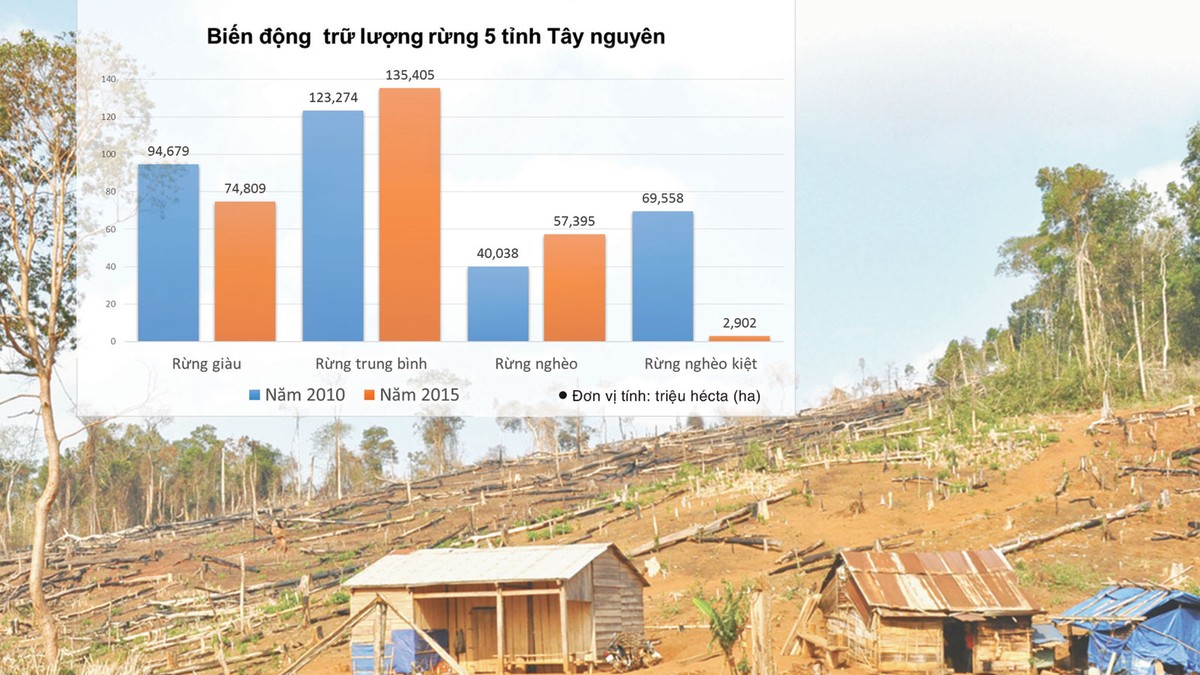
Tây Nguyên giao rừng tràn lan – 4 bài
- Bài 1: Rừng cộng đồng bị… “cộng đồng” phá!
- Bài 2: Chuyển rừng giàu thành… rừng nghèo!
- Bài 3: Cán bộ đua nhau chiếm đất rừng
- Bài 4: Phải giao rừng cho ai?
***
Tây Nguyên giao rừng tràn lan
Bài 1: Rừng cộng đồng bị… “cộng đồng” phá!
Trong thời gian qua, các tỉnh Tây Nguyên đã giao nhiều diện tích rừng tự nhiên cho cộng đồng, cá nhân, nhóm hộ… để bảo vệ, quản lý và phát triển rừng. Nhưng mô hình giao rừng này đã nhanh chóng thất bại vì chủ nhân được giao rừng lại phá rừng hoặc bỏ mặc rừng bị phá.
Rừng Tây Nguyên có vai trò đặc biệt quan trọng, không những cho nội vùng mà còn chi phối rất lớn đến nguồn nước, môi trường sinh thái và phát triển kinh tế – xã hội của các tỉnh ven biển miền Trung, Đông Nam bộ và ĐBSCL. Trong những năm qua, các tỉnh Tây Nguyên đã thực hiện nhiều chính sách giao đất, giao rừng cho người dân và doanh nghiệp để bảo vệ rừng. Lợi dụng các chính sách này, nhiều cá nhân và doanh nghiệp đã ngang nhiên chặt phá, chuyển đổi rừng tràn lan để lấy đất sản xuất nông nghiệp.
Bac Lieu Offshore Wind Farm
Project Type: Offshore wind farm, Bac Lieu Province, Vietnam
Developer: Cong Ly Construction-Trade-Tourism
Capacity: 99.2MW

Developed on a 540ha site in the East Dam region of Bac Lieu province, Vietnam, the 99.2MW Bac Lieu near-shore wind farm is Asia’s first offshore wind farm in the Mekong Delta region. Tiếp tục đọc “Bac Lieu Offshore Wind Farm”

