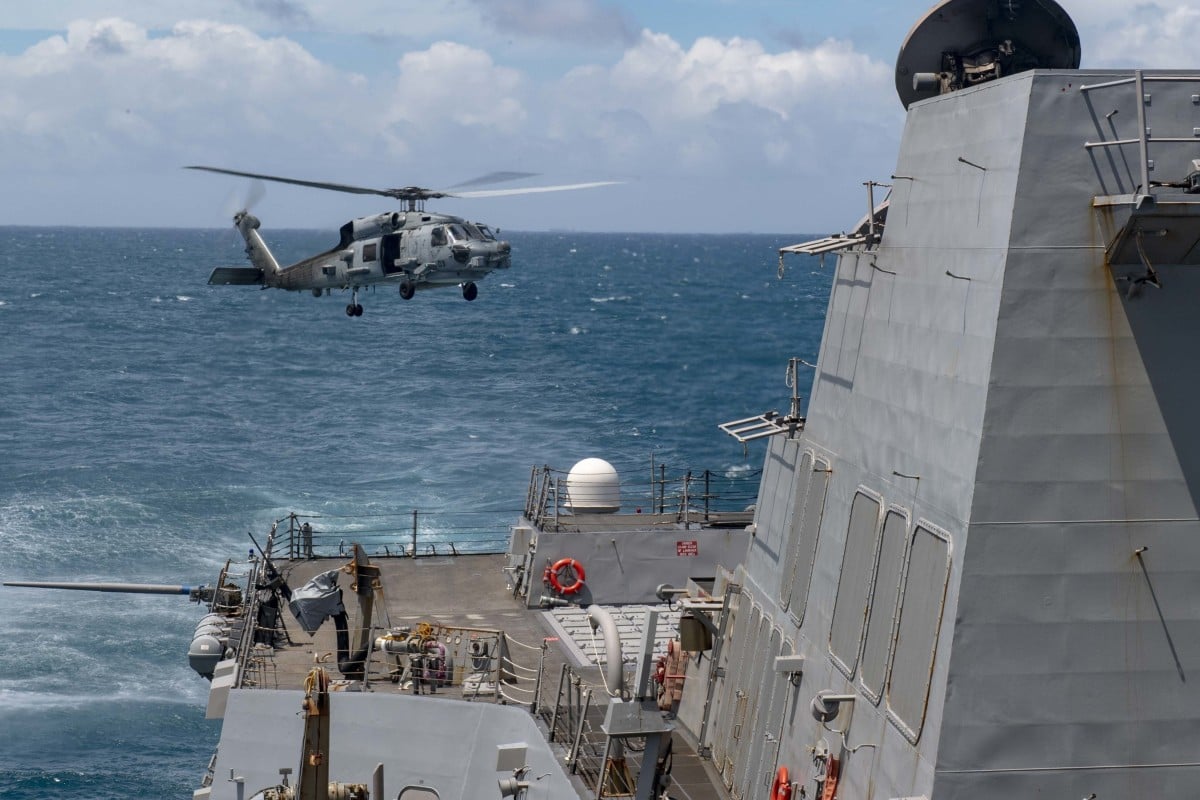
An MH-60R helicopter takes off from the flight deck of the USS Mustin during routine operations. Photo: US NavyThe United States sent a warship through the Taiwan Strait on Tuesday in what it said was a demonstration of its “commitment to a free and open Indo-Pacific”, as military tensions between Washington, Beijing and Taipei in the region continue to simmer.
US President Donald Trump told reporters on Tuesday that he had called off US – China trade deal negotiations.
“I don’t want to talk to them now,” Trump said. “If you know what they’ve done to this country and the world, I don’t want to talk to China just yet. So yes, I canceled the talks.”
A mushroom cloud hangs over Hiroshima on 6 August 1945. An estimated 90,000 to 120,000 people died that day or soon after; many others developed cancer later.
HIROSHIMA—Kunihiko Iida wants the world to know that the atomic bombs the United States dropped on Hiroshima and Nagasaki 75 years ago next month are still claiming lives and causing suffering.
Iida was 3 years old in August 1945. His father had died in battle; he was living with his mother and her parents in a house 900 meters from Hiroshima’s hypocenter, the spot right beneath the detonation. The blast crumpled the house. The family fled the city, but Iida’s mother and older sister soon died from their injuries, a fact the little boy didn’t grasp. “Until I entered elementary school, I thought they were living and that we would meet someday,” he says.
His injuries left him bedridden for years, and he has suffered debilitating illnesses ever since. Childhood anemia caused him to collapse at school. He’s had ulcers and asthma, underwent two surgeries to remove brain tumors, and now has thyroid growths. “There has never been a break in these illnesses,” he says. Tiếp tục đọc “How atomic bomb survivors have transformed our understanding of radiation’s impacts”→
Bloomberg News August 17, 2020, 4:00 AM GMT+7 Updated on
Tensions rise as president highlights tough-on-China stances
Topics range from TikTok to Taiwan jet sales to Hong Kong
The almost daily drumbeat of tensions between the U.S. and China shows little sign of letting up, while touching on everything from the coronavirus to trade to defense issues to monetary policy.
President Donald Trump has made his tough positions on China a key element in the lead-up to the U.S. presidential election, now less than three months away, and he seems intent on keeping the pressure on.
The hawks in Donald Trump’s administration are on the ascent. Do not expect the US to u-turn on this march towards a harsher stance on China, say Steven R Okun and James Green.
A WeChat logo is displayed on a mobile phone as a woman walks past as she talks on her mobile phone at a taxi rank in this picture taken on Jul 21, 2016. (Photo: REUTERS/Siphiwe Sibeko)
SINGAPORE: Last week’s suite of actions by the United States against WeChat and TikTok were among the most significant developments since March 2018 when US President Donald took formal action in retaliation for China’s unfair trade practices.
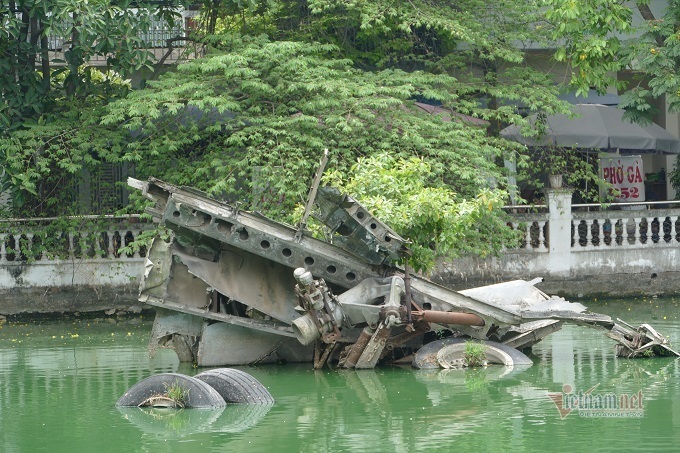
On the night of December 27, 1972 during the “Hanoi-Dien Bien Phu in the air” campaign, an American B-52 bomber was shot down by Vietnamese soldiers and part of it landed where it still remains today in Huu Tiep Lake in Ngoc Ha Ward, Ba Dinh District. Ms. Doan Thi Hien, a local who was a witness of the plane crash, said Battalion 72 of Regiment 285 of Hai Phong Air Defense shot down the B-52 bomber.
What a difference two months can make. In May, Taiwan Semiconductor Manufacturing Co. (TSMC), the world’s largest chipmaker, lost the business of Huawei Technologies—its biggest Chinese customer and the source of 13% of its revenue—as a casualty of geopolitical jockeying between superpowers. But TSMC shareholders took the loss in stride. And by late July, after a stumble by rivalIntel, TSMC’s stock had risen almost 50% since May, making it one of the world’s 10 most valuable companies.
May’s low and July’s high have something in common: They both reflect TSMC’s distinctive role in the global tech economy. Although far from a household name, TSMC controls roughly half of the world’s contract chip manufacturing. Brand-name companies that design their own chips—most notably Apple—rely on TSMC’s world-class production so they don’t have to spend tens of billions to build their own factories. Crack open your iPhone and you’ll find a chip from TSMC. If you could crack open an American guided missile, you’d likely find one there too. Its prowess has elevated TSMC to No. 362 on the Global 500, with $35 billion in revenue. Today it gets 60% of sales from the U.S. and about 20% from mainland China.
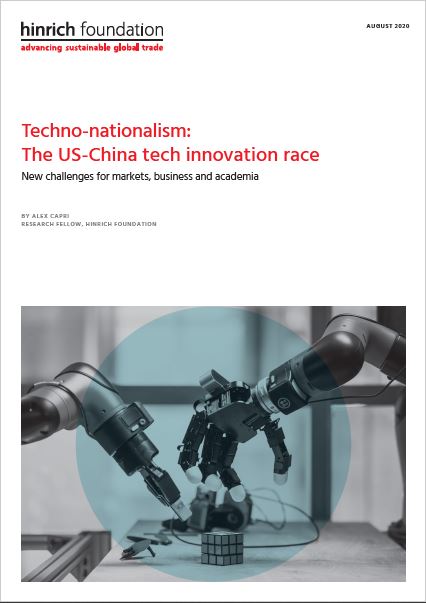
Techno-nationalism: The US-China tech innovation race New challenges for markets, business and academia BY ALEX CAPRI RESEARCH FELLOW, HINRICH FOUNDATION, 20202
The US-China tech innovation race is challenging the laissez-faire economic model. State interventionism, techno-nationalism and US tech funding initiatives are increasing. This paper outlines the implications for markets, academia, research organizations, and governments of the US-China competition to achieve innovation advantage.
A US-China tech innovation race has sparked a paradigm shift in global trade and commerce that is challenging the long-standing primacy of the world’s open trading system.
Current thinking is tilting towards increased state activism and interventionism, not only in the technology landscape but in many of the industries of the future.
Driving this change is techno-nationalism: a mercantilist-like behavior that links tech innovation and enterprise directly to the national security, economic prosperity and social stability of a nation.
In response to decades of Beijing’s innovation-mercantilism, the US has embarked on its own innovation offensive. Washington’s future tech funding initiatives could surpass the scale of the “moonshot” projects last seen during the space race with the former Soviet Union.
Download “Techno-nationalism: The US-China tech innovation race” by Alex Capri
The innovation race involves a broad range of emerging and foundational technologies that will define the industries of the future, including:
Artificial Intelligence (AI) and machine learning
Quantum computing and information systems
Robotics
Energy storage
Semiconductors
Next generation communication (including 5G and 6G)
Hypersonics.
Underlying themes: US techno-nationalism and innovation
As Washington and its allies ramp up techno-nationalist initiatives, core themes will drive the paradigm shift.
Public-private partnerships (PPP) – Technology alliances and government-funded initiatives will play an increasingly important role in advancing long-term innovation in the US, the EU and other traditionally open markets.
Avoiding the China innovation model – The US and EU innovation agendas will not seek to emulate China’s centralized, authoritarian system of techno-nationalism, but, rather, to turbo-charge markets and leverage entrepreneurial ecosystems, as well as academic and defense establishments.
Balancing tensions between MNEs, markets and techno-nationalism – Multinational enterprises (MNEs) will remain the primary drivers of R&D and innovation in free markets and play a vital role in PPP initiatives. They will be pulled into the US-China technology war in a variety of ways which will require a careful balancing of market forces, the interests of MNEs and the needs of state actors.
Multilateral technology alliances – US techno-nationalist policy will increasingly align with the security, economic and ideological objectives of the EU and other historic allies. This will produce more cooperation between the US and its partners.
Section I – The US-China innovation race: The role of the state
This section examines trends for public-spending in R&D and innovation and reviews a series of techno-nationalist funding initiatives from the US government.
It analyzes state activism in free markets and why governments are uniquely qualified to promote innovation and “blue-sky” technologies in ways that the private sector cannot.
Finally, Section I spotlights a historic example of techno-nationalism: SEMATECH and the US semiconductor public-private partnership, which led to a technological leapfrog by the US semiconductor industry, past Japan, in the 1990s.
Section II – MNEs, markets and governments: Navigating new complexities
Section II focuses on non-state actors and their increasingly complex role in public-private partnerships. It explores the tensions between open market forces, multinational companies, and techno-nationalist state activism.
To highlight these tensions, the report analyzes Facebook’s “Libra initiative and Beijing’s efforts to reduce dependency on the US dollar via the digital Yuan, and the challenges those create for MNEs. A US semiconductor sector case study illustrates how state activism can have detrimental effects on markets and backfire on the very parties it is looking to protect.
Section II concludes with an analysis of how open-sourced innovation could be a game-changer in the US-China technology war, particularly regarding future 5G wireless competition.
Section III – Academia and techno-nationalism: Open versus closed systems
Universities, research organizations and academia have become hot zones in the US-China innovation race. Human capital development is key to conducting leading-edge R&D and driving innovation.
Section III looks at how US export controls are affecting R&D activities at universities. It highlights the rules-based frameworks that universities must build to handle increasing government funding into academia.
The section showcases China’s Thousand Talents program and highlights its challenges for public-private partnerships involving academia. It also discusses why the US, in particular, should keep its human capital and innovation pipeline open as it pertains to foreign students, fundamental research programs and, ultimately, why an open system (despite China’s exploitation of it) is better than a closed one.
Finally, section III looks at how some inevitable strategic decoupling between Chinese and US entities will result in the ring-fencing of more “sensitive” R&D activities within the US defense establishment.
Listen to a summary of the report in this podcast featuring Alex Capri and Andrew Staples, Director of Research and Outreach.
Alex Capri is a Research Fellow at the Hinrich Foundation with over 20 years of experience in value chains, logistics and global trade management, both as an academic and a professional consultant.
HONOLULU (29 July 2020)—In recent years, relations with Southeast Asia have emerged as an important pillar of US engagement with the Indo-Pacific region. The Association of Southeast Asian Nations (ASEAN) is central to US foreign policy in the region, with a growing focus on the five countries bound together by the Mekong River—Cambodia, Lao PDR, Myanmar, Thailand, and Vietnam.
Fishing boats are unloaded on Tonle Sap Lake, which is fed by the Mekong River in Cambodia. Conservationists warn that dam construction on the Mekong could threaten the food supply of more than 40 million people who rely on fish from the river as an important source of protein. Photo: Jason South/Fairfax Media/Getty Images.
As they emerge from a tumultuous history, these countries must confront new elements of great-power competition even as their youthful populations push for economic growth and integration into the wider region and the world. Among other impacts, urbanization, infrastructure expansion, and climate change all affect the Mekong River, the natural resources along its banks, and the 240 million people who live in the region.
Điện đàm với người đồng cấp Trung Quốc, Bộ trưởng Quốc phòng Mỹ đã bày tỏ quan ngại về hoạt động ‘gây bất ổn’ của Bắc Kinh ở Biển Đông và gần Đài Loan.
Theo hãng tin Reuters, thông tin trên được Lầu Năm Góc công bố hôm 6/8. Đây là cuộc điện đàm đầu tiên giữa ông Esper và Bộ trưởng Quốc phòng Trung Quốc Ngụy Phượng Hòa kể từ tháng 3 tới nay. Cuộc điện đàm diễn ra trong lúc quan hệ hai bên đang ở mức thấp nhất trong hàng chục năm qua.
President Trump signed an executive order on Thursday that will prohibit Americans from doing business with ByteDance, the company that owns TikTok, and a similar order that bans transactions involving WeChat, a social messaging app, with its owner, Tencent, beginning September 20, in an effort to bar the China-owned social media platforms from the U.S. due to national security concerns.
Prime minister also says stronger Indo-Pacific alliance with like-minded nations is a ‘critical priority’ for Australia.
Australia’s Scott Morrison, standing, walks past China’s Xi Jinping during the G20 leaders’ meeting in Japan last year [File: Lukas Coch via EPA]
Australia’s Prime Minister Scott Morrison has said his government held a less dramatic view of US-China strategic tensions than a predecessor who warned of a potential “hot war” before US presidential elections in November, but added that a conflict is no longer inconceivable.
Republican senators line up in favor of Microsoft purchase
Mnuchin says Democratic leaders agree new approach needed
The Trump administration will announce measures shortly against “a broad array” of Chinese-owned software deemed to pose national-security risks, U.S. Secretary of State Michael Pompeo said.
The comments suggest a possible widening of U.S. measures beyond TikTok, the popular music-video app owned by ByteDance Ltd., one of China’s biggest tech companies. President Donald Trump told reporters Friday that he plans to ban TikTok from the U.S., but his decision hasn’t been announced. Pompeo signaled he expects a Trump announcement “shortly.” Chinese newspapers slammed a potential ban on TikTok.









![Australia's Scott Morrison, standing, walks past China's Xi Jinping during the G20 leaders' meeting in Japan last year [File: Lukas Coch via EPA]](https://www.aljazeera.com/mritems/imagecache/mbdxxlarge/mritems/Images/2020/8/5/abeee44e48264f8a84ffe7b27ef8499c_18.jpg "Australia's Morrison says US-China war no longer inconceivable")