Người có tầm nhìn của Thái Lan xây dựng ngành công nghiệp mặt trời với thúc đẩy từ IFC như thế nào

English: How Thailand’s Solar Power Visionary Built an Industry with a Boost from IFC

Image

TIÊU ĐIỂM

– Một trong những người chiến thắng giải thưởng – UN Momentum for Change – Động lực cho sự thay đổi của LHQ năm nay đang thay đổi hoàn toàn công suất năng lượng tái tạo của Thái Lan với các trang trại năng lượng mặt trời quy mô lớn.

– Để có được nguồn tài chính liên tục cho những thứ mà lúc đó là một ngành công nghiệp mới của nước này, bà đã làm việc với Tập đoàn tài chính Quốc tế (IFC) của Ngân hàng Thế giới và Quỹ Công nghệ sạch để sử dụng nguồn tài chính tổng hợp.

– Dự án nâng công suất năng lượng sạch đã góp phần thúc đẩy tăng trưởng kinh tế ở một trong những vùng nghèo nhất của Thái Lan.

Ngân hàng Thế giới – thị trường năng lượng mặt trời của Thái Lan đã bế tắc trong năm 2008, với năng lượng mặt trời chiếm ít hơn 2 MW công suất lắp đặt. Mặc dù, chi phí công nghệ đã giảm, và chính phủ đã bắt đầu có ưu đãi khuyến khích phát triển năng lượng tái tạo. Wandee Khunchornyakong, một giám đốc điều hành sản xuất pin năng lượng mặt trời (đã về hưu), đã nhìn thấy tiềm năng.

Bà muốn giúp giảm sự phụ thuộc của Thái Lan vào năng lượng nhập khẩu, và bà tin rằng bà có thể thúc đẩy tăng trưởng kinh tế ở một trong những vùng nghèo nhất của đất nước cùng một lúc bằng cách xây dựng các trang trại năng lượng quy mô nhỏ.

Tài trợ từ Công ty Tài chính Quốc tế của Ngân hàng Thế giới đã cho Công ty năng lượng mặt trời (SPCG) của bà một lực đẩy cần thiết để thu hút các nhà đầu tư vào một sân chơi mới được kiểm chứng ở Thái Lan. Tiếp tục đọc “Người có tầm nhìn của Thái Lan xây dựng ngành công nghiệp mặt trời với thúc đẩy từ IFC như thế nào”

The Problem with Biofuels

The U.S. Navy is touting its “Great Green Fleet,” but why haven’t biofuels made a bigger splash despite a decade of hype and investment?

technologyreview – Last week the U.S. Navy, with its accustomed pomp and fanfare, launched its first carrier strike group powered partly by biofuel—in this case, a blend made primarily from beef fat. The biofueled warships form a central element of the Navy’s Great Green Fleet program to draw half of its power from clean energy sources, rather than petroleum, by 2020.

Attended by secretary of the Navy Ray Mabus and agriculture secretary Tom Vilsack, the ceremony masked what has been nearly a decade of problems for biofuels—an energy source once touted as capable of virtually eliminating the use of petroleum in the transportation sector. Today biofuels production and consumption stand at a fraction of the levels foreseen under the Renewable Fuel Standard, a federal mandate signed by President George W. Bush that requires fuels made from corn, sugarcane, and other biological sources to be mixed into the nation’s gasoline supply. Tiếp tục đọc “The Problem with Biofuels”

Who’s afraid of cheap oil?

Low energy prices ought to be a shot in the arm for the economy. Think again Jan 23rd 2016 | From the print edition Timekeeper

economist – ALONG with bank runs and market crashes, oil shocks have rare power to set monsters loose. Starting with the Arab oil embargo of 1973, people have learnt that sudden surges in the price of oil cause economic havoc. Conversely, when the price slumps because of a glut, as in 1986, it has done the world a power of good. The rule of thumb is that a 10% fall in oil prices boosts growth by 0.1-0.5 percentage points.

In the past 18 months the price has fallen by 75%, from $110 a barrel to below $27. Yet this time the benefits are less certain. Although consumers have gained, producers are suffering grievously. The effects are spilling into financial markets, and could yet depress consumer confidence. Perhaps the benefits of such ultra-cheap oil still outweigh the costs, but markets have fallen so far so fast that even this is no longer clear.

The new economics of oil

The world is drowning in oil. Saudi Arabia is pumping at almost full tilt. It is widely thought that the Saudis want to drive out higher-cost producers from the industry, including some of the fracking firms that have boosted oil output in the United States from 5m barrels a day (b/d) in 2008 to over 9m b/d now. Saudi Arabia will also be prepared to suffer a lot of pain to thwart Iran, its bitter rival, which this week was poised to rejoin oil markets as nuclear sanctions were lifted, with potential output of 3m-4m b/d. Tiếp tục đọc “Who’s afraid of cheap oil?”

IFC finances Canadian Solar Vietnam, Brazil fab projects to tune of $70m

Canadian Solar CEO Shawn Qu welcomed the partnership with the IFC: "With IFC's commitment, we are able to expand our production capacity to meet the increasing demand for solar energy worldwide."

Canadian Solar CEO Shawn Qu welcomed the partnership with the IFC: “With IFC’s commitment, we are able to expand our production capacity to meet the increasing demand for solar energy worldwide.”

pv-magazine: The International Finance Corporation (IFC) has entered into an agreement with Chinese Tier-1 solar power company Canadian Solar to deliver a finance package worth $70 million to aid the company’s overseas expansion plans.

The terms of the deal include a $60 million loan and a $10 million subscription in Canadian Solar common shares. Tiếp tục đọc “IFC finances Canadian Solar Vietnam, Brazil fab projects to tune of $70m”

Vietnam Plans Move Away From Coal

January 28th, 2016 by

cleantecnica – Vietnam Prime Minister Nguyen Tan Dung has announced his government’s intention to “review development plans of all new coal plants and halt any new coal power development.”

Vietnam prime minister

Nguyễn Tấn Dũng, Prime Minister of Vietnam

According to Solarplaza, the Premier stated that Vietnam needs to “responsibly implement all international commitments in cutting down greenhouse gas emissions; and to accelerate investment in renewable energy.”

The announcement comes in advance of the Solar PV Trade Mission, scheduled April 18 – 22 in Hanoi and Bangkok. It is hoped the trade missions will assemble diverse high-level delegations of stakeholders from around the world into emerging markets to jointly explore and create business development opportunities.
Tiếp tục đọc “Vietnam Plans Move Away From Coal”

Sensible subsidies – How should backing for clean technology be designed?

Governments usually provide subsidies based on overall adoption targets, such as the number of cars or solar panels they would like to see purchased over a period of time. But green technologies are often new products, and no one really knows how many consumers are waiting to buy them.

Peter Dizikes | MIT News Office
January 21, 2016

new.MIT.edu – Governments often offer subsidies to consumers for clean-technology products, from home solar panels to electric vehicles. But what are the right levels of subsidy, and how should they be calculated? As a new paper co-authored by MIT researchers shows, governments can easily make subsidies too low when they ignore a basic problem: Consumer demand for these products is usually highly uncertain.

Indeed, the paper’s analysis suggests this has already happened in the case of the Chevy Volt, an electric car introduced in 2010 that suffered slow initial sales before gaining more traction in the marketplace.

“The government will miss their target by a lot when ignoring demand uncertainty,” says Georgia Perakis, the William F. Pounds Professor of Management at the MIT Sloan School of Management and a co-author of the paper.

While discussion of “demand uncertainty” might sound a bit abstract, it matters. Governments usually provide subsidies based on overall adoption targets, such as the number of cars or solar panels they would like to see adopted over a period of time. But green technologies are often new products, and no one really knows how many consumers are waiting to buy them. Tiếp tục đọc “Sensible subsidies – How should backing for clean technology be designed?”

CSIS Energy Publication | Assessing the Final Clean Power Plan: Emissions Outcomes

FROM THE CSIS ENERGY AND NATIONAL SECURITY PROGRAM

Assessing the Final Clean Power Plan:
Emissions Outcomes

The U.S. Environmental Protection Agency’s (EPA) Clean Power Plan (CPP) is the most significant greenhouse gas (GHG) policy ever undertaken in the United States, and is expected to achieve significant emission reductions by the time it is fully implemented in 2030. However, calculating the ultimate emissions-abatement potential is more difficult than simply adding up the state reduction targets. While the EPA has set a floor on cumulative emissions from existing fossil-fuel-fired power plants, it has not set a ceiling, and projecting the actual emissions outcome on a national level is not straightforward due to the flexibility states have in implementation.

Our analysis deepens the understanding of the potential emissions outcomes of the CPP and what factors could influence that outcome. We start by explaining the primary factor that has the potential to undermine EPA’s emissions floor—leakage—and how EPA is attempting to address this issue. We then turn to a quantitative analysis of two potential pathways for state implementation plans (SIPs) under optimal implementation conditions. Bearing in mind that optimal implementation is unlikely, we also explore key drivers and decisions that could result in emissions that are higher or lower than our initial projections.

To read the full report, click here

By: John Larsen, Director, Rhodium Group, and Non-Resident Senior Associate, Energy and National Security Program, CSIS; Sarah Ladislaw, Director and Senior Fellow, Energy and National Security Program, CSIS; Michelle Melton, Associate Fellow, Energy and National Security Program, CSIS; and Whitney Herndon, Research Analyst, Rhodium Group

RECENT PUBLICATIONS

Adjusting to Low Prices:
Prospects for Fossil Fuel Subsidy Reform

By: Sarah Ladislaw, Director and Senior Fellow, Energy and National Security Program, CSIS and Zachary Cuyler, Research Associate, Energy and National Security Program, CSIS

Is India the Next China? An Energy-Related Comparison

By: Jane Nakano, Senior Fellow, Energy and National Security Program, CSIS and Michelle Melton, Associate Fellow, Energy and National Security Program, CSIS

Renewed Solar Subsidies – A Missed Opportunity

By: Francis O’Sullivan, Director of Research and Analysis, MIT Energy Initiative; Senior Associate, Energy and National Security Program, CSIS

Study Looks at Renewable Energy in Germany and Texas

Dec 29, 2015

renewablenergyworld – A report published by Stanford’s Steyer-Taylor Center for Energy Policy and Finance looks at three of the world’s largest economies and largest energy jurisdictions in an attempt to compare their approaches to ramping up renewable energy.  Included in the report is a comparison of electricity rates in Germany to those in Texas and California as well a discussion of how renewables contribute to overall costs.

The report compares Germany, the world’s fourth largest economy and an aggressive adopter of renewable energy, with the states of California and Texas.  California and Texas are the world’s 8th and 12th largest economies respectively, and are both leaders in the U.S. with respect to wind and solar deployment. Tiếp tục đọc “Study Looks at Renewable Energy in Germany and Texas”

Our Energy Transformation in 2015

Sơn La còn 313 bản vùng cao chưa có điện lưới quốc gia

ĐIÊU CHÍNH TỚI (TTXVN/VIETNAM+) LÚC : 07/12/15 14:47

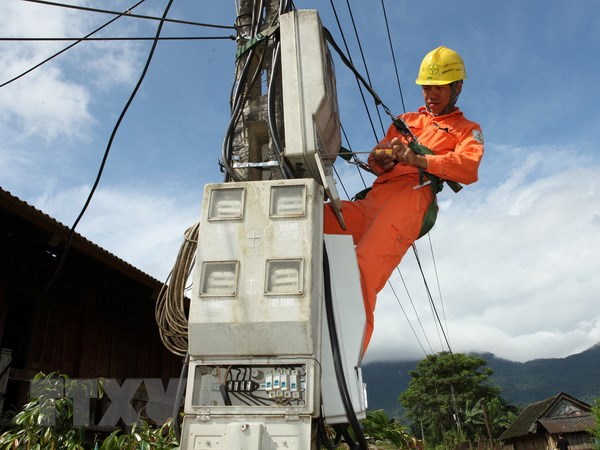
(Ảnh minh họa: Ngọc Hà/TTXVN)

 
Theo thống kê của Công ty Điện lực Sơn La, hiện còn 313 bản, với tổng số gần 36.400 hộ đồng bào dân tộc ở vùng cao, vùng sâu, vùng xa của tỉnh Sơn La chưa có điện lưới quốc gia.

Ủy ban Nhân dân tỉnh Sơn La đã chỉ đạo các ngành chức năng, các huyện phối hợp với ngành điện rà soát lại hệ thống lưới điện, các bản và số hộ chưa có điện trên địa bàn toàn tỉnh. Tiếp tục đọc “Sơn La còn 313 bản vùng cao chưa có điện lưới quốc gia”

Germany Could Make $2 Billion By Exporting Electricity

November 10th, 2015 by

cleantecnica – The Fraunhofer Institute has found that Germany made about €1.7 billion, or $1.93 billion, in 2014 by selling surplus electricity. In 2015, that amount could reach €2 billion or $2.2 billion. Germany may also achieve a record export surplus of 40 TWh of electricity in 2015. “Over the past years, Germany was able to secure higher prices for its electricity exports than it paid for electricity imports,” explained Fraunhofer professor, Bruno Burger.

germancliffsRenewables added 118 TWh of energy production capacity in Germany from the period beginning in 2010 through 2014. What are some of Germany’s other exports? According to one source, Germany exported about $2.6 billion in pharmaceuticals to Japan in 2014. In 2007, cheese exports were about €2.7 billion. Tiếp tục đọc “Germany Could Make $2 Billion By Exporting Electricity”

Powering the Internet with renewable energy

December 3, 2015

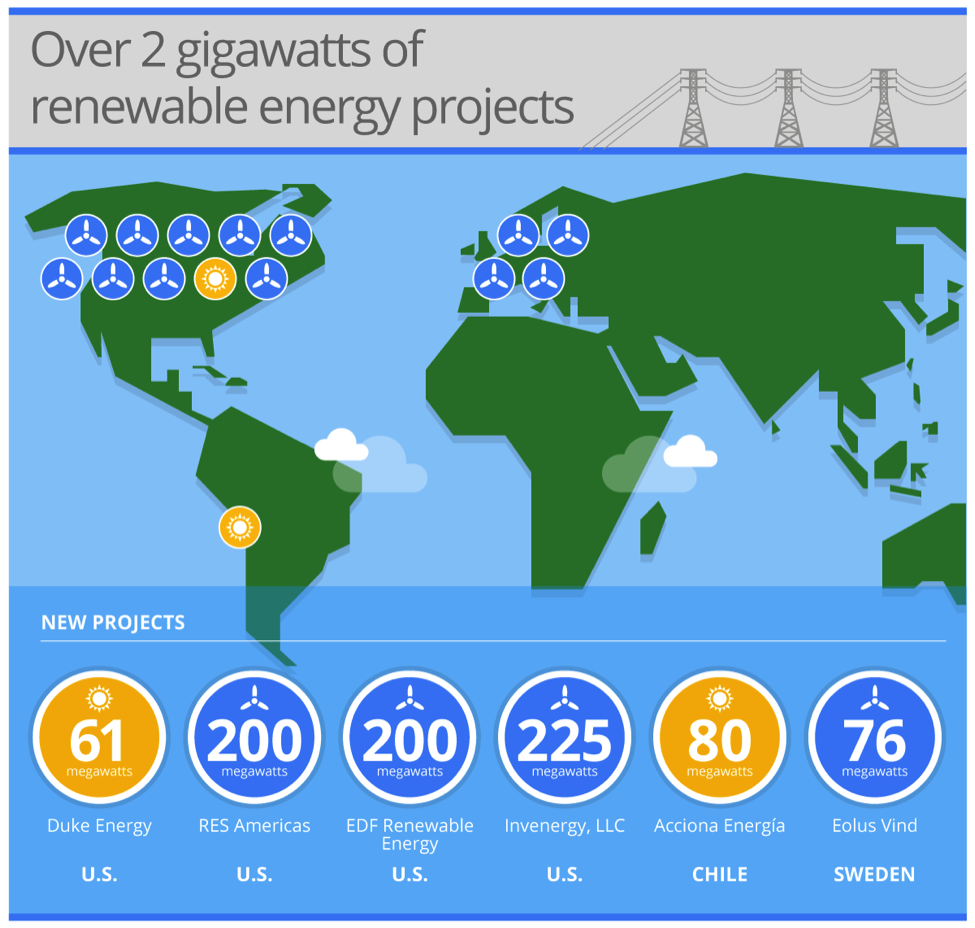
Googleblog – Today we’re announcing the largest, and most diverse, purchase of renewable energy ever made by a non-utility company. Google has already committed to purchase more renewable energy than any other company. Now, through a series of new wind and solar projects around the world, we’re one step closer to our commitment to triple our purchases of renewable energy by 2025 and our goal of powering 100% of our operations with clean energy. 842 MW of renewable energy around the world Today’s agreements will add an additional 842 megawatts of renewable energy capacity to power our data centers. Across three countries, we’re nearly doubling the amount of renewable energy we’ve purchased to date. We’re now up to 2 gigawatts—the equivalent to taking nearly 1 million cars off the road. These additional 842 megawatts represent a range of locations and technologies, from a wind farm in Sweden to a solar plant in Chile.

These long-term contracts range from 10-20 years and provide projects with the financial certainty and scale necessary to build these wind and solar facilities—thus bringing new renewable energy onto the grid in these regions. For our part, these contracts not only help minimize the environmental impact of our services—they also make good business sense by ensuring good prices. Our commitment to a sustainable energy future Since we opened our very first owned data center in 2006, we’ve been working to promote renewable and sustainable energy use in several ways:

  • First, we’re building the world’s most efficient computer infrastructure by designing our data centers to use as little energy as possible.

Tiếp tục đọc “Powering the Internet with renewable energy”

Đóng góp ý kiến cho Quy hoạch điện VII hiệu chỉnh (Việt Nam)

25/11/2015 | 13:40

Xem và tải báo cáo tại đây: Bản tiếng ViệtBản tiếng Anh

GreenID – “Không cần đầu tư xây dựng mới khoảng 30.000 tới 40.000 MW nhiệt điện than mà có thể dùng nguồn đầu tư này vào việc thực hiện sử dụng hiệu quả năng lượng và phát triển nguồn năng lượng tái tạo trong khi vẫn đáp ứng được nhu cầu”. Đây là một trong những thông tin quan trọng được đề cập trong báo cáo “Phân tích Quy hoạch điện VII và một số khuyến nghị đối với Quy hoạch điện VII hiệu chỉnh – hướng tới phát triển năng lượng bền vững tại Việt Nam” do Trung tâm Phát triển Sáng tạo Xanh (GreenID) thực hiện với sự tham gia và tư vấn của các chuyên gia năng lượng trong nước và quốc tế.

Sau hơn 4 năm thực hiện Quyết định Phê duyệt Quy hoạch phát triển điện lực Quốc gia giai đoạn 2011-2020 có xét đến năm 2030 số 1208/QĐ-TTg ngày 21/7/2011 của Thủ tướng Chính phủ, ngành điện đạt được một số thành tựu đáng ghi nhận, từ chỗ phải tiết giảm điện trong các năm 2010-2011 do thiếu điện đến nay ngành điện không những đã cung cấp được đủ điện cho sản xuất và sinh hoạt của nhân dân mà còn có dự phòng. Tuy nhiên, Quy hoạch điện VII cũng đã bộc lộ một số vấn đề mang tính vĩ mô và ảnh hưởng tới tính khả thi như dự báo nhu cầu điện năng quá lớn khiến nhu cầu vốn đầu tư quá nhiều mà nền kinh tế không chịu nổi; huy động nhà máy nhiệt điện chạy than quá cao, nhu cầu than cung cấp cho điện quá lớn, có thể dẫn tới không đủ nguồn cung cấp kể cả nhập khẩu, không đảm bảo môi trường và phát triển bền vững; chưa chú trọng đúng mức tới nguồn năng lượng tái tạo. Tiếp tục đọc “Đóng góp ý kiến cho Quy hoạch điện VII hiệu chỉnh (Việt Nam)”

Carbon capture analyst: ‘Coal should stay in the ground’

Date:December 2, 2015

Source:University of Michigan

Summary:Serious flaws have been found in a decade’s worth of studies about the best way to reduce greenhouse gas emissions and stabilize the climate, report experts in a new article.

Serious flaws have been found in a decade’s worth of studies about the best way to reduce greenhouse gas emissions and stabilize the climate.

sciencedaily – The findings, from the University of Michigan, are released as world leaders at COP21 attempt to negotiate the globe’s first internationally binding climate agreement.

The U-M researchers have found that most economic analysis of carbon capture and storage, or CCS, technology for coal-fired power plants severely underestimates the technique’s costs and overestimates its energy efficiency. CCS involves sucking carbon out of coal-fired power plants’ flue gases, compressing it and then injecting it deep underground.

The new analysis puts the cost of reducing carbon emissions with CCS-equipped coal plants higher than any previous study — and most importantly, higher than wind and comparable to solar power. It’s the first study to confront the so-called ‘energy loop’ inherent in the CCS process. Tiếp tục đọc “Carbon capture analyst: ‘Coal should stay in the ground’”

Tìm ra điểm sáng trong quyết định Keystone XL

English: Finding the Silver Pipelining in the Keystone XL Decision

“Dù cho Hilary Clinton có ý nói theo nghĩa này hay không, Hilary Clinton gọi đường ống Keystone XL là một “sự phân tâm” khỏi việc giải quyết vấn đề biến đổi khí hậu – một thông điệp mà tổng Thống Obama lặp đi lặp lại khi giải thích cho quyết định từ chối của mình. Cho những ai trong chúng ta nhận ra nhu cầu bức thiết của việc giải quyết vấn đề biến đổi khí hậu và của việc đưa ra những lựa chọn khó khăn và phác thảo những chính sách rõ ràng để đưa đến những kết quả khả quan và cân bằng, thời gian, công sức và sự chú ý hướng đến Keystone XL đã thực sự là một sự phân tâm.”

Photo courtesy of rickz from https://www.flickr.com/photos/rickz/2113212191/in/photolist-4dJLmX-8AaSq8-4R2T6-ogvPnb-cHW8qL-9c4B2L-H8U2t-6YX1eb-6YWZVG-6YX1J7-4ZLHta-P4pxK-P3MCu-P4py8-P4ABV-P432S-P432b-P4ABR-P3Mgd-6YSZz2-axSvq-6hmrrn-P4ABK-5btKCU-BmhUs-9YT

Hôm nay Tổng thống Obama, sau 7 năm nghiên cứu và thảo luận, đã từ chối yêu cầu của TransCanada xin Giấy Phép của Tổng thống cho đường ống Keystone XL – một đường ống dài 1179 dặm được thiết kế để vận chuyển số lượng đến 830,000 thùng dầu một ngày sản xuất tại Canada đến một hệ thống ống dẫn tích hợp ở Mỹ. Mặc cho sự biểu tình phản đối của chính quyền Obama đối với sự kiện này, quyết định từ chối cấp giấy phép được đồn là đã được đưa ra một thời gian trước đây và quyết định công bố vào thời điểm hôm nay là một bước đi có tính toán để thắng chiếc ghế tổng thống và sự hỗ bổ sung của chính quyền từ cộng đồng môi trường trước khi đến Paris để dự các cuộc đàm phán về khí hậu của Liên Hiệp Quốc vào cuối tháng này. Tổng thống xác nhận rằng chấp thuận cho đường ống Keystone XL sẽ làm giảm vai trò của Mỹ với tư cách là nước đi tiên phong trong cuộc chiến khí hậu, khi trong thực tế quyết định này dường như có trọng lượng trong nước hơn là quốc tế. Thực sự, vai trò lãnh đạo của Mỹ trong cuộc chiến khí hậu được hỗ trợ mạnh mẽ hơn bởi các hoạt động Mỹ đã thực hiện như là một phần của Kế hoạch Hành động vì Khí hậu – Climate Action Plan. Tiếp tục đọc “Tìm ra điểm sáng trong quyết định Keystone XL”