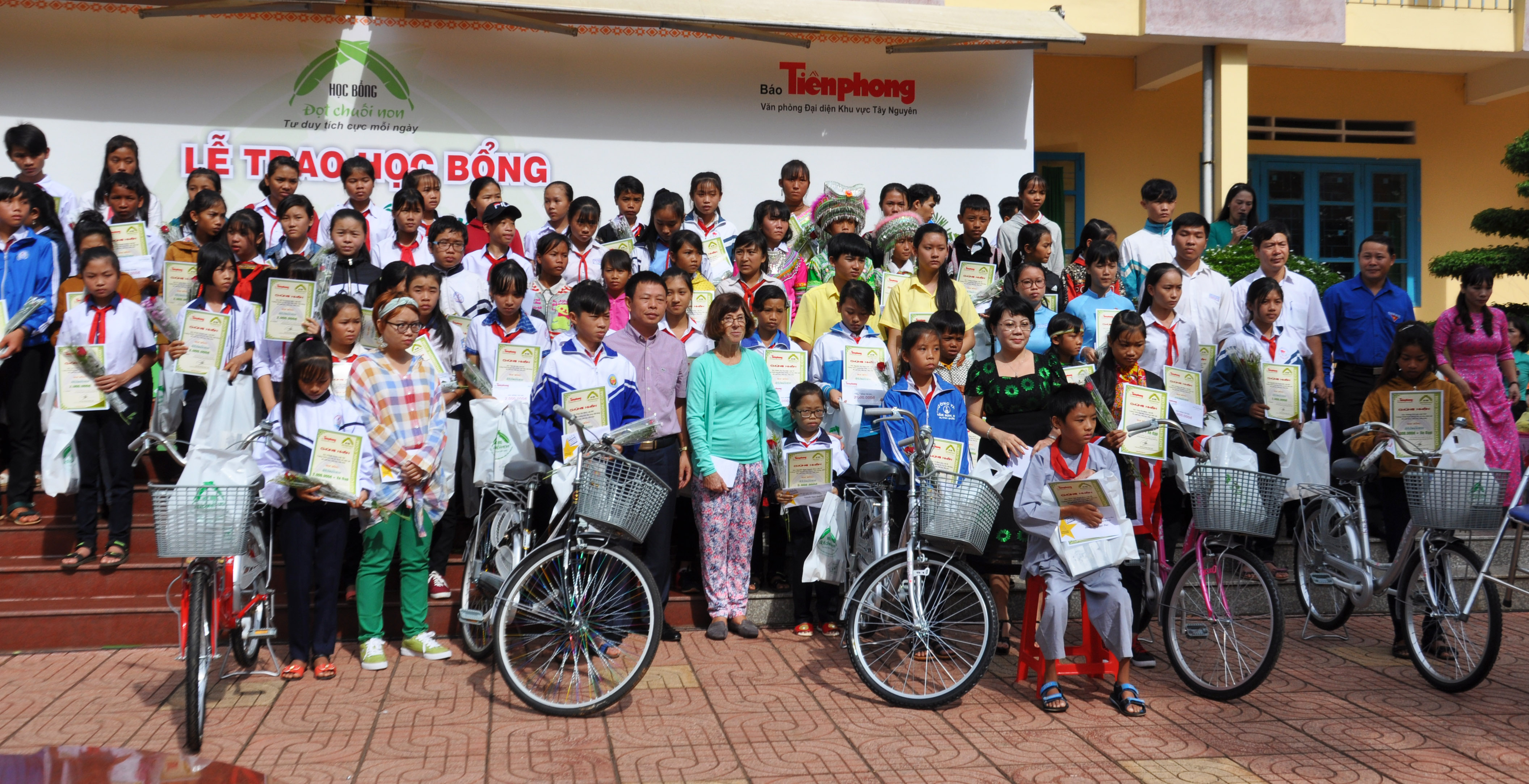
Lễ trao học bổng Đọt Chuối Non lần thứ 10 – Rơi lệ trước những tấm gương vượt khó phi thường

Bài cùng chuỗi:
Tiếp thêm động lực phấn đấu – Học bổng Đọt Chuối Non 2017

TP
BMT – Trong 97 học sinh đặc biệt hiếu học, hiếu thảo trên 2 tỉnh Tây Nguyên được tuyển chọn trao học bổng Đọt Chuối Non lần thứ 10, có những học sinh mang trọng bệnh hoặc khuyết tật nặng, nhưng vẫn nỗ lực theo đuổi sự học, học giỏi, và đầy nghị lực vươn lên.

97 suất học bổng và nhiều phần quà đã được trao

Suốt gần 3 tiếng đồng hồ sáng ngày 18/11/2017, hơn 1.400 đại biểu, thầy cô giáo, nhà tài trợ và học sinh đã chăm chú theo dõi buổi lễ mừng ngày Nhà giáo Việt Nam, và trao học bổng Đọt Chuối Non lần thứ 10 trong khuôn viên thoáng rộng, rợp mát bóng cây của trường THCS Lương Thế Vinh (số 1 Tôn Đức Thắng TP Buôn Ma Thuột) Tiếp tục đọc “Lễ trao học bổng Đọt Chuối Non lần thứ 10 – Rơi lệ trước những tấm gương vượt khó phi thường”

Global nuclear weapons: downsizing but modernizing

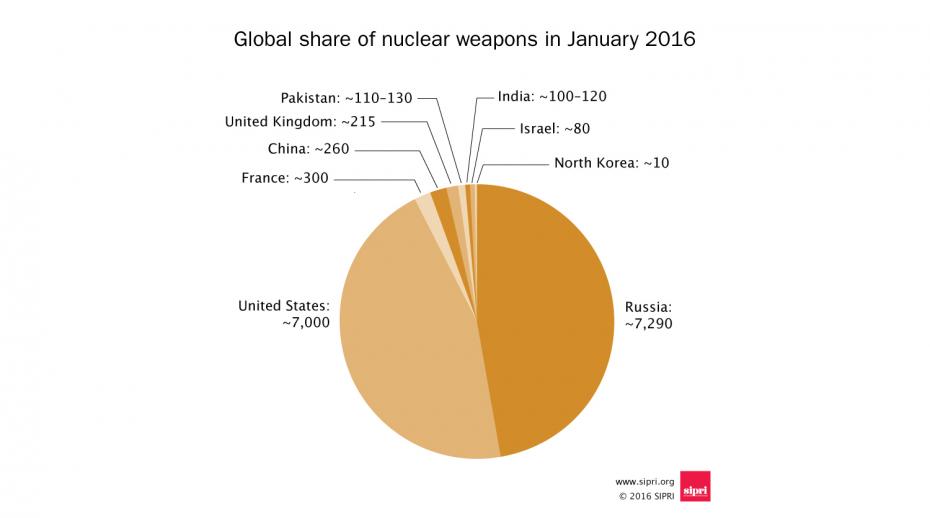
Pie chart showing gloal share of nuclear weapons in January 2016

SPIRI_(Stockholm, 13 June 2016) The Stockholm International Peace Research Institute (SIPRI) today launches its annual nuclear forces data, which highlights the current trends and developments in world nuclear arsenals. The data shows that while the overall number of nuclear weapons in the world continues to decline, none of the nuclear weapon-possessing states are prepared to give up their nuclear arsenals for the foreseeable future.

At the start of 2016 nine states—the United States, Russia, the United Kingdom, France, China, India, Pakistan, Israel and North Korea—possessed approximately 4,120 operationally deployed nuclear weapons. If all nuclear warheads are counted, these states together possessed a total of approximately 15,395 nuclear weapons compared with 15,850 in early 2015 (see table 1).


Table 1. World nuclear forces, 2016 Tiếp tục đọc “Global nuclear weapons: downsizing but modernizing”

Universities and students are revolutionalizing Sustainability

worldwatch_As leaders of knowledge and innovation, universities are places where sustainable futures are imagined. They are institutions where experts research emerging issues and generate new ideas. They contain multitudes of idealistic and adaptive young students who can be mobilized to protect their futures. It is only natural that some of the most progressive sustainability ideas are emerging from universities.

Universities around the world are striving to curb their wasteful tendencies as well as to foster an atmosphere that encourages environmental consciousness. Here are three areas of campus life that universities have sought to make greener:

bikeshare

  1. Fostering sustainable lifestyles through transportation initiatives

One of the most pressing issues pertaining to environmental sustainability at universities is transportation. A 2011 study by Complete College America reports that 75 percent of all college students in the United States commute to campus, often traveling by car, bus, and other carbon-emitting vehicles. Overall, the transportation sector is one of the country’s highest contributors to greenhouse gas emissions.
Tiếp tục đọc “Universities and students are revolutionalizing Sustainability”

Using real-time satellite data to track water productivity in agriculture

New FAO tool offers water-scarce countries and river basins a way to boost productivity

Photo: ©FAO/Olivier Asselin

Watering crops in the Democratic Republic of Congo.

FAO 20 April 2017, Rome – Measuring how efficiently water is used in agriculture, particularly in water-scarce countries, is going high-tech with the help of a new tool developed by FAO.

The WaPOR open-access database has gone live, tapping satellite data to help farmers achieve more reliable agricultural yields and allowing for the optimization of irrigation systems.

WaPOR was presented this week during a high-level partners meeting for FAO’s Coping with water scarcity in agriculture: a global framework for action in a changing climate. It allows for fine-grained analysis of water utilised through farming systems, generating empirical evidence about how it can be most productively used.

Worldwide water utilization – the majority of which is used by agriculture – has outpaced the rate of population growth for most of the last century and some regions are close to breaching viable limits. Tiếp tục đọc “Using real-time satellite data to track water productivity in agriculture”

Using Remote Sensing to Map Rice Paddy Drop in the Mekong Delta

Gislounge_The Mekong River Delta is an important water source flowing through South East Asia. Primarily feeding the rice fields of Vietnam, the Mekong River Delta has long been an area of great fertility due to water flow and silt build up. However, agricultural efforts in the area have shown a decline in production because of the weather effects of El Niño. This year’s El Niño has been particularly strong, causing droughts in South East Asia.

Satellites including Europe’s Sentinel-1A can now track the rise and fall of different agricultural products around the world. The satellite’s imagery showed that rice production in the Mekong Delta has decreased in the past year, threatening the livelihoods of local farmers as well as food security worldwide. Tiếp tục đọc “Using Remote Sensing to Map Rice Paddy Drop in the Mekong Delta”

Why Alibaba Founder Jack Ma Is Cozying Up With China’s Cops

By Scott Cendrowski

October 26, 2016

fortune_Eight months after Apple CEO Tim Cook staged a very public spat with U.S. law officials over accessing users’ private data, Alibaba executive chairman Jack Ma is moving in the opposite direction. Sort through our country’s data, he told Chinese law officials last Friday, it can help pinpoint terrorist activity. Tiếp tục đọc “Why Alibaba Founder Jack Ma Is Cozying Up With China’s Cops”

The scientist who spots fake videos

nature_Hany Farid discusses how to detect image manipulations — and the increasing sophistication of forgers.

Article tools

Rights & Permissions

Eli Burakian/Dartmouth College

Hany Farid.

Hany Farid, a computer scientist at Dartmouth College in Hanover, New Hampshire, specialises in detecting manipulated images and videos. Farid, who provides his services to clients as varied as universities, media organizations, and law courts, says that image manipulation is becoming both more frequent and more sophisticated. He spoke to Nature about the arms race to stay ahead of the forgers.

Where do you start when trying to spot a fake image?

One simple but powerful technique is reverse image search. You give the image to a site such as Google Image Search or TinEye, and they show you all other instances of it. A project at Columbia University, in New York City, is taking this to the next level, and starting to find parts of images that have been repurposed from other images.

“I’ve seen the technology get good enough that I’m now very concerned”

Tiếp tục đọc “The scientist who spots fake videos”

Báo động tình trạng lao động nô lệ của người Việt ở các tiệm làm móng tại Anh

English: Slavery report sounds alarm over Vietnamese nail bar workers

Lời kêu gọi có một cơ chế cấp phép để ngăn chặn tội ác buôn người nhập cư để làm việc trong điều kiện nô lệ

Nail bar
Nghiên cứu phân tích những kinh nghiệm từ hơn một chục cá nhân đã trải qua chế độ lao động nô lệ hiện đại trong các cửa hiệu làm móng. Hình ảnh: Graham Turner của the Guardian

Thứ Hai, 11 Tháng 9 năm 2017

Các cửa hiệu làm móng tại Anh đang đối mặt với nguy cơ cao về tình trạng lao động nô lệ hiện đại, mà cần phải có một cơ chế cấp phép nhằm ngăn chặn những người Việt nhập cư bị buôn bán làm việc trong điều kiện như nô lệ, theo một cố vấn chống buôn người tại Anh. Tiếp tục đọc “Báo động tình trạng lao động nô lệ của người Việt ở các tiệm làm móng tại Anh”

FAO official: GMOs not needed but we should be open to biotechnologies

Gustafson: “The total food production of the planet, it is huge: it is a question of access.” [Sarantis Michalopoulos]

euractive_The requirements of food production can be met without GMOs but we should not eliminate the broader benefits that biotechnologies can provide, Daniel Gustafson, a senior United Nations official, told EURACTIV.com in an interview. Tiếp tục đọc “FAO official: GMOs not needed but we should be open to biotechnologies”

Vietnam uses water cannon to disperse protest at global fashion brands supplier


FILE PHOTO: Picture shows a protesting camp set by villagers to block entrance of Hong Kong’s Pacific Crystal textiles factory after villagers accused the company of polluting local water in Hai Duong province, outside Hanoi, Vietnam July 13, 2017. REUTERS/Staff

HANOI (Reuters) – Vietnamese authorities on Monday used water cannon and electric rods to end a five-month long protest by villagers blockading a textile plant that serves global fashion brands, an official and a villager said.

The blockade represents another challenge to the communist nation’s government over industrial pollution woes, at a time when Vietnam seeks more foreign investors to keep up one of the highest rates of growth in Southeast Asia.

Hundreds of people from the northern province of Hai Duong have maintained watch in shifts day and night since April to stop work at the Pacific Crystal Textiles mill, operated by Hong Kong-based Pacific Textiles.

Tiếp tục đọc “Vietnam uses water cannon to disperse protest at global fashion brands supplier”

Vietnam’s Social Media Shaping New Environmentalism

Mekongeye

Social media is proving its important role in promoting environmental awareness to the young generation in Vietnam and throughout SE Asia Credit: Judith Scharnowski

By James Borton

Can Tho, Vietnam, June 14, 2017

Geopolitical Monitor

“I am frequently on several environmental online forums and campaigns led by Vietnamese, who have addressed Hanoi’s logging of 6,700 trees, the Thai Binh deforestation for economic development, and the construction in Cat Ba,” says Tran Thi Thuy Binh, a member of the Vietnam Forum for Environmental Journalists in Hanoi. Tiếp tục đọc “Vietnam’s Social Media Shaping New Environmentalism”

Quản lý giá biệt dược: Làm gì để thị trường thuốc không “nhảy múa”?” – 5 kỳ

***

Quản lý giá biệt dược: Làm gì để thị trường thuốc không “nhảy múa”?”

THÙY GIANG (VIETNAM+) Bản in

Những cửa hàng thuốc tư nhân san sát nhau trên tuyến phố Quán Sứ (Hà Nội). (Ảnh: TTVN/Vietnam+)

Tổng kết công tác khám chữa bệnh của Bộ Y tế trong năm 2015 cho thấy, các chỉ tiêu tổng hợp như số lần khám bệnh, số bệnh nhân nội trú, ngoại trú, số ngày điều trị nội, ngoại trú, số phẫu thuật, thủ thuật, chẩn đoán, xét nghiệm… đều tăng so với năm 2014, đạt bình quân 2,34 lượt khám/người/năm.

Như vậy, trong năm qua, mỗi người dân đạt bình quân có hơn 2 lần tới các cơ sở y tế khám chữa bệnh. Và mỗi năm, lượng thuốc được tiêu thụ trong khám chữa bệnh không hề nhỏ. Tiếp tục đọc “Quản lý giá biệt dược: Làm gì để thị trường thuốc không “nhảy múa”?” – 5 kỳ”