JRC scientists have mapped tourism hotspots in Europe for all four seasons and created an index on the estimated vulnerability of regions to shocks in the tourism sector.
With travel becoming easier and less expensive, tourism has become an important economic sector in the European Union. In 2016, the EU had an estimated 40.5% market share of global international tourist arrivals.
The total contribution of the travel and tourism sector to the EU’s GDP in 2016 was 10.2%, but with strong variation between countries, ranging from more than 20% in Malta, Croatia and Cyprus to about 5% in Poland, the Netherlands and Romania.
Vietnam, a leading indicator for the rest of the developing world, has seen tremendous growth in per capita energy consumption.
During a recent family vacation in Vietnam, I learned that the country is a microcosm for several major trends in energy consumption in the developing world: (1) there’s a thriving middle class, (2) hot and humid weather is driving air conditioning demand and (3) rural electrification rates are very high. (We also loved the food, culture and beaches, and we were gripped by the poignant remnants of the American War, as it’s known locally. I highly recommend it as a vacation destination if that’s your thing.)
Let’s start with some basic facts: Vietnam has seen extraordinary growth in per capita energy consumption over the past several decades. Since 1990, the earliest year for which data are available for most countries, total per capita energy consumption in Vietnam has more than doubled. (All the country-level data in this post come from the World Bank Development Indicators.) This puts Vietnam in the top 3% of countries in the world in terms of growth in per capita energy consumption. Of the countries with more than 5 million people, only China and Thailand have had more rapid growth. Tiếp tục đọc “Good Morning Vietnam, Energy-wise”→
Vấn đề rác đô thị vẫn phụ thuộc vào sức chịu đựng của những “chị lao công như sắt như đồng” mà Tố Hữu mô tả 60 năm trước.
Anh Minh sống ở Hà Nội đã 10 năm, nhưng vẫn chưa nói sõi tiếng Kinh.
Công việc chính của Minh không cho anh nhiều cơ hội để học tiếng Kinh: anh là một công nhân dọn rác dưới hầm chung cư. Ngăn cách giữa người đàn ông dân tộc Tày và đời sống xã hội là những tấm bê tông dày trên đầu. Kết nối đáng kể nhất giữa anh và những cư dân thành phố này là một chiếc ống rác thông tầng. Người ta ném rác vào ống, Minh thu dọn ở phía dưới, cho lên xe và đẩy đi.
The number of poor countries facing major debt crises has doubled since 2013, and only 1 in 5 are now considered to be at low risk of crisis. With some countries in the midst of crisis and others on the brink, meeting the Sustainable Development Goals (SDGs) remains a pipe dream, writes Mark Perera.
Mark Perera is a Senior Networking and Advocacy Officer at European Network on Debt and Development (Eurodad).
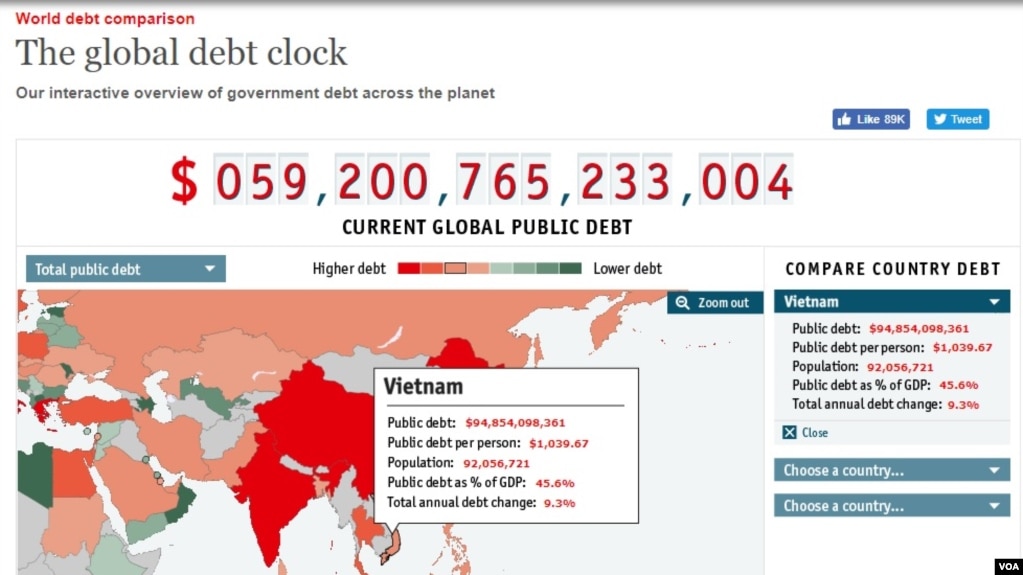
Đồng hồ nợ công của tạp chí The Economist nêu con số nợ công của Việt Nam vào ngày 16/7/2017 là hơn $94 tỉ. (Hình: Trích từ website của The Economist)
Andy Mukherjee – cây bút bình luận về kinh tế và tài chính của Bloomberg – trong một bài báo gần đây có tựa đề “(Nền kinh tế) Việt Nam không còn là con cá bé nữa”, đã tỏ ra ngạc nhiên xen lẫn thán phục về “hệ thống ngân hàng sạch hơn về nợ xấu, cổ phần hóa các doanh nghiệp Nhà nước đang diễn ra mạnh mẽ, sự tham gia và chuỗi sản xuất điện thoại thông minh trong bối cảnh tình hình kinh tế toàn cầu đang tốt hơn là những yếu tố đang giúp cho kinh tế Việt Nam khởi sắc mà dấu hiệu là thị trường chứng khoán Việt Nam có tăng trưởng đột biến” (Bài “Kinh tế Việt Nam có dấu hiệu khởi sắc”, VOA tiếng Việt 29/11/2017). Tiếp tục đọc “Kinh tế Việt Nam khởi sắc hay ngược lại?”→
Kinh tế Việt Nam có một năm khởi sắc với tốc độ tăng trưởng cao và kinh tế vĩ mô ổn định. Tốc độ tăng trưởng kinh tế GDP năm 2017 không những đạt kế hoạch đề ra mà còn là tốc độ tăng cao ấn tượng trong vòng 7 năm trở lại (đạt mức 6,81%). Các khu vực kinh tế lớn đều có những đóng góp đáng kể vào thành tích tăng trưởng chung, sự cải thiện tích cực trong tiêu dùng và sức mua; gia tăng mạnh mẽ của cầu đầu tư do tín dụng tăng cao và giải ngân vốn FDI tăng mạnh, xuất siêu hàng hoá từ quý II/2017, giải ngân vốn đầu tư NSNN tăng tốc từ những tháng cuối năm, đều là các yếu tố quan trọng giúp năm 2017 có được mức tăng trưởng ấn tượng này. Tiếp tục đọc “Các điểm nổi bật trong tăng trưởng kinh tế Việt Nam năm 2017”→
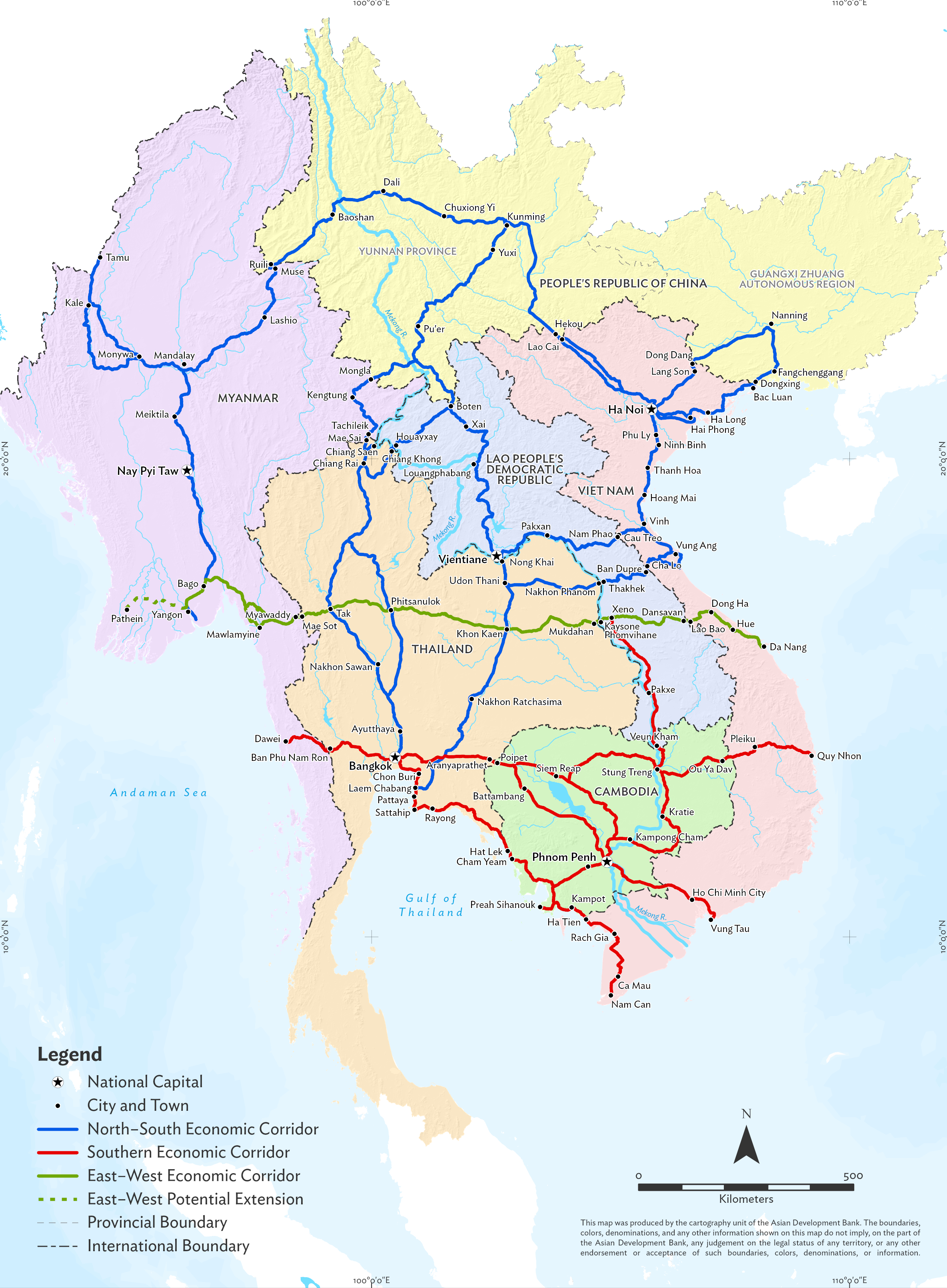
Abstract: This review recommends possible extension and/or realignment of economic corridors to enhance their effectiveness and efficiency in advancing economic integration in the Greater Mekong Subregion. The economic corridor approach was adopted by the Greater Mekong Subregion (GMS) countries in 1998 to help accelerate subregional development. The development of economic corridors links production, trade, and infrastructure within a specific geographic area. The review of these corridors was conducted to take into account the opening up of Myanmar and ensure that there is a close match between corridor routes and trade flows; GMS capitals and major urban centers are connected to each other; and the corridors are linked with maritime gateways. The review came up with recommendations for possible extension and/or realignment of the corridors, and adoption of a classification system for corridor development. The GMS Ministers endorsed the recommendations of the study at the 21st GMS Ministerial Conference in Thailand in 2016.
saigoneer.comPublished on Thursday, 05 April 2018 15:39Written by Luca Powell. Photos courtesy of Teach For Vietnam.
Vu Thi Hang’s (not pictured above) teaching style is far from traditional.
In her class, it’s common to find students moving, dancing, acting and singing. In fact, she encourages it.
“I think it helps students to feel the language,” Hang, 25, tells Saigoneer. She describes herself as a theater hobbyist, while also holding a Masters in Asia Pacific Studies. “I like to encourage expression, so the students can try and use the language creatively.”
The kind of creativity and free-play her class fosters is relatively uncommon in most public school English programs in Vietnam. At every rung, from rural county classrooms to top-tier universities, traditional programs have long prioritized reading, writing and grammar as benchmarks for fluency.
In the infrastructure domain, “price” is a prism with many façades.
An infrastructure economist sees price in graphic terms: the coordinates of a point where demand and supply curves intersect.
For governments, price relates to budget lines, as part of public spending to develop infrastructure networks.
Utility managers view price as a decision: the amount to charge for each unit of service in order to recover the costs of production and (possibly) earn a profit.
By 2030, more than 40% of the population in the Greater Mekong Subregion will be living in cities. Photo: ADB.
greatermekong – The subregion is one of the least urbanized areas in the world, but its cities are growing and their economic impact is being felt.
Urbanization levels in the Greater Mekong Subregion are low, ranging from 19.5% in Cambodia to 44.2% in Thailand. However, in all GMS countries, urban areas account for a much larger percentage of the gross domestic product (GDP)—at least half in most countries and about 75% in Thailand—than the share of its national populations.
Urbanization growth rates in the subregion range from 4.9% annually in Yunnan Province, People’s Republic of China (PRC) —six times the provincial population growth rate—to a low of 2.6% annually in Myanmar—1.7 times the national population growth rate. Tiếp tục đọc “The Greater Mekong Subregion: Rural no more”→
The Greater Mekong, including Vietnam, is expected to have a colossal US$66 billion poured in to strengthen regional economic co-operation in the next five years, said an Asian Development Bank (ADB) official on Tuesday.
Director of ADB’s division of regional co-operation and operations coordination in Southeast Asia Alfredo Perdiguero.
The money was upped by $2 billion compared to what ministers of the six Greater Mekong Sub-region (GMS) countries – Myanmar, Laos, Viet Nam, Cambodia, Thailand and China – agreed to in the action plan framework for 2018-2022 late last year. Tiếp tục đọc “$66b invested in Greater Mekong Sub-region: ADB official”→
greatermekong – Economic corridors are areas, usually along major roadways, that host a variety of economic and social activities. This includes factories, tourism, trade, environmental protection activities and other aspects of the economy and social development of an area.
An economic corridor is much more complex than a mere road connecting two cities. It involves not only the development of infrastructure but also the crafting of laws and regulations that make it easier to do business, access markets, and conduct other activities that support trade and development in a comprehensive manner.
(Chinhphu.vn) – Bản ghi nhớ “Thu hoạch sớm” được các nước Tiểu vùng Mekong mở rộng (Việt Nam, Campuchia, Trung Quốc, Lào, Thái Lan và Myanmar) cho phép triển khai có hiệu quả Giấy phép vận tải đường bộ GMS và Sổ theo dõi tạm nhập cho xe thương mại.
Các nước thành viên GMS ký Bản ghi nhớ thực hiện “Thu hoạch sớm” Hiệp định GMS. Ảnh: VGP/Phan Trang
Hội nghị Ủy ban Hỗn hợp lần thứ 6 thực hiện Hiệp định Tạo thuận lợi vận chuyển người và hàng hóa qua lại biên giới 6 nước Tiểu vùng Mekong mở rộng (Hiệp định GMS-CBTA) cấp Bộ trưởng diễn ra chiều qua (15/3) đã thông qua và ký kết Bản ghi nhớ thực hiện “Thu hoạch sớm” và chính thức thực hiện từ tháng 6/2018. Tiếp tục đọc “Mở rộng vận tải xuyên biên giới Tiểu vùng sông Mekong”→
Công nghệ kỹ thuật số đã buộc chúng ta và cả nền kinh tế lệ thuộc vào chúng. Những nỗ lực dứt bỏ sự lệ thuộc này đến nay đều đã được xem là những lựa chọn đầy hoang phí. Ảnh: THÀNH HOA
(TBKTSG) – Sau hơn hai năm hiện diện dưới danh nghĩa “mô hình thí điểm” cùng nhiều bàn cãi, Uber và Grab sẽ tiếp tục chờ… cho tên. Bộ Giao thông Vận tải (GTVT) cần thêm sự nghiên cứu kỹ lưỡng và việc ban hành nghị định quản lý mô hình kinh doanh này vì vậy cần thêm thời gian. Thậm chí, Bộ trưởng Bộ GTVT còn tuyên bố rằng Uber hay Grab cần phải rời khỏi Việt Nam nếu không tuân thủ pháp luật trong khi ai ai cũng biết rõ rằng việc làm luật là của Nhà nước.




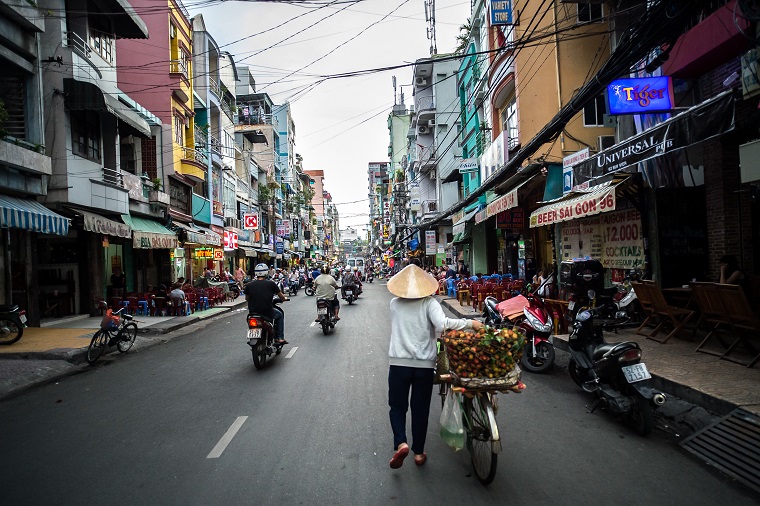 By 2030, more than 40% of the population in the Greater Mekong Subregion will be living in cities. Photo: ADB.

 Tiếp tục đọc “Economic Corridors in the Greater Mekong Subregion”


