Rừng ngập mặn: Trước sự mất mát và xé lẻ


Tia sáng – 122023 THANH NHÀN

Báu vật của những vùng đất ngập nước, của những mênh mông giao hòa giữa biển và đất liền, đang ngày một bị mất mát hoặc suy thoái. Các cánh rừng ngập mặn, giờ đây, phải vật lộn để tồn tại, trước những tác động của cả con người lẫn tự nhiên.

Một vạt rừng ngập mặn bị sóng đánh ở Thái Bình. Ảnh: Thanh Nhàn

Tiếp tục đọc “Rừng ngập mặn: Trước sự mất mát và xé lẻ”

COP28: Ai đang gây ô nhiễm

SÁNG ÁNH 23/12/2023 13:59 GMT+7

TTCT Hội nghị thượng đỉnh COP28 về biến đổi khí hậu kết thúc tại UAE với kết quả lừng khừng…

Các họp hành kiểu này thường kết thúc như vậy. Rất nhiều quyền lợi mâu thuẫn chưa giải quyết được nên mới phải họp hành và họp hành không giải quyết được nên mới phải dung hòa, ta nâng ly uống rồi về nhà, hẹn gặp lại sau.

Mỹ là nước thải ra rác thải nhựa nhiều nhất thế giới, theo cả hai thông số tổng số rác và số rác bình quân trên đầu người. Ảnh: Getty Images

Các quyền lợi mâu thuẫn này là giữa thế giới phát triển và đang phát triển, tức là mâu thuẫn nam bắc; giữa các nước sản xuất và có tài nguyên dầu khí với các nước tiêu thụ; giữa công nghệ cũ dựa trên dầu khí, than đá, và công nghệ mới dựa trên năng lượng nắng, gió, thủy triều… 

Các mâu thuẫn về quyền lợi chẳng khi nào đơn giản. Ở mức thế giới, quốc gia, ở mức công nghệ, nó bao giờ cũng đi kèm thượng tầng văn hóa, chính trị và ý thức hệ để bảo vệ, tuyên dương, phát triển hay duy trì quyền lợi.

Tiếp tục đọc “COP28: Ai đang gây ô nhiễm”

In memoriam: Saleemul Huq (1952-2023) – “For three decades, Huq was arguably the foremost champion of poorest countries in UN climate negotiations”

This short film pays tribute to professor Saleemul Huq, an environmental and climate change giant who died on 28 October 2023.

Professor Saleemul Huq OBE (1952-2023)

Following the passing of Professor Saleemul Huq, senior fellow of IIED. This book of remembrance is open to all who wish to share their memories of Saleem.

Article, 29 October 2023

Head and shoulders photo of Saleemul Huq.

Professor Saleemul Huq was an environmental and climate change giant and senior fellow and dear friend of IIED and many IIED colleagues past and present.

Director of the International Centre for Climate Change and Development (ICCCAD) and a senior associate of IIED, he was awarded an OBE by the Queen in the 2022 New Year’s Honours List for his services to combating international climate change.

The honour was awarded in recognition of his work to build climate expertise in Bangladesh, the UK and across the world. 

Saleem was an expert on the links between climate change and sustainable development, particularly from the perspective of vulnerable developing countries. A constant voice for climate action and justice for the global South, he was the lead author of chapters in the third, fourth and fifth assessment reports of the Intergovernmental Panel on Climate Change. Huq’s work with the IPCC spanned 1997 to 2014 and he contributed to reports that led to the panel being awarded the Nobel Peace Prize in 2007.

A professor at the Independent University, Bangladesh, and an advisor to the Least Developed Countries (LDC) Group of the UNFCCC, Huq published hundreds of scientific as well as popular articles and was named by Nature in 2022 as one of its top 10 scientists

He set up the climate change research group at IIED in 2000 and was its initial director – continuing as a senior fellow until 2021 – and worked across the institute to ensure climate was at the heart of all that IIED did. 

IIED executive director Tom Mitchell said: “I would like to offer my deepest sympathy and condolences to Saleem’s family and loved ones on behalf of IIED. There was no one quite like Saleem and I will remember his unique combination of warmth, generosity of spirit, academic prowess and enormous standing in climate science. 

Tiếp tục đọc “In memoriam: Saleemul Huq (1952-2023) – “For three decades, Huq was arguably the foremost champion of poorest countries in UN climate negotiations””

Three major gaps in climate-adaptation finance for developing countries

preventionweb.net

Source(s): Stockholm Environment Institute

In the new Adaptation Finance Gap Update, part of the UN Environment Programme(UNEP) Adaptation Gap Report 2023, we examine recent trends in adaptation funding.

Specifically, we focus on the flow of public adaptation funds from the governments of developed countries to developing countries, since the implementation of the Paris Agreement.

In this article, we identify three major gaps in adaptation finance and explain why these gaps have emerged even as nations commit to scaling up these funds.

Financial shortfall

Adaptation costs for developing countries are estimatedat between $215bn and $387bn annually this decade, according to the latest Adaptation Finance Gap Update report.

Spending from the public funds of developed nations, while not the only source of adaptation finance, remains a crucial source, especially for low-income countries.

As it stands, people in the least developed countries(LDCs) and small-island states are often more exposedto climate hazards and more likelyto be killed by climate-related disasters. This is despite the fact that these nations bear very little responsibilityfor causing climate change.

Tiếp tục đọc “Three major gaps in climate-adaptation finance for developing countries”

Asia’s climate goals at risk over Cop28’s modest transition from fossil fuels: ‘we have one foot in the grave’

scmp.com

  • Critics say the deal is still severely lacking when it comes to addressing the climate concerns of developing nations
  • Asia faces multiple obstacles to its clean energy transition, with countries such as China, India and Indonesia failing to provide clear timelines for ending coal usage

The United Nations Climate Change Conference in Dubai ended on Wednesday with a message signalling the eventual end to the fossil fuel era, but its lack of a clear timeline could leave parts of developing Asia increasingly vulnerable to climate shocks, experts said.

The conference, also known as Cop28, adopted within minutes of its presentation the proposed text for a final climate deal that acknowledges for the first time the need for “transitioning away from fossil fuels” and “accelerating action in this critical decade” to achieve net-zero carbon emissions by 2050.

The text also includes agreements to triple the deployment of renewable energy and double the rate of efficiency gains by the end of the decade.

Cop28 climate summit adopts world-first ‘transition’ from fossil fuels13 Dec 2023

Tiếp tục đọc “Asia’s climate goals at risk over Cop28’s modest transition from fossil fuels: ‘we have one foot in the grave’”

COP28 DELIVERS HISTORIC CONSENSUS IN DUBAI TO ACCELERATE CLIMATE ACTION

COP28.com

  • “The world needed to find a new way. By following our North Star, we have found that path,” said COP28 President, Dr. Sultan Al Jaber during his closing speech, “We have worked very hard to secure a better future for our people and our planet. We should be proud of our historic achievement.”
  • COP28 has concluded with a final consensus that lays out an ambitious response to the Global Stocktake and puts forward a plan to close the gaps to 2030. It calls on Parties to transition away from fossil fuels to reach net zero, encourages them to submit economy-wide Nationally Determined Contributions (NDCs), includes a new specific target to triple renewables and double energy efficiency by 2030, and builds momentum behind a new architecture for climate finance.
  • The COP28 Presidency took bold and decisive steps to deliver beyond the negotiated text through its ‘Action Agenda,’ which spans the four pillars of the Paris Agreement: fast tracking a just and orderly energy transition; fixing climate finance to make it more available, affordable, and accessible; focusing on people, nature, lives and livelihoods; and fostering full inclusivity in climate action.
  • COP28 has mobilized over $85 billion in funding for climate action, secured a historic agreement on Loss and Damage, advanced the Global Goal on Adaptation (GGA) and overseen breakthrough agreements on the energy transition.
  • This has been the most inclusive COP to-date, ensuring all voices could participate in the process.

Dubai, December 13, 2023

Tiếp tục đọc “COP28 DELIVERS HISTORIC CONSENSUS IN DUBAI TO ACCELERATE CLIMATE ACTION”

Người vắng mặt ở COP28

TỊNH ANH – 12/12/2023 09:51 GMT+7

TTCT Tham dự không sót kỳ COP (hội nghị khí hậu của Liên Hiệp Quốc) nào, nhưng đến đúng lúc mọi thứ có vẻ dần thành hình thì lại vắng mặt, vì đã từ giã cõi đời đúng một tháng trước. Đó là chuyện của nhà khoa học người Bangladesh Saleemul Huq.

Saleemul Huq phát biểu tại một sự kiện ở Bangladesh năm 2022. Ảnh: IIED

Tiếp tục đọc “Người vắng mặt ở COP28”

Climate change impacts on seaports: A growing threat to sustainable trade and development

UNCTAD.org

04 June 2021 Written by Regina Asariotis, Article No. 75 [UNCTAD Transport and Trade Facilitation Newsletter N°90 – Second Quarter 2021]

© Jan Hoffmann

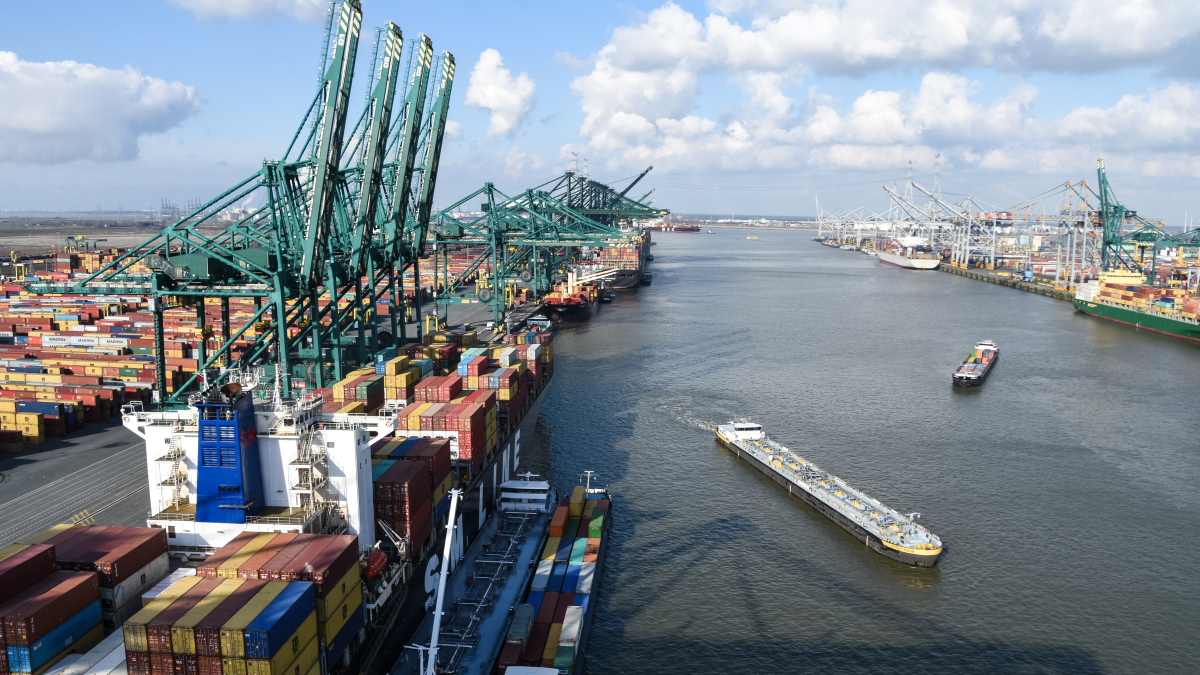
Seaports are essential for global trade-led development, and for the ‘Blue Economy’. They provide access to global markets and supply-chains for all countries, and are integral to maritime transport, as well as fisheries, offshore energy development, and many economic activities in coastal zones. With over 80 % of world trade volume carried by sea – from port to port -, they are crucial infrastructure nodes that  underpin global supply chains and are key to future trade and development prospects, particularly of developing States which currently account for around  60 % of goods loaded and unloaded globally. At the same time, ports are particularly exposed to various natural hazards, due to their locations along open coasts or in low-lying estuaries and deltas; their setting makes them susceptible to impacts of climatic hazards such as rising sea levels, storm surges, waves and winds,  riverine and pluvial flooding, as well as  tectonic events (e.g. tsunamis).  

Tiếp tục đọc “Climate change impacts on seaports: A growing threat to sustainable trade and development”

Một số vấn đề ứng phó với biến đổi khí hậu trong quy hoạch các đô thị ven biển Việt Nam

moc.gov.vn

Việt Nam là một trong số những quốc gia chịu ảnh hưởng nặng nề nhất của biến đổi khí hậu (BĐKH) trên thế giới. Trong những năm gần đây, biến đổi khí hậu đã gây ra nhiều hiện tượng như lũ lụt, sạt lở đất, gió bão, nước biển dâng, xâm nhập mặn…với tần suất ngày càng cao, mức độ tàn phá ngày càng nặng nề hơn đối với môi trường, đời sống kinh tế – xã hội Việt Nam.

Với bờ biển dài (trên 3.200km) và diện tích đồng bằng ven biển rộng lớn (135.946km2), Việt Nam đã xây dựng được hơn 405 đô thị ven biển. Đó là các thành phố cảng, trung tâm kinh tế biển, các đô thị du lịch và thương mại, dịch vụ – đóng vai trò quan trọng trong sự phát triển kinh tế của Việt Nam. Biến đổi khí hậu tạo ra những thiệt hại về kinh tế – xã hội ở các đô thị ven biển nhiều hơn bất cứ nơi nào khác vì vậy quy hoạch đô thị khu vực này cần phải có giải pháp kịp thời về cấu trúc đô thị, sử dụng đất, tổ chức không gian môi trường, cơ sở hạ tầng, cảnh quan, … để đô thị phát triển bền vững và chống chịu, tự phục hồi trước những diễn biến bất thường của BĐKH. Bài viết giới thiệu những ảnh hưởng của BĐKH đối với hệ thống đô thị ven biển Việt Nam và một số giải pháp quy hoạch đô thị nhằm giảm nhẹ và thích ứng với các tác động của BĐKH.

1. Giới thiệu

Việt Nam có bờ biển dài, đồng bằng ven biển rộng là cái nôi để phát triển hệ thống đô thị ven biển đa dạng, phong phú trở thành những trung tâm kinh tế, du lịch và dịch vụ quan trọng, đóng góp to lớn cho sự phát triển kinh tế của Việt Nam. Là một trong số những quốc gia được đánh giá là bị ảnh hưởng nghiêm trọng nhất trên thế giới, Biến đổi khí hậu có ảnh hưởng sâu rộng đến mọi lĩnh vực của đời sống, kinh tế – xã hội và môi trường Việt Nam. Đặc biệt các đô thị ven biển Việt Nam hiện nay đang phải đối mặt với các thách thức lớn của BĐKH như hiện tượng nước biển dâng, xâm nhập mặn, lũ lụt, và thiên tai… làm giảm quỹ đất xây dựng, phá hoại hệ thống hạ tầng xã hội và hạ tầng kỹ thuật, suy giảm nguồn nước, xáo trộn và ảnh hưởng đến chất lượng cuộc sống, sinh kế của người dân đô thị. Trước những yêu cầu thực tế, Quy hoạch đô thị cần có những thay đổi về cách tiếp cận để góp phần giảm thiểu các tác động bất lợi của BĐKH, giúp các đô thị ven biển Việt Nam chuyển hóa, thích ứng và chống chịu được BĐKH.

Tiếp tục đọc “Một số vấn đề ứng phó với biến đổi khí hậu trong quy hoạch các đô thị ven biển Việt Nam”

COP28 Ends With Deal on Transition Away From Fossil Fuels

bloomberg.com By Jennifer A DlouhyJess Shankleman, and Laura Millan Updated on 

  • First time fossil fuels have made it to a global climate deal
  • Steps needed to turn agreement into tangible actions: Al Jaber
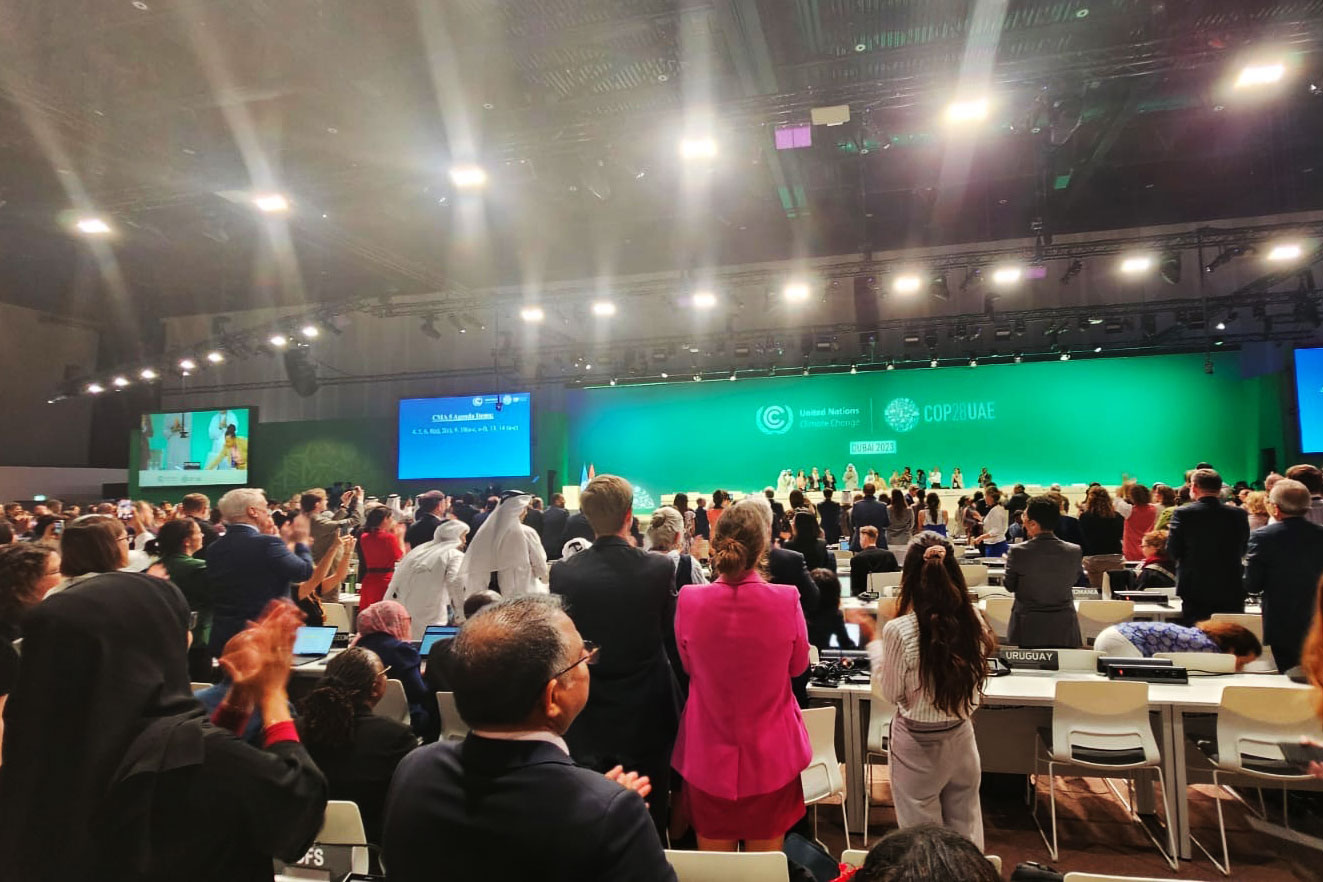
Standing ovation after COP28 President Sultan Al Jaber brokered an agreement to a commitment to transition away from fossil fuels.
Standing ovation after COP28 President Sultan Al Jaber brokered an agreement to a commitment to transition away from fossil fuels.Photographer: Nayla Razzouk/Bloomberg

The COP28 climate talks in Dubai ended in a deal that saw a commitment to transition away from all fossil fuels for the first time.

The president of this year’s UN-sponsored summit, the UAE’s Sultan Al Jaber, brokered an agreement that was strong enough for the US and European Union on the need to dramatically curb fossil fuel use while keeping Saudi Arabia and other oil producers on board.

The agreement calls for countries to quickly shift energy systems away from fossil fuels in a just and orderly fashion, qualifications that helped convince the skeptics. Under the deal, countries also are called to contribute to a global transition effort — rather than being outright compelled to make that shift on their own.

Tiếp tục đọc “COP28 Ends With Deal on Transition Away From Fossil Fuels”

Only half of young people able to identify correct definition of climate change – UNICEF, Gallup

Unicef.org

Findings highlight urgent need to protect and invest in children, including in climate education, in decisions at COP28

06 December 2023

a child stands by a pool of flood water and plastic pollution.

 UNICEF/UNI390327/Wilander

NEW YORK/DUBAI, 7 December 2023 – Most children and young people say they have heard of climate change but only half understand what it is, according to a new UNICEF-Gallup poll, as world leaders gather at this year’s COP28.

Tiếp tục đọc “Only half of young people able to identify correct definition of climate change – UNICEF, Gallup”

‘Heated’ debate on fossil fuels as COP28 winds down

By Editor On Dec 11, 2023 Last updated Dec 11, 2023

By Vishani Ragobeer in Dubai 

Fossils fuels- the main contributor to the climate crisis- were always going to be the hot topic at this year’s global climate talks in Dubai, COP28, with sweltering temperatures making 2023 the hottest year on record. But as the end of the conference draws nearer with a new draft agreement released, fiery debates have taken over the conference.

On Monday night (Dubai time), a new text for the Global Stocktake (GST) was released after negotiators from Guyana and other countries spent days hammering out how best to satisfy everyone.

The GST is a global inventory of sorts that shows how climate goals are unfolding. And the draft text said countries (called Parties) were called upon to take several actions that would reduce greenhouse gas emissions.

Those emissions include carbon dioxide, a harmful gas produced when fossil fuels like oil and diesel are burnt. When that gas is produced, it goes into the atmosphere and leads to global warming.

And countries were told that they could take actions ranging from tripling renewable energy use (that is, using more environmentally-friendly energy sources like solar energy or hydropower) to reduce both the production and use of fossil fuels in a “just orderly and equitable” manner.

Tiếp tục đọc “‘Heated’ debate on fossil fuels as COP28 winds down”

Climate change adaptation commitments so far lacking at COP28

World Dec 8, 2023 6:13 PM EST

DUBAI, United Arab Emirates (AP) — As United Nations climate talks enter their second week, negotiators who are largely focused on how to curb climate change have another thing on their plates: how to adapt to the warming that’s already here.

Discussions for what’s known as the Global Goal on Adaptation — a commitment made in the 2015 Paris Agreement to ramp up the world’s capacity to cope with climate-fueled extreme weather — are being overshadowed by negotiations on how the world is going to slash the use of fossil fuels, causing frustration among some climate campaigners in the most vulnerable countries.

READ MORE: At COP28, pageantry is over and negotiations get intense

Officials and activists from climate-vulnerable nations are pushing for more money to help them deal with scorching temperatures, punishing droughts and deluges and strengthening storms made worse by global warming. Major fossil fuel-emitting countries need to pay vulnerable, developing countries being battered by these events, experts and officials say, to help them avoid catastrophic humanitarian and economic losses.

Tiếp tục đọc “Climate change adaptation commitments so far lacking at COP28”

Trees alone will not save the world

economist.com

But better markets and better monitoring will let them do more

An image showing a trio of three-dimensional trees made out of an image of a leaf against a bark background.
image: ben denzer

“Everything you see, as far as the eye can see, belongs to us,” says David Beleznay. “Us” is Mosaic, a forest-management company that looks after the upkeep and logging of much of Vancouver Island; Mr Beleznay is its director of climate and watersheds. “As far as the eye can see” takes in a long, deep valley whose forested flanks rise to the rocky top of Mount Arrowsmith. Towering evergreens—Douglas fir, cedar, hemlock—drape the island from its central peaks to the water’s rocky edge.

This drapery is, though, a bit patchy in places. Directly behind Mr Beleznay’s parked pickup are some “polygons”, as the industry calls them, where the trees have been clear-cut, leaving behind jumbled soil, stumps and woody debris; tiny saplings poke through it higgledy-piggledy. Mosaic has an eye to water quality in forest streams, to maintaining biodiversity, to being a partner to the island’s first nations. But the forest it manages is also the basis of a timber business.

Tiếp tục đọc “Trees alone will not save the world”

Corporate Climate Action: Analyzing the Recent Surge of Climate Commitments

RMI.org
RMI analyzes what this increase in corporate commitments means and introduces a new tool to measure impact.

November 29, 2023 By  James Newcomb,  Adefunke Sonaike,  Daan Walter,  Laurens Speelman

On the eve of the UN Climate Change Conference (COP28), the media buzz about corporate climate action is decidedly mixed. Optimism about the growing numbers of companies setting climate goals is tempered by disappointing news about the pace of many companies’ actions to achieve their goals. We are still creating new structures and systems to guide corporate climate action and working through challenges as these systems mature. Beneath the surface, however, there are encouraging signals. Strong systemic forces are inexorably driving more companies to report greenhouse gas emissions, set independently verified climate action targets, and implement strategies to achieve these goals.

RMI is creating new tools and methods, still under development, to better analyze the potential implications of corporate climate action. In this article, we assess recent developments across this landscape, including preliminary analysis from the Corporate Commitments and Emissions Explorer (Corporate Explorer), a new online tool that allows users to explore sectoral emissions targets and actions.

Snapshot of corporate climate action: 2023
Tiếp tục đọc “Corporate Climate Action: Analyzing the Recent Surge of Climate Commitments”