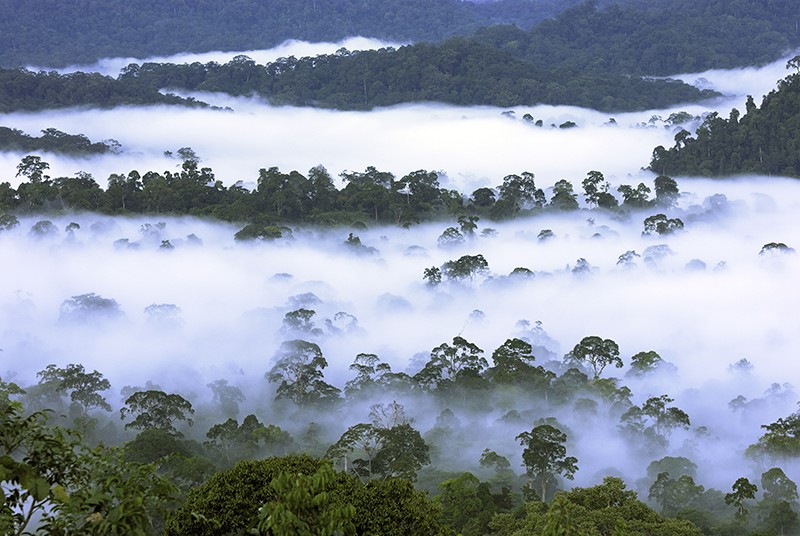
Tropical forests create cloud cover that reflects sunlight and cools the air.Credit: Thomas Marent/Minden Pictures
Tropical forests have a crucial role in cooling Earth’s surface by extracting carbon dioxide from the air. But only two-thirds of their cooling power comes from their ability to suck in CO2 and store it, according to a study1. The other one-third comes from their ability to create clouds, humidify the air and release cooling chemicals.
This is a larger contribution than expected for these ‘biophysical effects’ says Bronson Griscom, a forest climate scientist at the non-profit environmental organization Conservation International, headquartered in Arlington, Virginia. “For a while now, we’ve assumed that carbon dioxide alone is telling us essentially all we need to know about forest–climate interactions,” he says. But this study confirms that tropical forests have other significant ways of plugging into the climate system, he says.
The Ukraine war is complicating the calculus of China’s energy security and the prospect of a new energy deal with Russia
Can Beijing afford to be close to a Moscow that is increasingly politically and economically isolated?
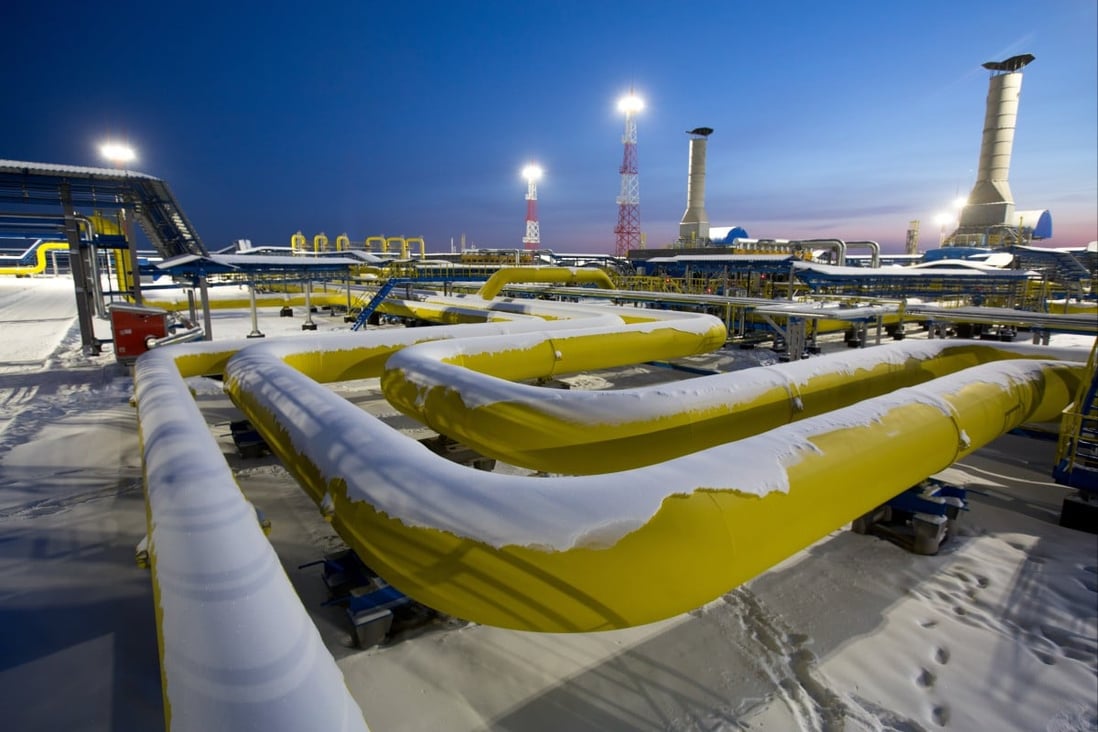
Snow covers sections of connected pipework at the Gazprom PJSC Atamanskaya compressor station, part of the Power Of Siberia gas pipeline extending to China, near Svobodny, in the Amur region, Russia, in 2019. Photo: Bloomberg
Two recent developments reveal the possibility of a new energy agreement between China and Russia. First, Russian gas giant Gazprom PJSC announced a contract to design the Soyuz Vostok pipeline across Mongolia towards China. Second, Beijing is reported to be discussing with its state-owned companies opportunities to buy stakes in Russian energy companies, and is also looking at a Power of Siberia 2 pipeline to China.
With the exit of international energy companies from Russia following its invasion of Ukraine, Germany’s decision to halt the certification process of the Kremlin-backed Nord Stream 2 pipeline, and rounds of sanctions on Russia, there are certainly new opportunities for the Chinese government and companies to strengthen their position in the Russian market.
However, even as domestic, regional and global factors may push China towards a new energy deal with Russia, Beijing could also face a range of challenges.
Firstly, Beijing’s ambition to be carbon-neutral by 2060 and replace much coal with gas is one of the most important domestic factors prompting China to further improve its relations with Russia.
Russian gas exports – whether liquefied natural gas or pipeline gas delivered through the original Power of Siberia, for example – would help China reduce greenhouse gas emissions as the country makes a green transition.
Secondly, the withdrawal of Western energy companies such as BP and Shell from Russia due to the Ukraine war creates opportunities for Chinese energy companies, especially state-owned ones, to invest in Russia and diversify their portfolio.
Thirdly, while China also imports gas from Turkmenistan, Russian gas is one of the cheapest options for Chinese consumers, making a new energy deal with Russia that much more attractive.
However, there could also be obstacles to such a deal. One problem could be the political and economic uncertainties now looming over Russia; the deterioration of the Russian business environment under current sanctions might discourage Chinese companies from investing in Russia.
Particularly, sanctions led by Washington seem to inspire caution in Beijing and Chinese companies. For example, the state-run Sinopec Group recently suspended talks about a major petrochemical investment and a gas marketing venture in Russia, apparently heeding a government call to tread carefully with Russian assets.
“And yet, just when the climate scientists and governments across the eight Arctic states should be working together to understand and address the climate crisis, Russia’s war on Ukraine has forced the Arctic Council, an intergovernmental group of Arctic states and Arctic Indigenous Peoples, to suspend their joint activities in protest of Russia’s unprovoked aggression.“
The Working Group II contribution to the IPCC Sixth Assessment Report assesses the impacts of climate change, looking at ecosystems, biodiversity, and human communities at global and regional levels. It also reviews vulnerabilities and the capacities and limits of the natural world and human societies to adapt to climate change.
Summary for Policymakers
The Summary for Policymakers (SPM) provides a high-level summary of the key findings of the Working Group II Report and is approved by the IPCC member governments line by line.
The Technical Summary (TS) provides extended summary of key findings and serves as a link between the comprehensive assessment of the Working Group II Report and the concise SPM.
The 18 Chapters and 7 Cross-Chapter Papers of the Working Group II Report assess the impacts of climate change on nature and humanity, and their capacities and limits for adaptation.
Đồng bằng sông Cửu Long thiếu nước phục vụ sinh hoạt và sản xuất trầm trọng. Ảnh từ www.moitruongvadothi.vn.
1. Bối cảnh
Đồng bằng sông Cửu Long (ĐBSCL) của Việt Nam là đồng bằng lớn thứ ba trên Trái Đất, là nơi sinh sống của gần 18 triệu người với sinh kế chủ yếu là sản xuất nông nghiệp và nuôi trồng thủy sản. Được coi là “Vựa lúa” của Việt Nam, ĐBSCL đóng góp hơn một nửa tổng sản lượng gạo của cả nước và 95% sản lượng gạo xuất khẩu, góp phần đưa Việt Nam trở thành quốc gia xuất khẩu gạo lớn thứ ba thế giới. Khu vực này cũng đóng góp 70% sản lượng trái cây và hơn 60% sản lượng thủy sản xuất khẩu của cả nước.1
Europe’s energy independence from Russia, including in its financial aspects, will be a key topic of discussion at a two-day summit in Versailles hosted by the French EU presidency. [France Diplomatie – MEAE]
European Union leaders will tackle ways to wean themselves off Russian fossil fuels on Thursday (10 March) and debate how quickly to ditch their key supplier, with countries split over whether to sanction oil and gas imports as Moscow wages war in Ukraine.
Better by degrees … a 2022 survey ranks the world’s most international universitie
Times Higher Education’s (THE) survey of over 10,000 academics features internationally oriented universities leading global academic collaboration efforts through knowledge diplomacy.
Knowledge diplomacy values scientific exchange and diverse, international student bodies and research teams
Universities in politically insular countries are increasingly working with research partners from around the world.
While the diplomatic world faces many challenges on the political front, knowledge diplomacy, led by many top international universities, “may be our last and best tool for rebuilding a broken world”.
This was the stirring message of Safwan Masri, Executive Vice-President for global development at Columbia University at a keynote speech at Times Higher Education’s MENA Universities Summit in 2021.
Masri lamented that much of the world is grappling with misunderstanding, division, polarization and cynicism. He adds that “We are living in profoundly undiplomatic times. The inability to understand and comprehend one another is turning neighbor against neighbor. Everything seems broken.”
For Masri and other delegates at the THE summit, global research universities are a shining light in difficult times, with Masri stating that: “Universities exist to increase our comprehension of the world and to enhance mutual understanding”.
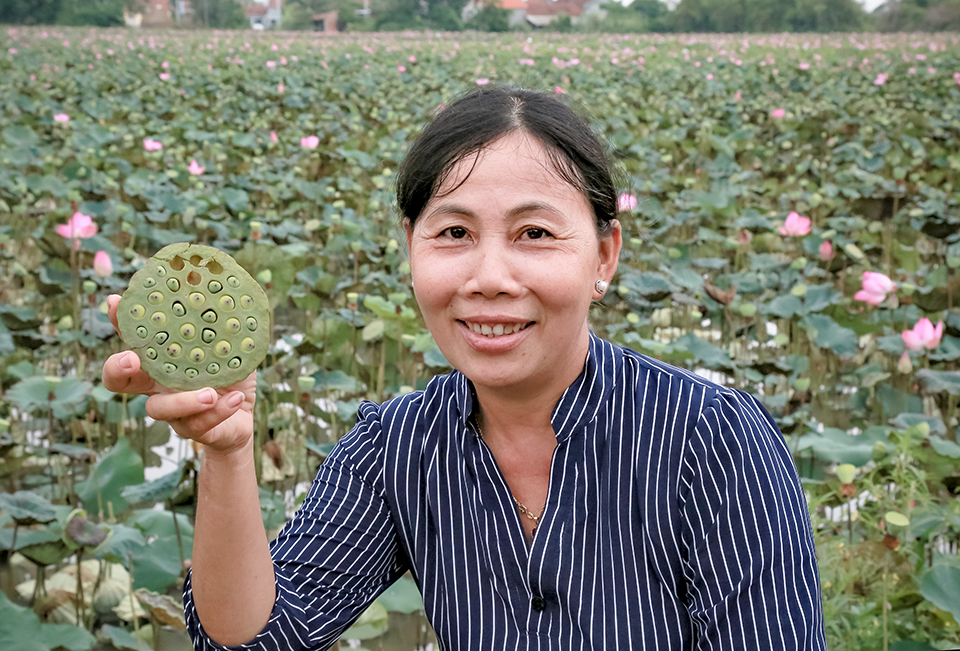
When Tran Thi My Linh, a 51-year-old rural woman first said that she would replace her rice fields with lotus fields, she raised many eyebrows. In the little commune of Hoa Dong in Phu Yen province, just south of Viet Nam’s capital, Ha Noi, villagers had planted rice for generations. However, with the changing weather patterns in recent years, millions of people have been affected in Phu Yen and in rural Viet Nam in general and people have started looking for new livelihoods.
Tran Thi My Linh, 51-year-old. Photo: UN Women/Thao Hoang
The newest report from the Intergovernmental Panel on Climate Change (IPCC) paints a troubling picture: Climate change is already impacting every corner of the world, and much more severe impacts are in store if we fail to halve greenhouse gas emissions this decade and immediately scale up adaptation.
Following on the first installment of the IPCC’s Sixth Assessment Report, Working Group II’s contribution, released on February 28, 2022, draws from 34,000 studies and involved 270 authors from 67 countries. It provides one of the most comprehensive examinations of the intensifying impacts of climate change and future risks, particularly for resource-poor countries and marginalized communities. The 2022 IPCC report also details which climate adaptation approaches are most effective and feasible, as well as which groups of people and ecosystems are most vulnerable.
UN Secretary-General Antonio Guterres called the report “an atlas of human suffering and a damning indictment of failed climate leadership.
Here are six takeaways from the report:
1. Climate impacts are already more widespread and severe than expected.
Climate change is already causing widespread disruption in every region in the world with just 1.1 degrees C (2 degrees F) of warming.
The Covid-19 crisis has stalled the delivery of much-needed climate finance to developing countries. For Southeast Asia, a region frequently cited as being one of the most vulnerable regions threatened by climate change, the broken promise of climate finance is highly disappointing.
INTRODUCTION
Climate finance has been one of the most contentious issues in global climate politics. At the 2009 United Nations Climate Change Conference (COP 15), developed countries committed to mobilising by 2020 US$100 billion climate finance annually to assist vulnerable countries. The pledge has been key to building trust between states to limit global warming to well below 2 degrees Celsius, as specified in the Paris Agreement.
Growing up, I learned to value each grain of rice. Rice was a main food item my Vietnamese refugee family turned to for both nutrition and comfort. After my parents’ long day of laboring in garment factories or in the hot sun of construction sites, the ritual of a warm, fresh bowl of rice was something my family and I enjoyed together. My sister and I would set our coffee table with newspaper, a tablecloth proxy. We each got a warm bowl of rice with a set of wooden chopsticks. Our rice would always be paired with a vegetable stir fry (cải xào), braised meat (thịt kho), or a hearty soup like stuffed bittermelon (canh khổ qua). And we ate as a family while watching the daily evening lineup of Jeopardy and Wheel of Fortune.
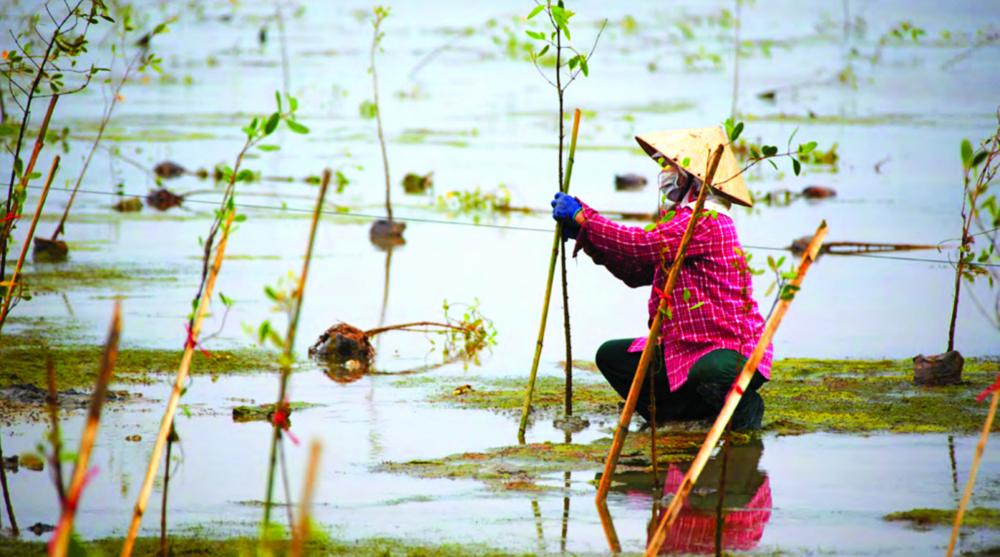
PNO – Bao năm, những người phụ nữ bên phá Tam Giang vẫn “lặn lội thân cò” theo mùa nước nổi. Việc đong cái ăn, cái mặc khiến họ không còn tâm trí để nghĩ xa hơn, nói gì tới khái niệm trừu tượng như “biến đổi khí hậu”. Rồi một ngày, những cây bần chua xuất hiện trong đời họ…
Phụ nữ thôn Vĩnh Trị, xã Hải Dương, TP. Huế chăm chút từng mầm xanh, gầy dựng rừng ngập mặn trên phá Tam Giang – Ảnh: Thuận Hóa
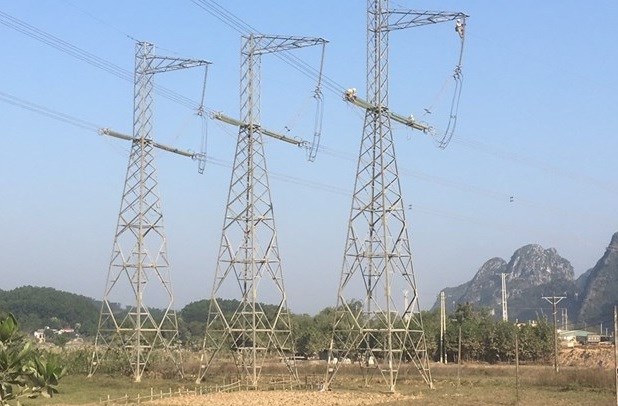
The Lao Government has given the green light for two private companies to carry out a feasibility study on the construction of a 220kV transmission line which would carry electricity from five dams in northern Laos to Vietnam.
If the study is approved, the line will transmit electricity from Nam Ou dams No.3, 4, 5, 6 and 7 through Luang Prabang and Phongsaly provinces to Vietnam.
Southeast Asia is home to over 54% of the world’s peatlands — tropical wetlands which have a major role to play in climate action. But they are being deforested rapidly: Around 25 million hectares of tropical peatlands in Southeast Asia have been deforested and drained over the last three decades alone, and only 6% of peatlands remain untouched.
This is a major blow to the region. These terrestrial wetland ecosystems help regulate water flow by capturing rainwater during the wet season and slowly releasing it during the dry season. They are also key habitats for endangered and rare species of both plants and animals, and are essential for the livelihoods of local communities.
Additionally, they are an important carbon store in the global carbon cycle; more than three-fourths of global peat carbon stocks (52 Gigatons) are stored in Southeast Asian peatlands. Their destruction warrants global attention.
Bằng là bạn học cấp hai của tôi. Hết lớp 9, Bằng thôi học dù thành tích đứng thứ nhì toàn trường.
Chú Sáu, ba của Bằng, lúc đó nói, nhà ruộng đất nhiều, cần gì học, ở nhà làm ruộng cũng sống khỏe re. Ở tuổi 16, Bằng không nghĩ được gì nhiều, người lớn nói sao nghe vậy. Vài năm sau, Bằng trở thành lao động trụ cột trong nhà. Một mình cậu quán xuyến hai mẫu ruộng, mỗi năm canh tác ba vụ, của ăn không thiếu. Rồi Bằng lấy vợ, sanh con, xây dựng một gia đình như bao gia đình khác ở quê tôi.

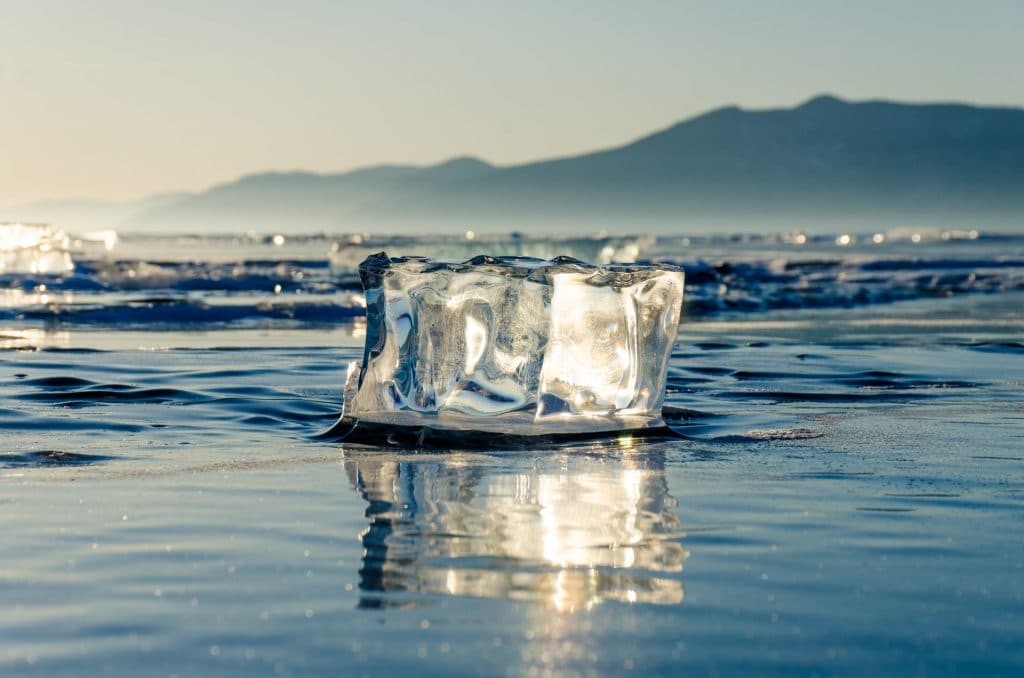 Lake Baikal, Siberia, Russia (Photo by