
- Trôi dạt dòng đời – Hồ Đình Ba
- Danh vọng thần quyền – Hồ Đình Ba
- Mối tình nghiệt ngã – Hồ Đình Ba
- Bên Này Ảo Vọng – Hồ Đình Ba
- Bến nước mười ba – Vĩnh An
- Hoa dâm bụt đỏ – Vĩnh An
- Hoa dại trên đường – Vĩnh An
- Trưởng thành tâm linh – Vĩnh An
- Thuyết giảng tốt hơn – Ken Untener (Vĩnh An dịch)
- Hãy biết chính mình – Tuyển tập
- Chữa lành các tương quan – Len Kofler (Vĩnh An dịch)
- Giấc mộng — Morton Kelsey (Vĩnh An dịch)
- Giao tiếp mãn nguyện — T.A. Harris (Vĩnh An dịch)
- Thơ dịch – Tuyển tập (Vĩnh An)
- Đường lên núi thánh – Vĩnh An
- Thần học về con người – Tuyển tập
- Trở về với đạo đức truyền thống văn hóa – Vĩnh An
- Elisabeth Chúa Ba Ngôi – Carmel De Dijon – Vĩnh An nhận định
- Ôi, Em Tội Nghiệp! – Hồ Đình Ba
- Người Mẹ Đơn Thân – Hồ Đình Ba
Tác giả: Trần Đình Hoành
I am an attorney in the Washington DC area, with a Doctor of Law in the US, attended the master program at the National School of Administration of Việt Nam, and graduated from Sài Gòn University Law School. I aso studied philosophy at the School of Letters in Sài Gòn.
.
I have worked as an anti-trust attorney for Federal Trade Commission and a litigator for a fortune-100 telecom company in Washington DC.
I have taught law courses for legal professionals in Việt Nam and still counsel VN government agencies on legal matters.
I have founded and managed businesses for me and my family, both law and non-law.
I have published many articles on national newspapers and radio stations in Việt Nam.
In 1989 I was one of the founding members of US-VN Trade Council, working to re-establish US-VN relationship.
Since the early 90's, I have established and managed VNFORUM and VNBIZ forum on VN-related matters; these forums are the subject of a PhD thesis by Dr. Caroline Valverde at UC-Berkeley and her book Transnationalizing Viet Nam.
I translate poetry and my translation of "A Request at Đồng Lộc Cemetery" is now engraved on a stone memorial at Đồng Lộc National Shrine in VN.
I study and teach the Bible and Buddhism. In 2009 I founded and still manage dotchuoinon.com on positive thinking and two other blogs on Buddhism.
In 2015 a group of friends and I founded website CVD - Conversations on Vietnam Development (cvdvn.net).
I study the art of leadership with many friends who are religious, business and government leaders from many countries.
I have written these books, published by Phu Nu Publishing House in Hanoi:
"Positive Thinking to Change Your Life", in Vietnamese (TƯ DUY TÍCH CỰC Thay Đổi Cuộc Sống) (Oct. 2011)
"10 Core Values for Success" (10 Giá trị cốt lõi của thành công) (Dec. 2013)
"Live a Life Worth Living" (Sống Một Cuộc Đời Đáng Sống) (Oct. 2023)
I practice Jiu Jitsu and Tai Chi for health, and play guitar as a hobby, usually accompanying my wife Trần Lê Túy Phượng, aka singer Linh Phượng.
US, UK and Australia announce Indo-Pacific defense partnership
The US and UK will share nuclear-powered submarine technology with Australia as part of the new three-way defensive alliance. The move comes amid tense relations with China.
The leaders of Australia, the UK, and the US announced the formation of a new Indo-Pacific security alliance on Wednesday, which will include the sharing of nuclear-powered submarine technology.
The partnership will see the three countries share technology to improve their defensive capabilities, including cyber security, artificial intelligence and underwater systems.
Tiếp tục đọc “US, UK and Australia announce Indo-Pacific defense partnership”
Joint Communication to the EU Parliament and Council, by the EU Commission and the High Representative of EU Foreign Affairs and Policy, on Strategy for Cooperation in the Indo Pacific
The Commission and the High Representative invite the European Parliament and the Council to endorse the approach set out in this Joint Communication and to work together on the implementation of its actions and their review.
UNCLOS Primer – UNCLOS nhập môn
These primers are for those who are not very familiar with UNCLOS and do not want to read the 202-page UNCLOS itself with all the crazy legalese that many law-of-the-sea lawyers are not even sure that they really mean 🙂
– Primer 1 (unknown author from Scribbs) >>
– Primer 2 (Fletcher Graduate School of International Affairs, Tufts University) >>
How America Can Win the Middle East
Beijing’s forays in the region present Washington with a test—and an opportunity.
By Kim Ghattas
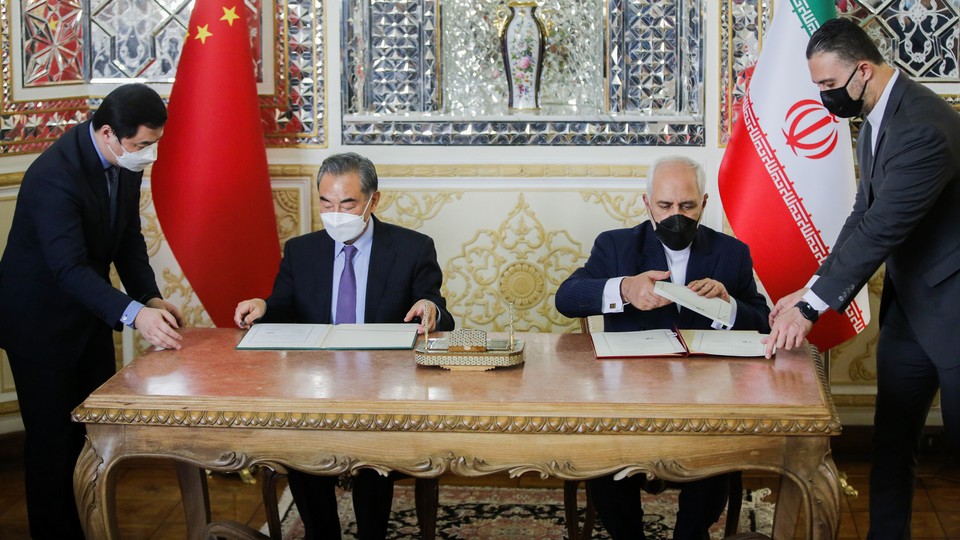
SEPTEMBER 4, 2021
Since taking office, President Joe Biden has talked repeatedly about competition with China. To fight off Beijing and other autocracies, he has said, democracies must uphold their values. He has talked much less about the Middle East in that time, and although he has never phrased it in so many words, Biden appears to be trying to deprioritize a region that he believes has consumed too much of America’s attention and resources.
Tiếp tục đọc “How America Can Win the Middle East”How Beijing’s New Maritime Rules in the South China Sea Will Affect India and Others
China’s new maritime law – in which foreign vessels will have to submit details to Chinese authorities when transiting through its ‘territorial waters’ – has now come into force.

FILE PHOTO: Chinese dredging vessels are purportedly seen in the waters around Mischief Reef in the disputed Spratly Islands in the South China Sea in this still image from video taken by a P-8A Poseidon surveillance aircraft provided by the United States Navy May 21, 2015. U.S. Navy/Handout via Reuters/File Photo

Manoj Joshi The Wire Powered by DIPLOMACYSOUTH ASIA 16 HOURS AGO
In a classic manoeuvre of what is called “lawfare”, China announced a new set of maritime regulations last week that require ships carrying certain types of cargo to provide detailed information to the Chinese authorities when transiting through Chinese “territorial waters”.
Though such demands by littoral states are not unusual, it does not take a genius to understand that this particular move is part of an ongoing Chinese project to establish its jurisdiction over the South China Sea by using Chinese laws and regulation. Neither is the use of “lawfare” to project a country’s goals. The US routinely uses what is called a “long-arm jurisdiction” to claim global authority of its laws and regulations as part of its exercise of projecting power.
Tiếp tục đọc “How Beijing’s New Maritime Rules in the South China Sea Will Affect India and Others”The long arm of China’s new maritime law risks causing conflict in far-off waters
Analysis by Brad Lendon and Steve George, CNN
Updated 0843 GMT (1643 HKT) September 3, 2021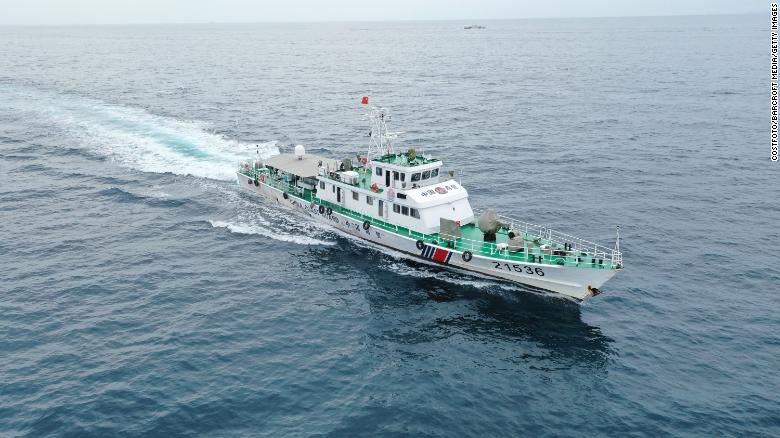 A Chinese Coast Guard taskforce advances at full speed in Zhanjiang, Guangdong Province in China on August 13.
A version of this story appeared in CNN’s Meanwhile in China newsletter, a three-times-a-week update exploring what you need to know about the country’s rise and how it impacts the world. Sign up here.
Hong Kong (CNN)Beijing wants foreign vessels to give notice before entering “Chinese territorial waters,” providing maritime authorities with detailed information — including the ship’s name, call sign, current position, next port of call and estimated time of arrival.It may sound like a reasonable enough request, especially if the ship is carrying hazardous goods, that is until you consider what constitutes “Chinese territorial waters.”Beijing asserts sovereignty over vast swathes of the South China Sea, under its widely contested and far-reaching nine-dash line, as well as disputed islands in the East China Sea.
Tiếp tục đọc “The long arm of China’s new maritime law risks causing conflict in far-off waters”Maritime Traffic Safety Law of the People’s Republic of China (2021 revision)
Document Number : Order No. 79 of the President of the People’s Republic of China
Area of Law : Maritime Transport
Level of Authority : Laws
Date issued : 04-29-2021
Effective Date : 09-01-2021
Issuing Authority : Standing Committee of the National People’s Congress
Status : Not Yet Effective
Order of the President of the People’s Republic of China (No. 79)
The Maritime Traffic Safety Law of the People’s Republic of China , as revised and adopted at the
28th session of the Standing Committee of the Thirteenth National People’s Congress of the People’s
Republic of China on April 29, 2021, is hereby issued, and shall come into force on September 1,
2021.
Xi Jinping, President of the People’s Republic of China
April 29, 2021
Maritime Traffic Safety Law of the People’s Republic of China
(Adopted at the Second Session of the Standing Committee of the Sixth National People’s Congress
on September 2, 1983; amended in accordance with the Decision of the Standing Committee of the
National People’s Congress on Amending Twelve Laws Including the Foreign Trade Law of the
People’s Republic of China at the 24th Session of the Standing Committee of the Twelfth National
People’s Congress on November 7, 2016; and revised at the 28th session of the Standing Committee
of the Thirteenth National People’s Congress on April 29, 2021.
UNESCO: General and Regional Histories
General and Regional Histories

UNESCO has launched a series of collected works – People writing their own history. Instead of just tracing the past of nations, these collections aim to provide a greater understanding of civilizations.
The world’s memory is composed of more than just kings and heroes, battles and conquests, great cathedrals and monumental undertakings.
Through this broad perspective, readers gain a global understanding of the evolution of societies, flourishing of cultures, major currents of exchange and interaction with other parts of the world.
These collections also aim to provide a culturally relevant perspective. They provide the point of view of the populations concerned, whose past has often been distorted, discredited or treated as peripheral to the history of the colonizers and the dominant nations – those who usually write history. The idea here is to rediscover a people’s consciousness and the vision it develops of its own destiny. This shift in perspective is reflected by the significant number of local historians, with impeccable academic credentials, who contributed to these collections as editors and authors.
Tiếp tục đọc “UNESCO: General and Regional Histories”Hydro power
Hydrogen Power
Keisuke Tanigawa, The Real Japan
Shozo Kudo has risen from local politics in his Nagoya to the national legislature, where he is serving his third term. Formerly the Director of the Committee on Land, Infrastructure, Transport and Tourism, Kudo is a strong advocate of hydrogen energy. He talks to Yukie Yamashita about the benefits hydrogen can bring the country
What are the challenges that need to be overcome in order for hydrogen use to become more widespread?
Japan lacks major fossil fuel resources such as oil, coal and natural gas, so the question of how to procure these is a constant issue. Hydrogen, which is found everywhere on the planet, is the ultimate renewable energy source and has the potential to solve Japan’s problem of scarce resources.
How did Japan come to push for research into hydrogen?
Tiếp tục đọc “Hydro power”Indonesia Unprepared as Great Powers Clash in Indo-Pacific
Jakarta is Asia’s greatest geopolitical prize. But its foreign-policy reflexes are long outdated.
FP, By Evan A. Laksmana, a senior research fellow at the Centre on Asia and Globalisation at the National University of Singapore’s Lee Kuan Yew School of Public Policy.
AUGUST 26, 2021, 12:47 PM
Indonesia could tilt the strategic balance in the Indo-Pacific. It’s the largest archipelagic state in the world and sits at the heart of the Indian and Pacific Oceans. The country’s growing economic power, tradition of regional leadership, and control over critical sea lanes seem to predestine it to be a strategic fulcrum in the era of U.S.-Chinese great-power competition.
Getting Jakarta to align with either Beijing or Washington therefore seems like a logical step in the unfolding geopolitical drama. Indonesia’s every move—from military exercises to vaccine diplomacy—is scrutinized through this lens. Depending on who you ask in Beijing or Washington, Indonesia’s choice seems obvious. One offers growth and prosperity, despite bullying the region. The other has built a global network of enduring security relationships, though its commitments are often doubtful, inconsistent, or come with strings attached.
Tiếp tục đọc “Indonesia Unprepared as Great Powers Clash in Indo-Pacific”Call Afghanistan What It Is: The Worst Hostage Crisis in American History
August 21st, 2021 Heritage Foundation

Vice President, Kathryn and Shelby Cullom Davis InstituteJames Jay Carafano is a leading expert in national security and foreign policy challenges.
KEY TAKEAWAYS
On Nov. 4, 1979, militants seized the U.S. Embassy in Tehran, taking more than 60 American hostages. It was hell for the captured Americans.
In rushing the withdrawal of U.S. troops, Biden, in stunning dereliction of duty, didn’t pause to ask about how many Americans remain at risk in Afghanistan.
Biden, America, and tens of thousands of desperate people still in the Afghanistan cauldron who are owed safe passage out are their hostages.
Tiếp tục đọc “Call Afghanistan What It Is: The Worst Hostage Crisis in American History”U.S., China accuse each other of “bullying” nation
By Nandita Bose and James Pearson, Reuters
HANOI, Aug 25 (Reuters) – U.S. Vice President Kamala Harris on Wednesday again charged China with bullying its Southeast Asian neighbours, the second time in two days she has attacked Beijing during a regional visit, as Washington tries to rally regional partners to take on China’s growing economic and military influence.
The Chinese foreign ministry shot back on Wednesday and accused the U.S. of meddling in regional affairs and disrupting peace. Earlier in the day, Chinese state media accused Harris of seeking to drive a wedge between China and Southeast Asian nations with comments in Singapore that Beijing used coercion and intimidation to back its unlawful South China Sea claims.
Tiếp tục đọc “U.S., China accuse each other of “bullying” nation”WHO says Covid misinformation is a major factor driving pandemic around the world
CNBC, PUBLISHED TUE, AUG 24 20213:38 PM EDTUPDATED TUE, AUG 24 20217:22 PM EDT
- WHO official Maria Van Kerkhove said Tuesday that misinformation about Covid and vaccines appears to have gotten worse and is keeping people from getting the shots, driving an increase in cases.
- In July, U.S. Surgeon General Vivek Murthy declared Covid misinformation a “serious public threat.”
- Most unvaccinated Americans think the Covid vaccines are more of a threat to their health than contracting the virus itself, according to Kaiser Family Foundation data.

RT: Maria Van Kerkhove, Head a.i. Emerging Diseases and Zoonosis at the World Health Organization (WHO), speaks during a news conference on the situation of the coronavirus at the United Nations in Geneva, Switzerland, January 29, 2020.Denis Balibouse | Reuters
A top World Health Organization official said Tuesday that misinformation about Covid-19 and vaccines is keeping people from getting the shots, driving an increase in cases around the world.
“In the last four weeks or so, the amount of misinformation that is out there seems to be getting worse, and I think that’s really confusing for the general public,” Maria Van Kerkhove, the WHO’s technical lead on Covid, said during a Q&A livestreamed on the organization’s social media channels.
Misinformation has become another risk factor that is “really allowing the virus to thrive,” she said.
Public health leaders have blamed conspiracy theories and misinformation for growing distrust of the vaccines around the world — so much so that in July U.S. Surgeon General Vivek Murthy declared Covid misinformation a “serious public threat.”
CNBC Health & Science
The White House: Strengthening the US-VN Comprehensive Partnership
The White House
FACT SHEET: Strengthening the U.S.-Vietnam Comprehensive Partnership
AUGUST 25, 2021•STATEMENTS AND RELEASES
Last year, the United States and Vietnam celebrated our 25th anniversary of diplomatic relations. Over the past several decades, the bilateral relationship between our countries has made significant strides, to the point where our nations now cooperate on a wide range of issues, including fighting COVID-19 and preparing for future health security threats, combatting climate change, and addressing shared legacies of war. We have deepened our economic ties as Vietnam’s second largest trading partner and its top export market worldwide, and our support for one another is mutually reinforcing: a vibrant Vietnamese economy is critical to the supply chains Americans depend on, a point that COVID-19 has made clear when production shutdowns abroad have led to difficulties in shipping goods at home. Our security relationship has dramatically expanded as we support Vietnam’s independence and sovereignty, particularly in the maritime domain. The United States and Vietnam have also advanced capacities to prevent, detect, and respond to infectious disease threats through our partnership on the Global Health Security Agenda. The already-robust and growing partnership between our peoples has resulted in nearly 30,000 Vietnamese studying in the United States, contributing nearly $1 billion to the U.S. economy, and the opening of a Peace Corps office in Hanoi.
The Vice President’s travel to Vietnam signifies the United States’ deep commitment not only to the region, but also to the U.S. – Vietnam relationship. In bilateral meetings with Vietnamese leaders, Vice President Harris reaffirmed the U.S. commitment to a strong, prosperous, and independent Vietnam, as well a free, open, healthy, and resilient Indo-Pacific region.
COVID-19 and Health Security: The Vice President reinforced the United States’ commitment to leading the world in ending the COVID-19 pandemic. She announced new COVID-19 vaccine donations to Vietnam, critical support for vaccine distribution, and the opening of a new regional CDC office to enhance health security cooperation.
 CVD
CVD 