Conserving the floods in the Mekong Delta: A story from the Vietnam component of the Integrated Planning to Implement the CBD Strategic Plan and Increase Ecosystem Resilience to Climate Change project

International Union for Conversation of Nature

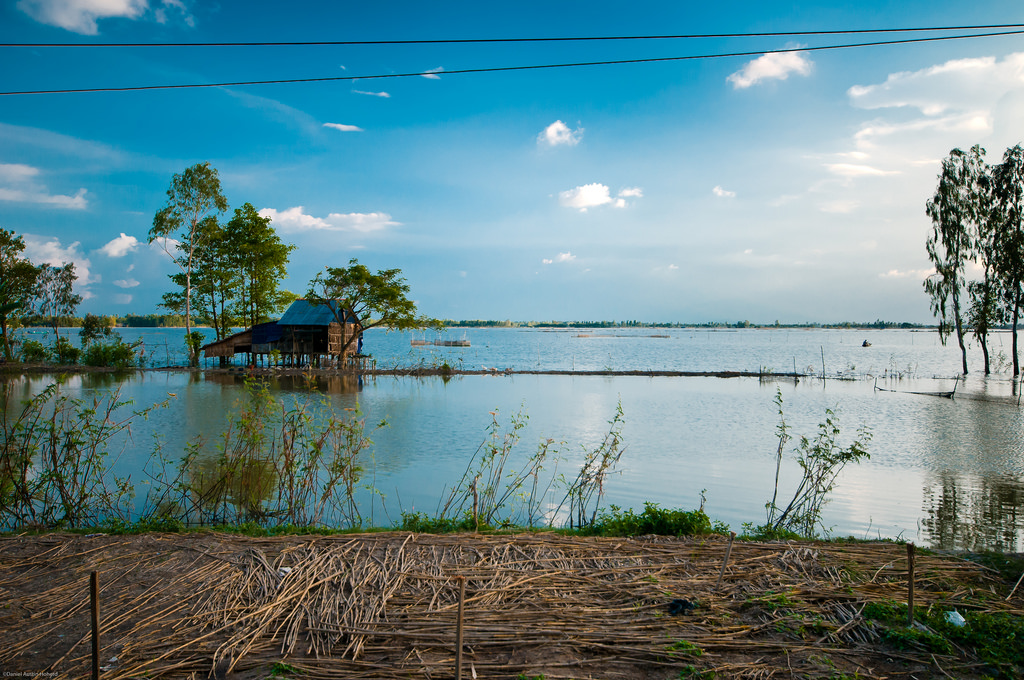
Intensive rice production is the predominant cause for the loss of biodiversity and resilience to climate change in the Vietnamese Mekong Delta. Today, less than 5% of the natural wetlands of the Delta remain. In order to intensively grow rice in the upper-delta deep flood zone, traditional low dyke systems that have supported 2 rice crops in a year while allowing floods to enter the dyke system in the flood season, have been converted into high dykes that displace the floods so that a third rice crop can be grown.

Consensus building at the second Mekong Delta Forum, June 2016 © IUCN Viet Nam Photo: Consensus building at the second Mekong Delta Forum, June 2016 © IUCN Viet Nam
Diversified lotus farming systems as flood retention areas © IUCN Viet Nam Photo: Diversified lotus farming systems as flood retention areas © IUCN Viet Nam
This costly hard infrastructure has disrupted the natural flood pulse of the Mekong Delta and reduced the amount of wetlands with devastating impacts on the aquatic biodiversity that underpins the fisheries livelihoods of particularly poor people, and the loss of sediment replenishment necessary for agricultural sustainability. Tiếp tục đọc “Conserving the floods in the Mekong Delta: A story from the Vietnam component of the Integrated Planning to Implement the CBD Strategic Plan and Increase Ecosystem Resilience to Climate Change project”

Vietnam, World Bank sign $560 million to support Mekong Delta urban development and climate resilience

PRESS RELEASE

Vietnam, World Bank sign $560 million to support Mekong Delta urban development and climate resilience

July 11, 2016


 Can Tho, July 11, 2016 — The World Bank and the State Bank of Vietnam today signed agreements for loans and credits worth $560 million for two projects to support urban development, climate resilience and sustainable livelihoods in the Mekong Delta.

Out of the total, $250 million will be used for the Can Tho Urban Development and Resilience Project, to reduce flood risk and improve connectivity between Can Tho city center and the new urban areas, benefiting more than 420,000 urban dwellers, and enhance the capacity of city authorities to manage disaster risk. Tiếp tục đọc “Vietnam, World Bank sign $560 million to support Mekong Delta urban development and climate resilience”

Mekong Delta Plan

Mekong Delta Plan download

Mekong Delta Plan website

Presentation by Dr. Martijn van de Groep, Chief Technical Advisor, MDP (2013)

Speech by Prime Minister Mark Rutte at the Mekong Delta Plan High-Level Meeting (june 17, 2014)

Presentation by Michael Tonneijck, Royal HaskoningDVH (6/6/2015)

Presentation by Dr. Martijn van de Groep, Chief Technical Advisor, MDP (2016)

Assessment studies for the Mekong Delta Plan

Strategic Delta Planning team (for Bangladesh, Vietnam, Netherlands)

Mongabay Series: A plan to save the Mekong Delta

  A plan to save the Mekong Delta

Mongabay Series:
Part 1 – Will climate change sink the Mekong Delta?
Part 2 – Vietnam sweats bullets as China and Laos dam the Mekong
Part 3 – Mother Nature and a hydropower onslaught aren’t the Mekong Delta’s only problems
Part 4 – A plan to save the Mekong Delta

18 October 2016 / David Brown

Rising seas and upstream dams are threatening to hammer the fertile region. Can Vietnam act in time to stave off disaster?

  • The Mekong Delta Plan is the product of several years’ work by Dutch and Vietnamese officials, supported by a platoon of experts from both nations.
  • It’s a blueprint for dealing not only with the effects of climate change and upstream dams but also with certain shortsighted activities by the Vietnamese themselves.
  • The region’s farmers as well as the relevant branches of government must be persuaded to buy into the plan.
This is the final installment of an in-depth, four-part series exploring threats facing the Mekong Delta and how they might be addressed. Read the firstsecond, third and fourth installments.“I think this year Vietnam got a taste of the new normal,” said Dinh Tuyen, my journalist friend in bustling Can Tho, the Mekong Delta’s hub city. “Less fresh water from rains or from up the river, and more salt water as sea levels rise.”We’d been talking about a story Tuyen had written in May for Thanh Nien, a leading Vietnamese daily. It featured photos of blue-green river waters, and called attention to a remarkable development: the Mekong’s southern branch was not, as usual, muddy with a cargo of silt. Tiếp tục đọc “Mongabay Series: A plan to save the Mekong Delta”

Mongabay series: Mother Nature and a hydropower onslaught aren’t the Mekong Delta’s only problems

Mother Nature and a hydropower onslaught aren’t the Mekong Delta’s only problems 

Mongabay Series:
Part 1 – Will climate change sink the Mekong Delta?
Part 2 – Vietnam sweats bullets as China and Laos dam the Mekong
Part 3 – Mother Nature and a hydropower onslaught aren’t the Mekong Delta’s only problems
Part 4 – A plan to save the Mekong Delta

13 October 2016 / David Brown

Climate change and dams going in upstream are threatening to render the crucial region unviable. But are the Delta’s biggest problems of Vietnam’s own making?

  • Vietnam’s Mekong Delta, home to nearly 20 million people, is one of the most highly productive agricultural environments in the world, thanks in part to an elaborate network of canals, dikes, sluice gates and drainage ditches.
  • On the strength of Delta agriculture, Vietnam has gone from a chronic importer of rice to a major exporter.
  • But farmers in the region are critical of the government’s food security policies, which mandate that most of the Delta’s land be devoted to rice production. And many of them are taking measures to circumvent those rules, in ways that aren’t always friendly to the environment.
  • That’s just one example of how water and land-use policy in the Delta is undermining efforts to protect the vulnerable region from climate change and upstream development.

This is the third article of an in-depth, four-part series exploring threats facing the Mekong Delta and how they might be addressed. Read the  first, secondthird and fourth installments. Tiếp tục đọc “Mongabay series: Mother Nature and a hydropower onslaught aren’t the Mekong Delta’s only problems”

Mongabay series: Vietnam sweats bullets as China and Laos dam the Mekong

Vietnam sweats bullets as China and Laos dam the Mekong

Mongabay Series:
Part 1 – Will climate change sink the Mekong Delta?
Part 2 – Vietnam sweats bullets as China and Laos dam the Mekong
Part 3 – Mother Nature and a hydropower onslaught aren’t the Mekong Delta’s only problems
Part 4 – A plan to save the Mekong Delta

6 October 2016 / David Brown

Tiếp tục đọc “Mongabay series: Vietnam sweats bullets as China and Laos dam the Mekong”

Mongabay series: Will climate change sink the Mekong Delta

Will climate change sink the Mekong Delta?

Mongabay Series:
Part 1 – Will climate change sink the Mekong Delta?
Part 2 – Vietnam sweats bullets as China and Laos dam the Mekong
Part 3 – Mother Nature and a hydropower onslaught aren’t the Mekong Delta’s only problems
Part 4 – A plan to save the Mekong Delta

3 October 2016 / David Brown

No delta region in the world is more threatened by climate change. Will Vietnam act in time to save it?

  • Scientists say the 1-meter sea level rise expected by century’s end will displace 3.5-5 million Mekong Delta residents. A 2-meter sea level rise could force three times that to higher ground.
  • Shifting rainfall and flooding patterns are also threatening one of the most highly productive agricultural environments in the world.
  • The onus is now on Vietnam’s government in Hanoi to approve a comprehensive adaptation and mitigation plan.
This is the first article of an in-depth, four-part series exploring threats facing the Mekong Delta and how they might be addressed. Read the first, secondthird and fourth installments.It’s a sad fact that several decades of talk about climate change have hardly anywhere yet led to serious efforts to adapt to phenomena that are virtually unavoidable. Neuroscientists say that’s because we’re humans. We aren’t wired to respond to large, complex, slow-moving threats. Our instinctive response is apathy, not action.

That paradox was much on my mind during a recent visit back to Vietnam’s fabulously fertile Mekong Delta, a soggy plain the size of Switzerland. Here the livelihood of 20 percent of Vietnam’s 92 million people is gravely threatened by climate change and by a manmade catastrophe, the seemingly unstoppable damming of the upper reaches of the Mekong River. Tiếp tục đọc “Mongabay series: Will climate change sink the Mekong Delta”

Sale of Cambodian breast milk to mothers in US criticised by UN

UN agency says trade puts babies of poor and vulnerable at risk of malnutrition as Cambodia moves to block further exports

A man on a motorbike past the offices of Ambrosia Labs in Phnom Penh.
A man on a motorbike rides past the offices of Ambrosia Labs in Phnom Penh. Photograph: Tang Chhin Sothy/AFP/Getty

The UN children’s fund has strongly criticised the sale by a commercial company of breast milk donated by Cambodian mothers to women in the US, warning it could lead to the babies of poor and vulnerable women becoming malnourished. Tiếp tục đọc “Sale of Cambodian breast milk to mothers in US criticised by UN”

China denies reports of building on disputed shoal

BEIJING: China’s Foreign Ministry on Wednesday denied reports that China will begin preparatory work this year for an environmental monitoring station on disputed Scarborough Shoal in the South China Sea.

China seized the shoal, which is northeast of the Spratly islands, in 2012 and denied access to Philippine fishermen. But after President Rodrigo Duterte visited China last year, it allowed them to return to the traditional fishing area. Tiếp tục đọc “China denies reports of building on disputed shoal”

Watergrabbing A Story of Water

Al Jazeera

Historically the source of many conflicts, water grabbing is the control and theft of water resources by the powerful, often at the expense of local populations and ecosystems. It can result in dispossession, displacement and ecological destruction.

In an age of dwindling resources and climate change, water is increasingly being privatised.

It is now 24 years since the United Nations designated March 22 as World Water Day.

Al Jazeera looks at water grabbing in four parts of the globe, including large-scale damming in the Omo Valley in Ethiopia, the mining industry in South Africa, inequitable water practices in Palestine/Israel and the impact of dams on people living along the Mekong River in southeast Asia.

Tiếp tục đọc “Watergrabbing A Story of Water”

North Korea vows to pursue nuclear arms amid US threat

al jazeera 5 hours ago

North Korea vows to pursue nuclear arms amid US threat

Pyongyang envoy to UN warns his country is developing ‘pre-emptive strike capabilities with nuclear forces’.

North Korean diplomat Choe Myong-nam, left, is seen at a press conference in this 2015 photo [Mike Segar/Reuters]

North Korea will pursue “acceleration” of its nuclear and missile programmes including developing a “pre-emptive first-strike capability”, a diplomat from Pyongyang warned on Tuesday. Tiếp tục đọc “North Korea vows to pursue nuclear arms amid US threat”

Philippines to China: Stop Scarborough Shoal plan

al jareeza 11 hours ago

Diplomatic protest planned against Beijing as President Duterte calls for regional guidelines to resolve sea disputes.

Chinese ships spotted last September at Scarborough Shoal, which is within the Philippines’ exclusive economic zone [AP File]

The Philippines plans to file a “strong” protest against China after it announced preparatory work for an environmental monitoring station on a shoal in the South China Sea, as President Rodrigo Duterte called for regional guidelines governing the disputed area.

Justice Minister Vitaliano Aguirre told reporters in Manila on Tuesday the government would file a complaint against Beijing’s plan to construct a radar station on Scarborough Shoal.

“The case which will be filed is fairly strong I think,” Aguirre said. Tiếp tục đọc “Philippines to China: Stop Scarborough Shoal plan”

France, Japan back free navigation in Asia-Pacific, Abe says

French President Francois Hollande and Japan’s Prime Minister Shinzo Abe attend a joint declaration at the Elysee Palace in Paris, France, March 20, 2017. REUTERS/Philippe Wojaze

France and Japan support a “free and open maritime order” in the Asia-Pacific region, Japanese Prime Minister Shinzo Abe said after talks with French President Francois Hollande on Monday.

The message seemed aimed at China, which claims almost all the South China Sea and which has fueled concern in Japan and the West with its growing military presence in the waterway. Tiếp tục đọc “France, Japan back free navigation in Asia-Pacific, Abe says”

Cà phê Sài Gòn xưa

Thứ Sáu, 10 tháng 3, 2017
Nguồn: http://dinhvankhai.blogspot.com/2017/03/ca-phe-sai-gon-xua.html

Hồi xửa hồi xưa … có một Sài gòn người ta gọi cà phê là “cà phe”, đi uống cà phê là đi uống “cà phe” với giọng điệu rất là ngộ nghĩnh. Tiếng Tây gọi cà phê là Café, tiếng Anh là Coffee nhưng mấy xì thẩu Chợ Lớn thì gọi là “cá phé”. Vậy thì café, coffee, cà phê, cà phe hay là cá phé muốn gọi sao gọi nhưng ai cũng hiểu đó là món thức uống màu đen có hương vị thơm ngon, uống vào có thể tỉnh người nếu uống quá đậm có thể thức ba ngày không nhắm mắt…

Tiếp tục đọc “Cà phê Sài Gòn xưa”

Internal Chinese Navy magazine says country has secured military dominance in South China Sea

Japan Times
A satellite image shows what appears to be anti-aircraft guns and what are likely to be close-in weapons systems on the artificial island at Fiery Cross Reef in the South China Sea in this image released Dec. 13. | CSIS ASIA MARITIME TRANSPARENCY INITIATIVE / DIGITALGLOBE / VIA REUTERS

Kyodo, Mar 20, 2017

China has secured the central leadership role in the South China Sea and other players cannot match its military supremacy in the region, according to an internal magazine of the People’s Liberation Army obtained by Kyodo News.

Amid staunch denials by China that it is militarizing the South China Sea, the article amounts to a rare admission by its military of its true intentions in the region. Specifically, it sheds light on the policy of boosting the military influence in the area under the cloak of “civilian activities” such as private aviation. Tiếp tục đọc “Internal Chinese Navy magazine says country has secured military dominance in South China Sea”