I am an attorney in the Washington DC area, with a Doctor of Law in the US, attended the master program at the National School of Administration of Việt Nam, and graduated from Sài Gòn University Law School. I aso studied philosophy at the School of Letters in Sài Gòn.
.
I have worked as an anti-trust attorney for Federal Trade Commission and a litigator for a fortune-100 telecom company in Washington DC.
I have taught law courses for legal professionals in Việt Nam and still counsel VN government agencies on legal matters.
I have founded and managed businesses for me and my family, both law and non-law.
I have published many articles on national newspapers and radio stations in Việt Nam.
In 1989 I was one of the founding members of US-VN Trade Council, working to re-establish US-VN relationship.
Since the early 90's, I have established and managed VNFORUM and VNBIZ forum on VN-related matters; these forums are the subject of a PhD thesis by Dr. Caroline Valverde at UC-Berkeley and her book Transnationalizing Viet Nam.
I translate poetry and my translation of "A Request at Đồng Lộc Cemetery" is now engraved on a stone memorial at Đồng Lộc National Shrine in VN.
I study and teach the Bible and Buddhism. In 2009 I founded and still manage dotchuoinon.com on positive thinking and two other blogs on Buddhism.
In 2015 a group of friends and I founded website CVD - Conversations on Vietnam Development (cvdvn.net).
I study the art of leadership with many friends who are religious, business and government leaders from many countries.
I have written these books, published by Phu Nu Publishing House in Hanoi:
"Positive Thinking to Change Your Life", in Vietnamese (TƯ DUY TÍCH CỰC Thay Đổi Cuộc Sống) (Oct. 2011)
"10 Core Values for Success" (10 Giá trị cốt lõi của thành công) (Dec. 2013)
"Live a Life Worth Living" (Sống Một Cuộc Đời Đáng Sống) (Oct. 2023)
I practice Jiu Jitsu and Tai Chi for health, and play guitar as a hobby, usually accompanying my wife Trần Lê Túy Phượng, aka singer Linh Phượng.
Farmers harvest rice in a paddy field in the southern province of Soc Trang, March 10, 2020. Photo by VnExpress/Nguyet Nhi.
The Asian Development Bank (ADB) has forecast the highest 2020 GDP growth rate in Southeast Asia for Vietnam at 4.1 percent.
The regional bank has placed Myanmar in second place with an estimated growth rate of 1.8 percent while Brunei in third place with 1.4 percent. Thailand is at the bottom of the list at -6.5 percent, behind Singapore (-6 percent) and Cambodia (-5.5 percent).
Southeast Asia’s average GDP growth is estimated to contract by -2.7 percent this year and expected to rebound to 5.2 percent next year.
TTO – Cao tốc Bến Lức – Long Thành kết nối các tỉnh miền Đông và miền Tây Nam Bộ vẫn chưa thôi lận đận sau 2 năm trễ hạn. Vốn vay không kịp nhận hết, dự án phát sinh nhiều khiếu nại, nợ nần và đường chưa biết bao giờ mới xong!
The land earlier zoned for the Ninh Thuan 1 Nuclear Power Plant in Thuan Nam District, Ninh Thuan Province, Vietnam. Photo: Minh Tran / Tuoi Tre
Restarting Vietnam’s nuclear power projects, which have been suspended since 2016 for economic reasons, is one of the options to be considered as the country seeks to ensure energy security after 2035.
The Institute of Energy, on behalf of the Vietnamese Ministry of Industry and Trade, is drafting a master plan for the country’s electricity development between 2021 and 2030, looking toward 2045. Tiếp tục đọc “Vietnam might reconsider nuclear power”→
Vietnam is expected to attract 15 Japanese firms of different sizes that will receive Japanese government’s subsidies to shift manufacturing plants out of China to diversify its supply chain.
Manufacturing semiconductors at MTEX – a Japanese invested company in Vietnam (Photo: Cao Thang)
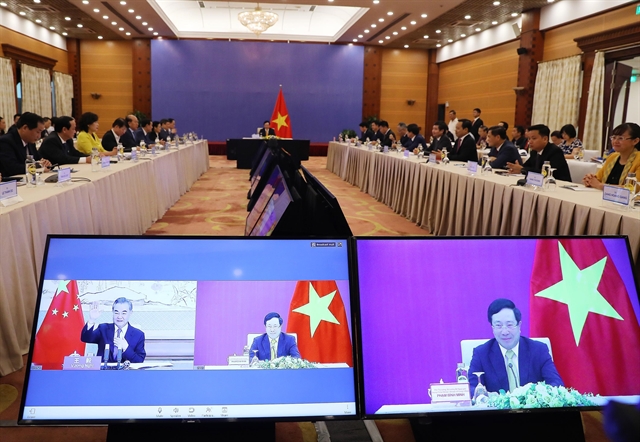
Chinese diplomat meets with Vietnamese counterpart to discuss the waterway, while Beijing-backed investment institution loans US$100 million to bank in Vietnam
Moves come just days after US secretary of state rejects most of China’s claims to South China Sea
A crewman from a Vietnamese coastguard ship looks out at Chinese military vessels in the South China Sea in 2014. The countries’ disputes over the waterway go back decades. Photo: Reuters
Beijing is carefully managing its relationship with Vietnam after the United States took a harder line on the South China Sea dispute and rejected most of its claims in the strategic waterway as “unlawful” this week.
US Air Force surveillance plane spotted off south coast of China, think tank says
E-8C aircraft seen reconnoitring near Guangdong province for third time this week, South China Sea Strategic Situation Probing Initiative says
US Navy says two aircraft carrier strike groups led by USS Nimitz and USS Ronald Reagan carried out tactical air defence exercises in region to maintain combat readiness
The US Navy said two of its aircraft carrier strike groups carried out dual exercises in the South China Sea to boost their combat readiness. Photo: US Navy
A US military surveillance aircraft was spotted close to China’s south coast for the third time this week on Friday, Chinese sources said, as the US Navy reported two of its aircraft carrier strike groups had conducted dual exercises in the South China Sea to boost their combat readiness.
The US Air Force E-8C aircraft, which is fitted with specialist radar, communications, operations and control systems, was seen reconnoitring as close to 72 nautical miles off the coast of Guangdong province, according to the South China Sea Strategic Situation Probing Initiative, a think tank based at Peking University.
The sighting was the third this week, it said. Analysts said the plane was probably monitoring Chinese troop deployments and movement along the coast.
The think tank said also that a US Air Force E-3 Sentry early warning and control aircraft, which provides all-weather surveillance, command, control and communications, was spotted over the South China Sea.
Also on Friday, the US Navy said two of its aircraft carrier strike groups had conducted dual exercises in the South China Sea to boost their combat readiness.
The groups, led by the USS Nimitz and USS Ronald Reagan, were showing their “operational commitment to allies and partners in the region, providing combatant commanders with significant operational flexibility if needed in response to regional situations”, according to a report published on Friday on cpf.navy.mil, a news portal for the US Navy.
Rear Admiral Jim Kirk, commander of the Nimitz strike group, was quoted as saying the warships had been “operating in the South China Sea, wherever international law allows, to reinforce our commitment to a free and open Indo-Pacific, a rules based international order, and to our allies and partners in the region”.
The two groups conducted tactical air defence exercises to maintain combat readiness, the report said, adding that they trained “to the highest levels of readiness to ensure responsiveness to any contingency through power projection”.
SCMP GLOBAL IMPACT NEWSLETTER
Uncover the most important stories from China that affect the world
“Security and stability is essential to peace and prosperity for all nations, and it is for that reason the US Navy has been present and ready in the Pacific for over 75 years,” Kirk said.
The US Navy said on July 4 that the two aircraft carrier strike groups had been deployed to the South China Sea “in support of a free and open Indo-Pacific”, while Chinese forces were staging a drill near the Paracel Islands, which are claimed by mainland China, Taiwan and Vietnam.
Boatswain’s mate Seaman Clarkensy Smith looks on from the USS Antietam as the USS Nimitz, USS Ronald Reagan and USS Mustin steam in formation. Photo: US Navy
, claiming the US had “carried out navigational hegemony” through its repeated deployments of warships to the region and describing Washington as the biggest driver of militarisation in the strategic waterway.
Kirk’s comments on the latest naval activity came after US Secretary of State Mike Pompeo said the US formally opposed Beijing’s territorial claims within the so-called nine-dash line that encompasses almost all of the South China Sea – in line with a 2016 ruling by an international tribunal at The Hague.
to the disputed waters but observers say most are unlikely to openly choose sides between the US and China.
Collin Koh, a research fellow at the S Rajaratnam School of International Studies at Singapore’s Nanyang Technological University, said the carrier strike groups’ operations showed the US Navy was intent on maintaining its freedom of navigation in the South China Sea regardless of the rising challenge from the Chinese military.
“The US Navy remains operationally ready and has been able to bring the Covid-19 contagion under control,” he said.
“The intended audience of such signalling isn’t just China, but also other regional governments to underline continued US security commitments.”
Purchase the 120+ page China Internet Report 2020 Pro Edition, brought to you by SCMP Research, and enjoy a 30% discount (original price US$400). The report includes deep-dive analysis, trends, and case studies on the 10 most important internet sectors. Now in its 3rd year, this go-to source for understanding China tech also comes with exclusive access to 6+ webinars with C-level executives, including Charles Li, CEO of HKEX, James Peng, CEO/founder of Pony.ai, and senior executives from Alibaba, Huawei, Kuaishou, Pinduoduo, and more. Offer valid until 31 August 2020. To purchase, please
This article appeared in the South China Morning Post print edition as: US military making waves in China’s backyard
US spy drone seen over South China Sea headed for Taiwan, Chinese think tank says
United States could be seeking to track Chinese navy’s underwater activities in the region, observer says
It comes as Washington steps up military presence after formally rejecting most of Beijing’s claims to the waterway
, a Chinese think tank said on Thursday, days after Washington declared most of Beijing’s claims in the hotly contested waterway were “unlawful”.
The US Navy MQ-4C Triton – a long endurance unmanned aerial vehicle – was seen flying towards the southeast of Taiwan at about noon on Wednesday, according to the SCS Probing Initiative (SCSPI), a Peking University think tank.
It said a US P-8A anti-submarine aircraft and a KC-135R aerial refuelling aircraft were also seen on Thursday flying southwest of Taiwan over the South China Sea.
While details of the air patrols were unclear, military observers said the US Navy appeared to be stepping up reconnaissance efforts in the strategic waterway that is
The Triton drone seen on Wednesday is part of the US Navy’s Maritime Patrol and Reconnaissance Force. Operated autonomously using maritime sensors, it can work with the manned anti-submarine aircraft to carry out intelligence, surveillance and reconnaissance missions over vast ocean and coastal regions.
Song Zhongping, a Hong Kong-based military expert, said the US Navy could be seeking to track underwater activities by the Chinese navy.
“The deployment of surveillance aircraft such as the MQ-4C, P-8A and P-3C [Orion maritime patrol and anti-submarine warfare aircraft] could help the US Navy to reconnoitre warship, submarine and other underwater activities in the region as they are able to detect sound pulses and track submarines,” Song said.
The air patrols came as the US has stepped up its military presence in the South China Sea after Secretary of State Mike Pompeo on Monday said
. The move has raised concerns about a possible military confrontation between the two superpowers that are already at odds over issues ranging from trade to human rights and Hong Kong.
SCMP GLOBAL IMPACT NEWSLETTER
Uncover the most important stories from China that affect the world
A day after Pompeo’s statement, guided-missile destroyer the USS Ralph Johnson carried out a freedom of navigation operation in the South China Sea, sailing near the disputed Spratly Islands, the US Pacific Fleet said in a statement. Known as the Nansha Islands in Chinese, they are also claimed by the Philippines, Malaysia, Taiwan and Vietnam.
According to the SCSPI, the US warship sailed within 12 nautical miles of Beijing-controlled Cuarteron Reef for the first time since 2016, and Fiery Cross Reef for the sixth time this year.
A US warship sailed within 12 nautical miles of Cuarteron Reef on Tuesday, according to the SCSPI. Photo: Weibo
The US has increased its so-called freedom of navigation and overflight operations in the South China Sea as part of efforts to challenge China’s military build-up and land reclamation projects in the disputed waters. Beijing has rejected these patrols and accused the US and its allies of raising tensions in the region.
The under-the-radar South China Sea projects Beijing uses to cement its claims
15 Jul 2020
According to the Asia Maritime Transparency Initiative (AMTI) at the Centre for Strategic and International Studies, a Washington-based think tank, China has significantly expanded Cuarteron Reef since 2013, building helicopter pads, radar facilities and possible gun or missile emplacements.
China has also carried out land reclamation work at Fiery Cross Reef since 2014, turning it into one of its biggest artificial islands with an airbase, 3,000-metre runway and shelters that could house mobile missile launchers, according to AMTI.
On 12 December 2019, Malaysia submitted to the Commission on the Limits of the Continental Shelf, in accordance with Article 76, paragraph 8, of the Convention, information on the limits of its continental shelf beyond 200 nautical miles from the baselines from which the breadth of the territorial sea is measured in the South China Sea.
It is noted that the Convention entered into force for Malaysia on 13 November 1996.
Năm 1956, thuốc bảo vệ thực vật gần như không tồn tại ở Việt Nam. Nửa đầu năm 2020, nước ta nhập khẩu thuốc trừ sâu nhiều hơn xăng.
Từ đầu năm 2020 cho đến ngày 15/6, Tổng cục Hải quan công bố Việt Nam đã nhập khẩu 308 triệu USD thuốc trừ sâu và nguyên liệu sản xuất mặt hàng này. Để so sánh, trong cùng kỳ, Việt Nam nhập 249 triệu USD tiền xăng.
ASEAN hoan nghênh ủy ban quốc hội Mỹ ra tuyên bố Biển Đông
Đại diện các nước ASEAN cảm ơn sự ủng hộ của Mỹ trong nỗ lực duy trì luật pháp quốc tế, sau khi ủy ban quốc hội Mỹ bác bỏ yêu sách của Trung Quốc ở Biển Đông.
Đại sứ Hà Kim Ngọc cùng Đại sứ, Đại biện các nước ASEAN tại Washington D.C. chiều 16/7 trao đổi trực tuyến với Hạ nghị sĩ Joaquin Castro, Phó Chủ tịch Ủy ban Đối ngoại Hạ viện, đồng Chủ tịch Nhóm ASEAN của Quốc hội Mỹ về củng cố quan hệ Đối tác Chiến lược ASEAN – Mỹ, theo thông cáo của đại sứ quán Việt Nam tại Washington D.C.
Nhóm tác chiến tàu sân bay USS Ronald Reagan và USS Nimitz diễn tập trên Biển Đông ngày 6/7. Ảnh: US Navy.
Đại sứ, Đại biện các nước ASEAN cảm ơn sự ủng hộ của Mỹ trong nỗ lực duy trì luật pháp quốc tế, trong đó có Công ước Luật biển Liên Hợp Quốc 1982, tại Biển Đông và các vùng biển trong khu vực. Đại sứ Hà Kim Ngọc đánh giá cao Ủy ban Đối ngoại Thượng viện và Hạ viện ra tuyên bố khẳng định các yêu sách lãnh thổ và hàng hải của Trung Quốc ở Biển Đông là bất hợp pháp.
Hạ nghị sĩ Joaquin Castro khẳng định sự đồng thuận lưỡng đảng đối với cách tiếp cận đề cao luật pháp quốc tế, giải quyết hòa bình các tranh chấp tại Biển Đông, nhấn mạnh giá trị pháp lý của phán quyết Tòa Trọng tài Thường trực trong vụ kiện giữa Philippines với Trung Quốc. Ông khẳng định Mỹ luôn sát cánh cùng các nước trong khu vực, không cho phép bất kỳ nước nào sử dụng sức mạnh để mở rộng lãnh thổ dù ở Biển Đông, biên Hoa Đông hay trên đất liền.
Ông Castro cũng cảm ơn và đánh giá cao các bài học và kinh nghiệm kiểm soát Covid-19 của các nước ASEAN, đặc biệt là Việt Nam, cũng như hợp tác ASEAN – Mỹ ứng phó với dịch bệnh thời gian qua. Ông Castro cho rằng ưu tiên trước mắt là đẩy mạnh phối hợp trong ứng phó với diễn biến phức tạp của Covid-19.
Đại sứ Hà Kim Ngọc nhấn mạnh với vai trò Chủ tịch ASEAN, Việt Nam đã phối hợp với các thành viên ASEAN duy trì chương trình hoạt động của ASEAN và hy vọng Covid-19 sớm được kiểm soát để Việt Nam có thể đón các lãnh đạo ASEAN và đối tác, trong đó có Tổng thống Mỹ, đến Hà Nội tham dự Thượng định Đông Á vào cuối năm nay.
Bộ Ngoại giao Mỹ hôm 13/7 đăng tuyên bố của Ngoại trưởng Mike Pompeo, bác bỏ hầu hết yêu sách chủ quyền của Trung Quốc ở Biển Đông. Cùng ngày, các lãnh đạo Ủy ban Đối ngoại của Thượng viện và Hạ viện ra tuyên bố chung khẳng định họ ủng hộ việc chính quyền làm rõ lập trường rằng yêu sách của Trung Quốc tại Biển Đông là bất hợp pháp. Trung Quốc đã không tuân thủ phán quyết của Tòa Trọng tài Thường trực năm 2016.
Tuyên bố chỉ trích Trung Quốc “bắt nạt nước láng giềng, quyết liệt cải tạo và quân sự hóa các thực thể, tiếp tục hoạt động trong vùng đặc quyền kinh tế của quốc gia khác” và nhấn mạnh những hành động này leo thang trong vài tháng qua khi thế giới đang tập trung chống Covid-19.
Mỹ cam kết duy trì luật pháp quốc tế, tiếp tục tự do hàng không, hàng hải ở những nơi luật pháp quốc tế cho phép, đồng thời ủng hộ các đối tác và tổ chức trong khu vực tìm kiếm giải pháp ngoại giao hòa bình cho tranh chấp ở Biển Đông.