Từng được coi là có vai trò chủ đạo và giờ đây là đóng vai trò chính trong việc đảm bảo cấp điện cho nền kinh tế cũng như quản lý hệ thống truyền tải xương sống của quốc gia, những ý kiến góp ý của Tập đoàn Điện lực Việt Nam (EVN) với Dự thảo Đề án Quy hoạch Điện VIII được giới chuyên môn rất quan tâm bởi sự liên quan mật thiết hơn cả.
Tác giả: Đào Thu Hằng
Nuclear energy, ten years after Fukushima
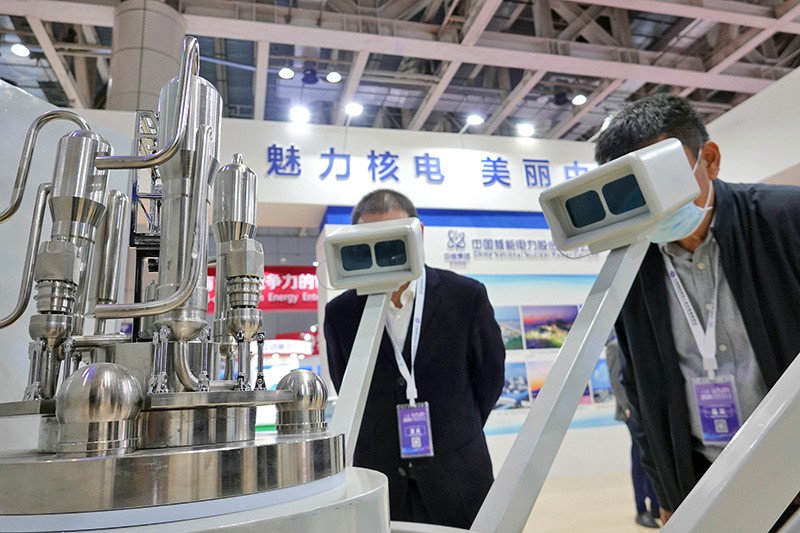
Visitors to an industry exhibition in 2020 in China view a model nuclear-power reactor through augmented-reality headsets.Credit: Tang Ke/VCG via Getty
Ten years have passed since a catastrophic earthquake and tsunami damaged the Fukushima Daiichi nuclear power plant in Japan, triggering the worst nuclear accident since the Chernobyl disaster in 1986.
The accident struck at a time of renewed hope and untested optimism surrounding a new wave of nuclear-energy technologies and the part they might play in achieving a low-carbon future. It led to retrenchment, amid fresh concerns over the technological, institutional and cultural vulnerabilities of nuclear infrastructures, and the fallibility of humans in designing, managing and operating such complex systems. Tiếp tục đọc “Nuclear energy, ten years after Fukushima”
COVID-19: Schools for more than 168 million children globally have been completely closed for almost a full year, says UNICEF
UNICEF unveils ‘Pandemic Classroom’ at United Nations Headquarters in New York to call attention to the need for governments to prioritise the reopening of schools

The Role of Long-Duration Energy Storage in Deep Decarbonization: Policy Considerations
- A recent growth in targets for ambitious clean energy use and net zero greenhouse gas emissions has increased interest in the role of utility-scale storage, including long-duration energy storage, to achieve deep decarbonization of the power sector.
- In future deep-decarbonization scenarios, energy storage holds the potential to address multiday weather-related events that lower the production of renewable energy, as well as seasonal differences in renewable energy resource availability that can last for weeks.
- Today’s storage technologies provide only hours of storage, though with design and operational changes, compressed air energy storage and pumped hydro storage capacity could be stretched into days.
- Other, less mature storage technologies may evolve to provide long-duration storage that compensate for seasonal variations in renewable energy supply, for example, technologies that create hydrogen through low-carbon processes.
- Recent storage deployments in the United States have been driven by state storage mandates, utility investment, frequency regulation markets and declining battery costs.
- Policymakers can play an important role in driving innovation, encouraging cost reductions and assessing the benefits of storage to provide greater options for maintaining reliability in future decarbonized grids through research and development, demonstration projects and regional studies. New approaches to financing, planning and procurement could reduce barriers to the adoption of long-duration storage technologies.
Lessons from Texas Freeze: 5 Ways to Strengthen US Energy Resilience

Even as people are suffering through the harshest winter storm Texas has seen in decades, the reasons for the state’s devastating power grid failure have become a political battleground. While vulnerable people freeze in their homes, pundits snipe about whether wind turbines are to blame. Tiếp tục đọc “Lessons from Texas Freeze: 5 Ways to Strengthen US Energy Resilience”
In Defense of Bảo Tàng Địa Chất, Saigon’s Most Neglected Museum
- saigoneer.com
- Wednesday, 12 February 2020.
- Written by Paul Christiansen. Photos by Alberto Prieto.
The Collection
When a meteor, a hulking hunk of prehistoric mass, shreds through Earth’s atmosphere and slams into the surface, the impact vaporizes terrestrial scraps of minerals and sends debris into the sky. The molten globs float like glassy raindrops and fall thousands of kilometers away. Buried under layers of rock laid over millions of years, occasionally the shiny shards work their way to the surface; shimmering examples of Earth’s immensity and the intensity of time. Have you ever seen one? If not, you can.
A case filled with these tektites awaits in District 1 alongside literal pieces of lava, impressions made by long-extinct sea creatures straight out of a science-fiction movie, and wood transformed to stone. Can you imagine, wood to stone! What was once a tiny seed and then a towering tube of pulp pumping sap to a canopy of soft leaves made into solid rock by the geological machinations of our exceedingly strange planet. No one seems to care. Tiếp tục đọc “In Defense of Bảo Tàng Địa Chất, Saigon’s Most Neglected Museum”
The Role of the Private Sector in Protecting Civic Space
Robust civic space is essential for good governance, the rule of law and for enabling citizens to shape their societies. However, civil society space around the world is under significant pressure and the COVID-19 pandemic has exacerbated this situation.
The weakening of international institutions and democratic norms worldwide has resulted in fewer constraints on autocracies. Meanwhile, the rise of nationalism, populism and illiberalism is taking its toll on civil liberties.
The private sector is in a unique position to work with civil society organizations to uphold and defend civic freedoms and support sustainable and profitable business environments. Companies have the capacity, resources and expertise to enhance the protection of civic space. Tiếp tục đọc “The Role of the Private Sector in Protecting Civic Space”
What Is Going on With China’s Crazy Clean Energy Installation Figures?
China says it installed more wind than the rest of the world put together last year.

Chinese government reports of 120 gigawatts of wind and solar installed last year have confounded industry analysts.
Analysts have been left dumbfounded after China last month released official 2020 wind and solar installation figures that were seemingly too big to be true.
The Chinese National Energy Administration (NEA) “stunned the world,” according to Wood Mackenzie senior analyst Xiaoyang Li, when it announced total wind and solar capacity additions of 120 gigawatts.
Notwithstanding uncertainty over COVID-19’s impact on the supply chain, China had been expected to report big numbers for last year. The International Energy Agency, for example, had predicted the country would add around 32 GW of wind and 50 GW of solar.
But the magnitude of the official figures caught even seasoned China watchers off guard. BloombergNEF had forecast 36 GW each of new solar and wind in 2020 and the official figure for PV capacity additions was 48 GW AC.
Tiếp tục đọc “What Is Going on With China’s Crazy Clean Energy Installation Figures?”
Beyond Declining Battery Prices: 6 Ways to Evaluate Energy Storage in 2021
Balance of systems, software, supply chain constraints, and reliability and performance guarantees all weigh on total costs.
Batteries make up only a slice of energy storage system costs. (Credit: Ameren)
The energy storage market in the United States is booming, with 476 megawatts of new projects installed in the third quarter of 2020 alone, up 240 percent over the second quarter, according to industry analysts at Wood Mackenzie. 2021 is expected to be another record-breaking year for storage, but with technological innovation accelerating across the market, renewable energy asset owners need to carefully select safe and reliable systems to protect their storage investments. As the market accelerates, these are a few of the essential questions asset owners should be asking.
1. Evaluate pricing beyond the cell
When analysts speak about declines in storage pricing, they are referring to battery pricing, which continues to decline every year. Bloomberg New Energy Finance’s latest report states that current lithium-ion pricing stands at about $137 per kilowatt-hour and will drop as low as $100 per kWh by 2023.
However, purchasers of energy storage systems may see substantially higher prices for their projects, depending on a range of factors. For example, the lowest pricing for lithium-ion batteries is generally available for either a major supply contract or for very large-scale deployments of 500 megawatt-hours and above. Since most projects today are not that large, that $137 per kWh figure will be closer to $150 to $170 per kWh, and perhaps as high as $200 to $210 per kWh on the battery-pack level, depending on the size of the project.
Tiếp tục đọc “Beyond Declining Battery Prices: 6 Ways to Evaluate Energy Storage in 2021”
A Lesson from Physics on Oil Prices: Revisiting the Negative WTI Oil Price Episode
While the episode of negative WTI price is still being actively debated, its proper root cause is yet to be determined. This Comment contributes to the discussion and studies the event by modifying the theory of storage for an oil market with rigid operational infrastructure, where short-term supply and demand are price inelastic. We found that such pricing anomaly can be well characterized by a simple concept borrowed from the physics of extreme events.
The future prices are modelled as a financial derivative of the storage capacity. During normal market conditions, the spread between nearby futures contract is mostly determined by the carry trade and the cost of storage. However, if either inventory or the storage capacity is no longer available, the carry trade breaks down as the futures trader is unable to make or take the delivery of physical barrels. These events are akin to defaults in financial markets and prices leading to them are characterized by the financial squeeze.
We calibrate the model to inventory data at Cushing, Oklahoma and conclude that only a small fraction of the abnormal price move could be attributed to constraints on the storage capacity. The rest of the move was caused by the financial squeeze on long futures positions held against over-the-counter products. We detail the behavior of main market participants that led to negative prices. The Comment also points to several shortcomings of the recent CFTC report on this topic and suggests additional areas where a more granular look at the data could be helpful.
This comment looks at the announcement by the Danish government on 4 December to cancel the 8th offshore licensing round and all future rounds and to phase out all production of oil and gas by 2050. It describes the industry and political background to the announcement, including the ambitious legal target of a 70% reduction in GHG emissions by 2030 and climate neutrality by 2050, and the most recent official projections of offshore production. It concludes that it will shape operators’ investment and management of mature fields but its impact on Danish emissions and upstream production in 2030 and 2050 is likely to be much more modest than at first appears. However, if the reform galvanises the Danish authorities and investors to commit resources to the development of offshore CO2 storage in the period 2025-30, it may contribute significantly to Denmark’s climate objectives.
View full paper https://www.oxfordenergy.org/wpcms/wp-content/uploads/2021/01/A-Lesson-from-Physics-on-Negative-Oil-Prices.pdf
Key Considerations for Adoption of Technical Codes and Standards for Battery Energy Storage Systems in Thailand.
Executive Summary
The deployment of battery energy storage systems (BESS) is rapidly increasing throughout the world. This technology presents many opportunities for increasing contributions of variable renewable energy technologies, providing ancillary services, enabling energy access to remote areas, and increasing resilience during grid power outages. At the same time, BESS has not been widely deployed and operated in many contexts. The use of BESS requires codes and standards similar to those for other inverter-based technologies but may also necessitate special safety considerations in specific contexts. As countries in Asia consider the inclusion of BESS in their power systems to meet policy objectives, renewable energy goals, increase resilience, and expand energy access, there is an opportunity to learn from the experiences of other regions and jurisdictions that have developed more advanced storage markets and practices.
This report presents global best practices of codes, standards, and interconnection procedures developed to support the safe and reliable deployment of BESS. Several relevant case studies highlight current efforts to ensure safe operation of BESS and showcase potential pathways for adoption of relevant codes and standards. Specifically, this report is intended to support the Thailand Office of Energy Regulatory Commission (OERC) and other stakeholders in their efforts to develop technical codes and standards to govern the installation and operation of BESS; it may also be utilized as a guide for other countries as interest in the deployment of BESS technologies continues to grow. Coupled with well-defined regulatory objectives, market incentives, permitting procedures, and technical review processes, the adoption of technical codes and standards that govern the design, construction, installation, and operation of BESS can help provide regulatory certainty, as well as reduce barriers to investment. Such codes and standards also ensure BESS deployment will meet national, regional, and local goals, while maintaining a reliable grid, and ensuring public safety.
Finally, a robust BESS market can support the increased adoption of variable renewable energy generation technologies to meet Thailand’s energy portfolio goals. This report has been prepared by the National Renewable Energy Laboratory (NREL) with support from the U.S. Agency for International Development (USAID) Regional Development Mission for Asia, and in collaboration with USAID Clean Power Asia.
Download full report https://www.nrel.gov/docs/fy21osti/78780.pdf
Steps to Aid US Fossil Fuel Workers in the Clean Energy Transition

The economic fallout from COVID-19 took a serious toll on U.S. fossil fuel workers and communities. But well before the coronavirus pandemic arrived, the U.S. fossil fuel industry was under significant pressure as the country moves toward cleaner forms of energy.
Tiếp tục đọc “Steps to Aid US Fossil Fuel Workers in the Clean Energy Transition”
Better infrastructure is way to absorb surge in renewable energy production: experts
Storing renewable energy in batteries and pumped storage of water to generate power, and improving transmission capacity are keys for Vietnam to foster renewable energy, according to experts.
Nguyen Duc Ninh, director of the National Load Dispatch Center, said earlier this month Vietnam plans to reduce its renewable energy output by 1.3 billion kilowatt hours this year since it lacks transmission capacity.
Installed solar power capacity reached 19,400 MWp by the end of last year, or 25 percent of total power capacity.
Dr Hang Dao, a sustainable energy expert at the World Resources Institute (WRI), said the reason Vietnam has solar energy surplus is the country’s electric grid and infrastructure are quite weak, and so energy is not transmitted to locations where needed.
The national grid is out of date and needs to be upgraded, but it would take time to install a modern network, and while waiting for it the country could focus on short-term storage plans, said Hang.
Tiếp tục đọc “Better infrastructure is way to absorb surge in renewable energy production: experts”
2020 tied for warmest year on record, NASA analysis shows
Earth’s global average surface temperature in 2020 tied with 2016 as the warmest year on record, according to an analysis by NASA.
Continuing the planet’s long-term warming trend, the year’s globally averaged temperature was 1.84 degrees Fahrenheit (1.02 degrees Celsius) warmer than the baseline 1951-1980 mean, according to scientists at NASA’s Goddard Institute for Space Studies (GISS) in New York. 2020 edged out 2016 by a very small amount, within the margin of error of the analysis, making the years effectively tied for the warmest year on record.
Tiếp tục đọc “2020 tied for warmest year on record, NASA analysis shows”
Bans on Parler and Trump Show Big Tech’s Power Over Web Conversation
As Facebook Inc. and Twitter Inc. banished users and groups supporting the violent mobs at the U.S. Capitol last week — including President Donald Trump himself — downloads surged for a less restrictive social media app called Parler. But in an effort to prevent further riot organizing, Google Inc. and Apple Inc. booted Parler from their app stores, and Amazon.com Inc. shut off its web services.
“We will not cave to pressure from anti-competitive actors!” John Matze, Parler Inc.’s chief executive officer, said on his site Friday. “We WON’T cave to politically motivated companies and those authoritarians who hate free speech!”
In reality, Matze doesn’t have much choice. His free-speech-centric network, where some extremists turned to rally insurgents and organize future uprisings, was deemed an “ongoing and urgent public safety threat” by Google. Apple quickly rejected as insufficient a Parler plan to moderate its content. Amazon employees asked that the web giant “deny Parler services until it removes posts inciting violence, including at the Presidential inauguration.” Amazon plans to shut down the service at midnight Sunday, according to Matze.
Tiếp tục đọc “Bans on Parler and Trump Show Big Tech’s Power Over Web Conversation”