Road to nowhere:China’s Belt and Road Initiative at tipping point

Pakistan, Sri Lanka debt crises threaten Beijing’s regional influence

asia.nikkei.com

By Adnan Aamir, Marwaan Macan-Markar, Shaun Turton and Cissy Zhou – AUGUST 10, 2022

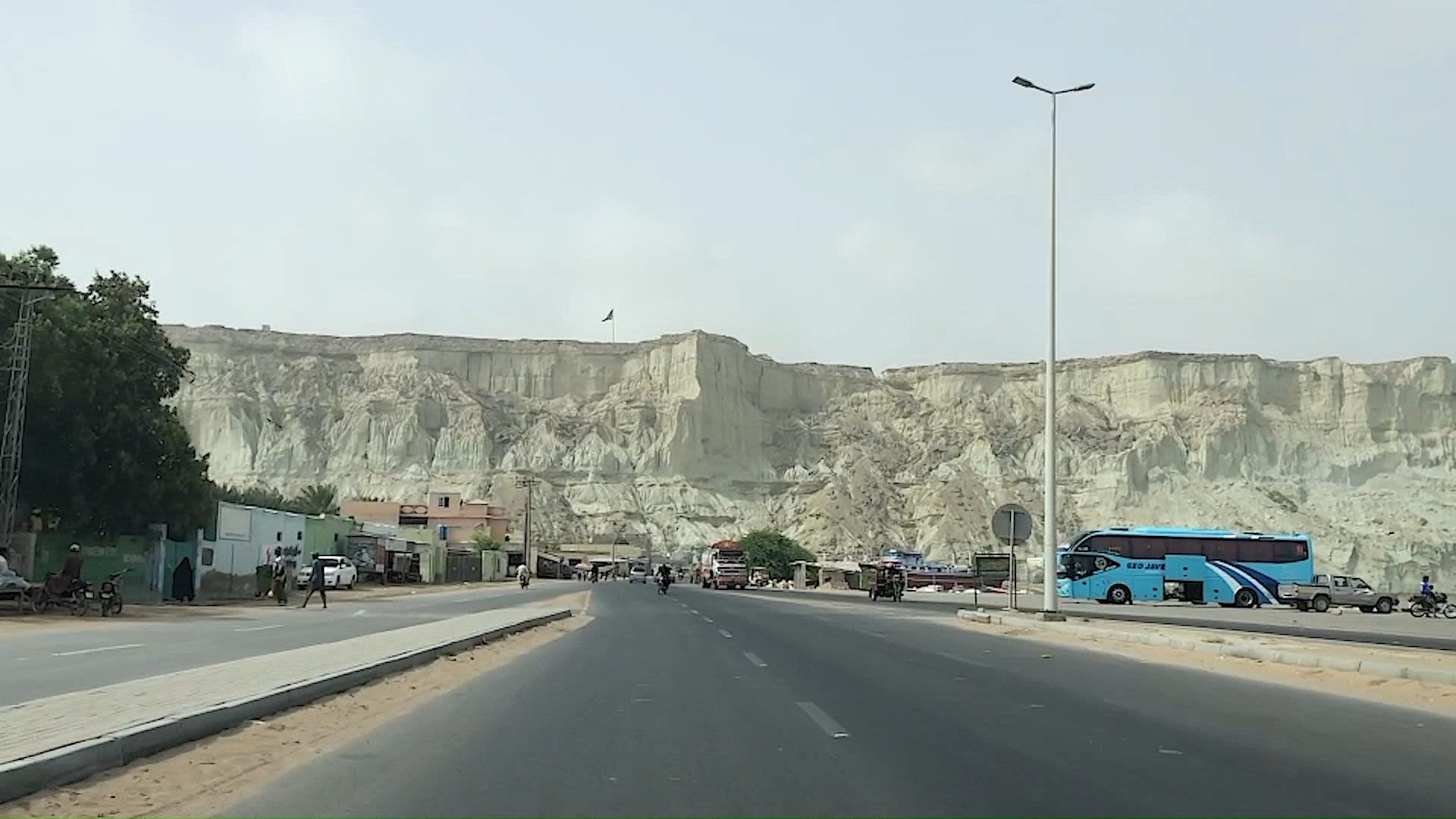
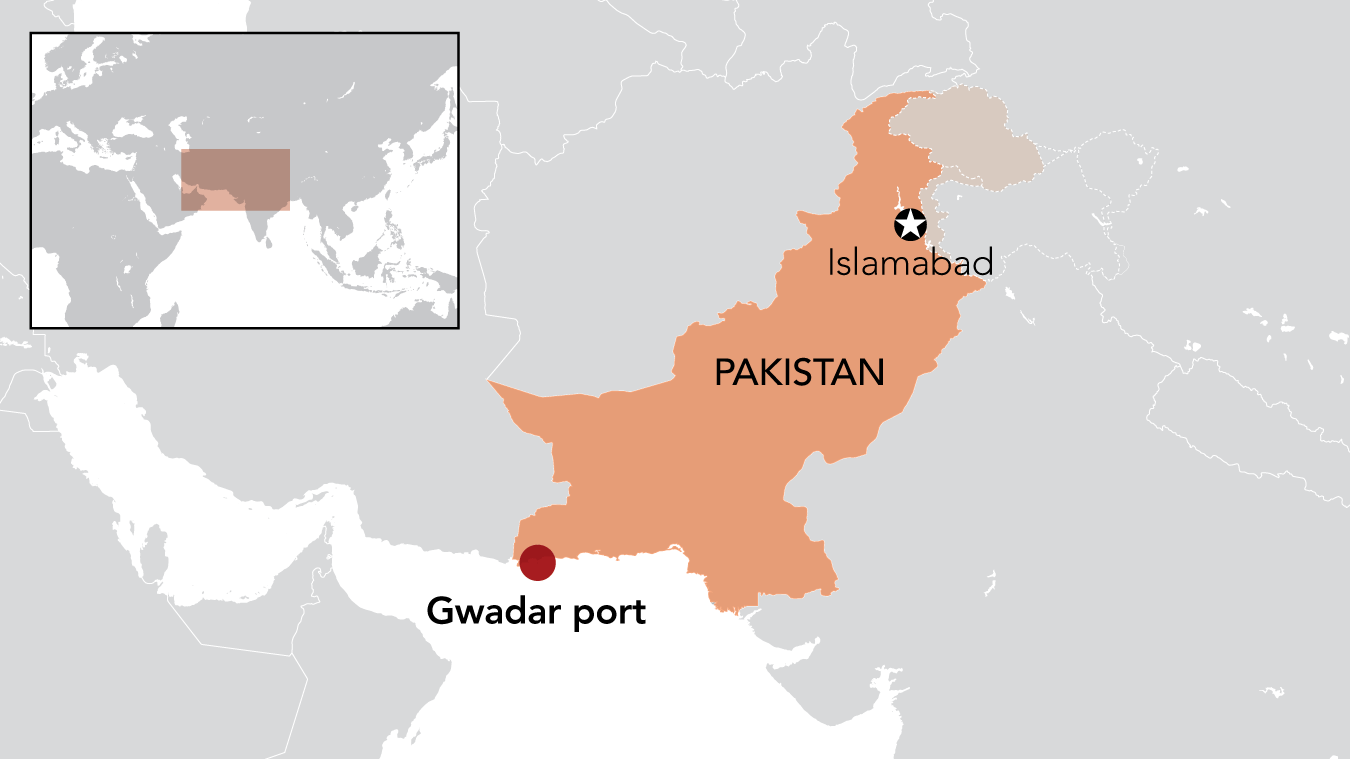
The drive to Pakistan’s port of Gwadar takes seven and a half hours from Karachi via the Makran coastal highway. Much of the 600-km route is deserted, with no restaurants, restrooms or even fuel stations. On a recent journey, around 200 vehicles in total could be counted during the entire drive.

Arriving in the city on Pakistan’s Indian Ocean coast, Chinese and Pakistani flags are ubiquitous, and Chinese-financed construction projects loom, but the city is spookily devoid of economic activity. Near the seafront, broad avenues are curiously empty of vehicles. Inside the city center, the roads are narrow, congested and covered with foul smelling drain water, with few multistory buildings aside from the Chinese-built port compound. 

It is hard to visualize Gwadar as the launch pad of a new global paradigm, but that is what Beijing would have the world believe.

Nine years ago it was plucked out of obscurity —  a backwater in Pakistan’s restive Balochistan region — and presented as China’s commercial window onto the Indian Ocean, a hub for regional integration under the Belt and Road Initiative, which was to harness the juggernaut of the Chinese economy to the goal of Asian economic development. 
 

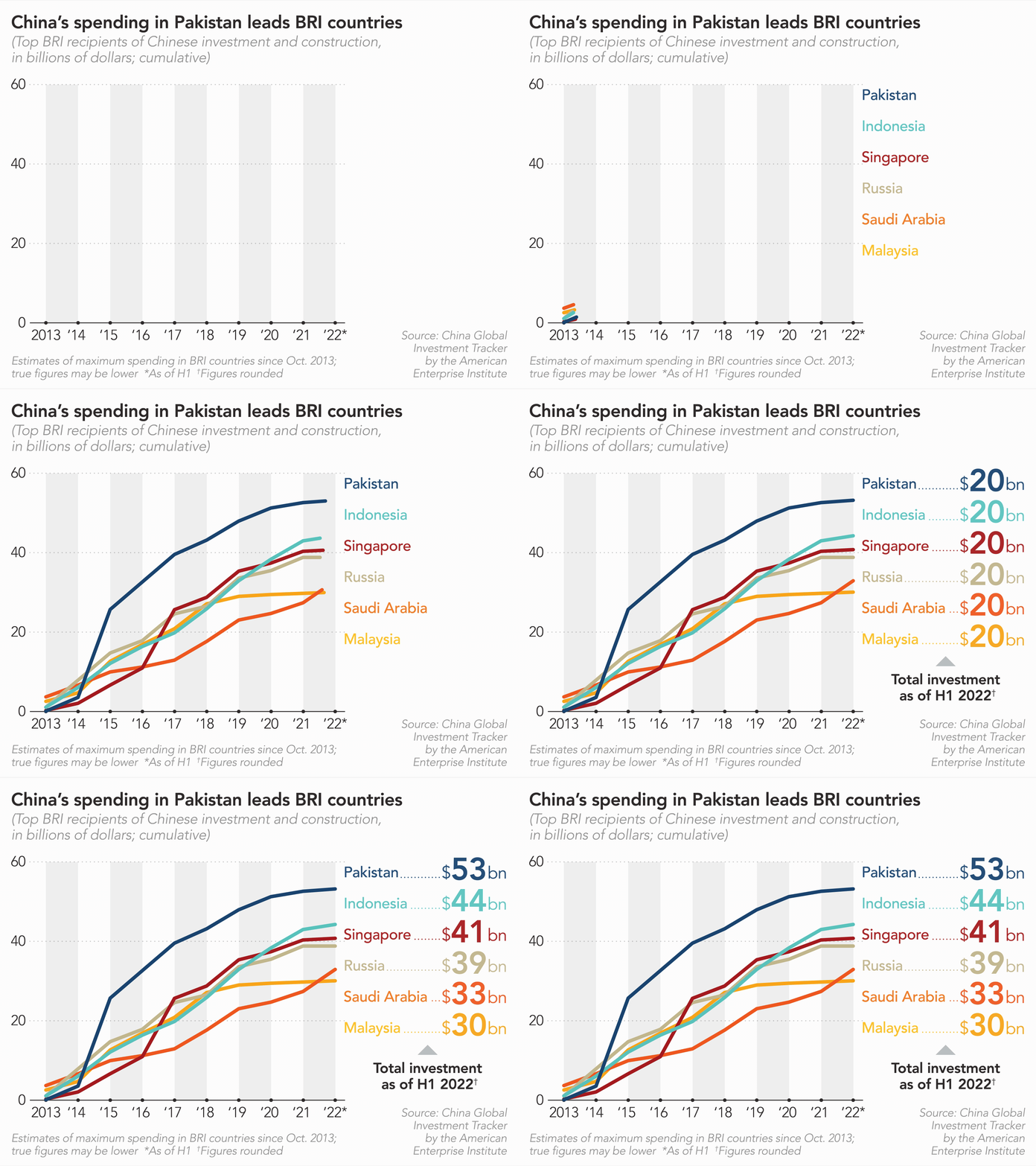
The BRI is an audacious program of lending, aid and infrastructure contracts totaling over $880 billion, according to the American Enterprise Institute.

The initiative, which includes pledges to 149 countries, aims to promote Chinese-led regional integration — and sow economic dependence on Beijing.

First announced in a speech by Chinese President Xi Jinping in 2013 as the “Silk Road,” the BRI was fleshed out in April 2015 with the announcement of the China-Pakistan Economic Corridor (CPEC), stretching from Gwadar to the Chinese city of Kashgar, in Xinjiang. The CPEC showcased the China-Pakistan “all-weather friendship” with $46 billion in pledged funds that has since grown to $50 billion. It was to be the backbone of the now renamed Belt and Road Initiative.

Tiếp tục đọc “Road to nowhere:China’s Belt and Road Initiative at tipping point”

Arctic is warming nearly four times faster than the rest of the world

theconversation.com

The Earth is approximately 1.1℃ warmer than it was at the start of the industrial revolution. That warming has not been uniform, with some regions warming at a far greater pace. One such region is the Arctic.

new study shows that the Arctic has warmed nearly four times faster than the rest of the world over the past 43 years. This means the Arctic is on average around 3℃ warmer than it was in 1980.

This is alarming, because the Arctic contains sensitive and delicately balanced climate components that, if pushed too hard, will respond with global consequences.

Why is the Arctic warming so much faster?

A large part of the explanation relates to sea ice. This is a thin layer (typically one metre to five metres thick) of sea water that freezes in winter and partially melts in the summer.

The sea ice is covered in a bright layer of snow which reflects around 85% of incoming solar radiation back out to space. The opposite occurs in the open ocean. As the darkest natural surface on the planet, the ocean absorbs 90% of solar radiation.

When covered with sea ice, the Arctic Ocean acts like a large reflective blanket, reducing the absorption of solar radiation. As the sea ice melts, absorption rates increase, resulting in a positive feedback loop where the rapid pace of ocean warming further amplifies sea ice melt, contributing to even faster ocean warming.

Tiếp tục đọc Arctic is warming nearly four times faster than the rest of the world

Why Salman Rushdie’s ‘The Satanic Verses’ remains so controversial decades after its publication

theconvesrsation.com

Author Salman Rushdie is in the hospital with serious injuries after being stabbed by a man at an arts festival in New York State on Aug. 12, 2022. The following article was published on the 30th anniversary of the release of The Satanic Verses.

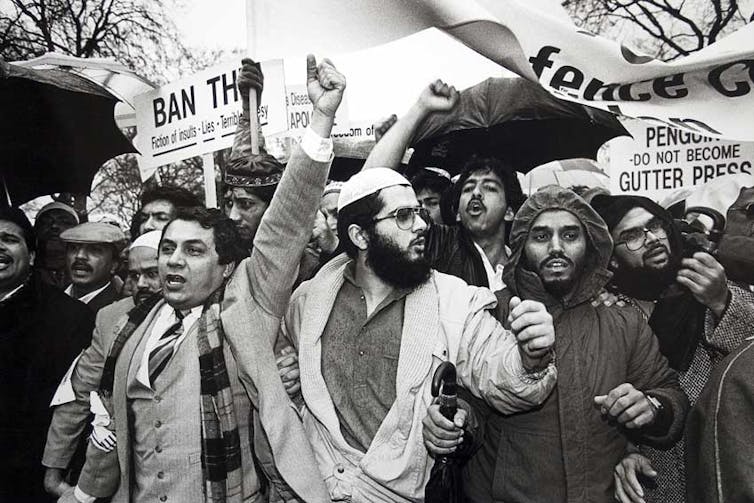
One of the most controversial books in recent literary history, Salman Rushdie’s “The Satanic Verses,” was published three decades ago this month and almost immediately set off angry demonstrations all over the world, some of them violent.

A year later, in 1989, Iran’s supreme leader, the Ayatollah Khomeiniissued a fatwa, or religious ruling, ordering Muslims to kill the author. Born in India to a Muslim family, but by then a British citizen living in the U.K., Rushdie was forced to go into protective hiding for the greater part of a decade.

Angry demonstrators protest against the book in 1989. Robert CromaCC BY-NC-SA

What was – and still is – behind this outrage?

Our mission is to share knowledge and inform decisions.

About us

The controversy

The book, “Satanic Verses,” goes to the heart of Muslim religious beliefs when Rushdie, in dream sequences, challenges and sometimes seems to mock some of its most sensitive tenets.

Muslims believe that the Prophet Muhammed was visited by the angel Gibreel – Gabriel in English – who, over a 22 year period, recited God’s words to him. In turn, Muhammed repeated the words to his followers. These words were eventually written down and became the verses and chapters of the Quran.

Tiếp tục đọc Why Salman Rushdie’s ‘The Satanic Verses’ remains so controversial decades after its publication

58% of human infectious diseases can be worsened by climate change – we scoured 77,000 studies to map the pathways

theconversation.com

Published: August 8, 2022 4.00pm BST

Climate change can exacerbate a full 58% of the infectious diseases that humans come in contact with worldwide, from common waterborne viruses to deadly diseases like plague, our new research shows

Our team of environment and health scientists reviewed decades of scientific papers on all known pathogenic disease pathogens to create a map of the human risks aggravated by climate-related hazards.

The numbers were jarring. Of 375 human diseases, we found that 218 of them, well over half, can be affected by climate change.

Flooding, for example, can spread hepatitis. Rising temperatures can expand the life of mosquitoes carrying malaria. Droughts can bring rodents infected with hantavirus into communities as they search for food.

With climate change influencing more than 1,000 transmission pathways like those and climate hazards increasingly globally, we concluded that expecting societies to successfully adapt to all of them isn’t a realistic option. The world will need to reduce the greenhouse gas emissions that are driving climate change to reduce these risks.

More Vietnamese willing to donate organs after death

vnexpress.net

By Le Nga   August 10, 2022 | 08:08 am GMT+7

More Vietnamese willing to donate organs after death

A doctor checks the eyes of a 53-year-old woman in Vietnam after she received corneas from a brain-dead man at a hospital in HCMC. Photo by VnExpress/Thu AnhThe number of people registered to donate organs after brainstem death has kept increasing over the years to almost 50,000.

When the Vietnam National Coordinating Center for Human Organ Transplantation was established in 2014, it received just 200 registrations, most including center officials and staff while the rest comprised medical workers.

Tiếp tục đọc “More Vietnamese willing to donate organs after death”

Cyber slavery: inside Cambodia’s online scam gangs –

Illicit industry traffics thousands of victims from China through Southeast Asia

“The videos provide a window into the dark world run by transnational criminal networks able to smuggle people from China, through Vietnam and into Cambodia and Myanmar”

SHAUN TURTON, Contributing WriterSEPTEMBER 1, 2021 06:00 JST

PHNOM PENH — The first punch lands on the left side of the young man’s face, the second on the right.

Several more follow. Knees strike his stomach. He cannot defend himself, his hands are cuffed. His attacker, face outside the frame, has his fist wrapped in cloth.

He drags his victim by the lapels into the middle of the frame, faces him to the camera and tells him to speak.

“Dad, I’m in Cambodia, I’m not inside of China,” says the young man, through tears, his voice breaking and blood streaming from his nose. “I beg you, please send money.”

The ransom video, which was sent to the victim’s parents, was one of several shown to Nikkei Asia by Li*, a person who helps rescue human trafficking victims in Cambodia.

This ransom video supplied to Nikkei shows a handcuffed man being beaten with a stick while other victims watch in horror. 

Another video shows a shirtless man cuffed on the ground being beaten with a stick while two more captives, handcuffed to a nearby window grill, watch on in terror. In a third, a grounded man, a foot on his neck, writhes in pain as he is electrocuted with a Taser.

The videos provide a window into the dark world run by transnational criminal networks able to smuggle people from China, through Vietnam and into Cambodia and Myanmar.

Tiếp tục đọc “Cyber slavery: inside Cambodia’s online scam gangs –”

Take-away food packaging makes up most plastic waste in Vietnam: survey

vnexpress.net

By Minh Nga   July 28, 2022 | 08:00 am GMT+7

Take-away food packaging makes up most plastic waste in Vietnam: survey

Take-away food and drink packaging is dumped in a public site in Thu Thiem New Urban Area in HCMC, May 2022. Photo by VnExpress/Quynh TranGarbage from take-away food and drinks make up 44 percent of plastic waste found at surveyed sites in Vietnam, according to the World Bank.

Plastic waste at both surveyed river and coastal sites across Vietnam came mostly from take-away-related sources.

Take-away related waste accounted for 43.6 percent in number and 35.1 percent in weight of the total plastic waste, followed by fisheries-related waste (32.6 percent in number and 30.6 percent in weight), and household-related waste (21.6 percent in number and 22.8 percent in weight), according to a World Bank report released this week.Total amount of plastic waste by source on surveyed sites in Vietnam2020-2021Take-away related wasteTake-away related wasteFisheries related waseFisheries related waseHousehold related wasteHousehold related wasteAgriculture related-wasteAgriculture related-wasteSanitary and medical related wasteSanitary and medical related wasteTake-away related waste●

 volume (%): 43.6

Tiếp tục đọc “Take-away food packaging makes up most plastic waste in Vietnam: survey”

Cần thay đổi thói quen đặt đồ ăn online để giảm rác thải nhựa ra môi trường

(VTC News)

Xu hướng gọi đồ ăn trực tuyến trong giai đoạn dịch COVID-19 làm gia tăng chóng mặt lượng rác thải nhựa, tạo áp lực nặng nề đến môi trường toàn cầu.

Theo thống kê của Bộ Tài nguyên và Môi trường, bình quân mỗi hộ gia đình sử dụng khoảng 1 kg túi nilon mỗi tháng. Lượng chất thải nhựa và túi nilon hiện tại chiếm khoảng từ 8 – 12% chất thải rắn sinh hoạt, nhưng chỉ có khoảng từ 11 – 12% trong số đó được xử lý tái chế. Số còn lại chủ yếu được chôn lấp, đốt và thải ra ngoài môi trường. Vậy đâu là giải pháp để xử lý rác thải nhựa thông minh và hiệu quả.

Tiếp tục đọc “Cần thay đổi thói quen đặt đồ ăn online để giảm rác thải nhựa ra môi trường”

Human disruption to Earth’s freshwater cycle has exceeded the safe limit 

theconversation.com

Green water – the rainwater available to plants in the soil – is indispensable for life on and below the land. But in a new study, we found that widespread pressure on this resource has crossed a critical limit.

The planetary boundaries framework – a concept that scientists first discussed in 2009 – identified nine processes that have remained remarkably steady in the Earth system over the last 11,700 years. These include a relatively stable global climate and an intact biosphere that have allowed civilisations based on agriculture to thrive. Researchers proposed that each of these processes has a boundary that, once crossed, puts the Earth system, or substantial components of it, at risk of upset.

Tiếp tục đọc “Human disruption to Earth’s freshwater cycle has exceeded the safe limit “

Bé 10 tuổi mất mạng sau khi cứu 4 em khỏi cháy nhà

vnexpress.net

Nhà cháy, Phú Quý đưa bốn đứa em ra ban công nhờ hàng xóm giải cứu rồi lại lao vào trong bế cậu em út nhưng mắc kẹt và tử vong trong đó.

Khoảng 4h chiều 23/7, người dân ấp 6, xã Vĩnh Lộc A, huyện Bình Chánh phát hiện ngôi nhà gia đình anh Nguyễn Vĩnh Phước đang thuê, bỗng nhiên bốc cháy. Mọi người hô hoán nhau chạy tới phá cửa, đập tường, dội nước dập lửa. Trong nhà, lúc đó có Nguyễn Đào Phú Quý (10 tuổi) cùng 5 đứa em nhỏ. Cậu bé kéo bốn đứa em ra lan can gác lửng và kêu mọi người cứu giúp còn mình tiếp tục lao vào trong nhà để cứu bé út gần một tuổi.

Trong lúc mọi người cố gắng đưa bốn em nhỏ xuống, một cậu bé sinh kế Quý nhất quyết cầm chặt sợi dây, đứng mãi ở lan can nhìn vào trong nhà, chờ anh trai với bé út xuống cùng. Người dân phải kéo mạnh tay mới đưa bé xuống đất an toàn.

Tiếp tục đọc “Bé 10 tuổi mất mạng sau khi cứu 4 em khỏi cháy nhà”

Nearly 1bn people lack access to disability aids

sciedev.net

Almah Kuambu with a prospective assistive technology user during a National Orthotic and Prosthetic Services outreach programme in Popondetta in southern Papua New Guinea.

Almah Kuambu and a prospective assistive technology user during a National Orthotic and Prosthetic Services outreach programme in Popondetta in southern Papua New Guinea. Copyright: National Orthotic and Prosthetic Services (PNG).

Speed read

  • Majority of people who would benefit from assistive technology lack access
  • Devices such as glasses, hearing aids, wheelchairs can be life-changing
  • 3.5 billion people will need assistive technology by 2050

By: Neena Bhandari

[SYDNEY]: Almost one billion children and adults with disabilities, and older people, are unable to access the assistive technology they need, according to a UN report, which calls for more investment in these life-changing products.

Tiếp tục đọc “Nearly 1bn people lack access to disability aids”

Civilians killed as Russia intensifies attacks across Ukraine

Aljazeera.com

Russian forces fire missiles and shells across Ukraine after military announces it is stepping up its onslaught.

A girl and an elderly lady walk among the debris of a destroyed local market after a Russian missile strike in the town of Bakhmut, Donetsk region on July 16, 2022
People walk by debris of a destroyed local market after a Russian missile attack in the town of Bakhmut, Donetsk region, Ukraine [Anatolii Stepanov/AFP]

Published On 16 Jul 202216 Jul 2022

Russian forces have fired missiles and shells at cities and towns across Ukraine after Russia’s military announced it was stepping up its onslaught against its neighbour, with Ukrainian officials reporting that at least 17 more civilians had been killed.

Russian Defence Minister Sergei Shoigu gave “instructions to further intensify the actions of units in all operational areas, in order to exclude the possibility of the Kyiv regime launching massive rocket and artillery attacks on civilian infrastructure and residents of settlements in the Donbas and other regions,” his ministry said on Saturday.

Tiếp tục đọc “Civilians killed as Russia intensifies attacks across Ukraine”

The New 14th BRICS Summit Declaration (Brazil, Russia, India, China, and South Africa)

 Jun 28, 2022 Posted by Silk Road Briefing Written by Chris Devonshire-Ellis

By Chris Devonshire-Ellis   

While the G7 group of nations (Canada, France, Germany, Italy, Japan, the United Kingdom, and the United States together with the European Union) has been meeting in Germany, the BRICS nations (Brazil, Russia, India, China, and South Africa) have been meeting in China for the 14th Summit. The contrasts could not be more different – one the grouping of mainly white, powerful Western nations, representing contemporary global leadership, the other a grouping of globally powerful emerging markets wanting a larger say in the developing world. The BRICS nations differ from the G7 in two main factors, most notably in the populations they serve – 3 billion as opposed to the G7’s 987 million (including the EU), and GDP, where the G7’s GDP is currently US$33.93 trillion and the BRICS about US$23.5 trillion.

Western economists as a result tend to talk up the G7’s role in global financial strength however the growth rates of both the G7 and BRICS predicted by the IMF suggest that the latter could be responsible for 50% of all global trade by the 2030’s. This means that paying attention to the BRICS consensus leads to some direction over how the global economy is likely to change over the next decade.

At present, the G7 appear determined to continue with the existing world order, which China and Russia in particular view as ‘unipolar’, meaning centered around the United States and directed by whatever US foreign, global and domestic policies are at the time. Both countries (and others) are looking for a more inclusive role in global affairs as befits their status. China for example is the world’s second largest economy, and India the fifth. Yet neither have the percentage say in global financial institutions such as the World Bank and IMF they would like – hence the development of alternative policy banks such as the Asian Infrastructure Investment Bank and the BRICS own New Development Bank. There are also accusations that global institutions such as the United Nations (based in New York) has begun to be too influenced by Washington’s policies than global ones. Calls for reform are increasingly being heard.

Tiếp tục đọc “The New 14th BRICS Summit Declaration (Brazil, Russia, India, China, and South Africa)”

India & China Continue to Lead –as World Population Projected to Reach 8.0 Billion

ipsnews.net

Credit: Freepik

UNITED NATIONS, Jul 11 2022 (IPS) – India and China, two Asian nuclear powers who are also longstanding rivals embroiled in the geo-politics of the Indian Ocean region, have remained two of the world’s most populous nations accounting for over a billion people each.

But as the world’s population reaches the 8.0 billion mark, come November, India is projected to surpass China.

The current numbers stand at 1.44 billion people in China and 1.39 billion in India. But the numbers are expected to change as India races ahead of China. The US ranks third with over 335 million people. By the end of last yar, the world’s total population was approximately 7.9 billion.

According to a report in the New York Times July 9, China is going through a “demographic crisis”. With abortion and reproductive health heavily centered on the Chinese Communist Party, the CCP now wants women to have multiple children abandoning the country’s longstanding one-child policy.

Tiếp tục đọc “India & China Continue to Lead –as World Population Projected to Reach 8.0 Billion”

Country Climate and Development Report for Vietnam

worldbank.org

Vietnam CCDR Report

Vietnam is increasingly seeing its development affected by climate change and now faces critical questions about how to respond. The Vietnam Country Climate and Development Report proposes that Vietnam shift its development paradigm by incorporating two critical pathways – resilient pathway and decarbonizing pathway – that will help the country balance its development goals with increasing climate risks.

After more than two decades of steady growth, Vietnam has set an ambitious goal of reaching high-income status by 2045. It has been recognized in the 2021-2030 Socioeconomic Development Strategy that the country’s economic transformation will greatly depend on better management of natural capital – the extensive stocks of agricultural, forest, and mineral resources that have helped drive development.

Yet Vietnam, with over 3,200 km of coastline and many low-lying cities and river delta regions, is one of the most vulnerable countries in the world to climate change. Climate change impacts  – mainly higher and more variable temperatures and sea level rise  – are already disrupting economic activity and undermining growth. Initial calculations suggest that Vietnam lost $10 billion in 2020, or 3.2 percent of GDP, to climate change impacts.

Tiếp tục đọc “Country Climate and Development Report for Vietnam”