Du học sinh Việt khởi nghiệp với mã nguồn mở ở Singapore

TTO – Đến Singapore du học, Đặng Hồng Phúc chọn đảo quốc này làm nơi khởi nghiệp trong lĩnh vực công nghệ thông tin.

Du học sinh Việt khởi nghiệp với mã nguồn mở ở Singapore - Ảnh 1.

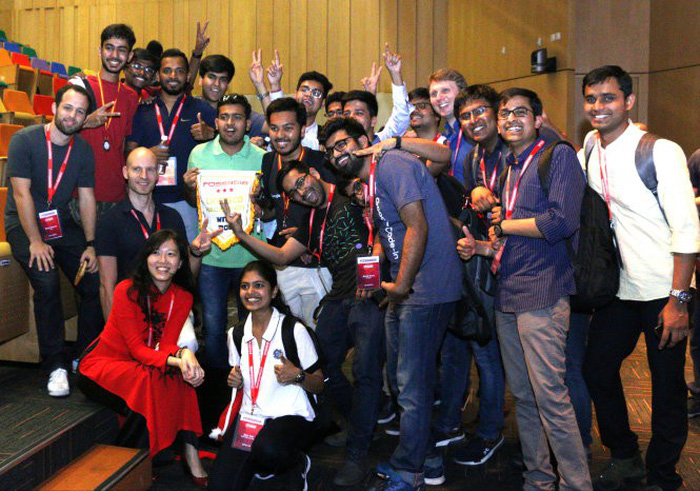
Hồng Phúc (áo dài, ngồi) chủ trì hội nghị mã nguồn mở với sự tham gia của các kỹ sư đến từ Ấn Độ, Singapore, Việt Nam… – Ảnh: NVCC

Dù khởi nghiệp thất bại hay sản phẩm “chết” đều mang về cho startup những bài học quý giá. Nếu bạn không bắt đầu, không vấp ngã thì sẽ không bao giờ học được gì” – Đặng Hồng Phúc

Cô gái người Cần Thơ 31 tuổi đã mở văn phòng ở Singapore đầu năm 2017 để bắt đầu cho hành trình khởi nghiệp của mình.

Nhiệt huyết với mã nguồn mở (open source), Phúc đã kết nối cộng đồng FOSSASIA hơn 20.000 thành viên – tự nguyện chia sẻ kiến thức công nghệ, hoàn thiện các giải pháp phục vụ nghiên cứu khoa học, giáo dục, thương mại…

Công ty của Phúc cũng là đối tác của Google trong nhiều sự kiện trại hè lập trình tại châu Á. Phúc và cộng sự cũng bắt đầu khởi nghiệp với hai sản phẩm là Trí tuệ nhân tạo mã nguồn mở (không độc quyền) và Phòng thí nghiệm mở (bộ sản phẩm giáo dục cho học sinh THPT).

* Tại sao Phúc chọn Singapore khởi nghiệp?

1,200 megawatt Vietnam coal plant gets funding, but Standard Chartered pulls out over climate policy conflict

The London-headquartered bank withdrew from the US$1.87 billion coal-fired power plant’s financing consortium, but eight other banks, including Singapore’s OCBC and DBS and Malaysia’s Maybank, closed the deal.

eco-business_What will be one of Vietnam’s largest coal-fired power stations has secured enough funding to get built, but a key member of the financing syndicate has pulled out following a campaign that highlighted a major conflict with the bank’s climate policy.

Financing closed on the US$1.87 billion, 1,200 megawatt Nghi Son 2 coal-fired power plant last week. But London-headquartered Standard Chartered Bank—which was initially part of a consortium of nine banks that includes Singapore’s Oversea-Chinese Banking Corporation (OCBC) and DBS, Malaysia’s Maybank and Japan Bank for International Cooperation—was absent from the final list of financiers.

A campaign by green groups Greenpeace and Market Forces pointed out that by financing the coal plant, StanChart was in breach of its own policy on energy and climate change. That policy rules out providing loans for coal plants above a certain emissions intensity.

The coal financing deal also goes against the Equator Principles, a framework for banks to assess the environmental and social risk of the infrastructure projects they finance, that StanChart signed in 2003.

Vietnam is well-placed for clean energy investment, but Singapore’s major banks continue to miss opportunities to fund a clean energy development pathway, instead locking in polluting coal for decades to come.

Julien Vincent, executive director, Market Forces

Tiếp tục đọc “1,200 megawatt Vietnam coal plant gets funding, but Standard Chartered pulls out over climate policy conflict”

The world’s required reading list: The books that students read in 28 countries

reading2

This compilation of reading assigned to students everywhere will expand your horizons — and your bookshelves.

In the US, most students are required to read To Kill a Mockingbird during their school years. This classic novel combines a moving coming-of-age story with big issues like racism and criminal injustice. Reading Mockingbird is such an integral part of the American educational experience that we wondered: What classic books are assigned to students elsewhere?

We posed this question to our TED-Ed Innovative Educators and members of the TED-Ed Community. People all over the globe responded, and we curated our list to focus on local authors. Many respondents made it clear in their countries, as in the US, few books are absolutely mandatory. Below, take a look at what students in countries from Ireland to Iran, Ghana to Germany, are asked to read and why. [Note: To find free, downloadable versions of many of the books listed below, search Project Gutenberg.]

Afghanistan

Quran
What it’s about: The revelations of God as told to the prophet Muhammad, this is the central religious text of Islam and remains one of the major works of Arabic literature.
Why it’s taught: “Overall, there is no culture of reading novels in my country, which is sad,” says Farokh Attah. “The only book that must be read in school is the holy Quran, and everyone is encouraged to read it starting from childhood.” Tiếp tục đọc “The world’s required reading list: The books that students read in 28 countries”

Remembering Agent Orange this Earth Day

The legacy of Agent Orange/dioxin continues to impact our veterans and the Vietnamese.  Since 1991, scientists at the United States Institute of Medicine have shown dioxin to be a risk factor in a growing number of illnesses and birth defects, and their research is corroborated by the work of Vietnamese scientists. Tiếp tục đọc “Remembering Agent Orange this Earth Day”

Natural selection gave a freediving people in Southeast Asia bigger spleens

Date:April 19, 2018
Source:Cell Press
FULL STORY

This image shows a Bajau diver hunting fish underwater using a traditional spear.
Credit: Melissa Ilardo

The Bajau people of Southeast Asia, known as Sea Nomads, spend their whole lives at sea, working eight-hour diving shifts with traditional equipment and short breaks to catch fish and shellfish for their families. In a study published April 19 in the journal Cell, researchers report that the extraordinary diving abilities of the Bajau may be thanks in part to their unusually large spleens. The adaptation, the researchers say, is a rare example of natural selection in modern humans — and one that could provide medically relevant insight into how humans manage acute hypoxia.

Tiếp tục đọc “Natural selection gave a freediving people in Southeast Asia bigger spleens”

How do we control dangerous biological research?

Filippa Lentzos

Người Việt Nam đầu tiên nhận giải thưởng môi trường Goldman Environmental Prize,

Diễn văn lễ trao giải (Nguỵ Thị Khanh – Việt Nam  từ 1:1:00 – 1:10:00)

Goldmanprize

Ngụy Thị Khanh đã sử dụng các nghiên cứu khoa học và hợp tác với các cơ quan nhà nước Việt Nam nhằm thúc đẩy các kế hoạch phát triển năng lượng dài hạn bền vững ở Việt Nam. Nêu bật những phí tổn và tác động môi trường của nhiệt điện than, cô đã hợp tác với các cơ quan chức năng nhằm giảm sự lệ thuộc vào than và hướng tới một tương lai năng lượng xanh hơn.

Những hiểm họa rõ ràng của năng lượng than

Nền kinh tế phát triển bùng nổ đã khiến cho nhu cầu điện của Việt Nam tăng khoảng 12%/năm trong thập kỷ qua. Việt Nam là một trong bốn nước châu Áđứng đầu thế giớivề xây dựng mới nhiệt điện than. Sau khi đã khai thác gần hết tiềm năng thủy điện, năm 2011 chính phủ Việt Nam đã chuyển sang phát triển nhiệt điện than và điện hạt nhân nhằm đáp ứng nhu cầu năng lượng trong tương lai. Một lượng khá lớn than sử dụng ở Việt Nam là than nhập khẩu, làm gia tăng sự lệ thuộc của đất nước vào các nguồn nhập khẩu đắt đỏ.Là một loại nhiên liệu phát điện gây ô nhiễm nhất, than đá gây ra 40% lượng phát thải khí nhà kính toàn cầu và là một nguồn chủ yếu gây ô nhiễm không khí và nước. Tiếp tục đọc “Người Việt Nam đầu tiên nhận giải thưởng môi trường Goldman Environmental Prize,”

Goldman environmental prize: top awards dominated by women for first time

theguardian.com

Winners are all grassroots activists who have taken on powerful vested interests

Goldman environment prizewinners 2018: (clockwise from top left) Manny Calonzo, Francia Márquez, Nguy Thi Khanh, LeAnne Walters, Makoma Lekalakala and Liz McDaid, Claire Nouvian.
 Goldman environment prizewinners 2018: (clockwise from top left) Manny Calonzo, Francia Márquez, Nguy Thi Khanh, LeAnne Walters, Makoma Lekalakala and Liz McDaid, Claire Nouvian. Photograph: 2018 Goldman Environmental Prize

The world’s foremost environmental prize has announced more female winners than ever before, recognising the increasingly prominent role that women are playing in defending the planet.
Tiếp tục đọc “Goldman environmental prize: top awards dominated by women for first time”

Honoring Students’ Emotional Response to Complex Global Issues

Editor’s Note: For years, Noah Zeichnera National Board-certified social studies and Spanish teacher at Ingraham High School in Seattle, Washington, taught about complex global issues, including water and pollution, in his classroom. The urgency in teaching these topics renewed itself when he watched Chris Jordan’s new documentary ALBATROSS. Here he interviews Chris Jordan about his film and shares tips for teaching about difficult and emotional topics in the classroom. 

By guest blogger Noah Zeichner

UNSDG14.pngUN Sustainable Development Goal (SDG) #14 (Life Below Water) is to conserve and sustainably use the oceans, seas, and marine resource. While only a tiny portion of Goal 14’s targets address pollution, it is widely known that the problem is immense, if not catastrophic. On World Water Day this year, the journal Scientific Reports published a study that claims that the Great Pacific Garbage Patch is four to sixteen times larger than first thought, covering an area about four times the size of California. The estimates now are that 87,000 tons of plastic debris are floating in the Pacific and that approximately 94% of the 1.8 million trillion pieces of plastic are microplastics. At the same time, more than three quarters of the total mass of the Garbage Patch were found to be much larger pieces of plastic. These larger pieces will likely break down into nearly invisible microplastics over time.
Tiếp tục đọc “Honoring Students’ Emotional Response to Complex Global Issues”

Is Earth’s ozone layer still at risk? 5 questions answered

theconversation

False-color image of ozone concentrations above Antarctica on Oct. 2, 2015. NASA/Goddard Space Flight Center

Editor’s note: Curbing damage to Earth’s protective ozone layer is widely viewed as one of the most important successes of the modern environmental era. Earlier this year, however, a study reported that ozone concentrations in the lower level of the stratosphere had been falling since the late 1990s – even though the Montreal Protocol, a global treaty to phase out ozone-depleting chemicals, had been in effect since 1989. This raised questions about whether and how human activities could still be damaging the ozone layer. Atmospheric chemist A.R. Ravishankara, who co-chaired a United Nations/World Meteorological Organization Scientific Assessment panel on stratospheric ozone from 2007 to 2015, provides perspective. Tiếp tục đọc “Is Earth’s ozone layer still at risk? 5 questions answered”

Malaysian police adopt Chinese AI surveillance technology

Startup Yitu targets Southeast Asia with wearable face-recognition cameras

Yitu opened its first overseas office in Singapore in January to tap Southeast Asia’s growing market for AI-driven surveillance technology. REUTERS/Edgar Su   © Reuters

asia.nikkei.com

KUALA LUMPUR — Chinese surveillance and security startup Yitu Technology has made its first foray into Malaysia, supplying wearable cameras with artificial intelligence-powered facial-recognition technology to a local law enforcement agency. Tiếp tục đọc “Malaysian police adopt Chinese AI surveillance technology”

Doctor assaulted while treating child patient at Hanoi hospital, Vietnam

For Vietnamese doctors, a punch in the face leaves emotional scars that can’t be healed

e.vnexpress.net

By Tran Van Phuc   April 18, 2018 | 04:44 pm GMT+7

For Vietnamese doctors, a punch in the face leaves emotional scars that can't be healed

A doctor is seen protecting himself from a violent man at Saint Pall Hospital in Hanoi on April 13 in this still image from a camera footage.

Dr Tran Van Phuc was attacked by a patient’s relative 17 years ago, and the recent assault of a colleague has reopened the wound.

Tiếp tục đọc “Doctor assaulted while treating child patient at Hanoi hospital, Vietnam”

Phản ảnh bất cập tại Cục lãnh sự, Bộ Ngoại Giao VN – Cảm ơn Thanh tra Bộ Ngoại Giao đã phản hồi

Bài dưới đây ghi lại bất cập mà chính mình đã chứng kiến tại Cục lãnh sự, Bộ Ngoại Giao Việt Nam, tại Hà Nội. Dưới đây là email mình gửi tới thanh tra Bộ Ngoại Giao để phản ánh sự việc và email trả lời của Bộ Ngoại Giao. (Cảm ơn thanh tra Bộ Ngoại Giao đã phản hồi nhanh chóng). Mong rằng người dân Việt Nam mọi nơi ngày càng tích cực phản ánh với tính xây dựng về các dịch vụ hành chính để giúp nhà nước cải thiện hệ thống dịch vụ hành chính tốt hơn nữa.

Nhờ các bạn chuyển đi rộng rãi để các cơ quan nhà nước Việt Nam  có cơ hội lắng nghe góp ý của người dân nhiều hơn. Cảm ơn các bạn.

ĐTH

Email gửi Thanh tra Bộ Ngoại Giao 


from: Hang Dao 
to: thanhtrabng@mofa.gov.vn
date: Thu, Apr 12, 2018 at 8:12 AM
subject: Phản ánh về hệ thống đăng ký xếp số tại Cục lãnh sự Bô NG

Kính gửi quý Bộ Ngoại Giao Việt Nam,

Tôi là Đào Thị Thu Hằng, công dân Việt Nam, thường trú tại Hà Nội. Tôi có một số phản ánh dưới đây về thủ tục tại Cục lãnh sự Bộ NG, 40 Trần Phú, Ba Đình, kính mong Bộ NG lắng nghe.

Ngày 11/4/2018, tôi đến Cục lãnh sự Bộ NG 40 Trần Phú, Ba Đình, Hà Nội để làm thủ tục hợp pháp hoá lãnh sự cho giấy tờ cá nhân (Lý lịch tư pháp)

Trước khi đi, tôi đã in tờ khai theo hướng dẫn tại https://hopphaphoa.lanhsuvietnam.gov.vn/Legalization/Legalized-Introduction.aspx

Khi đến nơi, vừa vào cửa, có người chỉ cho tôi đăng ký trực tuyến để lấy mã số tại https://hopphaphoa.lanhsuvietnam.gov.vn/Legalization/Legalized-Registration.aspx

Và tôi đã đăng ký trực tuyến tại máy tính trong cục lãnh sự.

Lúc 15h chiều tôi đã xác nhận mã số mã vạch để xếp số. (mã xxxxxx)

Đến 16h, có thông báo của nhân viên qua loa rằng “Đã hết giờ làm việc. Những ai chưa được gọi hôm nay, xin mời mai đến”. Và không thông báo gì thêm.

Lúc đó, ngoài tôi còn ít nhất khoảng 20 cũng đang ngồi chờ phải đứng dậy ra về. Tiếp tục đọc “Phản ảnh bất cập tại Cục lãnh sự, Bộ Ngoại Giao VN – Cảm ơn Thanh tra Bộ Ngoại Giao đã phản hồi”

European Parliament sounds the alarm over developing world debt crisis

Ignoring the warning signs of a growing developing world debt crisis is no longer tenable. [Shutterstock]

The number of poor countries facing major debt crises has doubled since 2013, and only 1 in 5 are now considered to be at low risk of crisis. With some countries in the midst of crisis and others on the brink, meeting the Sustainable Development Goals (SDGs) remains a pipe dream, writes Mark Perera.

Mark Perera is a Senior Networking and Advocacy Officer at European Network on Debt and Development (Eurodad).

The debt burden of developing countries has been rising fast, both in absolute terms, and in relation to economic indicators such as GDP, export earnings, and government revenue – trends are driven by a number of factors. Tiếp tục đọc “European Parliament sounds the alarm over developing world debt crisis”