I'm from Hanoi, Viet Nam.
I'm an author of Dot Chuoi Non (dotchuoinon.com/author/hangbelu/), a blog on Positive thinking, founded by Dr. Tran Dinh Hoanh, an attorney in Washington DC.
I'm a co-founder of Conversations on Vietnam Development - cvdvn.net, a virtual think tank. I am a co-founder of two companies in Viet Nam working on children education services. I advise companies on STEAM education, English language education for children and students in Vietnam.
I'm studying the Buddha's teaching and the teaching of Jesus. I practice mindful living including meditation.
I hold a PhD on Sustainable Energy Systems from University of Lisbon and Aalto University.
I graduated from Hanoi University of Technology on Environmental Engineering. I obtained a Master degree of the same major from Stanford University and Nanyang Technological University.
My English-language blog at: hangbelu.wordpress/.
I play table tennis as a hobby.
Workers check solar panels of a project in Vietnam. Photo by VnExpress/Annie Le
Vietnam’s plan to pilot a direct power purchase agreement for renewable energy in 2019 has drawn keen interest from investors.
On June 12 this year, at a seminar on renewable energy, the Electricity Regulatory Authority of Vietnam (ERAV) discussed and disclosed information about such a pilot DPPA.
Generally, a DPPA is an agreement between a power generator and a corporate customer in which power is physically delivered and sold to the customer for its operation.
Annan served as UN secretary-general from 1997 to 2006 and was awarded the Nobel Peace Prize in 2001.
Kofi Annan, a former secretary-general of the United Nations and a Nobel Peace Prize laureate, has died aged 80.
The Ghanaian diplomat passed away at a hospital in the Swiss capital, Bern, on Saturday after a “short illness”, his foundation said in a statement.
“Kofi Annan was a global statesman and a deeply committed internationalist who fought throughout his life for a fairer and more peaceful world,” the statement said.
“He was an ardent champion of peace, sustainable development, human rights and the rule of law,” it added.
Annan served as the seventh UN chief for almost a decade, from 1997 to 2006. Having joined in 1962, he was the first staffer to take over the top UN job and the first hailing from sub-Sahara Africa.
In 2001, he received the Nobel Peace Prize jointly with the UN, lauded for “bringing new life to the organisation”.
Những nguy cơ tham nhũng chủ yếu trong ngành năng lượng Viêt Nam là gì? Báo cáo tập trung vào các nguồn tài trợ quốc tế, bao gồm các nguồn tài trợ từ châu Âu.
Mục đích
Nhận dạng những nguy cơ tham nhũng chính trong ngành năng lượng và các tác động đến nhà tài trợ tiềm năng
Nội dung
Tổng quan năng lượng Việt Nam
Tổng quan nguy cơ tham nhũng ở Việt Nam
Nguy cơ tham nhũng trong các nguồn tài trợ quốc tế trong ngành năng lượng
Tài liệu tham khảo
Tóm tắt báo cáo
Dân số tăng, thêm các nhu cầu về hàng hóa và dịch vụ, tốc độ đô thị hoá và các hoạt động kinh tế tăng trưởng nhanh trong lĩnh vực công nghiệp và dịch vụ đang tăng áp lực cho nguồn cung năng lượng ở Việt Nam. Có sẵn một nguồn cung năng lượng đầy đủ và đáng tin cậy là một điều kiện tiên quyết để duy trì tăng trưởng xã hội của đất nước bao gồm tăng trưởng kinh tế và đạt được các mục tiêu phát triển kinh tế xã hội của chính phủ.
This Anti-Corruption Helpdesk brief was produced in response to a query from one of Transparency International’s national chapters. The Anti-Corruption Helpdesk is operated by Transparency International and funded by the European Union.
Query
What are the key corruption risks in the energy sector in Vietnam, with a focus on international budget aid, including aid from European donors?
Purpose
Identify general risks of corruption, especially in the energy sector and determine what they mean for potential donors
Content
Overview of Vietnam’s energy sector
Overview of corruption risks in Vietnam
Corruption risks for budget support in the energy sector
References
Summary
A growing population, a rising appetite for goods and services, rapid urbanisation, and fast growing economic activities in industrial and service sectors are exerting increased pressure on energy supplies in Vietnam. The availability of an adequate and reliable energy supply is an essential prerequisite for maintaining the country’s record of socially inclusive economic growth and achieving the government’s socio-economic development goals. Tiếp tục đọc “CORRUPTION RISKS IN VIETNAM’S ENERGY SECTOR”→
Ascendant middle class gravitates toward high-performance models
ATSUSHI TOMIYAMA and DAISUKE ITO, Nikkei staff writers
Daikin air conditioners on display in a Hanoi store. Strong growth in recent years has created soaring demand from first-time buyers. (Photo by Atsushi Tomiyama)
HANOI/OSAKA — Air conditioner manufacturers around the world are locking horns in Vietnam, whose market has become the second largest in Southeast Asia as rapid economic growth supports a burgeoning middle class.
Vietnam’s market for the cooling systems ranked as Asia’s eighth largest in 2011, excluding Japan and China, with about 660,000 units sold. But the country surpassed Thailand in 2015, and sales of 1.98 million units in 2016 lifted the nation into third behind India and Indonesia. Tiếp tục đọc “Air conditioner makers battle for Vietnam’s red-hot market”→
Saigon Botanic Garden (SBG) was established in 1864 – the first botanic garden in Vietnam. This was the work of French Government in Vietnam, according to a Resolution of 23 March 1864 during the first years of occupation. Mr Germein was appointed to manage and establish the garden. An area of 12 ha. was chosen for the garden, situated a few hundred metres from the city. The ground was leveled and a plant nursery was started. In 1865, Louis Pierre, a herbarium curator from Calcutta Botanic Garden, India was appointed as Director of the Saigon Botanic Garden.
The original aim of the Garden was to grow a mixture of local and exotic species which has been continued to the present day.
In 1877, Marine Correy was appointed Director of the Garden as M. L. Pierre returned to France. M. Corroy published a list of plants in cultivation in the Garden in Annales du Jardin Botanique et de la Ferm‚ exp‚rimentale des Mares 2nd fase Juillet 1878 br. in 4 p. 30-90. The same year, Karl Schroeder also published an article in which 902 species in the botanic garden were cited. In 1898 and 1905, two further lists were published by E. Haffner, a later Director of Garden.
On the 1st January 1919, SBG was affiliated to the Scientific Institute of Indochina (SII) headed by Xavier Salomon. Nguyen Duc Hiep was a specialist who was responsible for living plants and the herbarium. At that time the number of plant species grown was 1,500. Tiếp tục đọc “Saigon Botanic Garden – The First Botanic Garden in Vietnam”→
Providing electricity access for all remains a critical topic in many parts of the developing world. The challenge is especially acute in Southeast Asia, one of the most dynamic regions of the global energy system, but whose rich and varied environment defies one-size-fits-all energy solutions.
Thanks to growing economies and burgeoning and urbanising middle classes, energy demand in Southeast Asia grows at one of the fastest rates in the world. Still, around 65 million people across the ten Association of Southeast Asian Nations (ASEAN) countries are without access to electricity. In a recent special report on the region, we looked in detail at how to close this gap. Tiếp tục đọc “Bringing electricity to all corners of Southeast Asia”→
As hydropower hits problems, China plans renewable energy for region
The Belt and Road Initiative (BRI), China’s ambitious outbound investment strategy which links at least 65 countries along terrestrial and maritime trade corridors, will open massive new opportunities for trade and investment in frontier markets. Energy infrastructure investments are a backbone of BRI, so aligning these investments with sustainable development goals is necessary for China to navigate regional patchworks of social, environmental and economic priorities. Tiếp tục đọc “China plans super-grid for clean power in Asia”→
The power grid as we know it began with isolated power generation systems across the world starting in the 1870s. The growth and unification of the systems into an interconnected AC power ‘grid’ helped raise the quality of life of people from all classes.
Direct Current Beginnings:
DC power systems dominated in the 1870’s and 1880s. “Small” systems were sold to factories around the world, both in urban areas, and remote undeveloped areas for industrial/mining use. Thomas Edison, Charles Brush, and Werner von Siemenslead the industry in DC systems. DC systems powered factories and small downtown areas but did not reach 95% of residents. Electric lighting was a luxury found only in hotels and other businesses as well as in the mansions of people like George Westinghouse and J.P. Morgan. Tiếp tục đọc “The History of Electrification”→
Construction of the first 35 kV power line in the North
In January 1958, the first 35 kV power line (Hanoi – Pho Noi) was built and in the third quarter of the same year was inaugurated and successfully energized. This was a remarkable milestone in the development of the Vietnam power network.
Construction of the first large scale thermal power plant in the North
Chuyển dịch sang phát triển năng lượng tái tạo đang trở thành xu thế tất yếu toàn cầu để ứng phó biến đổi khí hậu và phát triển Xanh. Chương trình “Tuần lễ Năng lượng tái tạo Việt Nam 2018” sẽ được tổ chức bởi Liên minh năng lượng bền vững Việt Nam (VSEA) và Nhóm Công tác về Biến đổi khí hậu (CCWG) trong thời gian từ ngày 21 – 26/8/2018 tại Hà Nội và một số tỉnh thành trong cả nước với một chuỗi sự kiện bao gồm hội thảo, tọa đàm, thăm quan thực địa, triển lãm và các sự kiện song song bên lề liên tiếp diễn ra trong vòng một tuần. Chương trình được đồng hỗ trợ tài chính bởi Liên minh Châu Âu, Đại sứ quán Đan Mạch và Tổ chức Bánh mì cho thế giới. Mục tiêu chính của chương trình năm nay hướng tới:
Tạo diễn đàn cho các bên liên quan đối thoại tìm ra các giải pháp nhằm tháo gỡ những khó khăn và thúc đẩy phát triển năng lượng tái tạo
Tăng cường nhận thức của công chúng về tính khả thi và các lợi ích của Năng lượng tái tạo và kêu gọi hành động
Khởi động và huy động sự quan tâm của các bên liên quan vào thực hiện chương trình Triệu ngôi nhà Xanh vì Việt Nam thịnh vượng.
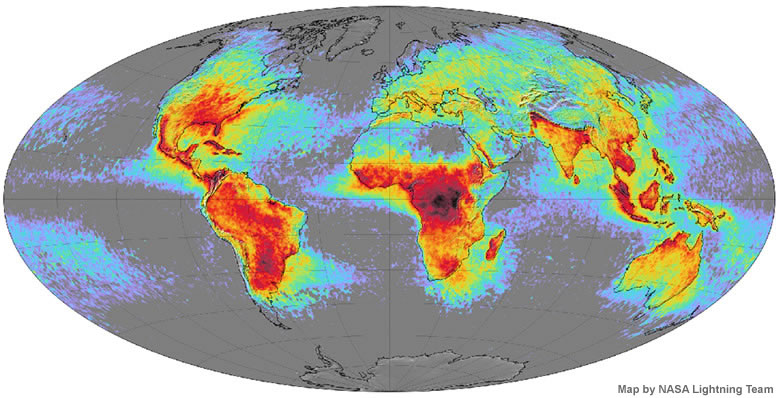
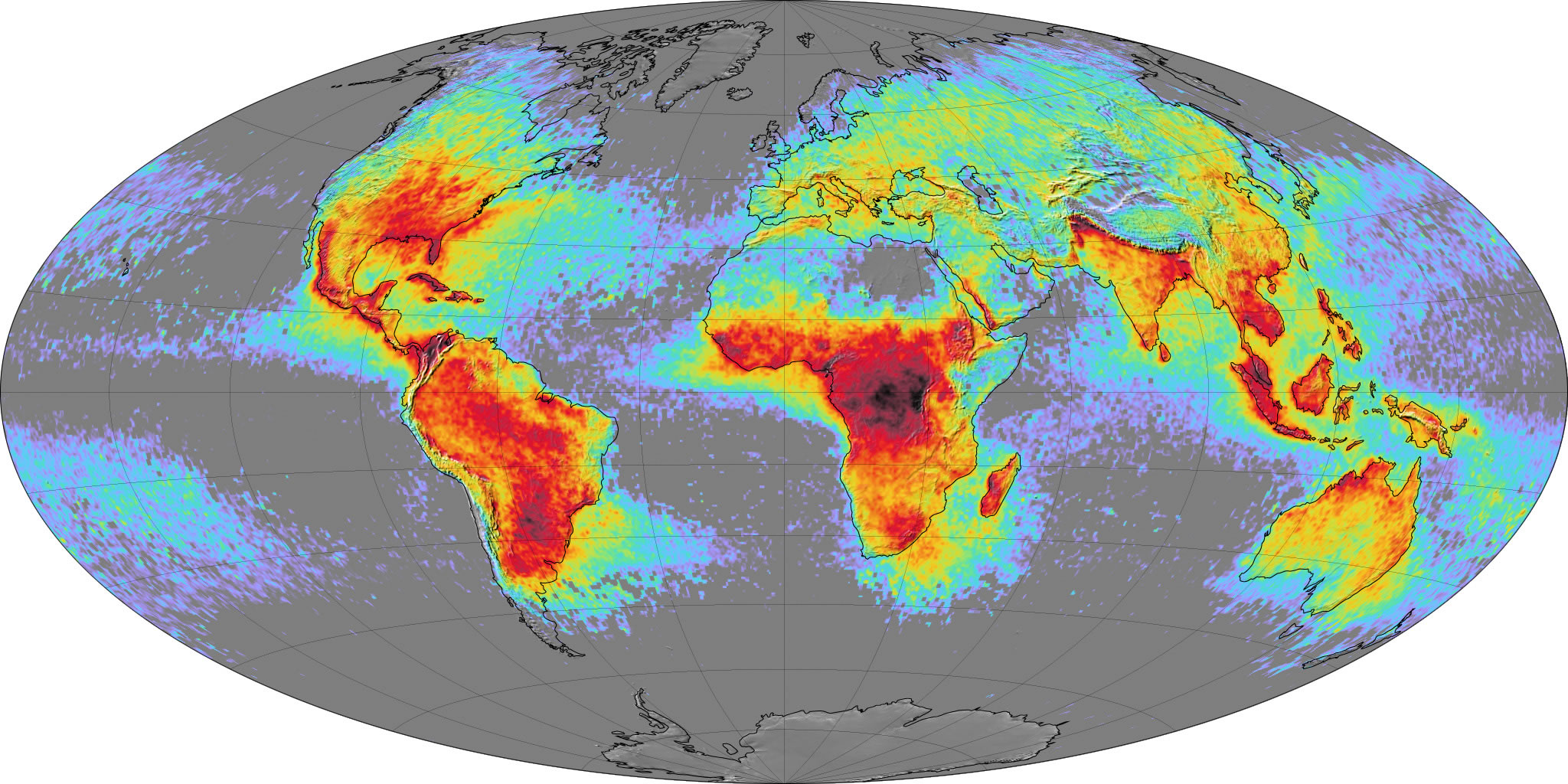
World Lightning Map: The map above shows the average yearly counts of lightning flashes per square kilometer based on data collected by NASA’s Lightning Imaging Sensor on the Tropical Rainfall Measuring Mission satellite between 1995 and 2002. Places where less than one flash occurred (on average) each year are gray or light purple. The places with the largest number of lightning strikes are deep red, grading to black. Enlarge.
What is Lightning?
Lightning is a sudden high-voltage discharge of electricity that occurs within a cloud, between clouds, or between a cloud and the ground. Globally, there are about 40 to 50 flashes of lightning every second, or nearly 1.4 billion flashes per year. These electrical discharges are powerful and deadly. Tiếp tục đọc “World Lightning Map: Lightning is not uniformly distributed across the Earth.”→
Vietnam is situated in the centre of the Asian thunderstorm region – one of three thunderstorm centres in the world. This article gives an overview of thunderstorm activity in Vietnam and results from the research on lightning position over the past year in Institute of Geophysics under the Vietnam Academy of Science and Technology.
Research on thunderstorms aims to observe and study thunderstorm activity over space and time, as well as exploring how and why lightning formulates. Research on lightning position aims to define the density of lightning (number of lightning flash/km2 /year), and also measure other lightning parameters such as the intensity and the slope of the lightning bolt. Lightning density is an important specific quantity for thunderstorm activity in each region. It requires complicated steps to determine a lightning bolts density. This value is different according to region, depending on characteristics in climate terrain and other weather conditions.