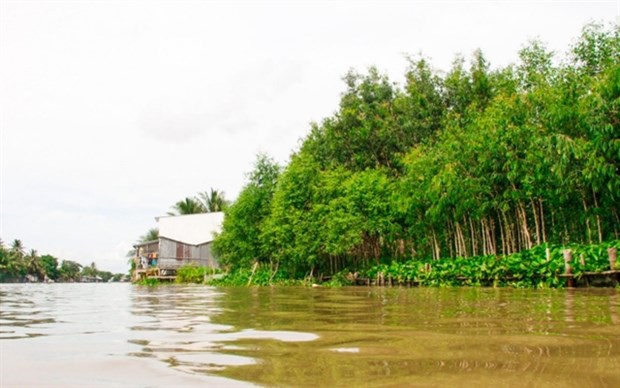
More people in the Mekong Delta are planting trees and building embankments made of natural materials to prevent erosion along rivers and canals.
A natural embankment in Phung Hiep District’s Bung Tau Town in Hau Giang Province (Photo: nhandan)
The delta, which has a dense river and canal network, has faced increasing erosion along rivers and canals in recent years because of human activity and climate change.
In Hau Giang Province, the Irrigation Sub-department built three natural embankments with a total length of 380 metres on a pilot basis to prevent erosion in Phung Hiep District and Nga Bay Town in 2017.
The natural embankments are made by filling eroded areas with soil and setting up a barrier made of cajuput trunks or bamboo between the embankments and water.
Cajuput and crabapple mangrove trees are planted inside the barriers so that their roots prevent soil erosion. Permeable fabric or fine nets are installed outside the barrier to hold the soil.
Does investor protection increase foreign direct investment? A meta‐analysis
par Josef C. Brada, Zdenek Drabek, Ichiro Iwasaki
Abstract
We undertake a meta‐analysis of the effects of international investment agreements for the protection of foreign investors on foreign direct investment using 2107 estimates drawn from 74 studies. Our meta‐analysis finds robust evidence that effect of international investment agreements is so small as to be considered zero. However, our results do not rule out the possibility that the effect of these agreements is, in fact, positive and that current research methods are insufficiently powerful or precise to identify the underlying genuine effect. FDI from developed countries appears to be more responsive to the existence of investment protection, and there is evidence of publication–selection bias in favour of studies that find a positive effect for investor protection.
Does investor protection increase foreign direct investment? A meta‐analysis
Journal of Economic Surveys | 30 September 2020
Does investor protection increase foreign direct investment? A meta‐analysis
par Josef C. Brada, Zdenek Drabek, Ichiro Iwasaki
Abstract
We undertake a meta‐analysis of the effects of international investment agreements for the protection of foreign investors on foreign direct investment using 2107 estimates drawn from 74 studies. Our meta‐analysis finds robust evidence that effect of international investment agreements is so small as to be considered zero. However, our results do not rule out the possibility that the effect of these agreements is, in fact, positive and that current research methods are insufficiently powerful or precise to identify the underlying genuine effect. FDI from developed countries appears to be more responsive to the existence of investment protection, and there is evidence of publication–selection bias in favour of studies that find a positive effect for investor protection.
By Dang Khoa November 1, 2020 | 11:46 am GMT+7 vnexpressVietnamese police during a drill in Hanoi in 2019. photo by VnExpress/Ngoc Thanh.
Vietnam is 10th in this year’s Global Law and Order index that measures people’s perceptions of personal security.
For the report published earlier this week, American analytics firm Gallup asked nearly 175,000 people in 144 countries and territories via telephone and in person about their “confidence in their local police, their feelings of personal safety, and the incidence of theft and assault or mugging in the past year.”
Mckinsey.com In just a few months’ time, the COVID-19 crisis has brought about years of change in the way companies in all sectors and regions do business. According to a new McKinsey Global Survey of executives,1 their companies have accelerated the digitization of their customer and supply-chain interactions and of their internal operations by three to four years. And the share of digital or digitally enabled products in their portfolios has accelerated by a shocking seven years.2 Nearly all respondents say that their companies have stood up at least temporary solutions to meet many of the new demands on them, and much more quickly than they had thought possible before the crisis. What’s more, respondents expect most of these changes to be long lasting and are already making the kinds of investments that all but ensure they will stick. In fact, when we asked executives about the impact of the crisis on a range of measures, they say that funding for digital initiatives has increased more than anything else—more than increases in costs, the number of people in technology roles, and the number of customers.To stay competitive in this new business and economic environment requires new strategies and practices. Our findings suggest that executives are taking note: most respondents recognize technology’s strategic importance as a critical component of the business, not just a source of cost efficiencies. Respondents from the companies that have executed successful responses to the crisis report a range of technology capabilities that others don’t—most notably, filling gaps for technology talent during the crisis, the use of more advanced technologies, and speed in experimenting and innovating.3Tiếp tục đọc “How COVID-19 has pushed companies over the technology tipping point—and transformed business forever”→
Climate change is pushing warmer Atlantic currents into the Arctic and breaking up the usual stratification between warm deep waters and the cool surface. This also makes it difficult for ice to form. Photograph: Alamy Stock Photo
For the first time since records began, the main nursery of Arctic sea ice in Siberia has yet to start freezing in late October.
The delayed annual freeze in the Laptev Sea has been caused by freakishly protracted warmth in northern Russia and the intrusion of Atlantic waters, say climate scientists who warn of possible knock-on effects across the polar region.
Ocean temperatures in the area recently climbed to more than 5C above average, following a record breaking heatwave and the unusually early decline of last winter’s sea ice.
The trapped heat takes a long time to dissipate into the atmosphere, even at this time of the year when the sun creeps above the horizon for little more than an hour or two each day.
Graphs of sea-ice extent in the Laptev Sea, which usually show a healthy seasonal pulse, appear to have flat-lined. As a result, there is a record amount of open sea in the Arctic.
“The lack of freeze-up so far this fall is unprecedented in the Siberian Arctic region,” said Zachary Labe, a postdoctoral researcher at Colorado State University. He says this is in line with the expected impact of human-driven climate change.
Advertisement
“2020 is another year that is consistent with a rapidly changing Arctic. Without a systematic reduction in greenhouse gases, the likelihood of our first ‘ice-free’ summer will continue to increase by the mid-21st century,’ he wrote in an email to the Guardian. Tiếp tục đọc “Alarm as Arctic sea ice not yet freezing at latest date on record”→
The unexpected visit by US Secretary of State Michael Richard Pompeo to Vietnam reflects the development of Vietnam – US relations. Pompeo’s visit to Vietnam took place after his visits to four Asian countries.
According to the Vietnamese Ministry of Foreign Affairs, at the invitation of Deputy Prime Minister and Foreign Minister Pham Binh Minh, US Secretary of State Michael Richard Pompeo officially visited Vietnam on October 29-30 to celebrate the 25th anniversary of Vietnam-US diplomatic relations.



 Abstract
 Vietnamese police during a drill in Hanoi in 2019. photo by VnExpress/Ngoc Thanh.
 CVD
CVD 
