Bà Nguyễn Thị Nhung tại căn nhà của mình ở Long An. – ISDS
Tư vấn pháp luật giúp tăng quyền cho người sở hữu đất
“Giờ tôi rất vui vì các chị của tôi đều đã nhận được giấy chứng nhận quyền sử dụng đất.”
USAID – Tháng 4/2016 — Bà Nguyễn Thị Nhung, 52 tuổi, là một nông dân tại Long An, một tỉnh miền nam thuộc vùng đồng bằng sông Cửu Long. Khi bố bà qua đời năm 2014, bà muốn chia cho bốn người chị gái của mình mỗi người một phần đất canh tác. Do bà là người duy nhất đứng tên trên giấy chứng nhận quyền sử dụng đất cho cả phần đất ở và đất canh tác của bố mẹ nên bà có toàn quyền quyết định chia đất cho các chị em gái. Tiếp tục đọc “Phụ nữ Việt Nam thực hiện được quyền về đất đai – Vietnam’s women farmers realize their land rights”→
Is Vietnam diverting its civilian know-how to create an indigenous nuclear weapons program? Not yet, says the CSS’ Oliver Thränert, but increased tensions or overt conflict with China could lead Hanoi to develop its own nuclear deterrent.
By Oliver Thränert for Center for Security Studies (CSS)
ISN – For many years, the international nuclear non-proliferation regime has been in deep crisis. This became apparent most recently when the ninth Review Conference of the Parties to the Treaty on the Non-Proliferation of Nuclear Weapons (NPT) in May 2015 ended without a common final document. At the same time, a number of threshold countries are planning to begin using nuclear energy for peaceful purposes. In a time of increasing international tensions, some of them might build on know-how acquired through their civilian programs to safeguard their national security needs through a nuclear weapons program in the near future. Vietnam is an interesting case in point. Irrespective of certain delays in the development of its peaceful nuclear program, the country has progressed quite far. At the same time, it is engaged in an increasingly precarious conflict with its main neighbor, nuclear-armed China. Currently, there are no signs of a Vietnamese nuclear weapons program. In the framework of the nuclear non-proliferation regime, the country is a model of transparency and cooperation. But it is uncertain whether this will always remain the case. On the contrary, Hanoi might change its policy if the conflict with China should come to a head while the NPT continues to be weakened.
Vietnam’s strategic situation
Vietnam might complete its first nuclear reactor within a few years, ahead of ambitious neighbors such as Indonesia or Malaysia. The country’s main motivations are its growing energy requirements and the desire to diversify its energy sources. Considerations of prestige may also be a factor. As a threshold nation, Vietnam aims to achieve the same level as Asia’s developed nations. With a view to China, Hanoi probably also wishes to demonstrate the high level of global confidence that the country enjoys in sensitive matters of security policy. Tiếp tục đọc “Nonproliferation and Nuclear Energy: The Case of Vietnam”→
TTO – Nhiều người cho rằng sau vụ nổ kinh hoàng ở Hà Đông, dân kinh doanh phế liệu là vỏ bom mìn ở “chợ bom” xã Diễn Hồng, huyện Diễn Châu tỉnh Nghệ An đã biết sợ.
Phế liệu bom mìn tại các cơ sở kinh doanh phế liệu ở Diễn Hồng năm 2005 – Ảnh: Vũ Toàn
Sau vụ nổ kinh hoàng ở Hà Đông (Hà Nội), chúng tôi tìm đến “chợ bom” ở xã Diễn Hồng, huyện Diễn Châu (Nghệ An) – nơi mà trước đây sắt, thép phế liệu, trong đó có bom, đạn đều được họ mua tuốt luốt (bài “Chợ… bom” , Tuổi Trẻ ngày 25-5-2005). Tiếp tục đọc ““Chợ bom” đã bớt cưa bom”→
The large crater caused by the blast in Hanoi on March 19. Photo: Minh Chien
thanhniennews: The Ministry of Public Security has found traces of explosives and bomb debris at the site of a blast in Hanoi on Saturday that killed four people, injured 10 others and damaged more than 120 houses.
The explosion at about 3.10 p.m. at a scrap metal trading business seriously tore through 36 houses and damaged 95 others, and left a large crater in Van Phu residential area, Ha Dong District, the police said. Many vehicles along the street were damaged too.
Although the police was yet to officially pinpoint the cause of the blast, they speculated that it was ignited when the shop owner tried to cut open a bomb using a blow torch.
One of the perished victims was Pham Van Cuong, 42, who had rent the house for his scrap metal shop since 2013 and reportedly often used a blow torch to cut large scrap metal pieces, police said.
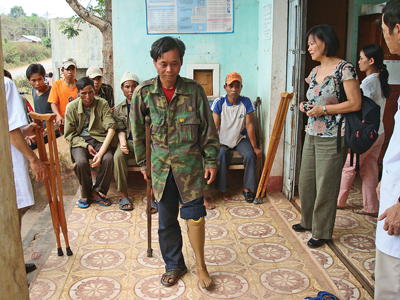
LM – Project RENEW established a mobile outreach program to provide prostheses, orthotics and education to explosive remnants of war survivors in the remote communities of Vietnam.
Susan Eckey, Former Deputy Director General for Humanitarian Affairs, Norwegian Ministry of Foreign Affairs, visits with the P&O team.
Photo courtesy of Dang Quang Toan/Project RENEW.
According to a 2014 report compiled by Vietnam’s Department of Labour, Invalids and Social Affairs, Quang Tri province currently has 37,292 persons with disabilities, 13,023 of whom were disabled by Agent Orange and 5,094 by explosive remnants of war (ERW).1,2,3 Disabled persons living in rural areas often live in poverty and do not have access to basic services. For those with injuries resulting from unexploded ordnance (UXO), prosthetics are difficult to obtain. Tiếp tục đọc “Project RENEW’s Prosthetics and Orthotics Mobile Outreach Program”→
(LLCT) – Cho đến khi kết thúc Chiến tranh lạnh, Mỹ vẫn coi châu Âu là trọng điểm chiến lược. Từ khi Bush (cha) lên cầm quyền, đồng thời với tăng cường thêm lực lượng ở châu Âu, Mỹ bắt đầu chuyển trọng tâm chiến lược toàn cầu sang khu vực châu Á – Thái Bình Dương (CATBD) với mục đích duy trì địa vị siêu cường trong thế kỷ mới. Chiến lược đối với CATBD của chính quyền B.Clintơn bắt đầu rõ nét hơn. Bản tuyên bố toàn diện nhất về chính sách mới đối với khu vực đã được Winston Lord trình bày trước Ủy ban Đối ngoại Thượng viện: Đối với Mỹ, không có khu vực nào quan trọng hơn CATBD và không có khu vực nào khác có tầm quan trọng như thế đối với Mỹ trong thế giới mới.
Transnationalizing Viet Nam Community, Culture, and Politics in the Diaspora
Kieu-Linh Caroline Valverde
“Bridging Asian Studies and Asian American Studies, Transnationalizing Viet Nam is a rich and nuanced study of transnational linkages between Viet Nam and its diaspora in the United States. Through fascinating case studies of Vietnamese popular music productions, Internet virtual communities, diasporic art and community politics, Kieu-Linh Caroline Valverde provides a rare glimpse into how Vietnamese have connected their worlds and made meanings for themselves.”
—Yen Le Espiritu, Professor of Ethnic Studies, University of California, San Diego
temple.edu – Vietnamese diasporic relations affect—and are directly affected by—events in Viet Nam. In Transnationalizing Viet Nam, Kieu-Linh Caroline Valverde explores these connections, providing a nuanced understanding of this globalized community. Valverde draws on 250 interviews and almost two decades of research to show the complex relationship between Vietnamese in the diaspora and those back at the homeland.
Arguing that Vietnamese immigrant lives are inherently transnational, she shows how their acts form virtual communities via the Internet, organize social movements, exchange music and create art, find political representation, and even dissent. Valverde also exposes how generational, gender, class, and political tensions threaten to divide the ethnic community.
Transnationalizing Viet Nam paints a vivid picture of the complex political and personal allegiances that exist within Vietnamese America and shape the relations between this heterogeneous community and its country of origin.
TT – “Bom mìn là thần chết, nhưng công việc của chúng tôi là đi tìm thần chết ấy.
Rà phá bom, mìn luôn đầy rẫy hiểm nguy
14 năm lăn lộn khắp vùng rừng rú của tỉnh Quảng Trị này, chúng tôi đã phát hiện và phá hủy hàng ngàn quả bom, quả đạn, mìn và các vật liệu chưa nổ” – chị Trần Thị Thảo, 39 tuổi, đội trưởng đội 1 của dự án MAG Quảng Trị (viết tắt của Mines Advisory Group – nhóm cố vấn bom mìn do Vương quốc Anh tài trợ), nói.
Trước khi ra hiện trường thực hiện phóng sự này, quy định bắt buộc chúng tôi phải đăng ký nhóm máu của mình với nhân viên y tế để xử lý cấp cứu nếu xảy ra rủi ro. Trên tấm bảng thông tin ở các điểm rà phá bom mìn luôn nổi bật sơ đồ chuyển thương ngắn nhất đến các bệnh viện. Tiếp tục đọc “8 người phụ nữ săn thần chết”→
Tóm lược: Bài viết này phản bác lại những diễn giải hiện có về Ngô Ðình Diệm bằng cách xem xét những hoạt động của ông trong vòng một thập kỷ trước khi ông trở thành lãnh đạo của miền Nam Việt Nam vào năm 1954. Ngô Ðình Diệm đã chủ động tìm cách nắm quyền trong những năm đó, và ông thành công chủ yếu nhờ nỗ lực của chính mình và của những đồng minh người Việt của ông. Cùng thời gian đó, ông và em trai là Ngô Ðình Nhu cũng phác thảo ra viễn kiến đặc biệt về quá trình hiện đại hoá, so rõ cho chúng ta thấy chiến lược xây dựng quốc gia ở miền Nam Việt Nam sau năm 1954. Tiếp tục đọc “Con đường lên nắm quyền của Ngô Đình Diệm, 1945-54 (3 Phần)”→
LM – The main objective of Project RENEW’s Mine Risk Education is the risk of ERW accidents among chilren and adults is reduced and eventually eliminated through education, information, and public awareness in support of EOD quick response.
World War I and World War II-era bombs are still found by the thousands in European countries, even today. According to Spiegel Online, in Germany alone, more than 2,000 tons of aerial bombs and all sorts of munitions ranging from hand grenades and tank mines to artillery shells are recovered each year. So it is impossible – and not necessary – to clean up every bomb and mine in Vietnam. The real goal must be to make Quang Tri safe – which means placing priority on removing cluster bombs, grenades, mortar and artillery rounds, and other small ordnance on the ground or just under the surface – the main items that kill and injure children, farmers, and other adults. Tiếp tục đọc “Mine Risk Education”→
UNDP – Hà Nội, ngày 19 tháng 3 năm 2015 – 170,000 người dân sống ở khu vực gần sân bay Biên Hòa ở miền Nam và các vùng lân cận của căn cứ không quân Phù Cát ở miền Trung sẽ không còn phải đối mặt với nguy cơ bị phơi nhiễm dioxin.
Văn phòng Ban Chỉ đạo Quốc gia (Văn phòng 33) và Chương trình Phát triển Liên Hợp Quốc (UNDP) đã công bố kết quả này trong hội nghị tổng kết dự án tại Hà Nội vào ngày 19 tháng 3 năm 2015. Tại hội nghị, các kết quả chính của dự án “Xử lý dioxin tại các vùng ô nhiễm nặng ở Việt Nam” đã được chia sẻ với Chính phủ và các đối tác phát triển cũng như các chuyên gia, các nhà nghiên cứu trong nước và quốc tế. Tiếp tục đọc “170,000 người thoát khỏi nguy cơ bị phơi nhiễm dioxin”→
For the first time since Vietnam opened up to the world in the late 1980s, the country’s trajectory could shape the future geopolitics of Southeast Asia in significant ways. What that trajectory ought to look like has been a topic of intense discussions among Vietnamese leaders in recent months, as Vietnam gears up for the twelfth Communist Party Congress, expected to take place in early 2016. Tiếp tục đọc “CSIS: Vietnam Eyes Greater International Integration— & That’s Good News for the United States”→
(TNO) Mỹ đang thực hiện chiến lược xoay trục về châu Á nhưng tham vọng này sẽ không thể thành công hoàn toàn chừng nào Washington chưa cho phép… con cá tra của Việt Nam “tự do bơi đến Mỹ”.
Chiến lược xoay trục của Mỹ ở châu Á sẽ không hoàn hảo nếu chỉ nhắm đến vấn đề quân sự – Ảnh: Reuters
Đó nhận định của tờ The Wall Street Journal (Mỹ) trong bài viết ngày 16.7 dưới nhan đề The US Trade Hypocrisy in Vietnam (tạm dịch: Sự ngụy biện của thương mại Mỹ ở Việt Nam) của tác giả Jeffrey Fowler, Phó Đô đốc, Giám đốc Học viện Hải quân Mỹ đã nghỉ hưu. Tiếp tục đọc “Mỹ muốn xoay trục thành công phải để cá tra Việt Nam tự do ‘bơi’”→
TTCT – “Các sinh viên (SV) tài năng sẽ được tiếp cận những chương trình đào tạo chất lượng cao với chi phí hợp lý, bất kể họ xuất thân từ hoàn cảnh kinh tế – xã hội nào”.
Bà Đàm Bích Thủy- Chủ tịch Fulbright Việt Nam. Ảnh VIệt Dũng
Đó là cam kết của ĐH Fulbright VN (FUV) được bà Đàm Bích Thủy – thành viên hội đồng quản trị Quỹ tín thác Sáng kiến ĐH VN, chủ tịch FUV – khẳng định trong bài phỏng vấn riêng của Tuổi Trẻ Cuối Tuần xung quanh những cơ hội và thách thức của mô hình đào tạo này.




 CVD
CVD 