Nghe nội dung chi tiết tại đây:
Tiếp tục đọc “Bom trong phố: Vì sao việc di dời cây xăng vẫn giậm chân tại chỗ?”
Conversations on Vietnam Development

Nghe nội dung chi tiết tại đây:
Tiếp tục đọc “Bom trong phố: Vì sao việc di dời cây xăng vẫn giậm chân tại chỗ?”

The sidewalks along major streets in Ho Chi Minh City’s new urban area have long been a favorite spot for young people to throw their BBQ parties, posing risks to fire safety and environmental hygiene, while local authorities have found it difficult to deal with the situation. Tiếp tục đọc “Roadside BBQ parties a headache in Ho Chi Minh City’s new urban area”
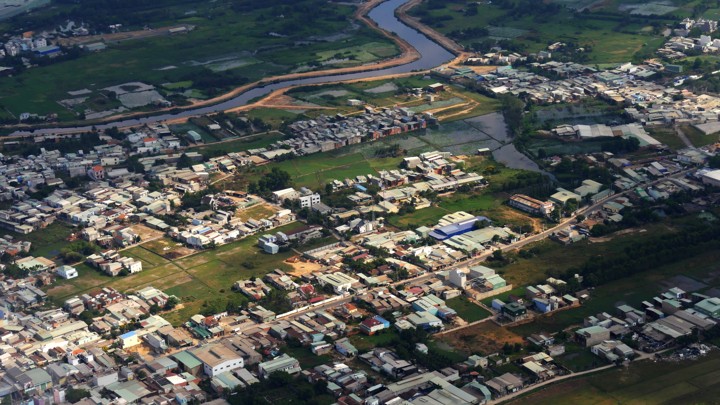
In Ho Chi Minh City, computer analysis of orbital images overlooks some urban communities. To represent them, cities will have to put boots on the ground.
An aerial view of the outskirts of Ho Chi Minh CityRAKSYBH / SHUTTERSTOCK
It turns out to be more complicated than that. When three different research groups (including my own at the University of Southern California) processed almost the same images of Ho Chi Minh City’s rapid urbanization during the 2000s, we produced different results. All three groups agreed on the location of the city center, but mine mapped the city’s periphery differently. That’s the place where most megacities in the global South exhibit their most dramatic physical growth. In particular, we identified more of the informal, self-built housing in the swampier southern area of the city.
Tiếp tục đọc “Satellite Images Can Harm the Poorest Citizens”
TP – Hơn 15 năm qua, “Hòn Ngọc biển Tây” đã thay đổi chóng mặt. Ðạt được một số thành tựu vượt bậc, song Phú Quốc đang phải trả giá cho sự phát triển “nóng” của mình. Ðó là đất đai bị “băm nát”, xã hội nảy sinh nhiều vấn đề phức tạp, trong khi chính quyền huyện đảo tỏ ra bất lực…

Tiếp tục đọc “Đảo ngọc Phú Quốc bị băm nát: Vỡ vụn trước khi thành đặc khu”
LĐO |
Mưa lớn đã giảm nhưng nhiều xã ngoại thành vẫn sống chung trong biển nước. Ngập lụt là câu chuyện “đến hẹn lại lên” của Hà Nội. Trao đổi với PV báo Lao Động GS.TS Trần Viết Ổn – Phó Hiệu trưởng Trường Đại học Thủy lợi nhận định, còn khá lâu nữa người dân ở đây mới hết cảnh ngập.
NN – 11/05/2018, 09:11 (GMT+7) Trong khi ở Thành phố Hồ Chí Minh, người dân Thủ Thiêm đang uất nghẹn, ngất xỉu với những cuộc tiếp xúc cử tri thì ở Hà Nội, nơi có một địa điểm vẫn được gọi là “làng Thủ Thiêm giữa Thủ đô”, hành trình đi đòi công lý vẫn đang miệt mài.
![]() |
| Bữa cơm của người dân Thủ Thiêm ở Hà Nội |
By 2030, more than 40% of the population in the Greater Mekong Subregion will be living in cities. Photo: ADB.
greatermekong – The subregion is one of the least urbanized areas in the world, but its cities are growing and their economic impact is being felt.
Urbanization levels in the Greater Mekong Subregion are low, ranging from 19.5% in Cambodia to 44.2% in Thailand. However, in all GMS countries, urban areas account for a much larger percentage of the gross domestic product (GDP)—at least half in most countries and about 75% in Thailand—than the share of its national populations.
Urbanization growth rates in the subregion range from 4.9% annually in Yunnan Province, People’s Republic of China (PRC) —six times the provincial population growth rate—to a low of 2.6% annually in Myanmar—1.7 times the national population growth rate. Tiếp tục đọc “The Greater Mekong Subregion: Rural no more”
Vietnam is facing numerous challenges caused by rapid urbanization, leaving burdens on its technical and social infrastructure and leading to many severe consequences. In this context, finding solutions for sustainable urban development is one of Vietnam’s current top priorities.

Vietnam is struggling with many challenges caused by its rapid urbanization, which is among the fastest in the region.
There are a total of 800 urban areas across Vietnam with a current urbanization percentage of around 37%. This figure is expected to increase by 50% by 2025. Tiếp tục đọc “Vietnam seeks solutions for problems caused by rapid urbanization”
Hanoi plans to construct a super satellite city by 2030, with a total area of over 17,270ha located in two districts of Thach That and Quoc Oai and Son Tay Town.

The super satellite city on paper.— Photo tienphong.vn
The Hoa Lac super satellite city will be some 30km from Hanoi’s centre.
The plan is part of the master plan of Hoa Lac Urban Area, compiled by the municipal People’s Committee and recently submitted to the municipal People’s Council for approval. Tiếp tục đọc “Super satellite city planned in Hanoi”
![]() A small alley at 48 – 50 Hang Thiec Street. Tiếp tục đọc “Super-small alleys in Hanoi Old Quarter” |

Cu Nguyen Khanh leads a recent HVAC training session under the USAID Vietnam Clean Energy Program. – USAID VCEP
USAID – Engineers and architects learn new ways to save energy
“I really would like to contribute to sector development by promoting energy efficiency principles and methods.”
September 2016—Energy efficiency in the building sector is becoming a key area of interest in Vietnam, where energy consumption is growing quickly as a result of increasing industrialization and urbanization. In 2012, the building sector accounted for 38 percent of the country’s power consumption, and energy demand is expected to increase as the urban population continues to grow. Tiếp tục đọc “Vietnam builds energy efficiency expertise”

Phu Quoc used to be an almost unknown island, but in recent years, the southern beaches of the island have turned into a worldwide vacation paradise thanks to the investment of many domestic and foreign companies. One of the biggest investor is Sun Group, with up to VND20 trillion ($881 million) of investment capital. Tiếp tục đọc “Giant projects transform the face of Phu Quoc”
LĐ – 109 9:22 AM, 14/05/2017
Những giếng Chăm, những miếu mạo, đình chùa ở Nam Ô đang được kiến nghị giữ lại. Dẫu vậy, những di tích này sẽ không còn “sống” bởi đã bị tách khỏi cộng đồng.Ảnh: T.Hải
Đà Nẵng vốn hình thành từ những làng chài như Nam Ô, Nam Thọ, Hà Khê, Nại Hiên, Hải Châu… nhưng theo thời gian, cùng với sự phát triển kinh tế xã hội, các làng chài đang bị xoá dần đến mất dấu tích. Quá trình đô thị hoá thần tốc thời gian gần đây, những làng chài cuối cùng đã phải nhường đất cho các dự án đô thị, du lịch…
Thứ Năm, 4/5/2017, 07:12 (GMT+7)
Với khiếu kiện đất đai, cái gốc của vấn đề không phải là chế độ sở hữu mà do khó có thể xác định được mức đền bù thỏa đáng, sự không minh bạch và tham nhũng, cũng như thiếu vắng sự tham gia thực chất của người dân. Ảnh: MAI LƯƠNG
(TBKTSG) – LTS: Hiện nay, các vụ khiếu kiện và tranh chấp liên quan đến đất đai không chỉ nhiều mà còn diễn biến phức tạp, gây ra những căng thẳng xã hội. Các cuộc thảo luận đang diễn ra xung quanh vấn đề đâu là nguyên nhân chính của tình trạng này. TBKTSG nhận được bài viết của chuyên gia kinh tế Huỳnh Thế Du về vấn đề này. Bài viết thể hiện quan điểm riêng của tác giả, xin giới thiệu để bạn đọc tham khảo.
Tiếp tục đọc “Tranh chấp đất đai: cái gốc không phải là vấn đề sở hữu”
![]() |
| HCM City People’s Committee has selected Lotte group as the investor of a smart complex project in the city’s Thủ Thiêm New Urban Area. — Photo alotrip.com |
The project is set to cost the investor VNĐ20.1 trillion (nearly US$884 million), excluding site clearance expenses.
It aims to develop a multifunctional finance-trade-service and residential centre, in which finance, trade and service functions play a crucial role in the core area of Thủ Thiêm. Tiếp tục đọc “Lotte to build smart complex in Thủ Thiêm”