Ranked: Emerging Markets by FDI Confidence

 visualcapitalist.com June 30, 2025
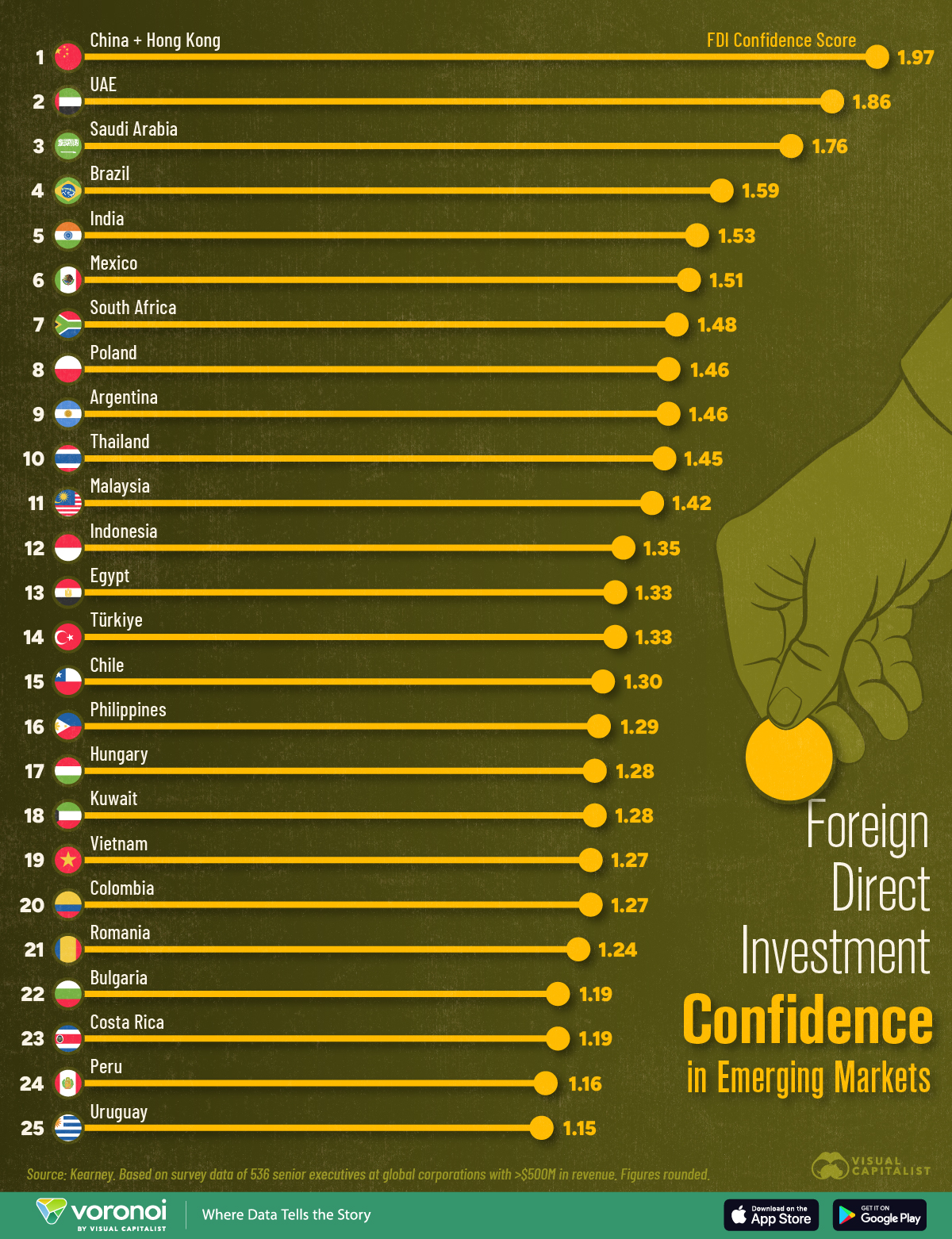
This infographic ranks the top 25 emerging markets by their FDI confidence in 2025, based on a survey of global business leaders.

Key Takeaways

  • China, the UAE, and Saudi Arabia are the top three emerging markets by FDI confidence in 2025
  • Brazil overtook India to take the fourth spot, with both countries making the top five
  • Domestic economic performance and efficiency of legal and regulatory processes were the top two priorities for FDI investors

Emerging markets often attract foreign investors with prospects for higher economic growth and diversification.

Where are global business leaders placing their foreign direct investment (FDI) bets in 2025?

This chart highlights the top 25 emerging markets by FDI confidence score in 2025, based on a survey conducted by Kearney. The rankings are drawn from responses by 536 senior executives at global companies with annual revenues above $500 million.

China Leads in Foreign Investor Sentiment

China (including Hong Kong) remains the top emerging market for foreign investor confidence in 2025. However, FDI inflows have slowed in recent years, hitting multi-year lows in 2023.

Following China, the UAE and Saudi Arabia also retain their places as the second and third-most favored developing economies for FDI.

Here’s a look at the full list of top emerging markets for FDI confidence in 2025:Search:

RankCountryFDI Confidence Score
1China (including Hong Kong) 🇨🇳🇭🇰1.97
2United Arab Emirates 🇦🇪1.86
3Saudi Arabia 🇸🇦1.76
4Brazil 🇧🇷1.59
5India 🇮🇳1.53
6Mexico 🇲🇽1.51
7South Africa 🇿🇦1.48
8Poland 🇵🇱1.46
9Argentina 🇦🇷1.46
10Thailand 🇹🇭1.45

Brazil and India—two of the biggest emerging economies by GDP—round out the top five, with Brazil overtaking India in FDI confidence in the 2025 rankings.

These rankings align with investors’ FDI priorities from the same survey, where the efficiency of legal and regulatory processes and domestic economic performance top the list.

South Africa made the largest upward move in 2025, jumping from 11th to 7th in the rankings. It also recorded FDI inflows of around $661 million in Q1 2025, up 56% from the fourth quarter of 2024.

Overall, 11 of the top 25 emerging markets for FDI confidence are in Asia and the Middle East.

What’s Driving Investor Confidence?

The factors driving FDI confidence vary for each economy.

In China, tech innovation was the leading driver of investor confidence, while economic performance ranked highest for the UAE and Saudi Arabia.

Meanwhile, the talent/skill of the labor pools in India and Mexico were the strongest factors attracting investors.

More than a third of this country’s population has applied to relocate

By Angus Watson, CNN Updated 4:50 AM EDT, Fri June 27, 2025

People swim in the lagoon in Funafuti, Tuvalu, on November 28, 2019.

People swim in the lagoon in Funafuti, Tuvalu, on November 28, 2019. Mario Tama/Getty ImagesSydney, AustraliaCNN — 

More than a third of the population of Tuvalu has applied to move to Australia, under a landmark visa scheme designed to help people escape rising sea levels.

The island nation – roughly halfway between Hawaii and Australia – is home to about 10,000 people, according to the latest government statistics, living across a clutch of tiny islets and atolls in the South Pacific.

With no part of its territory above six meters, it is one of the most at-risk places in the world to rising seas caused by climate change.

On June 16, Australia opened a roughly one-month application window for what it says is a one-of-a-kind visa offering necessitated by climate change. Under the new scheme, Australia will accept 280 visa winners from a random ballot between July and January 2026. The Tuvaluans will get permanent residency on arrival in Australia, with the right to work and access public healthcare and education.

More than 4,000 people have applied under the scheme, according to official figures seen by CNN.

“The opening of the Falepili Mobility Pathway delivers on our shared vision for mobility with dignity, by providing Tuvaluans the opportunity to live, study and work in Australia as climate impacts worsen,” Australian Foreign Minister Penny Wong said in a statement.

CNN has reached out to the Tuvalu government.

According to Tuvalu’s Prime Minister Feleti Teo, more than half of Tuvalu will be regularly inundated by tidal surges by 2050. By 2100, 90% of his nation will be regularly under water, he says.

Fongafale, the nation’s capital, is the largest and most populated islet in Tuvalu’s main atoll, Funafuti. It has a runway-like strip of land just 65 feet (20 meters) wide in some places.

“You can put yourself in my situation, as the prime minister of Tuvalu, contemplating development, contemplating services for the basic needs of our people, and at the same time being presented with a very confronting and disturbing forecast,” Teo told the United Nations Oceans Conference this month in Nice, France.

Tiếp tục đọc “More than a third of this country’s population has applied to relocate”

‘Madness’: World leaders call for deep-sea mining moratorium at UN ocean summit

Mongabay.com Elizabeth Claire Alberts 11 Jun 2025 France

  • World leaders have renewed calls for a global moratorium on deep-sea mining at the 2025 U.N. Ocean Conference (UNOC) in Nice, France, as the U.S. moves to mine the deep sea in international waters under its own controversial authority.
  • Four additional countries have joined the coalition of nations calling for a moratorium, precautionary pause, or ban on deep-sea mining, bringing the total number to 37.
  • The U.S., which did not have an official delegation at UNOC, is pushing forward with its plans to mine in international waters — a decision that has drawn criticism from the international community.

Tiếp tục đọc “‘Madness’: World leaders call for deep-sea mining moratorium at UN ocean summit”

Number of internally displaced people tops 80 million for first time

“Internal displacement refers to the forced movement of people within the country they live in.” 

Internal-displacement.org

     –  83.4 million people were living in internal displacement at the end of 2024, more than twice as many as only six years ago (2018).

     –  90 per cent had fled conflict and violence. In Sudan, conflict led to 11.6 million internally displaced people (IDPs), the most ever for one country. Nearly the entire population of the Gaza Strip remained displaced at the end of the year.

     –  Disasters triggered nearly twice as many movements in 2024 as the annual average over the past decade. The 11 million disaster displacements in the United States were the most ever recorded for a single country. 

GENEVA, Switzerland – The number of internally displaced people (IDPs) reached 83.4 million at the end of 2024, the highest figure ever recorded, according to the Global Report on Internal Displacement 2025 published today by the Internal Displacement Monitoring Centre (IDMC). This is equivalent to the population of Germany, and more than double the number from just six years ago.  

“Internal displacement is where conflict, poverty and climate collide, hitting the most vulnerable the hardest,” said Alexandra Bilak, IDMC director“These latest numbers prove that internal displacement is not just a humanitarian crisis; it’s a clear development and political challenge that requires far more attention than it currently receives.”

Tiếp tục đọc “Number of internally displaced people tops 80 million for first time”

Another year, another rise in food insecurity – including famine

UN.org

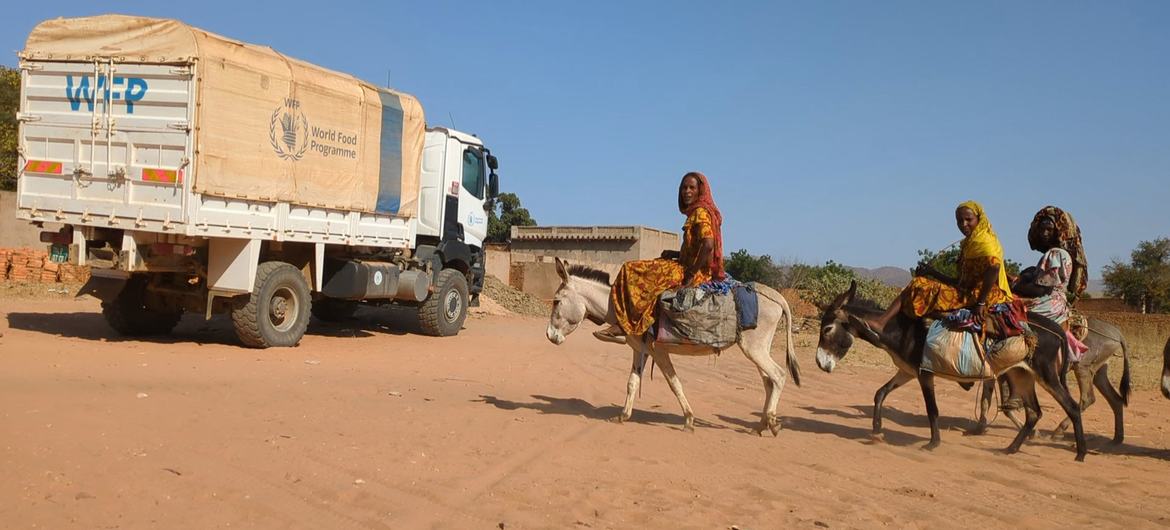
Hundreds of thousands of Sudanese have sought refuge in Chad due to the ongoing conflict and resulting food shortages.

© WFP/Lena von Zabern

Hundreds of thousands of Sudanese have sought refuge in Chad due to the ongoing conflict and resulting food shortages.

 Humanitarian Aid

In July 2024, famine was detected in the Sudan’s Zamzam IDP camp. In the following months, the official alert expanded to other camps in Darfur and Western Nuba Mountains. From December until now, famine has been confirmed in five other areas of the war-torn country. A further 17 areas are at risk. 

It is the first time since 2017 that a famine has been declared anywhere on Earth.

In the 20 months since the war between rival militaries erupted, 13 million Sudanese have been forcibly displaced and over 30.4 million are in desperate need of humanitarian assistance, according to UN estimates.

Tiếp tục đọc “Another year, another rise in food insecurity – including famine”

Australia PM Anthony Albanese wins second three-year term

Aljazeera.com

Labor Party leader becomes the first Australian prime minister to win a second consecutive three-year term in two decades.

Australian PM Anthony Albanese
Australia’s Prime Minister Anthony Albanese speaks at the Labor Party election night event in Sydney, May 3, 2025 [Hollie Adams/Reuters]

Published On 3 May 20253 May 2025

Anthony Albanese has become the first Australian prime minister to win a second consecutive three-year term in two decades, in a dramatic comeback for his Labor Party in a general election dominated by the cost-of-living crisis.

The Labor Party was on track on Saturday for an unexpectedly large parliamentary majority, as Peter Dutton, leader of the conservative Liberal Party, conceded defeat, having lost his own seat.

In his victory speech, left-leaning Albanese pledged to steer the nation through a rough patch of global uncertainty.

“Australians have chosen to face global challenges the Australian way, looking after each other while building for the future,” he told supporters in Sydney.

“We do not need to beg or borrow or copy from anywhere else. We do not seek our inspiration overseas. We find it right here in our values and in our people.”

Australia’s public broadcaster ABC projected that Labor was on track to win 85 seats in the House of Representatives, easily surpassing the 76-seat threshold needed to reach a majority.

Tiếp tục đọc “Australia PM Anthony Albanese wins second three-year term”

Impact of Trump 2.0 on Southeast Asia’s Energy Geopolitics

Fulcrum.sg Published 3 Mar 2025 Mirza Sadaqat Huda

Trump’s rent-seeking foreign policy pertaining to energy and critical minerals will force Southeast Asian countries to do what they least desire: making a choice between China and the US.

The Trump administration’s insular and rent-seeking foreign policy will significantly alter the geopolitics of energy transition in Southeast Asia. This will manifest in two ways. First, the potential cessation of US involvement in the region’s energy sector will heighten fears of China’s dominance in energy infrastructure projects — including the ASEAN Power Grid (APG). Second, Trump’s intentions of using critical minerals as a bargaining chip for providing military assistance, if applied to the ASEAN region, will impact the regional vision for sustainable mineral development.

The shutting down of the United States Agency for International Development (USAID), an important player in the energy sector, will intensify existing fears of China’s dominance in electricity transmission and generation. As shown in Table 1, China provided approximately US$534 million in aid to the region’s energy sector in 2022, accounting for more than a quarter of the total share. Comparatively, the US provided only US$23.7 million, or 1 per cent of total energy-related aid to Southeast Asia. In addition, the China Southern Power Grid Company and State Grid Corporation of China own and operate significant portions of the national grids in Laos and the Philippines, respectively.

China Leads in Energy Aid

Table 1 Energy-related aid to Southeast Asia 2022 (excerpt) (USD, in %)

Donor Amount Contribution
China 534 million 26
ADB 368 million 18
Germany 274 million 13
Canada 231 million 11
South Korea 211 million 10
Japan 167 million 8
World Bank 90.0 million 4
EU Institutions 42.3 million 2
France 42.2 million 2
AIIB 34.8 million 2
United States 23.7 million 1

The table is modified from Lowy Institute’s (2024) Southeast Asia Aid Map.

Tiếp tục đọc “Impact of Trump 2.0 on Southeast Asia’s Energy Geopolitics”

The National Security Imperative of USAID’s Food Security Programs

Climateandsecurity.org

As of today, the Trump Administration has paused two essential US global food security initiatives, Feed the Future and the Famine Early Warning Systems Network (FEWS NET). Created in reaction to the 2007-8 global food crisis and resulting instability, Feed the Future is a marquee US government food security program and tool for implementing the bipartisan Global Food Security Act, working in 20 countries to build a more resilient food system and supporting agricultural innovation at 17 US universities. Operating since 1985, FEWS NET provides rigorous analysis and forecasting of acute food insecurity to inform US and other humanitarian responses in 30 countries.

These programs make invaluable contributions to US national security and global stability. For example, Feed the Future builds resilience in five countries where the US National Intelligence Estimate on climate change assesses “building resilience…would probably be especially helpful in mitigating future risks to US interests.” In Central America, where drought during growing seasons has driven increased migration to the United States, Honduran Feed the Future beneficiaries report a 78% lower intent to migrate than the wider population. Meanwhile, FEWSNET’s data and analysis more quickly and efficiently direct US humanitarian support in reaction to conflict, economic shocks, and extreme weather, including in regions where the US military is deployed. 

Both programs have historically received consistent bipartisan support. Speaking at the launch of a new Feed the Future initiative last year, Senator John Boozman (R-AR) noted, “food security is national security.” Another Feed the Future supporter, Representative Tracey Mann (R-KS 1st District), has highlighted the value of his district’s Feed the Future Innovation Lab and stated that global food security programs have “an especially strong return on investment because they support American agriculture producers today, while greatly reducing the need for conflict or war-related dollars spent tomorrow” and are “a way to stop wars before they start.” As Executive Director of the World Food Program (2017-2023), former South Carolina Governor and Representative David Beasely testified to the Senate that “Investments in early warning systems like USAID’s Famine Early Warning System…allow humanitarian partners to project and respond in real time to potential emergencies….Without this capacity to forecast food insecurity, the cost of humanitarian intervention is much greater, both in dollars and lives lost.”

Last year, dozens of national security leaders, including the former commanders of Indo-Pacific Command (INDOPACOM), Africa Command (AFRICOM), and Central Command (CENTCOM), endorsed the Council on Strategic Risks’ The Feeding Resilience Plan: Safeguarding US National Security at the Crossroads of Food and Climate Change. The report makes recommendations to US policymakers to better anticipate, prevent, and respond to food- and climate-driven national security threats, including to:

  • “Support long-term resilience building in vulnerable countries by sustaining and expanding Feed the Future,” noting it and similar programs “bolster vulnerable countries’ ability to withstand food shocks and forestall security threats or need for costly US assistance,” and
  • “Expand on USAID’s FEWS NET to include longer-term food insecurity warnings” and to have security and defense agencies better “integrate FEWSNET projections with processes to forecast political instability and conflict.”

Amid multiplying threats from instability, extreme weather, and geopolitical competition, these recommendations remain critical today, and highlight the important national security benefits of capabilities like Feed the Future and FEWS NET.  

Launch of Southeast Asia Energy Outlook 2015

Launch of Southeast Asia Energy Outlook 2015

Kuala Lumpur: 8 October 2015World Energy Outlook Special Report

Details

IEA – The ten countries that make up the Association of Southeast Asian Nations (ASEAN) are exerting an increasingly important influence on global energy trends. Underpinned by rapid economic and demographic growth, energy demand in the region has more than doubled in the last 25 years, a trend that is set to continue over the period to 2040. Given Southeast Asia’s role as a global growth engine, understanding what is shaping energy markets in this vibrant region and the implications for energy security and the environment is vital for policy makers and anyone with a stake in the energy sector.

The International Energy Agency, in collaboration with the Economic Research Institute for ASEAN and East Asia (ERIA) prepared the Southeast Asia Energy Outlook 2015 in response to a request from ministers at the Seventh East Asia Summit Energy in Bali, Indonesia, in 2013. Drawing on the latest data and policy and market developments, this report examines the current status and future prospects for energy markets in the region and their implications for energy security, the environment and economic development.

The report highlights:

  • Trends in domestic energy demand and supply prospects to 2040, broken down by fuel and sector.
  • The outlook for the power sector and the increasing share of coal in the region’s electricity generation.
  • The role that Southeast Asia will play in international energy trade and the implications for its energy expenditures.
  • The potential energy and environmental benefits of implementing pragmatic measures that would help limit the rise in the region’s greenhouse gas emissions.
  • An in-depth analysis of energy prospects in Malaysia to 2040.
  • A focus on four key issues that will shape the direction of the region’s energy system: power grid interconnection, energy investment, energy access and fossil fuel subsidies.

The same event will also feature the launch of the IEA publication Development Prospects for ASEAN Power Sector: Towards Electricity Market Integration.

Vietnam​ searches for solutions to deal with domestic e-waste

Ensia – Much of the world’s electronic waste ends up in Vietnam — not only cell phones, computers, printers and TVs, but also items many people may not think of when they consider e-waste, such as washing machines, microwaves and fans. This waste is often burned or dumped in landfills where toxicants such as arsenic, mercury, lead and cadmium are released into the air or leach into the water. Perhaps most concerning, domestic e-waste is growing by about 25 percent each year in Vietnam, with up to 113,000 metric tons (124,500 tons) discarded this year.Earlier this year, Vietnam tried to address this problem by requiring electronics producers to collect and process the e-waste generated by their products. Hewlett-Packard Asia Pacific and Apple South Asia launched a pilot program called “Vietnam Recycles” (Việt Nam Tái Chế) with new collections centers where used products could be safely recycled. But most Vietnamese say they prefer to sell their old electronics to scrap collectors who repair and resell the electronics or dismantle them for salvageable materials, a process that can be hazardous to workers’ health. Tiếp tục đọc “Vietnam​ searches for solutions to deal with domestic e-waste”

Firmer ties between EU and ASEAN on clean technology

An EU-organised trade mission brought Europe’s leading cleantech companies to meet Southeast Asian firms, creating new growth opportunities and strengthening trade ties between both regions.

European clean technology firms and their Southeast Asian counterparts spent a week exploring new collaborations and growth opportunities during a trade mission to Singapore and Vietnam – a move that is expected to strengthen trade ties between both regions.

Organised by the EU delegation to Singapore, the EU Business Avenues trade mission brought 41 small and medium enterprises (SMEs) from Europe’s energy efficiency, pollution, waste and water technology sectors to explore opportunities in Southeast Asia. Tiếp tục đọc “Firmer ties between EU and ASEAN on clean technology”

Geneticists reveal what makes great rice

Gene responsible for long grains and pleasing texture can now be bred into existing varieties without sacrificing yield.

Article tools – Rights & Permissions

Xiangdong Fu

Nature – Breeders in China have discovered the secret for creating rice varieties that could improve breakfast, lunch and dinner for millions of people in Asia. Two teams of molecular geneticists, working independently, have identified a gene that controls both shape and texture and can be selected for without sacrificing the yield of the crop. Tiếp tục đọc “Geneticists reveal what makes great rice”

Thai Solar Energy Plans 300 MW Solar PV Capacity In Japan

July 2nd, 2015 by

Cleantechnica– Global interest in Japan’s renewable energy sector, specifically the solar power market, continues to strengthen with a major developer from Thailand looking to boost its footprint in the land of the rising sun.

Thai Solar Energy has announced that it will set up 300 MW worth of solar power capacity in Japan over the next 3 years. The company will start with the implementation of a 25 MW solar power plant, then expand the installed capacity to 100 MW by the end of 2016, which will eventually be increased to 300 MW.

Thai Solar Energy claims to be “the first company in Southeast Asia to have effectively applied solar energy commercially.” The company is moving into Japan as the government policies support development of renewable energy projects and a large number of solar power projects are already under construction. Tiếp tục đọc “Thai Solar Energy Plans 300 MW Solar PV Capacity In Japan”

Việt Nam tham gia Ngân hàng AIIB do Trung Quốc khởi xướng

(TNO) Việt Nam nằm trong số 50 nền kinh tế đã ký vào điều lệ hoạt động của Ngân hàng Phát triển hạ tầng châu Á (AIIB) do Trung Quốc khởi xướng tại buổi lễ tổ chức ở Bắc Kinh hôm nay 29.6, theo Business Standard.

Việt Nam tham gia Ngân hàng AIIB do Trung Quốc khởi xướng - ảnh 1Đại diện các nước tham gia buổi lễ ký kết thông qua điều lệ hoạt động của AIIB hôm 29.6 – Ảnh: AFP

Trung Quốc sẽ chiếm 30,34% cổ phần trong AIIB và giữ 26,06% quyền biểu quyết. Theo điều lệ hoạt động của AIIB, mỗi quyết định muốn thông qua đều cần một lượng phiếu thuận “siêu lớn”, lên đến 75%, Business Standard cho biết.

Tiếp tục đọc “Việt Nam tham gia Ngân hàng AIIB do Trung Quốc khởi xướng”