|
|
| Trần Văn Nhiên (first from left), a coffee farmer in Quảng Hiệp, Cư M’Gar, Đắc Lắc Province with his cofee farm applying drip protection solution in the pilot phase, bringing healthier and taller coffee trees in comparison with curent farmer practices. — VNS Photo |
Thẻ: GMOs
US Food & Drug Administration allows import of GM salmon into the US for consumption
– Nine Things You Need To Know About GMO Salmon >>
– The science and politics of genetically engineered salmon: 5 questions answered >>
– Genetically Engineered Salmon: A Profit-making Frankenfish for whom? >>
FDA Statement
Statement from FDA Commissioner Scott Gottlieb, M.D., on continued efforts to advance safe biotechnology innovations, and the deactivation of an import alert on genetically engineered salmon
For Immediate Release
March 8, 2019
Advancements in the dynamic field of biotechnology are bringing about the development of innovative, new food products. At the U.S. Food and Drug Administration, we’re committed to helping food developers bring biotechnology innovations to market while at the same time providing consumers with confidence that foods available for purchase in the U.S. – whether developed using traditional breeding techniques or biotechnology – meet the FDA’s high safety standards. Tiếp tục đọc “US Food & Drug Administration allows import of GM salmon into the US for consumption”
What are the political drivers for GMOs in developing countries?
CANBERRA — In developing nations across the globe, governments are grappling with questions of what role, if any, genetically modified organisms should play in helping address a range of agriculture, nutrition, and climate challenges.
Concerns have been raised over the environmental and health impacts of GMOs, as well as their impact on traditional farming methods and issues around seed patents, and farmers having to be dependent on corporations.
Governments of developing countries are responding to those concerns in a variety of ways with some banning GMOs outright, some embracing them, and others attempting to find balance between the concerns and needs of all sides.
Developing countries are slowly increasing approved legislation and opening the door to research and commercialization of GMO crops. As these countries seek to expand their export markets, improve domestic living conditions, and address food insecurity in the wake of conflict and climate change, some are seeing a solution in genetically engineered crops. Tiếp tục đọc “What are the political drivers for GMOs in developing countries?”
FAO official: GMOs not needed but we should be open to biotechnologies
euractive_The requirements of food production can be met without GMOs but we should not eliminate the broader benefits that biotechnologies can provide, Daniel Gustafson, a senior United Nations official, told EURACTIV.com in an interview. Tiếp tục đọc “FAO official: GMOs not needed but we should be open to biotechnologies”
Những lời thất hứa của cây trồng biến đổi gien GMO
English: Broken Promises of Genetically Modified Crops
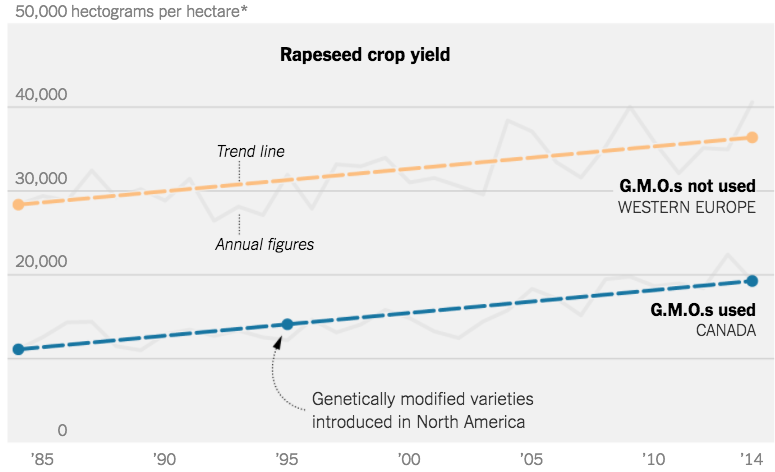
Khoảng 20 năm trước, Mỹ và Canada bắt đầu đưa ra các loại cây trồng biến đổi gien trong nông nghiệp.
Châu Âu không sử dụng công nghệ này, tuy nhiên năng suất vẫn gia tăng và việc sử dụng thuốc trừ sâu vẫn giảm ở mức ngang bằng, thậm chí là ở mức lớn hơn so với Mỹ, nơi các cây trồng biến đổi gien được phát triển rộng rãi.
Cây trồng biến đổi gien (GMOs) được cho là sẽ gia tăng năng suất cây trồng
Canada và các nước Tây Âu trồng các loại cải (canola) khác nhau, nhưng nông dân Canada sử dụng hạt giống biến đổi gien trong khi nông dân châu Âu thì không. Dù vậy, xu hướng năng suất lâu dài của cả hai khu vực đều tăng.
(biểu đồ) Tiếp tục đọc “Những lời thất hứa của cây trồng biến đổi gien GMO”
Nông nghiệp hữu cơ – Câu hỏi thường gặp – Hướng dẫn của Tổ chức Lương Thực Thế Giới (P2)
| FAO – Organic Agriculture
CÂU HỎI
Loạt bài Nông nghiệp Hữu cơ của FAO 6. Lợi ích về môi trường của nông nghiệp hữu cơ là gì? Tính bền vững dài hạn. Những thay đổi môi trường chỉ có thể quan sát trong thời gian dài, xảy ra chậm theo thời gian. Nông nghiệp hữu cơ tính đến các tác động trung và dài hạn của các can thiệp của nông nghiệp lên hệ sinh thái nông nghiệp. Nông nghiệp hữu cơ nhằm sản xuất lương thực trong khi thiết lập một sự cân bằng sinh thái để bảo toàn độ phì nhiêu của đất và ngăn chặn dịch hại. Nông nghiệp hữu cơ tiếp cận một cách chủ động chứ không phải chỉ xử lý các vấn đề sau khi đã phát sinh. Tiếp tục đọc “Nông nghiệp hữu cơ – Câu hỏi thường gặp – Hướng dẫn của Tổ chức Lương Thực Thế Giới (P2)” |
The Next Great GMO Debate
Biomedicine

Deep inside its labs, Monsanto is learning how to modify crops by spraying them with RNA rather than tinkering with their genes.
by Antonio Regalado August 11, 2015
technologyreview – The Colorado potato beetle is a voracious eater. The insect can chew through 10 square centimeters of leaf a day, and left unchecked it will strip a plant bare. But the beetles I was looking at were doomed. The plant they were feeding on—bright green and carefully netted in Monsanto’s labs outside St. Louis—had been doused with a spray of RNA.
The experiment took advantage of a mechanism called RNA interference. It’s a way to temporarily turn off the activity of any gene. In this case, the gene being shut down was one vital to the insect’s survival. “I am pretty sure 99 percent of them will be dead soon,” said Jodi Beattie, a Monsanto scientist who showed me her experiment.
The discovery of RNA interference earned two academics a Nobel Prize in 2006 and set off a scramble to create drugs that block disease-causing genes. Using this same technology, Monsanto now thinks it has hit on an alternative to conventional genetically modified organisms, or GMOs. It can already kill bugs by getting them to eat leaves coated with specially designed RNA. And if the company succeeds in developing sprays that penetrate plant cells, as it’s attempting to, it could block certain plant genes, too. Imagine a spray that causes tomatoes to taste better or helps plants survive a drought. Tiếp tục đọc “The Next Great GMO Debate”