As other Asian economies race to conserve energy, China has huge reserves of oil and gas as well as alternative energy sources like wind and solar
Xi Jinping has been preparing for a crisis like this for years. China must secure its energy supply “in its own hands”, its president was reported to have said during a visit to one of its vast oilfields in 2021.
The US-Israel war on Iran plunged the Middle East into a deep conflict, with the strait of Hormuz – one of the most important waterways in global trade – all but closed and key energy facilities across the region under attack.
Oil exports from the Middle East have tumbled 61% over recent weeks, according to maritime tracking consultancy Kpler – roiling countries across Asia, which relied on the region for 59% of its crude imports in 2025, and have been left racing to conserve energy.
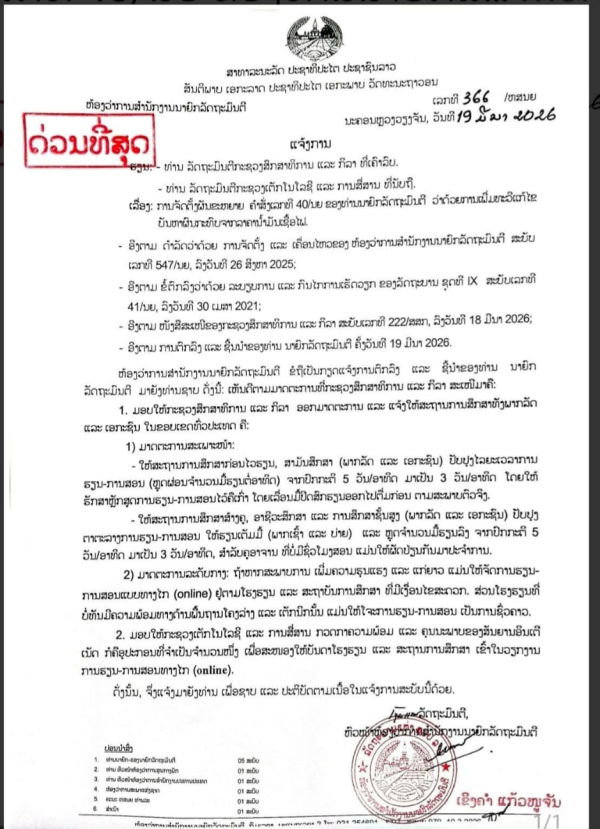
On March 19, 2026, the Prime Minister’s Office of the Lao PDR issued Notice No. 366/PMO mandating nationwide adjustments to school operations, as part of emergency measures to ease the financial strain on families amid continued fuel price volatility.
The directive, addressed to the Ministry of Education and Sports, introduces immediate changes to learning schedules while preserving academic standards and signaling further contingency steps if economic conditions worsen.
Under the order, all general education institutions—public and private—are required to scale back in-person instruction from five days to three days per week. Schools must continue delivering the full curriculum, with the academic calendar extended to compensate for reduced classroom time.
For teacher training institutes, vocational schools, and higher education institutions, schedules will be restructured into full-day sessions, combining morning and afternoon classes, while similarly reducing attendance to three days per week. Teaching personnel without assigned classes are instructed to report for duty on a rotating basis.
Officials said the policy is aimed at lowering transportation-related expenses for households while ensuring continuity in education delivery.
The government also outlined escalation measures should fuel-related pressures persist. Institutions with adequate digital infrastructure will transition to remote learning, while those lacking technical readiness may be required to temporarily suspend operations.
To support potential online learning, the Ministry of Technology and Communications has been tasked with verifying internet reliability nationwide and assessing the availability of essential equipment.
Authorities stressed that parents, teachers, and students must prepare for immediate implementation, highlighting the government’s broader effort to balance economic relief with uninterrupted access to education during a period of heightened cost pressures.
Trump’s rent-seeking foreign policy pertaining to energy and critical minerals will force Southeast Asian countries to do what they least desire: making a choice between China and the US.
The Trump administration’s insular and rent-seeking foreign policy will significantly alter the geopolitics of energy transition in Southeast Asia. This will manifest in two ways. First, the potential cessation of US involvement in the region’s energy sector will heighten fears of China’s dominance in energy infrastructure projects — including the ASEAN Power Grid (APG). Second, Trump’s intentions of using critical minerals as a bargaining chip for providing military assistance, if applied to the ASEAN region, will impact the regional vision for sustainable mineral development.
The shutting down of the United States Agency for International Development (USAID), an important player in the energy sector, will intensify existing fears of China’s dominance in electricity transmission and generation. As shown in Table 1, China provided approximately US$534 million in aid to the region’s energy sector in 2022, accounting for more than a quarter of the total share. Comparatively, the US provided only US$23.7 million, or 1 per cent of total energy-related aid to Southeast Asia. In addition, the China Southern Power Grid Company and State Grid Corporation of China own and operate significant portions of the national grids in Laos and the Philippines, respectively.
China Leads in Energy Aid
Table 1 Energy-related aid to Southeast Asia 2022 (excerpt) (USD, in %)
Donor
Amount
Contribution
China
534 million
26
ADB
368 million
18
Germany
274 million
13
Canada
231 million
11
South Korea
211 million
10
Japan
167 million
8
World Bank
90.0 million
4
EU Institutions
42.3 million
2
France
42.2 million
2
AIIB
34.8 million
2
United States
23.7 million
1
The table is modified from Lowy Institute’s (2024) Southeast Asia Aid Map.
Western leaders have long criticized OPEC’s power to raise oil prices, and the bloc continues to influence the global market even as U.S. oil production has soared and alternative energies have come to the fore.
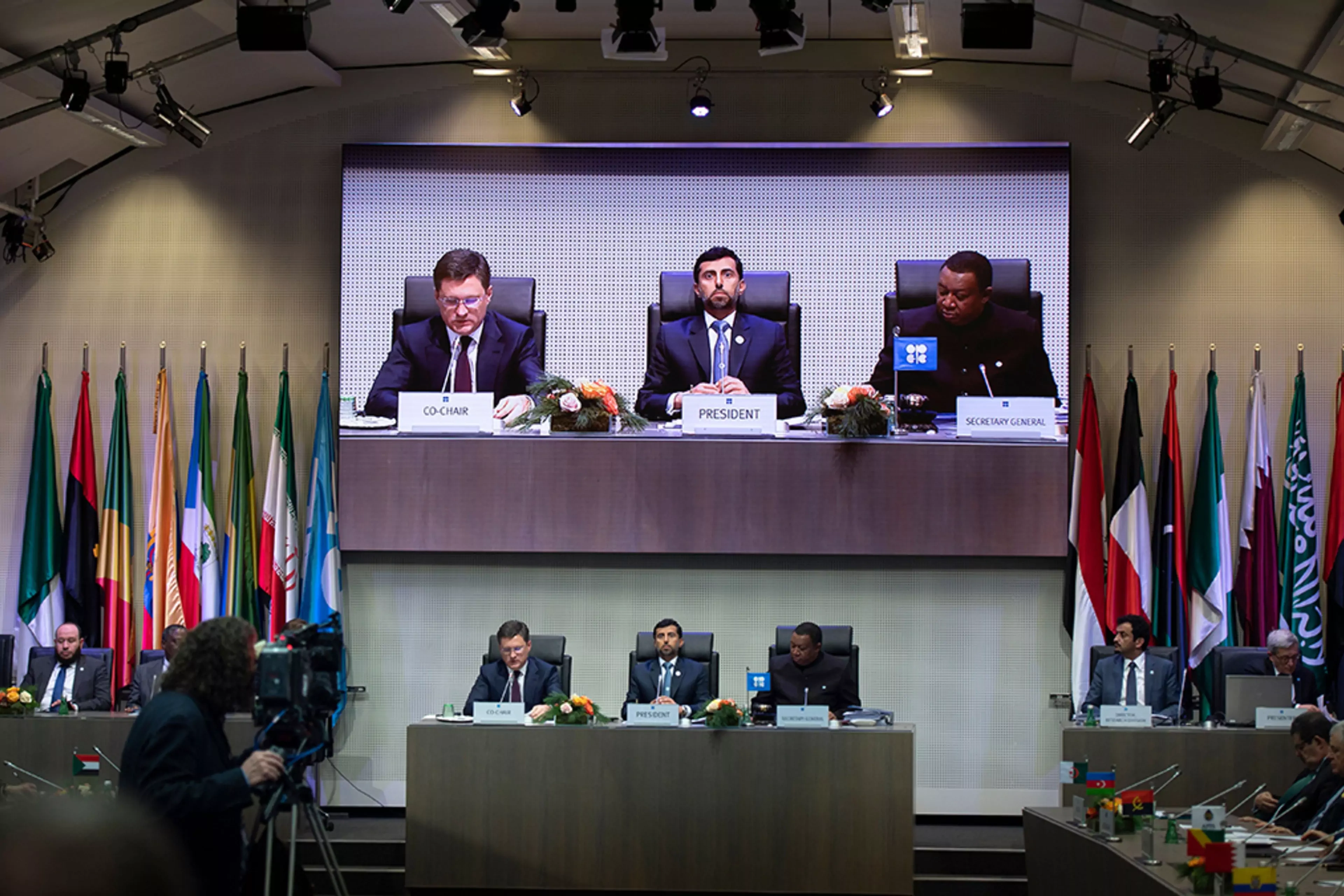
Russian and Emirati energy ministers speak alongside the OPEC secretary-general in Vienna. Joe Klamar/AFP/Getty Images
WRITTEN BY Anshu Siripurapu and Andrew Chatzky Last updated March 9, 2022 2:25 pm (EST)
Summary
The Organization of the Petroleum Exporting Countries (OPEC) is a group of oil-rich countries that together control nearly 40 percent of the world’s oil supply.
Russia’s war in Ukraine has caused global oil prices to surge, giving the bloc more leverage.
However, as the world shifts away from fossil fuels, OPEC’s power could diminish.
The Organization of the Petroleum Exporting Countries (OPEC) is a bloc of thirteen oil-rich member states spanning the Middle East, Africa, and South America. Combined, the group controls close to forty percent of world oil production. This dominant market position has at times allowed OPEC to act as a cartel, coordinating production levels among members to manipulate global oil prices. As a result, U.S. presidents from Gerald Ford to Donald Trump have railed against the oil cartel as a threat to the U.S. economy.
By Pamela Constable and Shaiq Hussain January 24, 2023 at 4:39 a.m. EST
ISLAMABAD, Pakistan — Three weeks ago, Pakistani authorities ordered all markets, restaurants and shopping malls to close early, part of an emergency plan to conserve energy as the country of 220 million struggled to make overdue payments on energy imports and stave off a full-fledged economic collapse.
But the measures were too little, too late. On Monday morning, the country’s overburdened electrical system collapsed in a rolling wave of blackouts that began in the desert provinces of Baluchistan and Sindh but quickly spread to nearly the entire country, including the densely crowded cities of Karachi, Lahore and Rawalpindi.
The writer is executive director of International Energy Agency
As the global energy crisis continues to hurt households, businesses and entire economies worldwide, it’s important to separate fact from fiction. There are three narratives in particular that I hear about the current situation that I think are wrong — in some cases dangerously so.
The first is that Moscow is winning the energy battle. Russia is undoubtedly a huge energy supplier and the increases in oil and gas prices triggered by its invasion of Ukraine have resulted in an uptick in its energy income for now. But its short-term revenue gain is more than offset by the loss of both trust and markets that it faces for many years to come. Moscow is doing itself long-term harm by alienating the EU, its biggest customer by far and a strategic partner. Russia’s place in the international energy system is changing fundamentally, and not to its advantage.
MITtechnologyreview: Can India modernize its manufacturing economy and supply electricity to its growing population without relying heavily on coal—and quite possibly destroying the global climate?
An old man wakes on the floor of a hut in a village in southern India. He is wrapped in a thin cotton blanket. Beside him, music wails softly on a transistor radio. A small wood fire smolders on the floor, filling the space with a light haze; above it,the bamboo timbers of the hut’s roof are charred to a glossy black.
The man’s name is Mallaiah Tokala, and he is the headman of Appapur village, in the Amrabad Tiger Reserve in Telangana state. On his forehead he wears the vibhuti, the sacred daub of white ash. He is uncertain of his exact age, but he is well into his 10th decade. He has lived in this village his whole life, a period that encompasses the tumultuous 20th-century history of India: the rise of Gandhi, the Salt March, the end of the Raj and the coming of independence, Partition and the bloodshed that followed, the assassination of Rajiv Gandhi and the dawning of a new era of sectarian violence and terrorism. And now he has lived long enough to witness the coming of electricity to Appapur, in the form of solar-powered lights and TVs and radios.