Studied Countries: Vietnam, Benin, Brazil, Cambodia, the Dominican Republic, El Salvador, the Philippines, Togo, Uganda
Groundbreaking research from Plan International that has documented girls from birth for eighteen years reveals that globally, girls’ lives have improved significantly over the past two decades but identifies these gains are now at risk with the next wave of challenges approaching.
With improved access to education, girls are dreaming bigger and new laws protecting them from child marriage means they have broader choices in shaping their futures. But significant barriers – including widespread gender-based violence and the ever-worsening impacts of climate change – still stand in the way of equality.
Nearly as many U.S. adults have little or no confidence as have high confidence
WASHINGTON, D.C. — An increasing proportion of U.S. adults say they have little or no confidence in higher education. As a result, Americans are now nearly equally divided among those who have a great deal or quite a lot of confidence (36%), some confidence (32%), or little or no confidence (32%) in higher education. When Gallup first measured confidence in higher education in 2015, 57% had a great deal or quite a lot of confidence and 10% had little or none.
The latest results are based on a June 3-23 Gallup survey that gauged Americans’ confidence in various institutions. A follow-up story reporting on the remainder of institutions will be published in the coming days.
This year, Gallup and Lumina Foundation partnered to better understand the nature of confidence in higher education. The research includes the trend results reported above from Gallup’s June telephone survey as well as new results from a contemporaneous web survey of more than 2,000 Gallup Panel members.
A review of the historical trends shows that confidence has dropped among all key subgroups in the U.S. population over the past two decades, but more so among Republicans. Americans who lack confidence in higher education today say their concerns lie in colleges pushing political agendas, not teaching relevant skills, and being overly expensive.
Confidence in higher education among Republicans today is nearly a mirror image of what it was nine years ago. In 2015, 56% of Republicans had a great deal or quite a lot of confidence, and 11% had little or none. Now, 20% are confident and 50% have little or no confidence.
Republicans are not alone in having reduced confidence in higher education, as 35% of independents, down from 48% in 2015, and 56% of Democrats, down from 68%, are confident.
In the past year, all party groups have shown at least some increase in the percentage with very little or no confidence, and a decrease in the percentage saying they have some. None of the party groups shows meaningful change in high confidence over the past year.
Recently, we reached out to education experts around the world to hear what they considered the most pressing issues facing our sector today. Surprisingly, they all said that little has changed in terms of our most common challenges. What was changing, they agreed, were the innovative ways that the global community has begun tackling them.
Our discussions frequently came back to advances in neuroscience, Massive Open Online Courses (MOOCs), Blockchain, and the consequences of negative population growth—as well as the ways that these phenomena are changing and challenging the way we think about education. Some of these changes have received more attention than others, but we are convinced of their importance—and education stakeholders around the world should be paying attention. Tiếp tục đọc “Four Education Trends that Countries Everywhere Should Know About”→
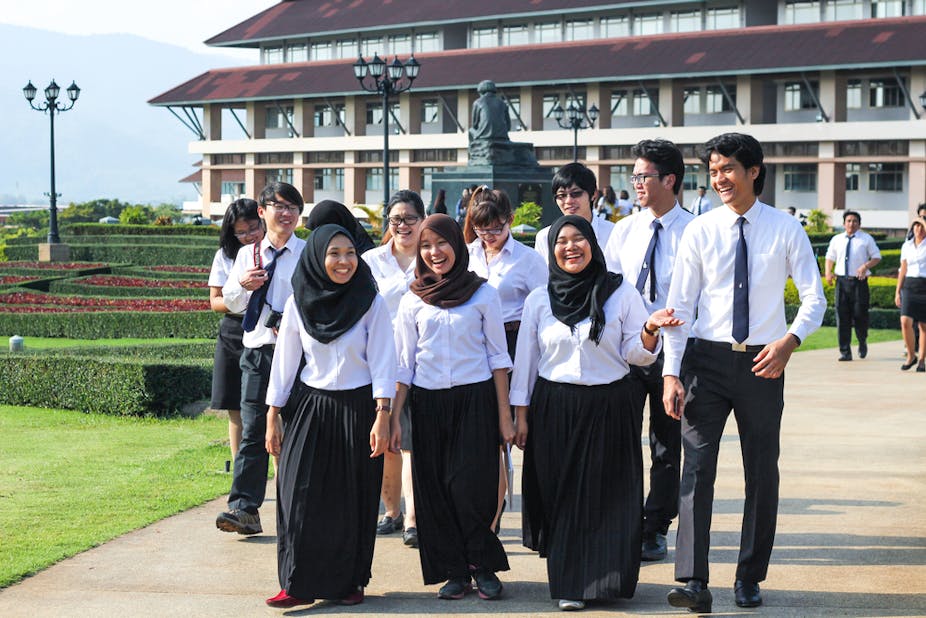
Exchange students from several universities in ASEAN countries at a university in Thailand. Encouraging trans-ASEAN student mobility is a huge challenge. Thiranun Kunatum/Shutterstock
As the celebration for last year’s 50th anniversary of the Association of Southeast Asian Nations (ASEAN) wanes, ASEAN now face the tasks to realise the ambitious vision of an integrated socio-cultural, economic and political community. Education is one of the sectors identified as having a pivotal role in this community building process.
This compilation of reading assigned to students everywhere will expand your horizons — and your bookshelves.
In the US, most students are required to read To Kill a Mockingbird during their school years. This classic novel combines a moving coming-of-age story with big issues like racism and criminal injustice. Reading Mockingbird is such an integral part of the American educational experience that we wondered: What classic books are assigned to students elsewhere?
We posed this question to our TED-Ed Innovative Educators and members of the TED-Ed Community. People all over the globe responded, and we curated our list to focus on local authors. Many respondents made it clear in their countries, as in the US, few books are absolutely mandatory. Below, take a look at what students in countries from Ireland to Iran, Ghana to Germany, are asked to read and why. [Note: To find free, downloadable versions of many of the books listed below, search Project Gutenberg.]
Afghanistan
Quran What it’s about: The revelations of God as told to the prophet Muhammad, this is the central religious text of Islam and remains one of the major works of Arabic literature. Why it’s taught: “Overall, there is no culture of reading novels in my country, which is sad,” says Farokh Attah. “The only book that must be read in school is the holy Quran, and everyone is encouraged to read it starting from childhood.” Tiếp tục đọc “The world’s required reading list: The books that students read in 28 countries”→
Science, technology, engineering, and math are more important than ever, so we’ve put together a list of books to encourage girls to persevere in these subjects.
Gutsy girls skateboard, climb trees, clamber around, fall down, scrape their knees, get right back up — and grow up to be brave women. Learn how to spark a little productive risk-taking and raise confident girls with stories and advice from firefighter, paraglider and all-around adventurer Caroline Paul.
Caroline Paul: To raise brave girls, encourage adventure
A small village in Weesp, the Netherlands, where every resident has severe dementia
Living with Dementia: To Be or Not To Be
Yvonne van Amerongen is Head of Quality and Innovation at Hogewey, and one of the founders of its internationally award-winning small-scale living model of care.
Yvonne has been working at Vivium Zorggroep since 1983, in particular at nursing home Hogewey. In 1990, she developed a new product which revolutionised care for people developing dementia in the vicinity of the Hogewey nursing home. In 1993, Yvonne became a fulltime project manager for the development of the care project small-scale living with lifestyle for the psycho-geriatrics target group.This project was also the subject matter of her graduation thesis for the Higher Vocational Training in Social Pedagogic Care with a specialisation in Management. Since 1996 Yvonne has been a staff executive for Quality & Innovation for Vivium Zorggroep in Weesp.
Hogewey is located in Weesp, a town outside Amsterdam. Since it opened in 2009, Hogewey has attracted a huge amount of interest from all over Europe, with a centre based on its design currently being built in Switzerland.
VietNamNet Bridge – The educational sector has been blamed for the unemployment of 200,000 university graduates, among other issues.
Insecurity at school
A report released by MOET and UNICEF shows that 80 percent of students suffered from gender-based violence at least once, while 71 percent suffered from school violence in the last six months.
The educational sector has been blamed for the unemployment of 200,000 university graduates, among other issues.
A report from Plan, an international non-government organization, showed that only 16 percent of female and 19 male students felt secure at schools.A fourth grader at Vo Thi Sau Primary School in Quang Ninh Primary School was at risk of becoming blind after a friend threw a pen into his eyes. Their teachers knew about the accident, but did not inform the parents and the school. Tiếp tục đọc “Problems in education sector mount”→
Comprehensive Sexuality Education (CSE) is an age-appropriate, culturally relevant approach to teaching about sex and relationships by providing scientifically accurate, realistic, non-judgemental information. Sexuality education provides opportunities to explore one’s own values and attitudes and to build decision-making, communication and risk reduction skills about many aspects of sexuality. Tiếp tục đọc “Sexuality Education”→
Tháng 3.2015, UNESCO Bangkok đưa ra báo cáo mớ – Một công thức phức tạp. Con gái và phụ nữ trong khoa học, Công nghệ, Kỹ thuật và Toán – STEM ở châu Á.
Báo cáo khám phá các yếu tố giáo dục, thị trường lao động và tâm lý xã hội mà có thể ảnh hưởng đến sự tham gia của con gái và phụ nữ trong các lĩnh vực STEM để trả lời ba câu hỏi cơ bản: Chúng ta đứng ở đâu? Điều gì đã dẫn chúng ta đến đây? Chúng ta sẽ đến đâu tiếp theo? Các thông điệp chính của báo cáo có thể được xem trong sản phẩm đẹp này minh họa bằng “Những video 1 phút”.
Tôi đã cố gắng làm một việc tốt nho nhỏ cho vợ mình. Điều khiến tôi đứng ở đây, sự nổi tiếng, tiền tài, tôi không bàn về chúng. Thế nên, những gì tôi đã làm, tôi đã quay trở lại những ngày đầu của cuộc hôn nhân của mình. Những gì bạn làm trong những ngày đầu của cuộc sống vợ chồng, là cố gắng gây ấn tượng với vợ của bạn. Tôi đã làm như vậy. Vào buổi đó, tôi đã thấy vợ mình mang theo một cái gì đó như thế này. Tôi đã thấy. “Là gì vậy?” Tôi hỏi. Vợ tôi trả lời, “Không phải là việc của anh.” Thế rồi, là người làm chồng, tôi chạy theo vợ mình và nhìn thấy cô ấy có một miếng giẻ lau bẩn. Tôi thậm chí còn không dùng nó để làm sạch chiếc xe máy của mình. Sau đó tôi hiểu ra rằng – vợ mình dùng phương pháp mất vệ sinh đó để xoay sở trong những ngày hành kinh.
Lakshmi Puri là Trợ lý Phó Tổng Thư ký Liên Hợp Quốc và Phó Giám đốc điều hành của Ủy Ban Phụ Nữ của Liên Hợp Quốc
ipsnews _ LIÊN HIỆP QUỐC, 08 Tháng Hai 2016 (IPS) – Bạn có thể tưởng tượng cả một ngày mà không cần truy cập vào điện thoại di động, máy tính xách tay, hoặc thậm chí với internet? Trong thế giới thay đổi nhanh chóng của chúng ta, bạn có thể hoạt động mà không có công nghệ trong tầm tay của bạn?
Điều này là không thể đo đếm được không chỉ đối với hầu hết chúng ta, mà còn trên toàn thế giới – đặc biệt là đối với nhiều nước đang phát triển – việc sử dụng và tiếp cận công nghệ không phải là thứ sẵn có, và chắc chắn không phải là một đặc quyền. Điều này đặc biệt đúng đối với phụ nữ và trẻ em gái. Tiếp tục đọc “Phụ nữ và con gái trong chương trình Khoa Học Công Nghệ: Điều bắt buộc”→




 CVD
CVD 