Tình trạng di cư gia tăng trên khắp châu Âu, bao gồm cả sự gia tăng lớn nhất về số người xin tị nạn kể từ cuộc khủng hoảng di cư 2015-2016, đang thúc đẩy sự ủng hộ đối với các đảng cực hữu chống nhập cư, từ đó có khả năng định hình lại nền chính trị châu Âu trong nhiều năm tới.
Từ điểm nhấn mới nhất tại Hà Lan…
Sự ủng hộ dành cho đảng theo chủ nghĩa dân tộc ủng hộ đường lối cứng rắn hơn chống nhập cư đang tăng mạnh trong các cuộc thăm dò dư luận ở châu Âu gần đây. Và, những đảng này cũng đã tham gia vào chính phủ ở các nước, từ Italy cho đến Phần Lan, khi mối lo ngại về tốc độ tăng trưởng kinh tế chậm chạp cũng như ảnh hưởng từ cuộc xung đột tại Ukraine và Trung Đông gia tăng.
Chính trị gia cực hữu Geert Wilders bày tỏ sự vui mừng khi đảng của ông giành thắng lợi trong cuộc bầu cử Quốc hội Hà Lan. Ảnh: BBC
Maurice StierlResearcher at the Institute for Migration Research and Intercultural Studies at Osnabrück University, Germany
Published On 17 May 202317 May 2023
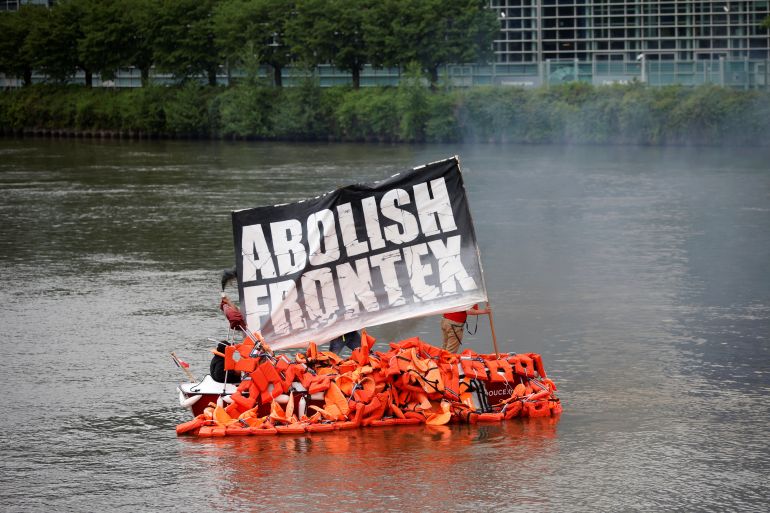
Members of German NGO migrant rescue Sea-Watch and art Kollektiv Ohne Namen sail a boat with life vests during a symbolic art action to bring attention to the plight of refugees crossing the Mediterranean Sea, on the Ill River in front of the European Parliament in Strasbourg, France, May 9, 2023. The slogan reads ‘Abolish Frontex’ [File: Johanna Geron/Reuters]
When boats with refugees are at risk of capsizing in the Mediterranean Sea, the speed of rescue operations is essential. Any delay in the emergency response can lead to serious bodily harm or the loss of life.
Still, offering a speedy response in such situations is not one of Europe’s priorities. In a study recently published in the journal Security Dialogue, I argue that time has become increasingly “weaponised” in Mediterranean migration governance.
Over the last decade, and in order to prevent arrivals, European Union authorities have sought out ways to slow down rescue engagement while accelerating interceptions to Libya.
The end of Italy’s humanitarian-military operation Mare Nostrum in 2014 marked a turning point. As a response to a devastating shipwreck on October 3, 2013 near Lampedusa, this operation sped up rescue activities off the Libyan coast, leading to the rescue of about 150,000 people. However, it was denounced by critics as a “pull-factor” that would incentivise the arrival of refugees. Mare Nostrum ended and gave way to successive European operations that experimented with delays in emergency responses.
This handout image provided by Greece’s coast guard on June 14 shows scores of people on a battered fishing boat that later capsized and sank off southern Greece, drowning hundreds of migrants.
Hellenic Coast Guard via AP
Many around the world closely followed the plight last week of five wealthy men who went missing aboard a Titanic-bound submersible. Meanwhile, researchers at the United Nations’ International Organization for Migration (IOM) updated the number of migrants who have died trying to reach Europe by sea this year: nearly 2,000.
The number of people who lose their lives each year in the crossing is staggering, and this year is on track to be worse than the last. Here are some of the reasons why this year has become so deadly:
Hundreds died aboard the Adriana
According to IOM data, at least 1,999 migrants died between January 1 and June 26 of this year, mostly from drowning. In the same period last year, 1,358 died. These tallies include those who died in the three major routes across the Mediterranean, as well as at the Atlantic route from West Africa.
One enormous tragedy accounts for a large portion of the uptick: the capsizing of the fishing boat Adriana two weeks ago in deep waters off the coast of Greece. The boat had departed Libya crammed with hundreds of people. When it capsized, it took the lives of most of the migrants on board, and IOM estimates the number who perished at 596.
Migrants from Eritrea, Libya and Sudan crowd the deck of a wooden boat as they wait to be assisted by aid workers of the Spanish NGO Open Arms, in the Mediterranean sea about 30 miles north of Libya, on June 17.
Joan Mateu Parra/AP
More people are attempting the crossing
Another factor is that the overall number of migrants attempting to cross the Mediterranean is higher than it was last year.
Sponsor Message
Italy in particular has seen a significant increase in the number of migrants arriving: more than 60,000 so far this year, compared with fewer than 27,000 at this point last year. IOM estimates that the total arrivals of migrants by sea to Mediterranean Europe are more than 82,000 this year, compared to fewer than 49,000 by this time last year.
Many of the migrant boats are aiming for the tiny Italian island of Lampedusa, which sits about halfway between Tunisia and Sicily. Two flows of migrants are now arriving at Lampedusa: those from Tunisia and those from Libya.Last week, 37 migrants went missing after their boat capsized between Tunisia and Lampedusa.
Migrants are traveling on boats not made for high seas
TTCT – Liệu những “hàng rào kỹ thuật” như quy định về đăng ký thường trú (và trước đây là hộ khẩu) có tác dụng ngăn cản dòng di cư vào đô thị lớn?
Mới đây, việc lập dự thảo quy định công dân làm thủ tục đăng ký thường trú phải có chỗ ở hợp pháp tối thiểu 8m2 đối nhà ở có nguồn gốc sở hữu nhà nước và 20m2 đối với nhà ở còn lại tiếp tục cho thấy chính sách thường trú ở Hà Nội khác biệt với các khu vực khác, cũng như nỗ lực cố gắng hạn chế dân số đăng ký thường trú vào đây.
Bức tranh Những ký ức của người nhập cư (Memories of immigrant) của Cristina Bernazzani, Ý.
Since 2015, the Cambodian government has been addressing the politically and diplomatically sensitive issue of illegal Vietnamese immigrants through methods such as documentation, deportation, eviction, relocation and registration. In this picture, Cambodia’s Prime minister Hun Sen (R) and his then Vietnamese counterpart Nguyen Xuan Phuc (L) inspect the guard of honour during a welcome ceremony at the Presidential Palace in Hanoi on 4 October 2019. Photo: Nhac NGUYEN/AFP.
EXECUTIVE SUMMARY
Since 2015, the Cambodian government has been addressing the politically and diplomatically sensitive issue of illegal Vietnamese immigrants through methods such as documentation, deportation, eviction, relocation and registration.
These actions are the ruling Cambodian People’s Party’s response to the opposition Cambodia National Rescue Party’s successful politicisation of anti-Vietnamese sentiments among Cambodian voters.
The Cambodian government’s Vietnamese immigrant policies also serve the ecological development goal of improving Cambodian water systems, as well as beautifying and developing its urban areas.
Given Cambodia’s asymmetrical power relationship with Vietnam and the sensitive issue of illegal Vietnamese immigrants, the closer bond between Cambodia and China serves as an enabling factor for the Cambodian government in adopting tougher policies.
The Cambodian government’s measures will however neither reduce the fear held by many Cambodians of Vietnamese domination nor will they alleviate the potential diplomatic fallout.
*Jing Jing Luo is Post-Doctoral Researcher at the School of Public Affairs, Xiamen University, China. Kheang Un is Professor of Political Science at Northern Illinois University, USA.
Vietnam’s new immigration law includes a new type of visa for foreigners who come to Vietnam to conduct activities as part of international agreements Vietnam has signed.
The change is expected to facilitate the implementation of new agreements that Vietnam has signed such as the EU-Vietnam Free Trade Agreement (EVFTA) and the EU-Vietnam Investment Protection Agreement (EVIPA), said Colonel Trần Văn Dự, deputy head of the Immigration Department under Ministry of Public Security. Tiếp tục đọc “Vietnam New Immigration Law: Things Every Foreigner Should Know”→
TTCT – Khi một thảm kịch 39 người chết như ở Essex (Anh) xảy ra, lẽ tự nhiên là tất cả mọi người đều muốn truy tìm trách nhiệm. Nhưng trách nhiệm đầu tiên của tấn thảm kịch có lẽ không phải là của (những) chính phủ mà từ đó công dân di cư lậu xuất phát, cũng không phải những nạn nhân đó và gia đình họ và thậm chí không phải của bọn buôn người. Vấn đề chính là một chính sách nhập cư đã trục trặc từ rất lâu ở các nước giàu.
Trên nền tuyết trắng xóa của một cánh rừng ở phía bắc nước Pháp, thấp thoáng phía sau những cành cây khẳng khiu, nổi lên một vài cái túp lều tạm bợ. Ít ai biết rằng đó là nơi tạm trú của những người Việt nhập cư bất hợp pháp. Họ đang chờ đợi để tìm cơ hội sang Anh, nơi mà họ cứ ngỡ rằng đó là thiên đường, để rồi trải qua biết bao gian nan, nếm trải biết bao cùng cực mà thiên đường ảo mộng đó vẫn mờ mịt như sương mù Luân Đôn. Vài ngày trước Tết Canh Dần, phóng viên TTXVN tại Pháp đã có dịp cùng với một nhóm hoạt động tình nguyện đến thăm họ, tìm hiểu về hành trình mà họ đã trải qua. Tiếp tục đọc “Người Việt nhập cư bất hợp pháp vào Anh (5 kỳ)”→
channelnewsasia – The Cambodian government is threatening to deport any “newcomers” unable to produce correct and legal documentation.
Many Vietnamese communities exist around the Tonle Sap. (Photo: Pichayada Promchertchoo) By Jack Board@JackBoardCNA
(Updated: )
PHNOM PENH: The Cambodian government has illegal Vietnamese migrants in its sights, threatening to deport any “newcomers” unable to produce correct and legal documentation.
– Hơn 1,4 triệu người Việt Nam đã và đang làm việc ở nước ngoài từ năm 1992 đến nay.
– Hàng năm có khoảng trên dưới 100.000 lao động Việt Nam xuất ngoại.
– Lượng kiều hối gửi về vào năm 2015 đạt 275 nghìn tỉ đồng (12,25 tỉ USD).
Tuy nhiên, không phải ước mơ lao động ngoài nước nào cũng đem lại quả ngọt, khi có nhiều rủi ro rình rập người di cư trái phép: bóc lột lao động, bạo lực hoặc thậm chí mua bán người. Bên cạnh ngăn ngừa những rủi ro này, di cư hợp pháp và an toàn sẽ mang lại lợi ích cho chính bản thân người lao động và cả xã hội. Tận tụy với sứ mệnh ấy, Tổ chức Di cư Quốc tế IOM, cơ quan di cư Liên Hợp Quốc, cùng với các chính phủ các quốc gia thành viên, các tổ chức xã hội và cộng đồng quốc tế luôn nỗ lực hỗ trợ người dân. Tiếp tục đọc “Phim ngắn: “Câu chuyện của những giấc mơ””→
TTO – Những ngày ở Malaysia chứng kiến sự lao động cực nhọc và nghiêm túc của nhiều lao động Việt xa xứ.
Chị Ngô Thị Chung tại một quán ăn ở Malaysia mà chị đã giúp việc trong 7 năm qua – Ảnh: Quỳnh Trung
Chúng tôi mới thấu hiểu rằng phía sau những đồng ngoại tệ gửi về gia đình ở quê nhà là mồ hôi, nước mắt, thậm chí là sự tủi nhục mà họ phải chịu nơi xứ người.
Một ngày đầu tháng 4, tại quán ăn Trung Hoa đối diện trung tâm thương mại Low Yat Plaza ở khu trung tâm sầm uất Bukit Bintang, thủ đô Kuala Lumpur, một phụ nữ trung niên nhỏ nhắn cầm thực đơn trên tay, liên tục mời du khách bằng tiếng Hoa. Người phụ nữ này tên Ngô Thị Chung (45 tuổi, quê Nghệ An). Tiếp tục đọc “Người Việt làm thuê ở Malaysia – 6 kỳ”→
TOKYO: A Vietnamese man held in a Japanese immigration detention centre died on Saturday, six people told Reuters, drawing fresh attention to conditions in the country’s detention system.
Dòng xoáy di dân đặt ra nhiều thách thức cho nền kinh tế Việt Nam trước sự chuyển dịch sắc xanh (ngoại tệ) và sắc xám (trí thức trẻ).
Trên chuyến bay đêm từ Hồng Kông đến TP.HCM, ánh mắt trầm ngâm hiện rõ trên gương mặt của ông Terance V., giám đốc phụ trách thị trường Việt Nam của một ngân hàng nước ngoài. Vài năm gần đây, chi nhánh ngân hàng của ông tại TP.HCM đối mặt với tình trạng thiếu hụt nhân sự cấp cao; Tiếp tục đọc “Người Việt di cư: Sự chuyển dịch sắc xanh và sắc xám”→
Việc người Mông di cư vượt biên trái phép không phải là vấn đề mới, gần đây sự việc lại nóng lên và được nhận định là có thể gia tăng với tính chất phức tạp hơn. Đây là một thách thức lớn đối với lực lượng Biên phòng và các địa phương có vùng đồng bào Mông sinh sống. Chúng tôi đi dọc tuyến biên giới của tỉnh Điện Biên tìm lại hồ sơ về người Mông vượt biên di cư, chuyện chưa hề cũ.
weforum_Did you know that Polish people represent the highest percentage of the foreign-born population in Norway? Or that the largest proportion of immigrants to the Republic of Ireland hail from the UK?
These four maps, created by Jakub Marian, a Czech linguist, mathematician and artist, are based on a 2015 study by the United Nations on international migration. They show European migration split into various numbers:








 CVD
CVD 