
DW_Earthworms help recuperate soil and enrich it with much needed minerals. But environmentalists are concerned as earthworms have come under threat from intensive use of manure and acidic soil.
Thẻ: Biến đổi khí hậu – Climate change

Singapore has declared 2018 the year of climate action—so why are its banks still funding coal?
eco-business_2018 is officially the year of climate action in Singapore, and yet the country’s powerful banks are bankrolling huge, greenhouse gas-producing coal-fired power stations in Asia Pacific, a report has found.
DBS is co-financing four 1200 MW coal-fired power plants in Vietnam—Nam Dinh 1, Nghi Son 2, Vinh Tan 4 and Vung Ang 2—and is a financial adviser for a number of planned coal-fired projects in Indonesia including the Jawa-6, Jawa-9 and Jawa-10 plants.

Israel’s agriculture minister leads prayers for water
WHAT DO YOU DO IF YOUR COUNTRY IS FACING WATER SHORTAGES EXACERBATED BY CLIMATE CHANGE? PRAY, APPARENTLY — ISRAEL’S AGRICULTURE MINISTER LEADS PRAYERS FOR WATER

Fighting climate change with bioenergy may do ‘more harm than good’
Mongabay.com
- A new study finds land-use like grazing and managing forests for resource extraction may have released more carbon than previously thought. Its results indicate the world’s terrestrial vegetation is currently sequestering less than half its full carbon-storage potential.
- Of that missing half, the researchers discovered 42 to 47 percent is attributed to land uses that don’t technically change the vegetation cover type. The researchers say that climate change mitigation strategies often focus on reducing intensive land-use like deforestation, with less-intensive uses that don’t change cover type largely overlooked and under-researched.
- One of these less-intensive uses is managing forests for biomass energy production. Many countries are trying to replace fossil fuels with biomass energy in-line with international climate agreements like the Paris Accord.
- The researchers warn that strategies developed under the assumption that producing biomass energy doesn’t come at a carbon cost could harm efforts to fight climate change. They urge that in addition to stopping deforestation, the protection of forest functions, like carbon stocks, should be moved more into focus when it comes to land-use and climate change planning.
As nations try to stem emissions to keep the world from warming more than 2 degrees Celsius in line with their commitments towards the Paris Accord, replacing fossil fuels with renewable alternatives is widely seen as a big step in the right direction. A major source of energy oft-extolled as renewable is biomass from trees, which are usually harvested from managed forests either established on land that has already been deforested or planted where forests didn’t naturally grow. But a new study finds land-use like managing forests for biomass production may come at a much higher carbon cost than previously thought.
Tiếp tục đọc “Fighting climate change with bioenergy may do ‘more harm than good’”
Climate change is triggering a migrant crisis in Vietnam
The Vietnamese Mekong Delta is one of Earth’s most agriculturally productive regions and is of global importance for its exports of rice, shrimp, and fruit. The 18m inhabitants of this low-lying river delta are also some of the world’s most vulnerable to climate change. Over the last ten years around 1.7m people have migrated out of its vast expanse of fields, rivers and canals while only 700,000 have arrived.
On a global level migration to urban areas remains as high as ever: one person in every 200 moves from rural areas to the city every year. Against this backdrop it is difficult to attribute migration to individual causes, not least because it can be challenging to find people who have left a region in order to ask why they went and because every local context is unique. But the high net rate of migration away from Mekong Delta provinces is more than double the national average, and even higher in its most climate-vulnerable areas. This implies that there is something else – probably climate-related – going on here. Tiếp tục đọc “Climate change is triggering a migrant crisis in Vietnam”
Critical Issues to Watch in 2018
 Print
Printipsnews_Martin Khor is Executive Director of the South Centre, a think tank for developing countries, based in Geneva

– Another new year has dawned, and on a world facing serious disruption on many fronts. What are the trends and issues to watch out for in 2018?
One obvious answer is to anticipate how Donald Trump, the most unorthodox of American Presidents, will continue to upset the world order. But more about that later.
Just as importantly as politics, we are now in the midst of several social and environmental trends that have important long-lasting effects. Some are on the verge of reaching a tipping point, where a long-term trend produces critical and sometimes irreversible events. We may see some of that in 2018.
Tiếp tục đọc “Critical Issues to Watch in 2018”
3 Things Companies Can Do in 2018 to Push Global Climate Action
 Eliot Metzger and –

Ice Loss and the Polar Vortex: How a Warming Arctic Fuels Cold Snaps
insideclimatenews_The loss of sea ice may be weakening the polar vortex, allowing cold blasts to dip south from the Arctic, across North America, Europe and Russia, a new study says.

A strong polar vortex (left, from December 2013) is centered over the Arctic. A weakened polar vortex (right, from January 2014) allows cold air to dip farther south. Credit: NOAA
When winter sets in, “polar vortex” becomes one of the most dreaded phrases in the Northern Hemisphere. It’s enough to send shivers even before the first blast of bitter cold arrives.
New research shows that some northern regions have been getting hit with these extreme cold spells more frequently over the past four decades, even as the planet as a whole has warmed. While it may seem counterintuitive, the scientists believe these bitter cold snaps are connected to the warming of the Arctic and the effects that that warming is having on the winds of the stratospheric polar vortex, high above the Earth’s surface.
Here’s what scientists involved in the research think is happening: The evidence is clear that the Arctic has been warming faster than the rest of the planet. That warming is reducing the amount of Arctic sea ice, allowing more heat to escape from the ocean. The scientists think that the ocean energy that is being released is causing a weakening of the polar vortex winds over the Arctic, which normally keep cold air centered over the polar region. That weakening is then allowing cold polar air to slip southward more often.
Tiếp tục đọc “Ice Loss and the Polar Vortex: How a Warming Arctic Fuels Cold Snaps”
Inspiring 12-year-old Timoci spoke at the UN Climate Change Conference.
Timoci Naulusala, 12-year-old class seven student from Tailevu province in Fiji, won the Fiji National Climate Change Speech Competition. He performed his speech for world leaders at the High-Level Opening of COP23. Video via UNFCCC.
The World Bank Year in Review: 2017 in 12 Charts
How to sum up 2017? The global economy improved but there were plenty of unsettling and upsetting events and trends. Catastrophic storms and flooding wrecked homes and livelihoods from South Asia to the Caribbean. Education quality in many countries fell short even as much of the world raced into the digital age. Yet extreme poverty continues to decline. Innovation and technology are enhancing the quality of life. And human capital is now the biggest driver of wealth in the world today. Here’s what 2017 looked like in 12 charts.
1. Millions faced famine and required emergency aid
2. The world emitted historic amounts of carbon
3. Natural disasters dominated the news
4. Two-thirds of global wealth is human capital
5. There’s a crisis in learning
6. Nutrition affects learning, and millions of children remain stunted
7. Child marriage carried high personal and economic costs
8. The world’s population is young. And jobless.
9. Natural capital and biodiversity are undervalued
10. Globally, about half of elections are considered free and fair
11. Starting a business is getting easier
12. The power of renewables
A Tribute to Hans Rosling
Tiếp tục đọc “The World Bank Year in Review: 2017 in 12 Charts”
Người Sài Gòn đắp chăn ngủ ngoài đường trong giá lạnh
docbao,vn 21/12/2017 09:14:00 GMT+7
Rạng sáng 21/12, nhiệt độ ở TP.HCM xuống dưới 20 độ C khiến người dân ra đường đốt lửa sưởi, trẻ nhỏ bịt tai, động vật mặc áo ấm tránh rét.

Tiếp tục đọc “Người Sài Gòn đắp chăn ngủ ngoài đường trong giá lạnh”
Only a fundamental mindset shift can save the Mekong Delta: expert
Last update 11:10 | 16/12/2017
VietNamNet Bridge – Well-meant but misguided climate change interventions in the Mekong Delta are set to do more harm than good, and only a change in policymakers’ mindset can reverse the damage, an independent researcher and expert said on December 14.
 |
| Nguyen Huu Thien (standing), expert on Mekong Delta ecology, responds to questions at a workshop on the region’s water and energy needs held on December 14 in Hanoi. — VNA/VNS Photo Trong Kien |
The change in mindset would involve a shift from forceful interventions to embracing natural cycles, said Nguyen Huu Thien.
Thien, whose work focuses on the Mekong Delta’s ecology, was giving his assessment of Resolution No 120 on sustainable development for the Mekong Delta that Prime Minister Nguyen Xuan Phuc signed in November. Tiếp tục đọc “Only a fundamental mindset shift can save the Mekong Delta: expert”
China to launch nationwide carbon market next week: officials
By Li Jing in Beijing
China’s long-awaited nationwide emissions trading scheme (ETS) will be officially launched on 19 December, starting with the power sector only, according to a document from National Development Reform Commission (NDRC).It represents a scaling back from the original plan for eight economic sectors to take part in the carbon market: petrochemicals, chemicals, building materials, iron and steel, non-ferrous metals, paper, power and aviation.
China’s long-awaited nationwide emissions trading scheme (ETS) will be officially launched on 19 December, starting with the power sector only, according to a document from National Development Reform Commission (NDRC).It represents a scaling back from the original plan for eight economic sectors to take part in the carbon market: petrochemicals, chemicals, building materials, iron and steel, non-ferrous metals, paper, power and aviation.
Nonetheless, it will instantly overtake the EU’s carbon market to become the world’s largest. The power sector accounts for 46% of China’s carbon dioxide emissions, of which an estimated 39% will be covered by the ETS, according to data from World Resource Institute.
Explaining the change, Chinese officials said some industrial sectors did not have strong statistical foundations, and the system would involve constant testing and continuous adjustments.
Carbon futures trading will not be available at the launch stage of the scheme, Xie Zhenhua, China’s special representative for climate change, said during the UN climate conference in Bonn last month. It is intended to create a cost for emitting carbon, not a platform for market speculation, he said. Tiếp tục đọc “China to launch nationwide carbon market next week: officials”
Ấn phẩm đầu tiên của VN về kinh tế từ góc nhìn biến đổi khí hậu
Cuốn sách chuyên khảo “Kinh tế và Chính sách Biến đổi khí hậu” do GS.TS. Trần Thọ Đạt và TS. Vũ Thị Hoài Thu biên soạn được Nhà xuất bản Đại học Kinh tế Quốc dân ấn hành năm 2017 là ấn phẩm đầu tiên ở Việt Nam trình bày chuyên sâu về các khía cạnh kinh tế và chính sách của vấn đề biến đổi khí hậu toàn cầu.
Cuốn sách gồm 10 chương và được cấu trúc thành 3 phần, tập trung giải thích tính toàn cầu của vấn đề biến đổi khí hậu, phân tích các khía cạnh kinh tế của biến đổi khí hậu, trình bày các nội dung về kinh tế học giảm nhẹ biến đổi khí hậu và kinh tế học thích ứng với biến đổi khí hậu, phân tích các chính sách biến đổi khí hậu và hành động quốc tế về biến đổi khí hậu.
 |
Các nội dung này được trình bày trên cả phương diện lý luận và thực tiễn, bao gồm thực tiễn ở cấp quốc gia, khu vực và toàn cầu. Tính toàn cầu, hiệu quả và công bằng là những tư tưởng xuyên suốt của kinh tế và chính sách biến đổi khí hậu.
Theo nhận xét của giới chuyên gia, kinh tế và chính sách biến đổi khí hậu là một lĩnh vực nghiên cứu rất rộng và phức tạp, huy động các ý tưởng và kỹ thuật phân tích từ rất nhiều lĩnh vực khác nhau của khoa học kinh tế như tăng trưởng và phát triển, công nghiệp, đổi mới và thay đổi công nghệ, thể chế, kinh tế quốc tế, tài chính công, thông tin và không chắc chắn, kinh tế môi trường và kinh tế công cộng. Tiếp tục đọc “Ấn phẩm đầu tiên của VN về kinh tế từ góc nhìn biến đổi khí hậu”
Biến đổi khí hậu đã tác động đến Việt Nam như thế nào?
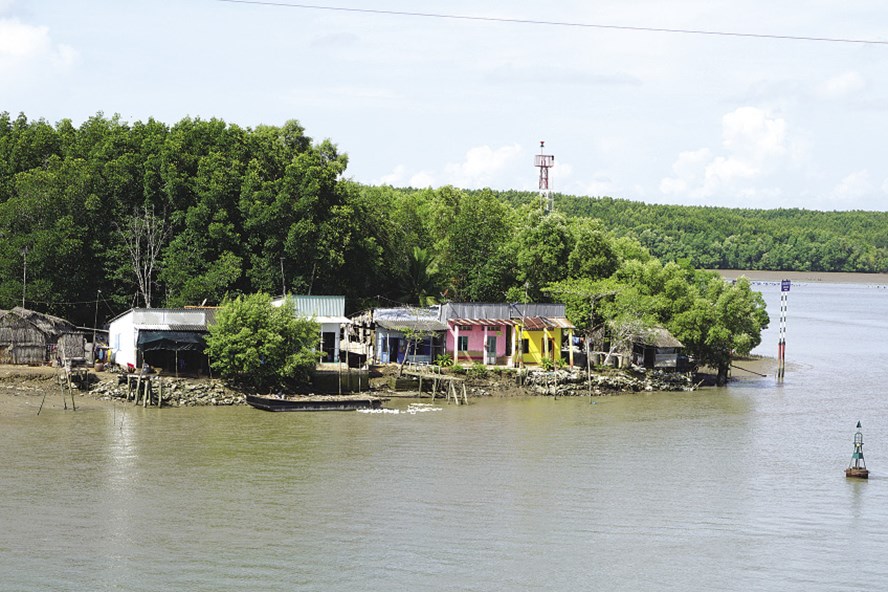
Do ảnh hưởng của nước biển dâng, hiện các nhà dân ở chân cầu Dần Xây (huyện Cần Giờ, TPHCM) lúc triều cao bị ngập đến 1,7m khiến việc sinh hoạt, đi lại rất khó khăn. Ảnh: MINH QUÂN

