Open Development Vietnam – 21 July 2022
https://datastudio.google.com/embed/reporting/1c94fab9-10c9-41bb-9fc6-56d0764ec5f4/page/p_4mtv27gwwc
Conversations on Vietnam Development

open development Vietnam – 8 October 2022

Thành phố Hồ Chí Minh trên đà phát triển, ảnh chụp bởi Tuấn Nguyễn, đăng trên Unsplash
Đầu tư cơ sở hạ tầng công cộng là một trong những động lực quan trọng thúc đẩy phát triển kinh tế Việt Nam trong những thập kỷ gần đây. 53% tổng vốn Hỗ trợ Phát triển Chính thức (ODA) nhận được trong giai đoạn 2010-2017 được dùng cho xây dựng cơ sở hạ tầng.1 Việt Nam đã chú trọng đầu tư phát triển giao thông vận tải, đặc biệt là hệ thống đường bộ, sân bay và cảng biển. Đầu tư từ khu vực công và tư vào cơ sở hạ tầng ở Việt Nam đạt 5,7% GDP trong những năm gần đây, cao nhất ở khu vực Đông Nam Á và cao thứ hai ở châu Á, chỉ sau Trung Quốc (6,8% GDP). Việc đẩy mạnh phát triển hạ tầng một mặt đáp ứng yêu cầu của các dự án đầu tư; mặt khác, giúp thúc đẩy tăng trưởng kinh tế và tạo ra nhiều việc làm hơn. Hơn nữa, tốc độ đô thị hóa nhanh chóng ở Việt Nam cũng là động lực mạnh mẽ để phát triển giao thông và tiện ích. Ước tính với 50% dân số hiện đang sinh sống ở các thành phố lớn, sự gia tăng dân số đã vượt quá khả năng cung ứng của các hệ thống kết nối và tiện ích hiện có.
By CNN Staff
Updated 11:20 PM EDT, Sat October 22, 2022

CNN —
Jolie’s nerves were running high as she walked into the campus of Goldsmiths, the University of London, last Friday morning. She’d planned to arrive early enough that the campus would be deserted, but her fellow students were already beginning to filter in to start their day.
In the hallway of an academic building, Jolie, who’d worn a face mask to obscure her identity, waited for the right moment to reach into her bag for the source of her nervousness – several pieces of A4-size paper she had printed out in the small hours of the night.
Finally, when she made sure none of the students – especially those who, like Jolie, come from China – were watching, she quickly pasted one of them on a notice board.
“Life not zero-Covid policy, freedom not martial-lawish lockdown, dignity not lies, reform not cultural revolution, votes not dictatorship, citizens not slaves,” it read, in English.
Tiếp tục đọc “Anti-Xi protest spreads in China and worldwide as Chinese leader begins third term”
JULIAN HUESMANN 17/10/2022 09:21 GMT+7
TTCT – Trong bối cảnh xung đột giữa các nước châu Âu và Nga, giá năng lượng ở Đức đã tăng vọt đến mức khiến đại đa số người Đức băn khoăn trước tình hình sinh hoạt trong mùa đông sắp tới.

Ảnh: Morning Consult
“Chúng ta lại vô địch thế giới”, một tay phóng viên giễu cợt trên truyền hình Đức, nhưng lần này không phải là chức vô địch World Cup hay số xe hơi bán ra. “Năng lượng của chúng ta có giá cao nhất thế giới”.
Tôi đã biết trước giá năng lượng ở Đức sẽ tăng cao, kể cả trước khi chiến tranh ở Ukraine nổ ra, nhưng “vô địch thế giới” thì quả là bất ngờ. Tượng trưng cho cuộc khủng hoảng hiện tại, mới đây tòa nhà Reichstag – trụ sở của chính quyền liên bang Đức – đã tắt đèn tối thui “làm gương” trong chuyện tiết kiệm năng lượng.
Suốt mấy thập niên qua, Đức hưởng lợi từ khí đốt giá rẻ của Nga thời Tổng thống Vladimir Putin. Còn năm nay, ngay cả trước khi hai đường ống cung cấp khí đốt chính là Dòng phương Bắc 1 và 2 gặp sự cố, Đức đã không nhận khí đốt từ Nga nữa, mà thay vào đó là từ các nước đồng minh như Hà Lan và Na Uy.
Trước cuộc chiến, Đức phụ thuộc nguồn cung từ Nga cho hơn 50% nhu cầu năng lượng (khí đốt và than đốt), nên cuộc khủng hoảng hiện giờ là dễ hiểu. Đây thậm chí được coi là mối đe dọa chưa từng thấy với cả nền kinh tế và sự giàu có của nước Đức kể từ Thế chiến II.
Giới lãnh đạo kinh tế và chính trị trong nước đột ngột nhận ra họ đã tham gia một cuộc chơi nguy hiểm và giờ đang phải trả giá đắt, theo đúng nghĩa đen.
Tiếp tục đọc “Nước Đức và nỗi lo năng lượng: Thu qua đông tới, cho lòng hiu quạnh”
The Wizards of Myanmar | 101 East Documentary
Al Jazeera English – 2-6-2022
In the light of a full moon on the outskirts of Yangon, a group of people gather around a glittering shrine, chanting incantations.
A rare look inside Bangladesh’s island camp for Rohingya refugees | 101 East Documentary
Al Jazeera English – 6-10-2022
Bangladesh is home to the world’s largest refugee camp, hosting more than a million Rohingya refugees who fled a brutal crackdown by Myanmar’s military in 2017.
LÊ MY 23/10/2022 06:08 GMT+7
TTCT – Khi người ta không chỉ “đặt tên cho dòng sông” mà còn trao cho nó các quyền lợi hợp pháp như thứ con người được hưởng, liệu có giúp nó được bảo vệ tốt hơn trước muôn mối đe dọa?

Minh họa: Matt Chinworth/Mother Jones
Trong bài báo sau này sẽ gây tiếng vang năm 1972, giáo sư luật Christopher Stone, người được cho là đã khởi động phong trào trao “nhân vị tính” (personhood) cho thiên nhiên, viết: “Tôi nghiêm túc đề xuất trao quyền lợi hợp pháp cho các khu rừng, đại dương, dòng sông và những cái gọi là ‘thực thể thiên nhiên’ khác trong môi trường – nói chung là cả môi trường tự nhiên”.
Ông cho rằng các tổ chức môi trường nên được quyền xin làm giám hộ cho những ngọn núi hay con suối mà họ cho rằng đang bị đe dọa và đại diện các thực thể thiên nhiên này trước tòa, tương tự cách con người suy sút năng lực vì bệnh tật hay tuổi tác có thể nhờ quyền giám hộ khi có vấn đề pháp lý.
Giáo sư Stone dạy tại Trường Luật Đại học Southern California từ năm 1965 cho đến khi qua đời hồi tháng 5-2021. Không bất ngờ khi không phải ai cũng lập tức đón nhận ý tưởng trao cho thiên nhiên đúng các quyền con người đang hưởng của ông. Trong nước, nhiều ý kiến chỉ trích, phê phán Stone, nhưng cũng có những thay đổi được nhen nhóm. Bên ngoài nước Mỹ, ý tưởng này lại được ủng hộ khá nhiều, hàng chục năm sau đó.

Dear Mr President, Excellencies, Ladies and gentlemen,
Xin chào!
Thank you for your warm welcome.
It is an honour to be with all of you to mark Viet Nam’s 45th anniversary in the United Nations.
Today, we recognize more than a strong partnership – we celebrate a remarkable journey.
A story of transformation and hope written by the Vietnamese people.
Tiếp tục đọc “Secretary-General’s remarks at the 45th Anniversary of Viet Nam’s Membership in the United Nations [as delivered]”by Hans Nicholas Jong on 20 October 2022
At a cost of $37 billion, Indonesia could retire its coal power plants as early as 2040 and reap economic, social and environmental benefits from the shift, a new analysis by nonprofit TransitionZero shows.
Replacing coal with renewables will create a windfall of new jobs, which would outweigh coal closure job losses by six to one, according to the analysis.
The analysis has also identified three coal plants in Indonesia that are the most suitable for early retirement, as they have lower abatement costs and are the most polluting.
JAKARTA — Indonesia’s plan to retire its coal-fired power plants and replace them with renewable energy by 2050 is not only feasible, but, when environmental costs are considered, will be less costly than relying on coal to power the Indonesian economy, according to a new analysis.
Indonesia is often dubbed as the last bastion for coal, as its power sector remains heavily reliant on the fossil fuel — about 70% of its generated electricity came from coal in 2021. Indonesia is also the world’s biggest thermal coal exporter.
Tiếp tục đọc “Early retirement for Indonesian coal plants could cut CO2, boost jobs, analysis says”
By Philip Wang, Tim Lister, Josh Pennington and Heather Chen, CNN
Updated 2:35 AM EDT, Sat October 15, 2022
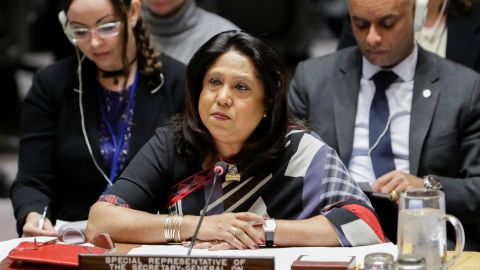
Pramila Patten, Special Representative of the UN Secretary-General on Sexual Violence in Conflict, at a Security Council meeting in New York in 2018.Xinhua/ShutterstockCNN —
Russia is using rape and sexual violence as part of its “military strategy” in Ukraine, a UN envoy said this week.
The claim follows data released by a panel of UN experts recently that verified “more than a hundred cases” of rape or sexual assault incidents reported in Ukraine since February.
“When you hear women testify about Russian soldiers equipped with Viagra, it’s clearly a military strategy,” Pramila Patten, UN Special Representative on Sexual Violence in Conflict, said in an interview with AFP on Thursday.
Tiếp tục đọc “Russia using rape as ‘military strategy’ in Ukraine: UN envoy”
| The New Nuclear Era, Richard Haass A Russian nuclear missile during the military parade in Moscow’s Red Square in 2020, marking the 75th anniversary of the end of World War II. Mikhail Svetlov/Getty ImagesThe world is on the cusp of a new era where nuclear weapons are likely to play a more prominent role. Read more on Project-Syndicate.org |
| Top of the Agenda Truss’s Departure Kicks Off Another UK Leadership Contest Lawmakers from the ruling Conservative Party in the United Kingdom (UK) will hold a preliminary vote (FT) on Monday to choose candidates to succeed Liz Truss, who announced her resignation yesterday. Party members will then choose from the final two candidates in an online poll next Friday. The victor will become the UK’s fourth prime minister in four years and take the helm of a country rattled by inflation and market turmoil under Truss’s six week tenure. Ex–finance minister Rishi Sunak, who opposed Truss’s controversial tax cuts, is expected to stand for the role. Former Home Secretary Suella Braverman, an immigration hard-liner, and former Prime Minister Boris Johnson could also join (The Economist) the race. Markets have calmed after Truss’s second finance minister reversed her budgetary plans, but the Conservative Party still trails the opposition Labour Party by around 30 percent in opinion polls. |
Human Rights Council
Fifty-first session
12 September–7 October 2022
Agenda items 2 and 3
Annual report of the United Nations
High Commissioner for Human Rights and
reports of the Office of the High Commissioner
and the Secretary-General
Promotion and protection of all human rights, civil,
political, economic, social and cultural rights,
including the right to development
The right to privacy in the digital age
Report of the Office of the United Nations High Commissioner for
Human Rights*
Summary
The present report, submitted pursuant to Human Rights Council resolution 48/4,
discusses recent trends and challenges concerning the right to privacy. The report focuses,
in particular, on: (a) the abuse of intrusive hacking tools; (b) the key role of encryption in
ensuring the enjoyment of the right to privacy and other rights; and (c) wide-spread
monitoring of public spaces. It highlights the risk of creating systems of pervasive
surveillance and control that may undermine the development of vibrant and rightsrespecting societies.
I. Introduction
II. Surveillance of personal devices and communications
A. Hacking
B. Restriction on encryption
III. Surveillance of the public
A. Surveillance of public places
B. Online monitoring
C. Human rights impact
D. Human rights requirements
IV. Conclusion and recommendations
October 20, 2022 The Chicago Council on Global Affairs
RESEARCHPUBLIC OPINION SURVEY BY DINA SMELTZ , IVO H. DAALDER , KARL FRIEDHOFF , CRAIG KAFURA , AND EMILY SULLIVAN
On some of the most significant issues of the day, including how the United States should respond to Russia’s invasion of Ukraine, Americans across party lines are in agreement, albeit often for different reasons.
Tiếp tục đọc “2022 Survey of Public Opinion on US Foreign Policy”Foreignaffair.com – November/December 2022
“the Author BORIS BONDAREV worked as a diplomat in the Russian Ministry of Foreign Affairs from 2002 to 2022, most recently as a counsellor at the Russian Mission to the United Nations Office in Geneva. He resigned in May to protest the invasion of Ukraine.”

For three years, my workdays began the same way. At 7:30 a.m., I woke up, checked the news, and drove to work at the Russian mission to the United Nations Office in Geneva. The routine was easy and predictable, two of the hallmarks of life as a Russian diplomat.читать статью по-русски (Read in Russian)
February 24 was different. When I checked my phone, I saw startling and mortifying news: the Russian air force was bombing Ukraine. Kharkiv, Kyiv, and Odessa were under attack. Russian troops were surging out of Crimea and toward the southern city of Kherson. Russian missiles had reduced buildings to rubble and sent residents fleeing. I watched videos of the blasts, complete with air-raid sirens, and saw people run around in panic.
As someone born in the Soviet Union, I found the attack almost unimaginable, even though I had heard Western news reports that an invasion might be imminent. Ukrainians were supposed to be our close friends, and we had much in common, including a history of fighting Germany as part of the same country. I thought about the lyrics of a famous patriotic song from World War II, one that many residents of the former Soviet Union know well: “On June 22, exactly at 4:00 a.m., Kyiv was bombed, and we were told that the war had started.” Russian President Vladimir Putin described the invasion of Ukraine as a “special military operation” intended to “de-Nazify” Russia’s neighbor. But in Ukraine, it was Russia that had taken the Nazis’ place
“That is the beginning of the end,” I told my wife. We decided I had to quit.
Resigning meant throwing away a twenty-year career as a Russian diplomat and, with it, many of my friendships. But the decision was a long time coming. When I joined the ministry in 2002, it was during a period of relative openness, when we diplomats could work cordially with our counterparts from other countries. Still, it was apparent from my earliest days that Russia’s Ministry of Foreign Affairs was deeply flawed. Even then, it discouraged critical thinking, and over the course of my tenure, it became increasingly belligerent. I stayed on anyway, managing the cognitive dissonance by hoping that I could use whatever power I had to moderate my country’s international behavior.
Tiếp tục đọc “The Sources of Russian Misconduct – A Diplomat Defects From the Kremlin”

