Chuyên mục: Văn hóa – Culture
The communal house with 400 dragons in Hai Phong
VietNamNet Bridge – One of the unique features of the Hang Kenh communal house in the northern port city of Hai Phong is nearly 400 dragons carved on wood plates, each with a different appearance.
Hang Kenh is also known as “Nhan Tho” communal house, located in Nguyen Cong Tru street, Hang Kenh ward, Le Chan district of Hai Phong city, worshiping Ngo Quyen. Tiếp tục đọc “The communal house with 400 dragons in Hai Phong” |
Community tourism brings changes to mountainous area
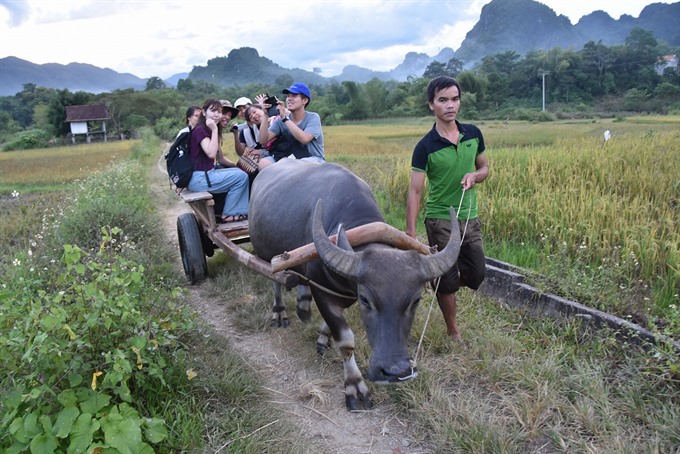
Community-based tourism has brought many changes to the lives of residents in Da Bac district, one of the most disadvantaged localities in the northern mountainous province of Hoa Binh.
Hoa Binh, about 70km northwest of Hanoi, is home to several ethnic groups, including Muong, Thai, Dao and Tay. Of the total population, 60 percent belong to the Muong group.

A view of Da river (Photo: VNA)
Tiếp tục đọc “Community tourism brings changes to mountainous area”
Vietnam’s longest 3D painting amazes locals in Hanoi
Tiếp tục đọc “Vietnam’s longest 3D painting amazes locals in Hanoi”
An obstacles course for highlands kids
| A young boy (centre) braves the weather and bad road conditions to go to school in the Central Highlands province of Đắk Nông. — Photo thethaovanhoa.vn |
They go swimming because they have no other way to get to school. Tiếp tục đọc “An obstacles course for highlands kids”
Science & Islam: Khoa học trong thế giới Hồi giáo, Phim tài liệu bởi BBC
Physicist Jim Al-Khalili travels through Syria, Iran, Tunisia and Spain to tell the story of the great leap in scientific knowledge that took place in the Islamic world between the 8th and 14th centuries.
The Language of Science
Science and Islam Episode 1 of 3
Its legacy is tangible, with terms like algebra, algorithm and alkali all being Arabic in origin and at the very heart of modern science – there would be no modern mathematics or physics without algebra, no computers without algorithms and no chemistry without alkalis. Tiếp tục đọc “Science & Islam: Khoa học trong thế giới Hồi giáo, Phim tài liệu bởi BBC”
Photos of the invisible man
In his talk from TED2013, Bolin shares the meaning behind these images — that they are a way to examine the relationship between culture and its development, and to speak for those who are rendered invisible by the Chinese government, by consumer culture or simply by the circumstances of history.
“From the beginning, this series has a protesting, reflective and uncompromising spirit,” says Bolin. “I think that in art, an artist’s attitude is the most important element. If an artwork is to touch someone, it must be the result of not only technique, but also the artist’s thinking and struggles in life.”
In this talk, Bolin shows us the very first image in the series, taken in November of 2005. He reveals many, many more images too, giving a peak into his process of being painted into the background — which can take anywhere from 3 to 4 hours to 3 to 4 days. The talk ends with a timelapse, showing how Bolin disappeared into the TED stage.
Meanwhile, in this gallery, Bolin shares many more of his fantastical and powerful images.
Hanoi Mid-Autumn Festival in the early 20th century
Here are selected photographs of the Mid-Autumn Festival in early 20th century Hanoi. The photos are part of an exhibition showcased at the Heritage House at 87 Ma May Street, Hang Buom ward, Hanoi.
![]() The management board of Hanoi’s Old Quarter introduces this unique art installation displaying the traditional Mid-Autumn Festival of a family in Hanoi with photos from the early 20th century provided by the Vietnam Academy of Social Sciences. Tiếp tục đọc “Hanoi Mid-Autumn Festival in the early 20th century” |
Hanoians enjoy nostalgic Mid-Autumn festival
A special Mid-Autumn festival began at Hanoi’s Temple of Literature on September 29, imbuing visitors with memories of the old days. Let’s explore the event through the following photos.
![]() The Temple of Literature is lit up with lanterns in almost of its corners. Tiếp tục đọc “Hanoians enjoy nostalgic Mid-Autumn festival” |
The magic of Khmer classical dance
“Robam kbach boran,” or the art of Khmer classical dance, is more than 1,000 years old. It was developed as a prayer in movement for rain and fertility, and a prosperity that this meant for an agricultural society. Dancers who were both men and women were offered to temples where they served as living bridges between heaven and earth. Their dancing bodies carried the prayers of the people up to the gods, and the will of the deities was delivered back through them to the people and the land.
Di dân tự do vẫn nóng ở Tây Nguyên – 4 kỳ
- Kỳ 1: Làng lập, rừng mất
- Kỳ 2: Đi không báo, đến không khai
- Kỳ 3: Sống… lậu ở Tây Nguyên
- Kỳ 4: Đất lành chim… ở lại
***
Di dân tự do vẫn nóng ở Tây Nguyên – Kỳ 1: Làng lập, rừng mất
TTO – Đến thời điểm này, vấn đề người di cư tự do vẫn đè nặng lên các tỉnh Tây Nguyên với nhiều áp lực từ nạn phá rừng và các vấn đề xã hội.
Loại thuốc diệt cây cỏ cực độc được người di cư tự do dùng để “diệt rừng” – Ảnh: THÁI LỘC
Rice paintings in Kon Tum highlight Central Highlands
| Participation: A tourist learns to make a rice painting under the guidance of Đăng. — Photo Courtesy of Hồng Điệp |
Viet Nam News by Phạm Thị Hồng Điệp
Kon Tum City, the capital of Kon Tum Province bordering Laos and Cambodia, is recognised for a massive assembly of ethnic groups and their distinctive cultures.
Part of its long history in Central Highlands culture are rice paintings. The best place to witness these paintings is at Hồ Village, located at Bắc Kạn Street, Kon Tum City. The village offers visitors a visual feast in art works. Tiếp tục đọc “Rice paintings in Kon Tum highlight Central Highlands”
International Day of the World’s Indigenous Peoples 9 August

There are an estimated 370 million indigenous people in the world, living across 90 countries. They make up less than 5 per cent of the world’s population, but account for 15 per cent of the poorest. They speak an overwhelming majority of the world’s estimated 7,000 languages and represent 5,000 different cultures.
Indigenous peoples are inheritors and practitioners of unique cultures and ways of relating to people and the environment. They have retained social, cultural, economic and political characteristics that are distinct from those of the dominant societies in which they live. Despite their cultural differences, indigenous peoples from around the world share common problems related to the protection of their rights as distinct peoples.
Tiếp tục đọc “International Day of the World’s Indigenous Peoples 9 August”
Hanoi’s Old Quarter before the Mid-autumn Festival
Streets in Hanoi’s Old Quarter are full of colours as the Mid-autumn Festival nears.
![]() Hang Ma, Hang Luoc, Hang Khoai and Hang Ruoi streets are crowded from the morning to the mid-night. Tiếp tục đọc “Hanoi’s Old Quarter before the Mid-autumn Festival” |
Vietnamese fast fashion market a gold mine

Three foreign fashion brands opened shops in early September – Stradivarius and Massimo Dutti from Spain, and H&M from Sweden. Vietnamese queued up at H&M shop on the opening day.
What Zara and H&M accomplished with their first shops in Vietnam, according to analysts, showed the attractiveness of the fast fashion market. Uniqlo will also open in Vietnam soon. Tiếp tục đọc “Vietnamese fast fashion market a gold mine”