Tiếp tục đọc “The History of China’s Green Energy Revolution”
The History of China’s Green Energy Revolution
Tiếp tục đọc “The History of China’s Green Energy Revolution”
Conversations on Vietnam Development
When Larry Fink announced in mid-January he’d be putting solving the climate emergency at the center of his US$7.43 trillion investment company BlackRock’s strategy, even long-time critics acknowledged it was a huge deal. “It takes leadership and a certain kind of courage to admit that change is needed,” wrote Sierra Club executive director Michael Brune at CNBC. “Now we must keep the pressure on.”
BlackRock had earlier stated a commitment to “sustainability,” yet for years faced pressure from the Sierra Club and others over its investments in fossil fuels and Amazon deforestation. In a letter last month to shareholders, Fink promised measurable change: BlackRock would no longer invest in companies deriving 25% or more of their revenues from thermal coal.
Shortly after, however, the environmental and human rights group Urgewald calculated that less than 20% of the coal industry would be affected. “The scope of the policy is still far too limited and further steps will need to follow quickly,” it argued.
In January, CEO Larry Fink announced that BlackRock would make the environment a key consideration in shaping its investment policy. Photo courtesy of BlackRock, Inc.
This is a familiar cycle these days: A large company makes an impressive-sounding climate commitment, but on closer inspection the reality ends up being messier and less inspiring than it first appeared. For example: Microsoft pledges to go “carbon negative” by 2030, removing more carbon from the atmosphere than it emits, while donating to the election campaign of U.S. Senator Mitch McConnell, who has questioned the science of climate change and has a 7% lifetime score from the League of Conservation Voters.
Tiếp tục đọc “3 WAYS TO TELL IF CORPORATIONS ARE GENUINE ABOUT FIGHTING CLIMATE CHANGE”

There is no doubt the world is facing a climate emergency. We must all act now to shift to climate-smart growth by redirecting our current investment and financing flows towards the Paris Agreement. National development banks (NDBs) have huge untapped potential to support this transformation. But our new report finds that despite their collective firepower – which far exceeds that of the multilateral and bilateral development banking system – NDBs have yet to step out of the shadows and into the international and domestic limelight. It is now time for NDBs to claim their rightful place at the policy table.
Tiếp tục đọc “Three ways national development banks can unlock climate-smart growth”

TS Mai Duy Thiện trao quyết định cho ông Hoàng Giang, Trưởng Văn phòng Đại diện Hiệp hội Năng lượng Sạch Việt Nam tại Thành phố Hồ Chí Minh
Đến tham dự buổi lễ có TS Mai Duy Thiện – Phó Chủ tịch Thường trực, Hiệp hội Năng lượng Sạch Việt Nam (VCEA) và đông đảo đại diện các doanh nghiệp, hội viên hoạt động trong lĩnh vực năng lượng tái tạo.
Phát biểu tại buổi lễ, ông Mai Duy Thiện cho biết, Việt Nam nằm trong khu vực nhiệt đới gió mùa, số giờ nắng bình quân trong năm từ 2.500 – 3.000 giờ; nhiệt độ bình quân năm trên 21 0 C; hơn 8% diện tích có tiềm năng gió rất tốt (tốc độ gió ở độ cao 65m là 7 – 8 m/giây)… Với lợi thế đó, Việt Nam xác định, đây là 2 nguồn năng lượng chính để phát triển điện sạch.
Tiếp tục đọc “Ra mắt Văn phòng Đại diện Hiệp hội Năng lượng Sạch Việt Nam tại TP.HCM”
Industry observers hope H&M Group’s new CEO, Helena Helmersson, will push for more durable fashion and steer the company away from overproduction.


Helena Helmersson. Image: Mattias Bardå/ H&M Group
Helmersson is the 73-year-old company’s first female chief executive, but what has caught the eye of activists and fashion industry insiders is the 46 year-old’s career path in the company that she joined in 1997. Tiếp tục đọc “Fast fashion giant H&M appoints former sustainability head as CEO; activists call for a different business model”
Date: January 27, 2020
Source: University of Texas Health Science Center at Houston
Summary: The grim effects that climate change will have on pediatric health outcomes was the focus of a recent article.Share:
The grim effects that climate change will have on pediatric health outcomes was the focus of a “Viewpoint” article published in the Journal of Clinical Investigation by Susan E. Pacheco, MD, an expert at The University of Texas Health Science Center at Houston (UTHealth).
Pacheco, an associate professor of pediatrics at McGovern Medical School at UTHealth, along with professors from Johns Hopkins Medicine and the George Washington University, authored a series of articles that detail how increased temperatures due to climate change will negatively affect the health of humanity. In the article authored by Pacheco, she shines a light on the startling effects the crisis has on children’s health before they are even born. Tiếp tục đọc “Children to bear the burden of negative health effects from climate change”
In copying other countries’ development mistakes, Vietnam has paid a heavy price for not deploying due foresight. Now, we cannot ignore hindsight wisdom.
![]() |
|
Nguyen Dang Anh Thi |
When he was 18, my eldest brother faced a tough decision – should he go to university or take up vocational training?
Although he wanted to persist with his academic pursuit, he deferred to the family’s economic needs and decided to join the workforce to support the family.
So, instead of going to university, he decided to go to Tay Loc District in my home province, Thua Thien Hue, and learn tailoring.
One year, with a sudden surge in the need for making windcheaters in HCMC, my brother left home and headed for the southern metropolis in search of better work opportunities. He boarded the crammed bus, not daring to look behind at his sobbing family.
Tiếp tục đọc “Vietnam needs to choose the path less traveled”
The amount of material consumed by humanity has passed 100 billion tons every year, a report has revealed, but the proportion being recycled is falling.
The climate and wildlife emergencies are driven by the unsustainable extraction of fossil fuels, metals, building materials, and trees. The report’s authors warn that treating the world’s resources as limitless is leading towards global disaster.
Tiếp tục đọc “World Consumes 100 Billion Tons of Materials Every Year”
“Governments around the world can, and must, build a human economy that is feminist and benefits the 99%, not only the 1%.”
That’s the message from Oxfam, the aid and development charity, in its latest report on the state of global inequality, Time To Care.
It focuses on the impact that unpaid and underpaid care work has on the prospects and livelihoods of women and girls across the world – and how that’s driving growing inequality.
Oxfam lists six recommendations to “close the gap between care workers and the wealthy elite who have profited most from their labour”, from ending extreme wealth to challenging harmful norms and sexist beliefs. Tiếp tục đọc “5 shocking facts about inequality, according to Oxfam’s latest report”

Within the South Asia region, where about a third of the world’s poor live, Bhutan has had astonishing success in reducing poverty and boosting shared prosperity. Following the development philosophy of Gross National Happiness, Bhutan has increased its GDP per capita to US$3,398 in 2018, exceeding South Asia’s average of US$1,905 in the same year.¹
GDP per capita (current US$)
Bhutan’s economic growth has been driven by its public sector through hydropower development, with hydropower contributing as much as 30% of the GDP.² In comparison, Bhutan’s private sector is weak given its mountainous terrain, small domestic market, sparse population, high transportation costs, skill shortages, and other factors.³
Bhutan has invested in infrastructure, education, and health to tackle youth employment, which stood at 12.3% in 2017.²
Tiếp tục đọc “Bhutan: Statistics and the pursuit of happiness”
VNE – By Nguyen Quy December 21, 2019 | 03:20 pm GMT+7

Struggling to eliminate gender inequality, Vietnam falls 10 places to 87th in 2019 global ranking.
With an average score of 0,700 on a scale of 1, Vietnam is making little progress toward gender equality, according to 2019 Global Gender Gap Report released by World Economic Forum.
Across Southeast Asia, the Philippines performed best, ranking 16th globally, followed by Laos (43rd), Singapore (54th), Thailand (75th), and Indonesia (85th). Vietnam lies ahead of Cambodia (89th), Brunei (95th), Malaysia (104th) and Myanmar (114th). Tiếp tục đọc “Vietnam caught pants down in gender gap ranking”
![]() |
| Babeth Ngoc Han Lefur, country director, Oxfam in Vietnam |
As climate change is progressing at an even greater pace than expected by various climate modelling scenarios, the Intergovernmental Panel on Climate Change (IPCC) is urging countries to take robust action to cut down greenhouse gas (GHG) emissions to limit the average global temperature increase to no more than 1.5 degrees Celsius by 2030. In September 2019, people in more than 150 countries were stepping up to support young climate strikers and demand an end to the age of fossil fuels and ensure a rapid, equitable energy revolution. The climate crisis will not wait, so neither should we. The 25th session of the Conference of the Parties (COP 25) to the United Nations Framework Convention on Climate Change (UNFCCC) in December 2019 calls for action and champions to demand more ambition from nations to fight the climate crisis. This is also an invitation to elevate care for the environment into a national theme where all have a role to play. Tiếp tục đọc “Developing renewable energy in Vietnam Through the lens of equality and sustainability”
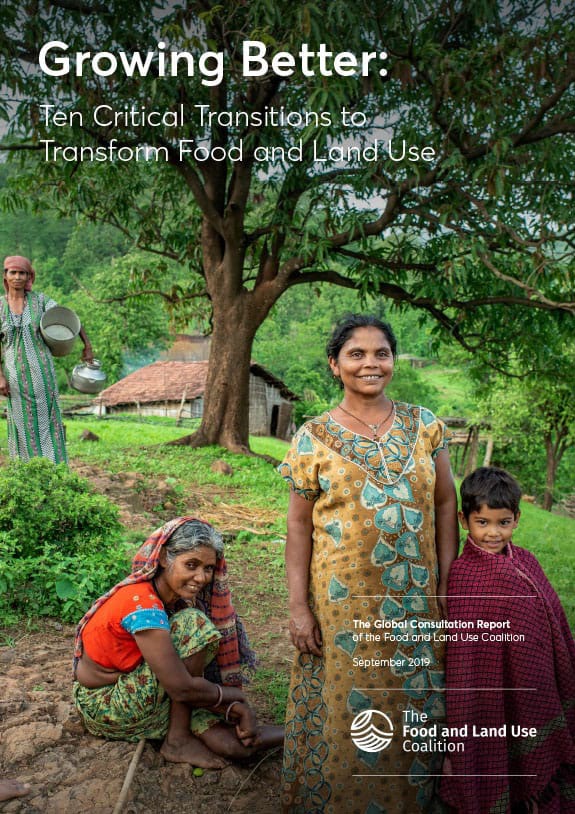
Growing Better: Ten Critical Transitions to Transform Food and Land Use
The Global Consultation Report of the Food and Land Use Coalition September 2019
For people, nature and climate
There is a remarkable opportunity to transform food and land use systems, but as the challenges are growing, we need to act with great urgency. The global report from the Food and Land Use Coalition (FOLU) proposes a reform agenda – centred around ten critical transitions – of real actionable solutions. These could deliver the needed change to boost progress towards the Sustainable Development Goals (SDGs) and the Paris Agreement, help mitigate the negative effects of climate change, safeguard biodiversity, ensure more healthy diets for all, drastically improve food security and create more inclusive rural economies. Tiếp tục đọc “Growing Better report 2019”

Worldwide, 800,000 people die by suicide each year – one every 40 seconds – making it the second leading cause of death among young people (aged 15 to 29), the World Health Organization (WHO) said on Thursday, spotlighting suicide prevention as the theme for this year’s World Mental Health Day.
“Mental health has been neglected for too long,” Secretary-General António Guterres said in a video message for the Day, saying it needs to be addressed urgently, as a matter “that concerns us all.” Tiếp tục đọc “World Mental Health Day sheds light on worrying rates of youth suicide”
By Thanh An
Cinnamon might smell like Christmas to many in the West, but to some Vietnamese farmers, it smells like prosperity.
The spice has been long seen by farmers of Phong Dụ Thượng Commune in the northern province of Yên Bái as a path to escaping poverty.
In recent years, demand for cinnamon has become greater than ever and has helped many households in the province’s Văn Yên District get a better life.
Bearing that in mind, the province has developed an organic cinnamon platform, focusing on building an agricultural sustainable chain from this valuable spice. Tiếp tục đọc “Wake up and smell the cinnamon”